The name “Lodge Grass” is one of the most genuinely interesting place-name stories in Montana, and it’s a story about translation rather than horticulture.
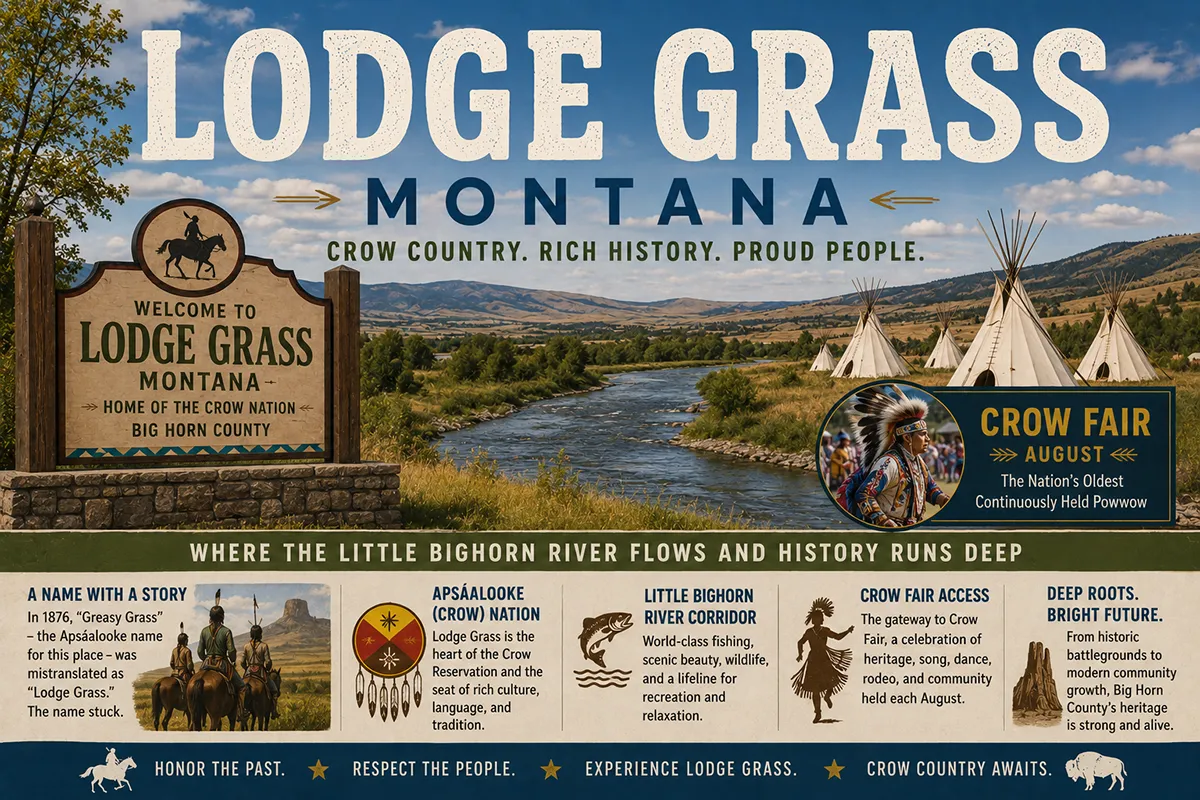
The Apsáalooke (Crow) people called the creek that runs through this part of southern Big Horn County Greasy Grass — Iisaxpúatahcheeaashisee in some renderings — because the lush native grasses in the creek bottom were so rich in nutrients that they would visibly “grease” the coats of horses and bison that grazed there. The animals fed in the valley grew fat through the seasons.
The Apsáalooke summer hunting camps gathered here at the confluence of Greasy Grass Creek and the Little Bighorn River, drawing on those abundant grasses to keep their herds strong before the buffalo hunt seasons.
When white settlers and government surveyors came through to translate Crow place names for railroad maps and post-office paperwork in the late 19th century, something went wrong.
The Crow words for “grease” and “lodge” are similar enough that a translator botched the conversion, and “Greasy Grass” became “Lodge Grass” on official maps.
The Crow knew what the creek had always been; the official name took the place of the descriptive one.
The town that grew up at the confluence of the two waters took its name from the mistranslated creek, and a century later, Lodge Grass continues to be officially Lodge Grass while informally remembering itself as Greasy Grass.
The community today is small — about 441 residents — and sits inside the Crow Indian Reservation about 20 miles south of Crow Agency on I-90 in Big Horn County. Lodge Grass is one of the Crow Reservation’s primary towns alongside Crow Agency, Pryor, St. Xavier, and Wyola.
The economy is built on ranching, government services, the local school district, and the layered relationships between tribal sovereignty, federal programs, and the surrounding agricultural country.
The Little Bighorn River flows through town — the same river that gave its name, eleven miles north of here, to one of the most consequential battles in American history.
TL;DR
- Lodge Grass (~441) is on the Crow Indian Reservation in Big Horn County, on the Little Bighorn River about 20 miles south of Crow Agency.
- The name comes from a mistranslation of the Apsáalooke word for “Greasy Grass” — referring to the rich native grasses that fattened horses and buffalo in the creek bottom.
- The site has been a traditional Apsáalooke summer hunting camp for centuries, at the confluence of Lodge Grass Creek and the Little Bighorn River.
- Crow scouts who served with the U.S. 7th Cavalry at Little Bighorn — including White Man Runs Him, Hairy Moccasin, Goes Ahead, and Curly — later lived in or near the Lodge Grass area.
- The Little Bighorn Battlefield National Monument at Crow Agency (20 miles north) is the most consequential historical site in the region.
- Crow Fair (mid-August at Crow Agency) is among the largest Indigenous gatherings in North America; the Lodge Grass area’s own Valley of the Chiefs Celebration (July 4) is a smaller community event.
- Best for: travelers visiting Little Bighorn Battlefield, Crow cultural heritage explorers, and Big Horn County agricultural country.
Liked this article?
Add Roaming Montana as a preferred source so you see more of our articles and guides on Google.
Lodge Grass at a Glance
| Population (2020) | ~441 |
|---|---|
| County | Big Horn County |
| Reservation | Crow Indian Reservation (Apsáalooke Nation) |
| Region | Southeast Montana |
| Distance to Crow Agency | ~20 miles north (~25 min on I-90) |
| Distance to Little Bighorn Battlefield NM | ~20 miles north (~25 min) |
| Distance to Hardin | ~45 miles north (~50 min) |
| Distance to Billings | ~70 miles north (~1.25 hours) |
| Distance to Wyola | ~10 miles south (~12 min) |
| Distance to Sheridan, WY | ~50 miles south (~1 hour) |
| Incorporated | 1907 |
| Best for | Little Bighorn travelers, Crow cultural heritage, Big Horn County |
What Makes Lodge Grass Different
Lodge Grass sits inside one of the most historically and culturally significant landscapes in the American West. The Apsáalooke — known to outsiders as the Crow — have been the dominant cultural and political presence in this part of southern Montana for several centuries. The Hidatsa-Crow ancestral migration began in the Ohio country, moved through northern Illinois and western Minnesota into the Red River Valley, and continued west through several generations of movement.
By the late 17th century, the Crow had settled in southwestern Montana and northern Wyoming. In the 18th century, they acquired horses from the Shoshone and became fully nomadic Plains Indians — warring, raiding, and trading across an enormous range. The name Apsáalooke translates as “children of the large-beaked bird,” which white traders and settlers misinterpreted as the English word “crow.”
The Little Bighorn River and its tributaries — Lodge Grass Creek prominently among them — became the heart of the Crow homeland.
When the U.S. government established the Crow Reservation in the late 19th century, the traditional summer hunting grounds at the confluence of Greasy Grass Creek and the Little Bighorn River became the site of one of the reservation’s primary communities.
Lodge Grass was formally incorporated as a town in 1907. The ranching economy that grew up around it — Crow-owned and non-tribal ranches alike — has dominated the area’s economic life for over a century.
The Little Bighorn battle context is essential to understanding the area. On June 25-26, 1876, about 20 miles north of present-day Lodge Grass, the U.S. 7th Cavalry under Lieutenant Colonel George Armstrong Custer was destroyed in an engagement with a coalition of Lakota, Cheyenne, and Arapaho forces.
The Crow, as traditional enemies of the Lakota and Cheyenne, had provided scouts to the U.S. military — including White Man Runs Him, Hairy Moccasin, Goes Ahead, and Curly.
Several of those Crow scouts and their descendants lived in or near Lodge Grass after the battle. The battlefield itself is now Little Bighorn Battlefield National Monument, one of the most-visited historic sites in Montana.
What’s striking about visiting Lodge Grass today is how much the contemporary community sits in tension with the famous historical narrative. The town is a small, working Crow community where families live, run ranches, attend school, and go about their lives.
It is not a tourism destination in the way Little Bighorn Battlefield is a tourism destination, and visitors should treat it accordingly — respectful of residents, careful about photography of private property, and aware that this is the ongoing home of the Apsáalooke Nation rather than a museum.
For broader trip context, see my Montana cities and towns hub.
The Top 10 Things to Do In & Around Lodge Grass
1. Little Bighorn Battlefield National Monument (20 miles north, Crow Agency)
The most significant historical attraction near Lodge Grass. The site of the June 1876 battle where Custer’s 7th Cavalry was destroyed includes a visitor center, the Custer National Cemetery, the Indian Memorial (added in 2003 to honor the Indigenous warriors), the Reno-Benteen Battlefield, and a 4.5-mile self-guided tour road.
The Indian Memorial provides perspective on the battle from the Lakota, Cheyenne, Arapaho, and Crow scout participants. Plan a full half-day. Admission required; National Park passes accepted.
2. Crow Fair (Mid-August, Crow Agency, ~20 miles north)
One of the largest Indigenous gatherings in North America, held annually for over a century at Crow Agency. The “Teepee Capital of the World” tagline reflects the scale — hundreds of tipis arranged in a vast camp, traditional dancing, parade of horses, rodeo competition, hand games, drumming, and powwow events.
Public attendance is welcome with cultural protocols (no photography of ceremonial events without permission, modest dress, respect for elders). Typically held the third weekend of August. Check current schedule with the Crow Tribal Council.
3. Valley of the Chiefs Celebration (July 4, Lodge Grass)
Lodge Grass’s own four-day community event held over the July 4th holiday — parade, traditional dancing, rodeo, community feast, and gatherings. Smaller and more locally focused than Crow Fair, but a substantive cultural event. Open to respectful visitors.
4. Little Bighorn River Fishing
The Little Bighorn River near Lodge Grass holds rainbow and brown trout in the upper sections (cooler water) and warm-water species including catfish in the lower reaches.
Access for fishing on the Crow Reservation requires a Crow Tribal permit in addition to a Montana state fishing license — purchase through the Crow Tribal Fish & Game Department or authorized vendors. Check current regulations.
5. Crow Scout Cemetery & White Man Runs Him Memorial
Several Crow scouts who served with the 7th Cavalry are buried at the Custer National Cemetery at Little Bighorn Battlefield.
White Man Runs Him’s grave is one of the most-visited individual memorials. For travelers interested in the scout perspective on the Battle of Little Bighorn, this is essential context. The cemetery is open to the public during regular National Monument hours.
6. Bighorn Mountains Foothill Drives
Lodge Grass sits at the base of the Bighorn Mountains’ Montana foothills. County roads east and south of town access genuinely beautiful Bighorn Mountains country — wildlife habitat, ranching country, and the kind of vast quiet that defines this corner of Montana. Backcountry road condition varies seasonally; verify before exploring.
7. Chief Plenty Coups State Park (Pryor, ~75 miles west via Hardin)
The home and gravesite of Chief Plenty Coups — the last traditional chief of the Apsáalooke Nation, who lived 1848-1932 — preserved as a Montana State Park. The visitor center, original log home, and memorial give substantive context on Crow cultural and political history. A worthwhile longer day trip from Lodge Grass.
8. Bighorn Canyon National Recreation Area (~75 miles southwest)
The Bighorn River — different from the Little Bighorn — flows through Bighorn Canyon, a spectacular reservoir-canyon landscape accessed via the Crow Reservation. Yellowtail Dam, the boat tour at Horseshoe Bend, and the bighorn sheep viewing make Bighorn Canyon one of southeast Montana’s underrated destinations.
9. Apsáalooke Cultural Tours
Local Crow-led tours offer cultural interpretation of the reservation, traditional sites, and Indigenous history.
Tour availability varies; contact the Crow Tribal Tourism office or Apsaalooke Tours for current options. This is the appropriate way to experience Crow Reservation cultural context — paid for, locally guided, and shaped by community knowledge rather than outside speculation.
10. Day Trip to Billings (1.25 hours north)
Montana’s largest city — Pictograph Cave State Park, the Yellowstone Art Museum, the Western Heritage Center, and Rimrocks scenery. Billings is the practical anchor for travelers basing in southeast Montana. See Billings guide.
Where to Stay
Lodge Grass has very limited lodging. Most travelers base in Hardin (~45 minutes north), Sheridan, Wyoming (~1 hour south), or Billings (~1.25 hours north).
| Hotel | Vibe | Price | Best For |
|---|---|---|---|
| Apsaalooke Glamping Co. | Unique tribal-area glamping | $150–280 | Cultural experience |
| Hardin hotels (50 min north) | Basic motels | $90–150 | Battlefield visitors |
| Sheridan, WY hotels (1 hour south) | Full selection | $130–250 | Bighorn Mountains base |
| Billings hotels (1.25 hours north) | Best selection | $140–280 | Most travelers |
| Hardin/Crow Agency vacation rentals | Limited options | $130–230 | Longer stays |
Where to Eat
- Cozy Corner Bar (Lodge Grass) — local community gathering place; hunters and ranchers
- Crow Agency cafés (25 min north) — basic options
- Hardin restaurants (50 min north) — more variety
- Sheridan, WY (1 hour south) — full restaurant variety
- Billings dining (1.25 hours north) — comprehensive options
Lodge Grass has limited dining; plan accordingly. Bring water and snacks for the broader Crow Reservation exploration.
Getting There & Around
From Billings: ~70 miles south on I-90, about 1.25 hours.
From Sheridan, WY: ~50 miles north on I-90, about 1 hour.
From Crow Agency: ~20 miles south on I-90, about 25 minutes.
From Hardin: ~45 miles south on I-90, about 50 minutes.
Cell service: Generally available along the I-90 corridor; reduced on the broader reservation backroads. Download offline maps for backcountry exploration.
What Lodge Grass Unlocks
Little Bighorn Battlefield National Monument (20 min north)
The most significant historic site in southeast Montana.
Crow Agency & Crow Fair (20 min north)
The capital of the Crow Indian Reservation and one of North America’s largest Indigenous gatherings.
Bighorn Mountains (south and east)
Wildlife habitat, hunting, scenic drives.
Bighorn Canyon NRA (~75 miles southwest)
Yellowtail Dam, Horseshoe Bend, dramatic canyon-reservoir landscape.
Chief Plenty Coups State Park (Pryor, ~75 miles west)
The last traditional chief of the Crow Nation; cultural context.
Sheridan, Wyoming (1 hour south)
Historic cattle-trail town; gateway to the Wyoming Bighorn Mountains.
When to Visit
Mid-August (Crow Fair): The signature cultural event. Plan lodging weeks in advance; expect substantial traffic to Crow Agency.
July 4 (Valley of the Chiefs): Lodge Grass’s own community celebration.
Summer (June–August): Best Little Bighorn Battlefield visiting conditions; full Crow Reservation accessibility; long daylight.
Fall (September–October): Crisp temperatures for battlefield walking; fewer crowds; hunting season for the surrounding country (with proper permits and respect for tribal lands).
Spring (April–May): Quiet shoulder season; the rolling grassland country is at its greenest.
Winter: Cold and quiet; battlefield is still accessible but limited services.
Personal Tips
Visit Little Bighorn Battlefield with the Indian Memorial perspective. Most travelers approach the battlefield through Custer’s story. The Indian Memorial (added in 2003) provides essential perspective on the Lakota, Cheyenne, Arapaho, and Crow participants. Allow time for both the visitor center exhibits and the Indian Memorial; the full experience is significantly more meaningful with both.
Crow Fair requires preparation. If you’re attending Crow Fair, read about appropriate visitor protocols beforehand. Modest dress, respect for ceremonial events (no photography of certain dances and songs without permission), and awareness that this is a family and community gathering, not a tourist performance. The hospitality and welcome of the Crow community is genuine when reciprocated with respect.
Hardin is the practical base. Lodge Grass itself has limited lodging and dining. Hardin 45 minutes north has more services and is the natural overnight base for travelers visiting Little Bighorn Battlefield, Crow Agency, and Lodge Grass on the same trip.
Apsáalooke tours are the right way to learn. If you want substantive cultural context beyond the National Monument’s exhibits, book a Crow-led tour rather than relying on speculation. The cultural understanding offered by local guides is genuinely different from anything you can read in a guidebook.
Respect the Greasy Grass story. When you stand at the Lodge Grass Creek confluence with the Little Bighorn, take a moment to acknowledge the actual Apsáalooke name. Lodge Grass is a mistranslation that persisted for 140 years; the original Greasy Grass is the more accurate name.
Lodge Grass Quick Facts
| Original Crow name | Greasy Grass (referring to rich native grasses) | | Lodge Grass incorporated | 1907 | | Apsáalooke meaning | “Children of the large-beaked bird” | | Battle of Little Bighorn | June 25-26, 1876 (20 miles north) | | Crow scouts who served at Little Bighorn | White Man Runs Him, Hairy Moccasin, Goes Ahead, Curly | | Crow Fair | Mid-August annually (Crow Agency) | | Valley of the Chiefs Celebration | July 4 annually (Lodge Grass) | | Average summer high | 86°F | | Average winter low | 9°F |
Conclusion
Lodge Grass is one of the most culturally substantive small communities in Montana, and the value of visiting comes from understanding the layers — the Apsáalooke homeland that predates the United States by centuries, the mistranslated creek name that persisted into the modern era, the 1876 battle whose consequences shaped American history, the Crow scouts whose graves rest at the Custer National Cemetery, and the contemporary community that continues to live and work in this part of Big Horn County.
Approached with appropriate respect and combined with Little Bighorn Battlefield, Crow Fair (if timing allows), and the broader Crow Reservation, Lodge Grass is one of the most meaningful destinations in southeast Montana.
Have a Lodge Grass question? Drop it in the comments — I read every one.
Frequently Asked Questions
Is Lodge Grass Montana worth visiting?
Yes — Lodge Grass is worth visiting primarily as part of a Crow Reservation and Little Bighorn Battlefield itinerary. The Little Bighorn Battlefield National Monument (20 miles north at Crow Agency) is one of the most significant historic sites in the American West, and Crow Fair (mid-August) is one of the largest Indigenous gatherings in North America. Lodge Grass itself is a small working Crow community with deep cultural significance to the Apsáalooke Nation.
What does the name “Lodge Grass” mean?
The name “Lodge Grass” is a mistranslation of the Apsáalooke (Crow) name for the creek that runs through town: Greasy Grass. The Crow called it Greasy Grass because the rich native grasses in the creek bottom were so nutritious that they would visibly “grease” the coats of horses and bison that grazed there. When white settlers and government surveyors translated the Crow place name for railroad maps and post-office paperwork in the late 19th century, the Crow words for “grease” and “lodge” — which are very similar — were confused, and “Greasy Grass” became “Lodge Grass” on official maps.
What is Apsáalooke?
Apsáalooke (also rendered Apsaalooke or Absaroka) is the self-designation of the Crow people, translating roughly as “children of the large-beaked bird.” When white traders and settlers encountered the Apsáalooke in the 18th and 19th centuries, they misinterpreted the name as the English word “Crow,” which has remained the common English-language name for the nation. Members of the tribe today use both “Apsáalooke” and “Crow” depending on context, with Apsáalooke increasingly used in formal and cultural contexts.
How close is Lodge Grass to Little Bighorn Battlefield?
Lodge Grass is approximately 20 miles south of the Little Bighorn Battlefield National Monument at Crow Agency — about a 25-minute drive on I-90. The battlefield is the site of the June 25-26, 1876 battle where the U.S. 7th Cavalry under George Armstrong Custer was destroyed by a coalition of Lakota, Cheyenne, and Arapaho forces. Several of the Crow scouts who served with the 7th Cavalry — including White Man Runs Him, Hairy Moccasin, and Goes Ahead — later lived in or near the Lodge Grass area.
What is Crow Fair?
Crow Fair is the annual cultural gathering of the Apsáalooke Nation, held in mid-August at Crow Agency (20 miles north of Lodge Grass). Often called the “Teepee Capital of the World” because of the hundreds of traditional tipis arranged in the encampment, Crow Fair includes traditional dancing, parade of horses, rodeo competition, hand games, drumming, and powwow events. It is one of the largest Indigenous cultural events in North America. Public attendance is welcome with appropriate cultural respect and protocols.
How far is Lodge Grass from Billings Montana?
Lodge Grass is approximately 70 miles south of Billings via I-90 — about a 1.25-hour drive. Billings is the practical urban anchor for most travelers visiting Lodge Grass and the broader Crow Reservation area.