In July 1881, three prospectors named James LeRoy Neihart, John O’Brien, and Richard Harley struck silver in the Little Belt Mountains.
They had come over from the existing mining camps at Barker and Hughesville — settlements founded after E.A. “Buck” Barker and Patrick Hughes had made the original Little Belt silver discovery on October 20, 1879. Neihart, O’Brien, and Harley pushed deeper into the mountains looking for their own claim.
They found it.
The Queen of the Mountains Mine was the result. The strike triggered a rush. A new camp called Canyon City sprang up almost overnight. By spring 1882, the camp had been formally renamed Neihart after James L. Neihart. A post office was established the same year.
Over the next 75 years, more than 40 mines operated in the Neihart area. Principal early operations included the Queen of the Hills, Moulton, Ingersoll, Mountain Chief, Benton group, and Florence mines.
In 1891, a branch line of the Montana Central Railroad reached Neihart, dramatically reducing shipping costs and renewing growth in the nearly decade-old camp.
Unlike most American mining towns that flared out within a few decades, Neihart persisted as a working mining center until World War II.
The railroad branch line operated until 1945. Silver was the primary product through the 1900s, but zinc demand during both World Wars kept the mines viable when silver prices fluctuated.
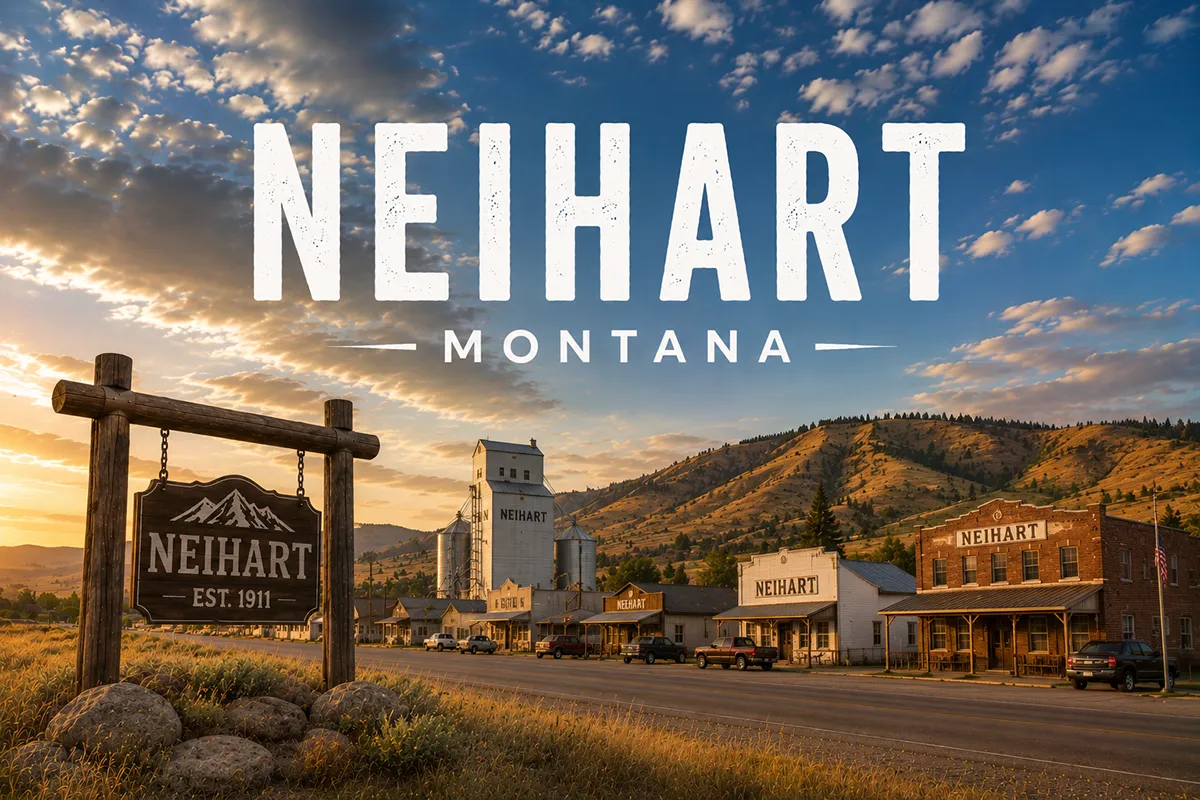
Today, Neihart has roughly 50 year-round residents.
The narrow canyon along Belt Creek means there isn’t much flat land to build on. Cabins and homes line both sides of Highway 89 in essentially single-file rows.
Ninety-six abandoned mine sites have been identified by EPA at the 9,000-acre Carpenter Snow Creek Mining District Superfund site, with at least 21 acting as ongoing sources of heavy-metal contamination.
But seven miles southwest, Showdown Montana — the state’s oldest operating ski area, dating to 1936 — continues to operate as one of central Montana’s most substantive outdoor recreation destinations.
TL;DR
- Neihart (~50) is in southern Cascade County in the Little Belt Mountains, on Highway 89 about 50 miles south of Great Falls and 75 miles north of White Sulphur Springs.
- Founded as a silver mining town by James L. Neihart and partners in 1881; formally named in spring 1882.
- Originally called Canyon City.
- More than 40 mines operated in the area over 75 years; mining persisted unusually long, until World War II.
- The 9,000-acre Carpenter Snow Creek Mining District is an active EPA Superfund site with 96 identified abandoned mines.
- The Montana Central Railroad branch line reached Neihart in 1891 and operated until 1945.
- An estimated $3 million in sapphires has been extracted from area mines, including some Yogo sapphires.
- Neihart quartzite — a distinctive Precambrian-age rock — is found in only three places worldwide.
- Showdown Montana ski area — 7 miles southwest — opened in 1936 as King’s Hill Ski Area and is Montana’s oldest operating ski resort.
- The town sits on the Kings Hill Scenic Byway (Highway 89) through the Lewis and Clark National Forest.
- Best for: silver mining heritage travelers, Showdown skiers, Kings Hill Byway road trippers, gemstone/rockhounding enthusiasts.
Liked this article?
Add Roaming Montana as a preferred source so you see more of our articles and guides on Google.
Neihart at a Glance
| Population (estimated) | ~50 |
|---|---|
| County | Cascade County (southern) |
| Region | Central Montana (Little Belt Mountains) |
| Elevation | 5,594 ft |
| Distance to Great Falls | ~50 miles north on US-89 (~1.25 hours) |
| Distance to White Sulphur Springs | ~75 miles south on US-89 |
| Distance to Belt | ~35 miles north |
| Distance to Showdown Ski Area | ~7 miles southwest |
| Distance to Lewistown | ~110 miles east |
| Distance to Stanford | ~70 miles east |
| Highway access | US-89 (Kings Hill Scenic Byway) |
| Founded | 1881 (silver discovery); officially 1882 |
| Best for | Silver mining heritage, Showdown skiing, Kings Hill Byway, rockhounding |
What Makes Neihart Different
The geography is the foundation.
Belt Creek runs through a narrow canyon between steep Little Belt Mountain slopes. The town site has so little flat ground that buildings are essentially stacked in single-file rows along Highway 89.
The canyon walls expose ancient Precambrian rocks of the Belt Supergroup — formations more than 1.4 billion years old.
The silver was in those rocks.
The 1879-1882 Silver Discoveries
The first significant silver discovery in the Little Belt Mountains happened on October 20, 1879, when E.A. “Buck” Barker and Patrick Hughes located ore deposits that gave birth to two early mining camps named for them: Barker and Hughesville.
Word spread quickly. Other prospectors moved into the area searching for additional deposits.
In July 1881, three prospectors from the Barker camp — James LeRoy Neihart, John O’Brien, and Richard Harley — found their own strike.
The Queen of the Mountains Mine was the result. Within weeks, a new mining camp — initially called Canyon City — had appeared at the strike site.
By spring 1882, the camp had been formally renamed Neihart in honor of the prospector who had led the discovery. A post office was established the same year.
The Wide Streets
When Neihart was platted, the town founders made an unusual choice.
They built exceptionally wide streets — the main street was 80 feet wide, and all cross streets were 60 feet wide.
The wide layout suggested optimism about growth that the narrow canyon site never really supported. Today the wide streets remain, even though the town never grew large enough to fully utilize them.
The Mining Persistence
Most Western mining towns flared out within a decade or two of their founding boom.
Neihart didn’t.
The Montana Central Railroad’s 1891 arrival reduced shipping costs and kept marginal operations viable. World War I and World War II created enormous demand for zinc — and the Neihart area mines could produce zinc when silver markets were weak.
Through the 1900s, mining continued at varying intensities. The last significant operations didn’t shut down until World War II.
The railroad branch line operated until 1945.
The 1896 Powder Magazine Explosion
The most catastrophic event in Neihart’s history happened on April 25, 1896.
The powder magazine belonging to the Broadwater group of mines near Neihart exploded at midnight. Seven men were killed. Sixteen were wounded, many seriously. The explosion was felt across the surrounding mountains.
The incident represents the broader human cost of the long mining era — one that Western mining heritage tourism often softens or omits.
The Carpenter Snow Creek Superfund Site
The 9,000-acre Carpenter Snow Creek Mining District surrounding Neihart was designated as an EPA Superfund site in the late 20th century.
EPA has identified approximately 96 abandoned mines at the site, with at least 21 considered probable sources of contamination. Historic mining operations contaminated soil, groundwater, surface water, and creek sediments with arsenic, lead, copper, zinc, and other heavy metals. Investigation and cleanup activities are ongoing.
The Superfund designation is a contemporary reminder that mining heritage isn’t just historical romance — it has lasting environmental consequences.
The Sapphires and the Quartzite
Beyond silver and zinc, Neihart-area mines have produced approximately $3 million in sapphires over the mining era — pale-to-royal-blue stones related to the famous Yogo sapphires found nearby on Yogo Creek.
The area is also one of only three places in the world where Neihart quartzite — a distinctive Precambrian quartzite — is found. Pinto diorite, a red-and-green spotted rock unique to the area, also occurs in substantial quantities.
For broader trip context, see my Montana cities and towns hub and Montana sapphires overview.
The Top 6 Things to Do In & Around Neihart
1. Showdown Montana Ski Area
Located 7 miles southwest of Neihart, Showdown is Montana’s oldest operating ski area, dating to 1936 (originally called King’s Hill Ski Area, operated by the Great Falls Ski Club).
Specifications: 1,400 ft vertical drop, 39 trails, 640 acres of skiable terrain, four lifts (one triple, two double, one conveyor), 20+ feet of annual snowfall. The mountain holds the state record for snowfall: 33 feet in one winter.
See Montana ski resorts for broader skiing context.
2. Kings Hill Scenic Byway
US Highway 89 between Great Falls and White Sulphur Springs is officially designated as the Kings Hill Scenic Byway.
The route passes through Neihart and over King’s Hill Pass — a major mountain pass at approximately 7,400 feet elevation. The byway accesses 450 miles of Forest Service roads, high-country lakes, trailheads, campgrounds, and abandoned mine sites.
3. Sluice Boxes State Park
About 10 miles north of Neihart, Sluice Boxes State Park preserves an 8-mile stretch of Belt Creek dominated by towering limestone cliffs and canyon walls.
Hiking, fishing, and primitive recreation. One of Montana’s more dramatic — and less crowded — state parks.
4. Neihart Silver Mining Walking
The townsite and surrounding mountainsides contain abandoned mine structures, tailings piles, and historical mining infrastructure visible from public roads.
The remnants of approximately 98 underground mines are visible along Highway 89 between Monarch (11 miles north) and Neihart. Respect Superfund site boundaries; don’t enter abandoned mine workings.
5. Snowmobile and Nordic Skiing
The Kings Hill Snowmobile trail system features 200 miles of marked snowmobile trails accessible from the Kings Hill Snowmobile parking lot just north of Showdown.
Silvercrest Nordic ski area at the same location offers 17 miles of cross-country trails (3 groomed, 1 ungroomed).
6. Day Trip to Great Falls (~1.25 hours north)
Montana’s third-largest city offers full attractions including the C.M. Russell Museum, the Lewis and Clark Interpretive Center, Giant Springs State Park, and significantly broader services than the Little Belt Mountains can provide.
The natural urban anchor for any Neihart-area visit.
Where to Stay
Lodging in Neihart itself is very limited.
The Showdown team operates The Edith Hotel — a stylish boutique hotel — providing the most substantive nearby option. Most travelers also consider Great Falls or White Sulphur Springs as base options.
| Lodging | Vibe | Price | Best For |
|---|---|---|---|
| The Edith Hotel (Neihart, Showdown-owned) | Stylish boutique | $150–280 | Showdown skiers (discounts available) |
| White Sulphur Springs lodging (1.5 hrs S) | Hot springs town | $130–250 | Spa-focused travelers |
| Great Falls hotels (1.25 hrs N) | Full city selection | $130–280 | City comforts |
| Vacation rentals (Neihart/Monarch area) | Mountain cabins | $130–280 | Outdoor enthusiasts |
| USFS campgrounds (Lewis and Clark NF) | Mountain camping | $20–30 | Self-sufficient summer travelers |
Where to Eat
- T-Bar Pub at Showdown — local brews, live music, après-ski food
- Local Neihart options — small cafes; verify current operations
- Great Falls restaurants (1.25 hrs N) — extensive variety
- White Sulphur Springs dining (1.5 hrs S) — small-town options
Getting There & Around
From Great Falls: 50 miles south on US-89, about 1.25 hours.
From White Sulphur Springs: 75 miles north on US-89, about 1.5 hours.
From Belt: 35 miles south on US-89, about 1 hour.
To Showdown Ski Area: 7 miles southwest of Neihart on US-89, just past King’s Hill Pass.
Cell service: Reduced in Neihart and along the Kings Hill Byway. Available at Showdown.
When to Visit
Winter (December-March): Peak Showdown ski season; full snow recreation; verify lift operations (often closed Mondays/Tuesdays).
Summer (June-August): Best for mining heritage exploration, hiking in the Lewis and Clark National Forest, Sluice Boxes State Park, and Kings Hill Byway driving.
Fall (September-October): Outstanding aspen color in the Little Belts; quieter shoulder season; cool but not yet snowy.
Spring (April-May): Late ski season early-month; snowmelt mid-month; shoulder season character.
Personal Tips
Visit Showdown deliberately. The 1936 founding makes Showdown genuinely historic. The on-mountain T-Bar Pub serves as social anchor; combine skiing with the broader Kings Hill Byway exploration.
Drive the Kings Hill Byway both ways. The full Highway 89 corridor from Great Falls through Neihart and Showdown to White Sulphur Springs is one of central Montana’s most substantively beautiful drives. Allow time in both directions.
Don’t enter abandoned mines. The Carpenter Snow Creek Superfund site is genuinely contaminated. Respect EPA boundaries. The visible mine remnants from public roads provide all the heritage context without exposure to health hazards.
Combine with White Sulphur Springs. After a ski day, soak at Spa Hot Springs Motel in WSS 75 miles south. The combination is one of central Montana’s signature heritage experiences.
Read the 1896 powder magazine story. Understanding the human cost of the mining era — including the seven men killed in the Broadwater explosion — adds substantive depth to the heritage walking.
Stop at Sluice Boxes State Park. Ten miles north of Neihart, the state park’s 8-mile Belt Creek canyon is one of Montana’s more dramatic — and less crowded — natural areas.
Neihart Quick Facts
| Population (estimated) | ~50 | | First Little Belt silver discovery | October 20, 1879 (Barker & Hughes) | | Neihart strike | July 1881 (Neihart, O’Brien, Harley) | | Originally named | Canyon City | | Officially named Neihart | Spring 1882 | | Discoverer the town honors | James LeRoy Neihart | | Number of area mines (peak) | 40+ over 75 years | | Number of abandoned mines (EPA) | 96 | | Carpenter Snow Creek Superfund acreage | 9,000 acres | | Montana Central Railroad branch reached Neihart | 1891 | | Railroad branch operated until | 1945 | | Broadwater powder magazine explosion | April 25, 1896 (7 killed, 16 wounded) | | Sapphires extracted | ~$3 million worth | | Neihart quartzite global occurrences | 3 (one of three worldwide) | | Main street width | 80 ft | | Cross streets width | 60 ft | | Showdown Ski Area founded | 1936 (Montana’s oldest operating) | | Showdown distance from Neihart | 7 miles southwest | | Showdown vertical drop | 1,400 ft | | Average summer high | 75°F | | Average winter low | 0°F |
Conclusion
Neihart is a 50-person Cascade County town with substantively significant heritage on multiple fronts.
The 1881 silver strike by James L. Neihart and partners. The Queen of the Mountains Mine and 40+ subsequent operations. The 1891 Montana Central Railroad arrival.
The April 25, 1896 Broadwater powder magazine explosion that killed seven men. The unusual mining persistence until World War II.
The 96 abandoned mines that now constitute a 9,000-acre EPA Superfund site. The $3 million in sapphires.
The Neihart quartzite found in only three places on Earth. And seven miles southwest, Showdown Montana — the state’s oldest operating ski area, dating to 1936 — continues to draw skiers from across Montana.
The Kings Hill Scenic Byway through Neihart is one of central Montana’s most substantive drives.
Have a Neihart question? Drop it in the comments — I read every one.
Frequently Asked Questions
Is Neihart Montana worth visiting?
Yes — Neihart is worth visiting for the silver mining heritage (the 1881 founding, 40+ historic mines, Carpenter Snow Creek Superfund context), the proximity to Showdown Montana ski area (Montana’s oldest operating ski area, 1936), the Kings Hill Scenic Byway (US-89 through the Little Belt Mountains), and access to Sluice Boxes State Park 10 miles north. Best for travelers interested in mining heritage, central Montana skiing, scenic driving, and uncrowded mountain recreation.
When was Neihart Montana founded?
The Neihart strike happened in July 1881 when prospectors James LeRoy Neihart, John O’Brien, and Richard Harley found silver in the Little Belt Mountains and established the Queen of the Mountains Mine. The resulting camp was initially called Canyon City, then formally renamed Neihart in spring 1882 in honor of the discoverer. A post office was established the same year. The first Little Belt Mountains silver discovery had happened slightly earlier, on October 20, 1879, by E.A. “Buck” Barker and Patrick Hughes at the nearby camps of Barker and Hughesville.
What is Showdown Montana?
Showdown Montana is an alpine ski area located approximately 7 miles southwest of Neihart in the Little Belt Mountains. Founded in 1936 as the King’s Hill Ski Area by the Great Falls Ski Club, Showdown is Montana’s oldest operating ski area and one of the oldest continuously operating ski areas in the United States. The mountain offers 1,400 feet of vertical drop, 39 trails, 640 acres of skiable terrain, four lifts (one triple, two double, one conveyor), and approximately 20 feet of annual snowfall (with a state record of 33 feet in one winter). Showdown is owned by the Showdown team that also operates the boutique Edith Hotel in Neihart. See Montana ski resorts for broader skiing context.
How big is Neihart Montana?
Neihart has approximately 50 year-round residents. The town covers a small footprint in a narrow Belt Creek canyon in southern Cascade County, with cabins and homes lined up essentially single-file along both sides of US Highway 89 due to the canyon’s lack of flat building area.
What is the Carpenter Snow Creek Superfund Site?
The Carpenter Snow Creek Mining District is a 9,000-acre EPA Superfund site surrounding Neihart, Montana. EPA has identified approximately 96 abandoned mines at the site, with at least 21 considered probable sources of ongoing heavy-metal contamination. Historic mining operations contaminated soil, groundwater, surface water, and creek sediments with arsenic, lead, copper, zinc, and other hazardous materials. Investigation and cleanup activities are ongoing. The site represents the contemporary environmental legacy of the long mining era (1881-WWII) that defined Neihart’s history. Visitors should respect Superfund boundaries and not enter abandoned mine workings.
What is Neihart quartzite?
Neihart quartzite is a distinctive Precambrian-age quartzite rock formation found in the Little Belt Mountains around Neihart, Montana. It is part of the larger Belt Supergroup of ancient sedimentary rocks formed more than a billion years ago. Notably, Neihart quartzite is found in only three places in the world, making the Neihart area geologically significant for petrologists, geologists, and serious rockhounds. Other distinctive rocks found in the area include Pinto diorite (a red-and-green spotted rock) and amethyst crystals and marine fossils.
What is the Kings Hill Scenic Byway?
The Kings Hill Scenic Byway is US Highway 89 between White Sulphur Springs and Belt, Montana, passing through Neihart in the Little Belt Mountains. The byway is one of Montana’s most scenically substantive mountain corridors, crossing King’s Hill Pass at approximately 7,400 feet elevation. Beyond Neihart and Showdown Ski Area, the byway accesses 450 miles of Forest Service roads, high-country lakes, trailheads, campgrounds, snowmobile trails, and abandoned mining sites throughout the Lewis and Clark National Forest. Both summer and winter recreational opportunities along the byway are extensive.
How far is Neihart from Great Falls Montana?
Neihart is approximately 50 miles south of Great Falls on US Highway 89 (the Kings Hill Scenic Byway) — about a 1.25-hour drive. Great Falls serves as the natural urban anchor for any Neihart visit, with full hotels, restaurants, the C.M. Russell Museum, the Lewis and Clark Interpretive Center, and Giant Springs State Park.