Silver Gate is the kind of place that makes you reconsider how you measure a community.
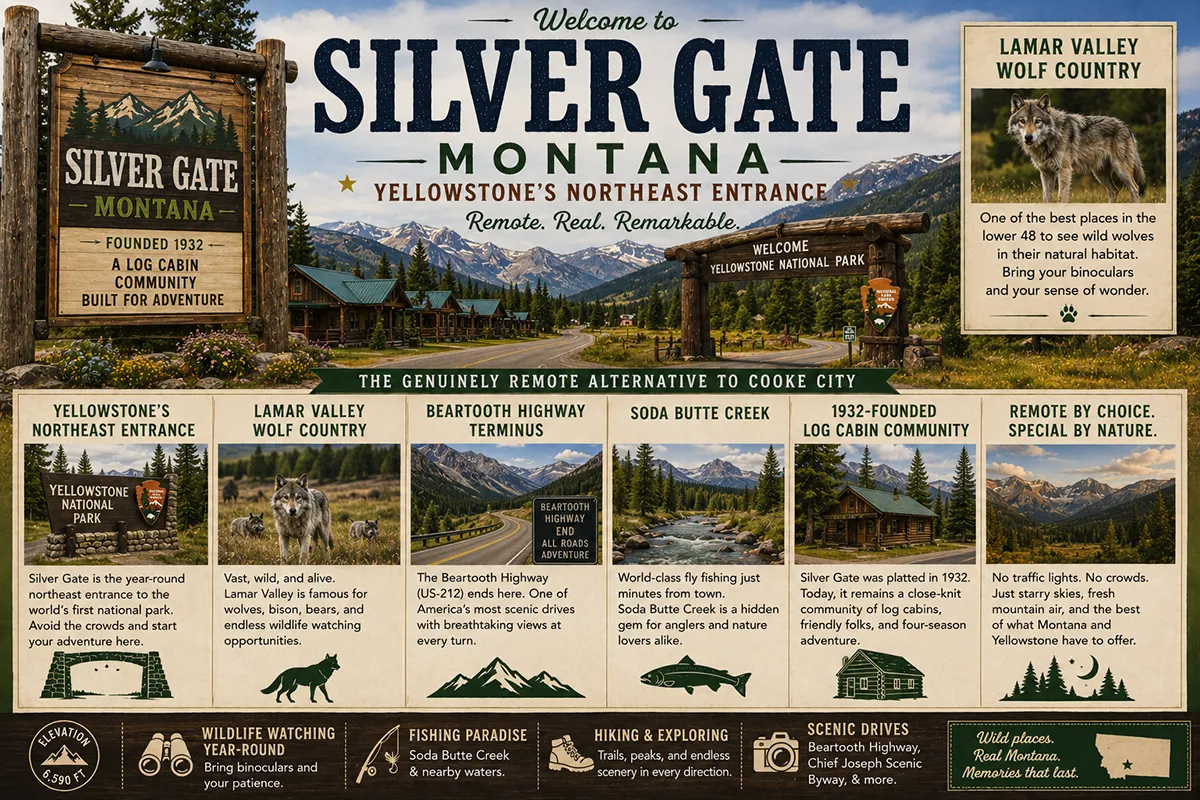
The unincorporated village sits at 7,400 feet elevation on US Highway 212, three miles east of Cooke City and one mile from the northeast entrance to Yellowstone National Park. Fewer than 20 people live here year-round. There is no cell phone service.
The wifi at the local cabins runs over satellite and is slow. US-212 ends just beyond Silver Gate during the winter months — when the Beartooth Highway closes between Cooke City and Red Lodge, locals call the stranded section between Yellowstone’s North Entrance at Gardiner and the dead-end at Cooke City “The Plug.”
For most of the year, you reach Silver Gate either via the Beartooth Highway (May-October only) or by driving through Yellowstone from Gardiner to the northeast corner.
What you find when you get there is one of the most architecturally consistent communities in Montana. In 1932, when John J. Taylor and J. J. White founded the village to serve Yellowstone visitors, they established construction covenants requiring all structures to be built of logs or other native materials.
Those covenants have remained in force for nearly a century. The cabins, the motels, the few cafés, the Range Riders Lodge, even the more recent buildings — all of them are log construction with rustic detailing.
The result is a place that looks remarkably similar to what early 20th-century park visitors would have seen, anchored on one end by the Northeast Entrance Station — a 1935 National Park Service Rustic log entrance gate designed by Thomas Chalmers Vint, declared a National Historic Landmark in 1987.
The natural setting matches the architectural commitment. Silver Gate sits in a narrow valley along Soda Butte Creek, surrounded on three sides by Beartooth Mountain peaks topping 10,000 feet.
The Custer Gallatin National Forest and Absaroka-Beartooth Wilderness extend in every direction outside the village.
Grizzly bears, black bears, moose, elk, and wolves move through regularly. The Lamar Valley — Yellowstone’s famous “American Serengeti” — is one mile away through the park entrance.
For wildlife watchers, photographers, fly fishers, and travelers seeking the genuinely remote alternative to busier Yellowstone gateways, Silver Gate is one of the most rewarding small destinations in the American West.
TL;DR
- Silver Gate is a small unincorporated community on US-212 at the northeast entrance to Yellowstone National Park — Park County, Montana.
- Founded in 1932 by John J. Taylor and J. J. White; original construction covenants require log and rustic architecture still in force today.
- Fewer than 20 people live here year-round; elevation 7,400 feet.
- One mile from Yellowstone’s NE Entrance Station (1935, designed by Thomas Chalmers Vint, NHL listed 1987) and the Lamar Valley (“American Serengeti” — wolves, grizzlies, bison).
- Three miles east of Cooke City — Silver Gate’s more developed sister community.
- No cell service; satellite internet only.
- The eastern terminus of the Beartooth Highway (US-212, open late May through mid-October only).
- Soda Butte Creek runs through town — Blue Ribbon trout fishery.
- Best for: serious Yellowstone wolf watchers, Lamar Valley wildlife photographers, fly fishers, Beartooth Highway travelers, and anyone seeking the genuine quiet end of Yellowstone tourism.
Liked this article?
Add Roaming Montana as a preferred source so you see more of our articles and guides on Google.
Silver Gate at a Glance
| Population (year-round) | <20 |
|---|---|
| County | Park County |
| Status | Unincorporated community |
| Region | South-Central Montana (Yellowstone NE corner) |
| Elevation | 7,400 ft |
| Distance to Yellowstone NE Entrance | ~1 mile west |
| Distance to Cooke City | ~3 miles east |
| Distance to Lamar Valley | ~5 miles into Yellowstone |
| Distance to Red Lodge (Beartooth Highway) | ~68 miles east (open May-October only) |
| Distance to Gardiner (Yellowstone N entrance) | ~55 miles via Yellowstone Park |
| Distance to Cody, Wyoming (via Chief Joseph) | ~78 miles southeast (open May-October only) |
| Best for | Lamar Valley wildlife, Beartooth access, fly fishing, quiet retreat |
What Makes Silver Gate Different
Silver Gate’s founding story is genuinely unique. By 1932, when John J. Taylor and J. J. White established the community, Cooke City three miles east had been a working mining town since the 1870 gold discovery in the New World Mining District.
Cooke City had saloons, dance halls, and the rough-and-tumble character of a continuing mining settlement.
Taylor and White wanted to create something different — a deliberately tourist-oriented village explicitly designed to serve Yellowstone visitors with a more refined, more architecturally consistent character.
The construction covenants they wrote required log construction and natural materials. Those covenants have largely held for 92 years.
The architectural commitment matters. Most American gateway communities to national parks have evolved into commercial strips with the standard mix of chain motels, gas stations, fast food, and generic visitor-services architecture.
Silver Gate didn’t. The structures along the village’s short main strip remain unmistakably what they were in the 1930s — log cabins, rustic lodges, and the Range Riders Lodge with its iconic facade.
When you arrive, the visual landscape itself reinforces the sense of having entered an older, quieter version of the American West.
The Henry Finkbeiner story adds to the contemporary picture. An Atlanta-based entrepreneur who in the early 2000s began quietly buying up Silver Gate businesses to preserve the village’s character and prevent the snowmobile-and-ATV development that had increasingly defined Cooke City.
By 2004 he had purchased three motels, the Range Riders Lodge, and the general store. His stated goal was to keep Silver Gate the “quiet alternative” to its busier sister community.
Two decades later, that goal has largely held. Silver Gate remains genuinely quiet; Cooke City retains its more commercial character.
The Lamar Valley access is what most visitors actually come for. Just one mile west of Silver Gate, the northeast entrance station opens onto Yellowstone’s most wildlife-rich area.
The Lamar Valley — sometimes called “America’s Serengeti” — supports one of North America’s most-studied wolf populations (following the 1995 wolf reintroduction), grizzly bears, black bears, bison, elk, pronghorn, bighorn sheep, and the predator-prey dynamics that draw wildlife photographers from around the world.
Dawn and dusk in Lamar Valley during summer are among the most reliably productive wildlife-viewing experiences available anywhere in the United States. From Silver Gate, you can be in the heart of Lamar Valley fifteen minutes after waking up — a logistic advantage no other lodging community offers.
For broader trip context, see my Montana cities and towns hub.
The Top 10 Things to Do In & Around Silver Gate
1. Wildlife Watching in Lamar Valley
The single most important reason most travelers come to Silver Gate. The Lamar Valley inside Yellowstone — entered via the Northeast Entrance Station one mile west — supports one of North America’s most reliably observable wildlife populations.
Wolves (multiple packs in the area following the 1995 reintroduction), grizzly bears, black bears, bison, elk, pronghorn, coyotes, and bighorn sheep are all routinely observed from the valley’s pull-offs. Dawn (especially the hours immediately after sunrise) and dusk are most productive.
Bring a spotting scope; the wildlife is often at significant distance from accessible viewpoints. Wolf-watching is best from late May through October; the Lamar Valley is also active in winter via snowcoach or skis.
2. Beartooth Highway (US-212) — Eastern Terminus
The Beartooth Highway is one of America’s most celebrated drives — 68 miles between Red Lodge and Cooke City, traversing 10,000-foot mountain passes, alpine plateau, glacial lakes, and dramatic high-country terrain.
Silver Gate sits at the highway’s western/southern terminus. Charles Kuralt called it “one of the most beautiful drives in America.” Open late May through mid-October only (the road closes for winter). Allow a full day for the round trip from Silver Gate to Red Lodge and back. See Red Lodge guide.
3. Northeast Entrance Station (NHL)
The 1935 log-construction entrance station designed by NPS architect Thomas Chalmers Vint is one of the finest examples of National Park Service Rustic architecture in the entire system.
It was declared a National Historic Landmark in 1987 and is on the National Register of Historic Places at the same listing.
The station straddles US-212 just west of Silver Gate. Stop, photograph, and appreciate the rustic-modern blend that defined the early-20th-century NPS architectural style.
4. Soda Butte Creek Fly Fishing
The creek that runs through Silver Gate is part of a Blue Ribbon trout fishery system that extends into the Lamar River and Yellowstone River watershed. Cutthroat trout, rainbow trout, and brown trout in scenic high-elevation water.
Access is straightforward from Silver Gate; multiple wade-fishing locations within walking distance of the village.
Yellowstone Park fishing permits required for sections inside the park; Montana fishing license required for sections outside. Note: fishing regulations in this area are strict and species-specific — read the current rules carefully.
5. Mt Republic Chapel of Peace
Between Silver Gate and Cooke City on US-212 sits one of Montana’s most architecturally interesting small churches — the Mt Republic Chapel of Peace, designed by Montana architect Charles Sumner in 1971 with first services held in 1972.
The chapel blends rustic-modern design with the surrounding alpine landscape. Worth a brief stop for the architecture and the setting.
6. Range Riders Lodge
The venerable Silver Gate lodge is one of the village’s signature properties — historic log construction, classic dining, and a bar that captures the post-cowboy alpine-lodge atmosphere that defines this corner of Montana. Stop for dinner or a drink even if you’re not staying overnight.
7. Backcountry Hiking & Backpacking
The Absaroka-Beartooth Wilderness surrounding Silver Gate provides some of the most spectacular alpine hiking in the contiguous United States.
Trailheads accessible from Silver Gate and Cooke City lead to alpine lakes, the Beartooth Plateau, Granite Peak (Montana’s highest at 12,807 feet), and remote backcountry destinations.
Bear safety is essential — carry bear spray, know how to use it, and follow current backcountry food storage requirements.
8. Winter Recreation
When the Beartooth Highway closes for winter (typically mid-October through late May), Silver Gate transforms into a genuinely remote winter destination accessible only via Yellowstone Park from Gardiner.
Cross-country skiing, snowshoeing, backcountry skiing, and wildlife photography in the winter Lamar Valley are all available. Snowmobiling is more associated with Cooke City; Silver Gate emphasizes quieter winter recreation.
9. Day Trip to Cooke City (3 miles east)
Cooke City — the more developed sister community — has additional dining, lodging, supplies, and the small but substantive Cooke City Museum covering the mining history of the area. The Miners Saloon is the regional gathering spot. See Cooke City guide.
10. Chief Joseph Scenic Byway (WY-296)
Wyoming Highway 296 — the Chief Joseph Scenic Byway — joins US-212 about 10 miles east of Cooke City and provides an alternative route to Cody, Wyoming (~78 miles southeast).
The route is one of the most dramatic scenic drives in the West, traversing the Sunlight Basin and the dramatic Clarks Fork Canyon. Open late May through mid-October only.
Where to Stay
Silver Gate offers genuinely small-scale rustic lodging. Larger options are in Cooke City (3 miles) or further afield.
| Hotel | Vibe | Price | Best For |
|---|---|---|---|
| Silver Gate Cabins & Motel | Historic rustic cabins | $180–280 | Authentic Silver Gate experience |
| Pine Edge Cabins | Log cabins, full kitchens | $200–320 | Families, longer stays |
| Range Riders Lodge & Motel | Historic Silver Gate institution | $160–250 | Classic Western lodging |
| Cooke City lodging (3 mi east) | Wider selection | $130–280 | More variety |
| Yellowstone NPS lodging (via park) | Roosevelt Lodge, Mammoth | $150–500+ | In-park experience (book months ahead) |
Reservations essential for summer. Many properties require multi-night minimums during peak periods (June-September).
Where to Eat
- Log Cabin Café (Silver Gate) — classic breakfast and lunch in log architecture
- Range Riders Lodge dining — Silver Gate’s signature dinner option
- Soda Butte Lodge restaurants
- Miners Saloon (Cooke City, 3 mi east) — classic Cooke City institution
- Beartooth Café (Cooke City) — burgers and Western food
Dining options are limited; reservations recommended for Range Riders dinner. Bring some food supplies; the village’s small store has basics but not extensive groceries.
Getting There & Around
From Cooke City: 3 miles east on US-212, about 5 minutes.
From Red Lodge (Beartooth Highway, summer only): ~68 miles southwest via US-212, about 2-2.5 hours of mountain driving.
From Gardiner (year-round via Yellowstone Park): ~55 miles via the park’s Mammoth-Tower-Lamar route, about 1.5-2.5 hours depending on wildlife stops.
From Cody, Wyoming (Chief Joseph Scenic Byway, summer only): ~78 miles northwest via WY-296 and US-212, about 2 hours.
From Bozeman: ~190 miles via Livingston/Yellowstone (winter requires the route via Gardiner; summer can also use Beartooth from Red Lodge via Billings).
From Billings: ~130 miles via US-212 and Beartooth Highway (summer only); via Yellowstone Park is significantly longer.
Cell service: None in Silver Gate. Satellite internet is the only option. Plan accordingly.
What Silver Gate Unlocks
Lamar Valley & Yellowstone NE Quadrant (1 mile west)
America’s most reliable wolf-viewing area and Yellowstone’s quietest entrance.
Beartooth Highway (eastern terminus)
68 miles of one of America’s most spectacular alpine drives. Summer access only.
Absaroka-Beartooth Wilderness (surrounding)
Granite Peak (Montana’s highest), alpine lakes, backcountry hiking.
Chief Joseph Scenic Byway (~10 mi east)
Alternative route to Cody, Wyoming via Sunlight Basin.
Cooke City (3 mi east)
More developed sister community with additional services.
Yellowstone Park (year-round via Gardiner; summer via Beartooth)
Old Faithful, Mammoth Hot Springs, Grand Canyon of the Yellowstone.
When to Visit
Late May through mid-October: Beartooth Highway open; Chief Joseph Scenic Byway open; full access from all directions; all Silver Gate businesses operating; wildlife active in Lamar Valley.
June through August: Peak summer; book lodging months in advance; wildflowers; long daylight; warmest temperatures.
September through mid-October: Fall colors; cooler temperatures; fewer crowds; bull elk rut in Lamar Valley; ideal photography light. One of the best times for wildlife.
Late October through early May: Winter season; Beartooth Highway and Chief Joseph closed; Silver Gate accessible only via Yellowstone Park from Gardiner; many businesses on reduced winter hours; cross-country skiing and snowshoeing; dramatic snowy landscape; wolf viewing in winter Lamar Valley.
Personal Tips
Book lodging far in advance. Silver Gate’s small-scale lodging fills up months ahead for peak summer dates. Wolf-watching enthusiasts often book a year out for prime September weeks.
Bring a spotting scope. Lamar Valley wildlife is usually at significant distance — half a mile to a mile or more — from the road pull-offs. Good binoculars are minimum equipment; a spotting scope on a tripod transforms the experience.
Plan for no cell service. Tell people where you’ll be, download offline maps before arriving, and prepare to be genuinely offline. Many travelers consider this a feature; some find it disorienting.
Wake up at 4:30 a.m. for Lamar Valley. Wolves and bears are most active immediately after dawn. Arriving in Lamar Valley by 5:30-6:00 a.m. during summer dramatically increases your chances of seeing major predators. This requires getting up much earlier than most travelers will tolerate; the trade-off is worth it.
Drive the Beartooth. If your visit is during summer, drive the full Beartooth Highway from Silver Gate to Red Lodge and back, or do it as a one-way drive with a return through Yellowstone. It is genuinely one of the best drives in America. Allow a full day with stops.
Pack a cooler with food. The dining options are limited and often have wait times. Having sandwich supplies, snacks, and beverages in a cooler significantly improves the daily logistics.
Pack warm clothing year-round. At 7,400 feet, even July nights can drop near freezing. Summer wildlife outings start before dawn when temperatures are coldest.
Silver Gate Quick Facts
| Founded | 1932 | | Founders | John J. Taylor and J. J. White | | Construction covenants | Log/rustic materials only — still in force | | Elevation | 7,400 ft | | Year-round population | <20 | | NE Entrance Station built | 1935 (architect Thomas Chalmers Vint) | | NE Entrance Station NHL designation | 1987 | | Mt Republic Chapel of Peace | 1971-72 (architect Charles Sumner) | | Beartooth Highway season | Late May – mid-October | | Cell service | None (satellite internet only) | | Average summer high | 68°F | | Average winter low | 2°F |
Conclusion
Silver Gate is one of the most genuinely unusual destinations in Montana — a 1932-founded log-cabin community of fewer than 20 year-round residents at 7,400 feet elevation, deliberately preserved with original construction covenants for nearly a century, sitting one mile from one of the most wildlife-rich places in North America.
The combination of architectural consistency, Lamar Valley access, Beartooth Highway terminus, and genuine disconnection from cell service and modern noise creates an experience that’s increasingly hard to find anywhere in the contemporary American West.
For wildlife photographers, serious Yellowstone visitors, Beartooth drivers, and travelers who genuinely value remoteness, Silver Gate is exactly the right base.
Have a Silver Gate question? Drop it in the comments — I read every one.
Frequently Asked Questions
Is Silver Gate Montana worth visiting?
Yes — Silver Gate is worth visiting for the immediate access to Yellowstone’s Lamar Valley (one mile west through the Northeast Entrance), the Beartooth Highway eastern terminus, the 1935 Northeast Entrance Station National Historic Landmark, Soda Butte Creek fly fishing, and the genuinely rustic 1932-era log-cabin community character preserved by original construction covenants. It’s the quietest of Yellowstone’s gateway communities.
What is the difference between Silver Gate and Cooke City?
Silver Gate and Cooke City are sister communities on US-212 about three miles apart, both serving Yellowstone National Park’s northeast entrance. Cooke City (the larger community) originated with the 1870 New World Mining District gold rush and retains a more developed, working-mining-town character with snowmobiling and ATV culture. Silver Gate was founded in 1932 specifically as a tourist-oriented village with original construction covenants requiring log and rustic architecture only. Silver Gate is deliberately quieter and more architecturally consistent; Cooke City has more services and businesses.
When does the Beartooth Highway open and close?
The Beartooth Highway (US-212 between Red Lodge and Cooke City/Silver Gate) typically opens in late May after winter snow is cleared from the high passes, and closes in mid-October when first major snowstorms make the alpine sections impassable. The highway is not maintained for winter travel. During winter, the only access to Silver Gate is via Yellowstone Park from the North Entrance at Gardiner.
Is there cell service in Silver Gate Montana?
No — Silver Gate has no cell service. Satellite-based wifi is available at some lodging properties but is slow and unreliable. Travelers should plan to be genuinely offline, tell people where they are before arriving, and download offline maps. Many visitors consider the disconnection from cell service one of Silver Gate’s most appealing features.
How close is Silver Gate to Lamar Valley?
The Northeast Entrance Station to Yellowstone National Park is approximately one mile west of Silver Gate. The heart of Lamar Valley wildlife viewing — the open meadows where wolves, grizzly bears, and bison are most reliably observed — is approximately 5 miles into the park. From Silver Gate, travelers can be in the heart of Lamar Valley in about 15 minutes.
What was the Northeast Entrance Station designed by?
The Northeast Entrance Station to Yellowstone National Park, located on US-212 just west of Silver Gate, was designed by National Park Service architect Thomas Chalmers Vint, who led the NPS Branch of Plans and Design. The station was built in 1935 in rustic log architecture characteristic of the NPS Rustic style. The structure was declared a National Historic Landmark in 1987 and placed on the National Register of Historic Places at the same time.