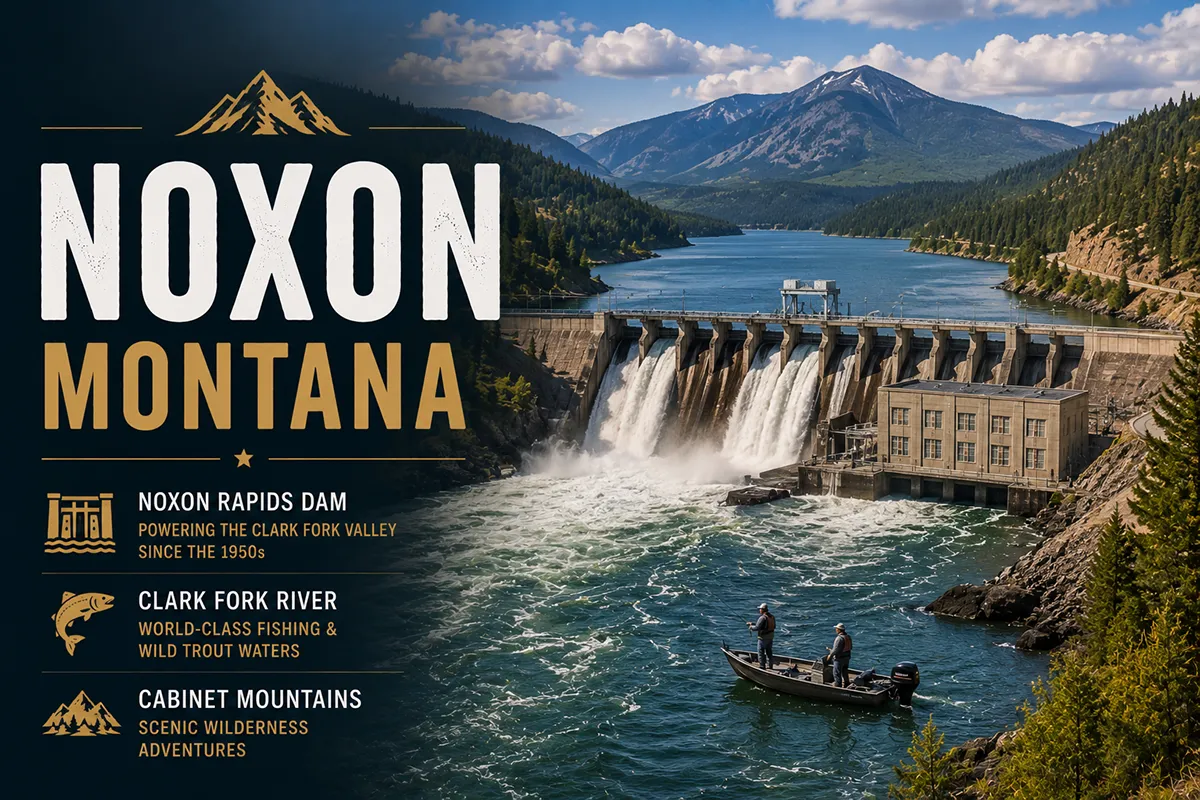
In 1955, the construction crews arrived at Noxon, Montana.
For the next four years, they substantially built one of the most substantial hydroelectric dams in the American West — an earthfill gravity-type structure stretching nearly a mile across the Clark Fork River, 260 feet tall, and 700 feet wide at its base.
The substantial Noxon Rapids Dam was completed in 1959 at a cost of $85 million. With five turbines producing 527 megawatts, the dam became the second-largest hydroelectric facility in Montana by installed capacity (behind only Libby Dam on the Kootenai River).
The substantial dam was operated by Avista — the Spokane-based utility that owns and operates the entire substantial Clark Fork hydroelectric system in northwestern Montana. Today, Noxon Rapids substantially produces enough electricity to power approximately 365,000 homes.
But Noxon itself isn’t really about the dam.
The substantial community of approximately 225 residents sits in the substantial Cabinet Mountains — one of the most substantively beautiful mountain ranges in the contiguous United States. The Cabinet Mountains Wilderness Area — substantial 94,272 acres of federally protected wilderness — has its substantial geographic center east of the Bull River near Noxon.
The substantial Kootenai National Forest surrounds the community. The substantial Clark Fork River — flowing west toward Lake Pend Oreille in Idaho — provides substantial recreational access. And the substantial mountain forests provide some of the most substantial huckleberry harvesting anywhere in the American West.
The substantial position 10 miles east of the Idaho border puts Noxon substantially closer culturally to the Pacific Northwest than to most of eastern Montana. The substantial Northern Pacific Railway founded the community in 1883.
Substantial logging and mining shaped its 19th and early-20th-century economy. The substantial 1959 dam transformed the river landscape. The substantial 21st-century community functions as a substantial rural gateway to the Cabinet Mountains Wilderness and the broader Clark Fork hydroelectric corridor.
TL;DR
- Noxon (~225) is a small unincorporated community in Sanders County along the Clark Fork River and Montana Highway 200, approximately 10 miles east of the Idaho border in far northwestern Montana.
- The community was founded in 1883 as a Northern Pacific Railway station.
- The Noxon Rapids Dam (1959) is the second-largest hydroelectric facility in Montana by installed capacity — 527 MW, 260 ft tall, 5,840 ft long, powering approximately 365,000 homes.
- The dam is operated by Avista (Spokane-based utility).
- The Cabinet Mountains Wilderness Area (94,272 acres) has its substantial geographic center east of the Bull River near Noxon.
- The Kootenai National Forest surrounds the community.
- The area is world-renowned for huckleberry harvesting.
- The substantial Ross Ancient Cedars State Park (26 miles north) preserves some of Montana’s oldest cedars.
- The Cabinet Gorge Dam (10 miles downriver, just into Idaho) provides substantial downstream context.
- Best for: Cabinet Mountains Wilderness exploration, Clark Fork River recreation, huckleberry harvesting, hydroelectric dam heritage.
Liked this article?
Add Roaming Montana as a preferred source so you see more of our articles and guides on Google.
Noxon at a Glance
| Population (estimated) | ~225 |
|---|---|
| County | Sanders County |
| Status | Unincorporated community |
| Region | Far Northwest Montana (Clark Fork corridor) |
| Elevation | 2,159 ft |
| Distance to Idaho border | ~10 miles west |
| Distance to Thompson Falls (county seat) | ~40 miles east |
| Distance to Trout Creek | ~20 miles east |
| Distance to Heron | ~10 miles south |
| Distance to Libby | ~40 miles northeast |
| Distance to Troy | ~50 miles north |
| Distance to Sandpoint, ID | ~50 miles west |
| Distance to Spokane, WA | ~125 miles west |
| Highway access | MT-200 |
| Founded | 1883 (Northern Pacific Railway station) |
| Noxon Rapids Dam completed | 1959 |
| Best for | Cabinet Mountains Wilderness, Clark Fork River, huckleberry harvesting, hydroelectric heritage |
What Makes Noxon Different
Three distinct stories define Noxon: the railroad founding, the dam transformation, and the contemporary wilderness gateway role.
The 1883 Northern Pacific Founding
The Northern Pacific Railway — completing its substantial transcontinental mainline through northwestern Montana in the early 1880s — required substantial intermediate stations.
In 1883, the railroad established a substantial new station along the Clark Fork River in what is now Sanders County.
The substantial location was selected for its substantial valley-bottom flatness, reliable water from the river, and accessible position between substantial timber resources on the surrounding mountainsides. The substantial new station was named Noxon.
For the next several decades, Noxon developed substantial logging and mining economies. The substantial old-growth timber of the surrounding Cabinet Mountains supported substantial sawmill operations.
Substantial mineral discoveries in the broader Cabinet Mountains supported substantial small-scale mining activity throughout the late 19th and early 20th centuries.
The substantial railroad-and-resource-extraction character of Noxon continued through the first half of the 20th century.
The 1955-1959 Dam Construction
The substantial transformation came with the dam.
In the early 1950s, the Washington Water Power Company (the predecessor to contemporary Avista) identified the Clark Fork River corridor as substantially well-suited for major hydroelectric development.
The substantial gradient drop along the lower Clark Fork — combined with substantial reliable winter flow from the substantial mountain snowpack and glaciers — promised substantial year-round generating capacity.
Construction of the substantial Noxon Rapids Dam began in 1955 at a substantial location immediately downstream from Noxon. For the next four years, substantial construction crews built the substantial structure:
- Earthfill gravity-type hydroelectric dam
- 260 feet tall at its highest point
- 5,840 feet long (just over a mile)
- 700 feet wide at its base
- Five turbines with substantial 527-megawatt installed capacity
The substantial dam was completed in 1959 at a substantial cost of $85 million. The substantial new Noxon Reservoir behind the dam covers approximately 7,700 acres and stores approximately 400,000 acre-feet of water — the catchment area drains approximately 21,800 square miles of northwestern Montana and surrounding regions.
When the substantial facility came online, the substantial energy produced nearly doubled Washington Water Power’s total generating capability.
The substantial transformation of Noxon was substantial. Substantial sections of the previous river landscape were submerged. The substantial original Northern Pacific Railway alignment had to be rerouted in places.
Substantial new infrastructure — Montana Highway 200 alignment, the substantial Noxon Bridge spanning the reservoir, substantial transmission line corridors — substantially reshaped the surrounding country.
The Second-Largest Hydroelectric in Montana
Today, the Noxon Rapids Dam stands as the second-largest hydroelectric facility in the state of Montana by installed capacity — substantial 527 MW compared to substantial 642 MW at Libby Dam on the Kootenai River. The substantial output substantially powers approximately 365,000 homes.
Of Avista’s eight hydroelectric facilities across the Pacific Northwest, Noxon Rapids has the largest generating capacity.
The substantial dam is also a top bass fishery in the state of Montana — the substantial warm-water Noxon Reservoir supports substantial smallmouth bass populations along with substantial other species.
The Cabinet Gorge Dam Downstream
Approximately 10 miles downstream from Noxon Rapids — substantially across the Idaho border into Bonner County, Idaho — is the substantial Cabinet Gorge Dam. The substantial Cabinet Gorge facility provides substantial additional Clark Fork hydroelectric capacity.
Together, the substantial Noxon Rapids Dam and Cabinet Gorge Dam form the substantial Clark Fork Project — Avista’s substantial lower-Clark-Fork hydroelectric system.
The Cabinet Mountains Wilderness
The substantial contemporary identity of Noxon centers substantially on the surrounding wilderness.
The Cabinet Mountains Wilderness Area — approximately 94,272 acres of federally protected wilderness — has its substantial geographic center east of the Bull River near Noxon.
The substantial wilderness preserves substantial sections of the substantial Cabinet Range, including substantial alpine peaks, substantial glaciated cirques, substantial high alpine lakes, and substantial old-growth forests.
The Kootenai National Forest surrounds the substantial wilderness area and the broader Noxon community. The substantial forest provides substantial dispersed recreation access throughout the region.
Huckleberries
The substantial Cabinet Mountains around Noxon are substantially famous for huckleberries.
Substantial wild huckleberry harvesting is a substantial annual tradition. The substantial fruit ripens substantially in late summer (typically late July through early September) at substantial mid-to-high elevations throughout the Cabinet Mountains.
Substantial commercial harvesting supports substantial small businesses across the region; substantial recreational harvesting is enjoyed by substantial visitors and residents.
For broader trip context, see my Montana cities and towns hub, Montana history overview, and key historical events in Montana.
The Top 6 Things to Do In & Around Noxon
1. Noxon Rapids Dam Overlook
The signature engineering attraction.
The substantial 1959 earthfill dam — 260 feet tall, over a mile long — provides substantial dramatic engineering character.
Multiple substantial parking areas and short walking trails (one of which passes over the historic line of the Northern Pacific Railroad) provide substantial dam viewing. Interpretive signs document substantial dam history and hydroelectric engineering.
2. Cabinet Mountains Wilderness
The signature natural attraction.
The substantial 94,272-acre wilderness — with its substantial geographic center east of the Bull River near Noxon — provides substantial alpine hiking, substantial high-elevation backpacking, substantial mountaineering, and substantial dispersed recreation. Multiple substantial trailheads accessible from secondary roads off MT-200 near Noxon.
3. Bull River Campground & Recreation
The substantial Bull River — flowing south from the Cabinet Mountains to join the Clark Fork near Noxon — provides substantial fishing, swimming, and shoreline recreation.
The substantial Bull River Campground (managed by the Kootenai National Forest) provides substantial 26 fully serviced sites with substantial potable water, flush/vault toilets, tables, ring fires, and substantial broader infrastructure.
4. Ross Ancient Cedars State Park
Approximately 26 miles north of Noxon in the Kootenai National Forest.
The substantial 100-acre Ross Ancient Cedars State Park features some of the oldest cedars in Montana. The substantial old-growth grove represents substantial pre-settlement forest character that has substantially disappeared from most of the broader region. A substantial boardwalk through the grove provides substantial accessibility.
5. Berray Mountain Lookout
The substantial Berray Mountain Lookout — accessible via substantial Forest Service roads from Noxon — provides substantial panoramic views of Sanders County, the Cabinet Mountains, and the broader Clark Fork River valley.
The substantial lookout is one of the more substantively beautiful viewpoints in northwestern Montana.
6. Day Trip to Thompson Falls (40 miles east) or Libby (40 miles northeast)
The substantial Thompson Falls is the Sanders County seat with substantial museum, golf course, river recreation, and the substantial Thompson Falls State Park.
The substantial Libby to the northeast offers substantial Kootenai Falls (Montana’s largest undammed waterfall), substantial Libby Dam access, and substantial broader Lincoln County exploration.
Where to Stay
Noxon has limited dedicated lodging.
| Lodging | Vibe | Price | Best For |
|---|---|---|---|
| Local Noxon options | Small motels, B&Bs | $90–160 | Wilderness travelers |
| Thompson Falls lodging (50 min E) | Sanders County seat | $100–180 | Most travelers |
| Libby hotels (1 hr NE) | Lincoln County seat | $100–200 | Eastern base |
| Sandpoint, ID options (1 hr W) | Larger Idaho town | $130–280 | Pacific Northwest travelers |
| Bull River Campground | Kootenai NF managed | $20–40 | Tent/RV campers |
| Vacation rentals (Noxon area) | Wilderness character | $150–300 | Anglers, longer visits |
Where to Eat
- Local Noxon options — small selection; verify current operations
- Thompson Falls dining (50 min E) — Sanders County variety
- Heron options (15 min S) — small selection
- Libby restaurants (1 hr NE) — Lincoln County selection
- Sandpoint, ID (1 hr W) — substantial Pacific Northwest options
- See best restaurants in Montana for broader regional context
Getting There & Around
From Thompson Falls: 40 miles west on MT-200, about 50 minutes.
From Libby: 40 miles southwest via MT-200, about 1 hour.
From Troy: 50 miles south via MT-56 and MT-200, about 1 hour.
From Sandpoint, ID: 50 miles east on MT-200 and ID-200, about 1 hour.
From Spokane, WA: ~125 miles east on I-90, US-95, and MT-200, about 2.25 hours.
Cell service: Limited in Noxon and along MT-200. Bring offline maps.
When to Visit
Summer (June-August): Best Cabinet Mountains weather; substantial Clark Fork River recreation; substantial Noxon Reservoir bass fishing; warmest temperatures.
Late Summer (Late July-Early September): Peak huckleberry harvest in the Cabinet Mountains.
Fall (September-October): Outstanding Cabinet Mountains fall color; cooler temperatures; substantial elk and deer hunting opportunities.
Winter (December-March): Substantial winter; some access limited; substantial dam viewing remains accessible.
Spring (April-May): Snowmelt; substantial waterfall activity in the Cabinet Mountains; the country greens up. See Montana waterfalls to visit for broader regional context.
Personal Tips
Time the huckleberry harvest. A Noxon visit timed for late July through early September provides substantial wild huckleberry harvesting opportunities — one of the more substantively distinctive outdoor experiences in Montana.
Approach the dam respectfully. The substantial Noxon Rapids Dam is an active hydroelectric facility. Respect substantial posted access restrictions. The dam overlook areas provide substantial public viewing without compromising substantial facility security.
Plan substantial wilderness access. The substantial Cabinet Mountains Wilderness is genuinely substantial — 94,272 acres with substantial alpine peaks, substantial backcountry character, and substantial route-finding requirements. Don’t undertake substantial wilderness travel without substantial preparation, substantial maps, substantial weather forecasting, and substantial appropriate equipment.
Visit Ross Ancient Cedars State Park. The substantial old-growth cedars at the 100-acre park (26 miles north of Noxon) represent substantial pre-settlement forest character. The substantial boardwalk through the grove provides substantial accessibility for visitors of all mobility levels.
Combine with Thompson Falls and Libby. A substantial Cabinet Mountains-focused itinerary combining Noxon’s wilderness access with Thompson Falls State Park, Libby‘s Kootenai Falls, and the broader northwestern Montana corridor makes a substantively memorable extended trip.
Don’t expect substantial Montana amenities. Noxon is substantially smaller than most Tier D communities — approximately 225 residents. The substantial attractions are the substantial wilderness, the substantial dam heritage, and the substantial natural character — not curated tourism infrastructure.
Note the Pacific Northwest character. The substantial 10-mile-from-Idaho position substantially gives Noxon a substantial Pacific Northwest cultural character — closer to Spokane and Sandpoint than to most of central or eastern Montana. The substantial moist forested climate, the substantial cedar groves, and the substantial broader cultural orientation reflect this substantial geographic position.
Noxon Quick Facts
- Population (estimated) | ~225
- County | Sanders County
- Elevation | 2,159 ft
- Founded | 1883 (Northern Pacific Railway station)
- Distance to Idaho border | ~10 miles west
- Noxon Rapids Dam construction | 1955-1959
- Dam cost | $85 million | | Dam height | 260 ft
- Dam length | 5,840 ft (over a mile)
- Dam width at base | 700 ft
- Dam type | Earthfill gravity hydroelectric
- Turbines | 5
- Installed capacity | 527 MW
- Rank in Montana | 2nd largest hydroelectric (behind Libby Dam)
- Avista facility ranking | Largest of Avista’s 8 hydroelectric facilities
- Powers | ~365,000 homes
- Noxon Reservoir | 7,700 acres, 400,000 acre-feet
- Catchment area | 21,800 sq mi
- Cabinet Mountains Wilderness | 94,272 acres
- Cabinet Gorge Dam | 10 mi downstream (in Idaho)
- Surrounding national forest | Kootenai National Forest
- Famous local crop | Wild huckleberries
- Ross Ancient Cedars State Park | 26 mi N (100 acres)
- Average summer high | 80°F
- Average winter low | 21°F
Conclusion
Noxon is a 225-person Sanders County community with substantively important hydroelectric heritage and substantial Cabinet Mountains Wilderness access.
The substantial 1883 Northern Pacific Railway founding. The substantial 1955-1959 Noxon Rapids Dam construction. The substantial 527 MW installed capacity that makes Noxon Rapids the second-largest hydroelectric in Montana.
The substantial 94,272-acre Cabinet Mountains Wilderness Area with its substantial geographic center east of the Bull River near the community. The substantial Kootenai National Forest surrounding.
The substantial huckleberry harvesting that has been a substantial annual tradition in the surrounding forests for generations. The substantial Ross Ancient Cedars State Park 26 miles north. The substantial proximity to Cabinet Gorge Dam 10 miles downstream in Idaho.
The next time you’re driving Montana Highway 200 between Thompson Falls and the Idaho border — perhaps making the substantial Pacific Northwest connection between Spokane and central Montana — consider an overnight in Noxon.
Have a Noxon question? Drop it in the comments — I read every one.
Frequently Asked Questions
Is Noxon Montana worth visiting?
Noxon is worth visiting for the substantial Cabinet Mountains Wilderness Area (94,272 acres of federally protected wilderness with substantial geographic center east of the community), the substantial 1959 Noxon Rapids Dam (Montana’s second-largest hydroelectric facility at 527 MW), the substantial Clark Fork River recreation (including bass fishing at Noxon Reservoir), the substantial huckleberry harvesting in the surrounding Kootenai National Forest, and as a substantively practical base for exploring far northwestern Montana along Montana Highway 200. Best combined with visits to Thompson Falls (Sanders County seat, 40 miles east) and Libby (Lincoln County seat, 40 miles northeast).
Where is Noxon Montana located?
Noxon is located in Sanders County in far northwestern Montana along the Clark Fork River and Montana Highway 200, approximately 10 miles east of the Idaho border. The community sits at 2,159 feet elevation in the heart of the Cabinet Mountains, surrounded by the Kootenai National Forest. Noxon is approximately 40 miles west of Thompson Falls (the Sanders County seat), 40 miles southwest of Libby, and 125 miles east of Spokane, Washington. The substantial Pacific Northwest geographic position gives Noxon a substantial cultural character closer to Idaho and Washington than to most of central or eastern Montana.
When was Noxon Montana founded?
Noxon was founded in 1883 as a Northern Pacific Railway station along the Clark Fork River. The substantial railroad needed substantial intermediate stations along its newly completed transcontinental mainline through northwestern Montana, and Noxon was substantially established at a substantially flat valley-bottom location with reliable river water and substantial access to surrounding timber and mineral resources. The community grew substantially through the late 19th and early 20th centuries based on substantial logging and mining economies. The substantial 1959 completion of the Noxon Rapids Dam substantially transformed the community and surrounding landscape.
How big is the Noxon Rapids Dam?
The Noxon Rapids Dam is a substantial earthfill gravity-type hydroelectric dam on the Clark Fork River near Noxon, Montana. Construction began in 1955 and was completed in 1959 at a cost of approximately $85 million. The substantial dam stands 260 feet tall, extends 5,840 feet long (just over a mile), and is 700 feet wide at its base. It uses five turbines to generate 527 megawatts of installed capacity — substantially making it the second-largest hydroelectric facility in Montana (behind only Libby Dam at 642 MW). The substantial Noxon Reservoir behind the dam covers approximately 7,700 acres and stores approximately 400,000 acre-feet of water. The substantial dam is owned and operated by Avista (Spokane-based utility) and is the largest of Avista’s eight hydroelectric facilities.
What is the Cabinet Mountains Wilderness?
The Cabinet Mountains Wilderness is a substantial 94,272-acre federally protected wilderness area in northwestern Montana, with its substantial geographic center east of the Bull River near Noxon. The substantial wilderness preserves substantial sections of the Cabinet Range — one of the most substantively beautiful mountain ranges in the contiguous United States — including substantial alpine peaks, substantial glaciated cirques, substantial high-elevation lakes, and substantial old-growth forests. The substantial wilderness is surrounded by the Kootenai National Forest and provides substantial alpine hiking, substantial backpacking, substantial mountaineering, and substantial dispersed recreation opportunities.
Why is Noxon famous for huckleberries?
The substantial Cabinet Mountains surrounding Noxon provide substantial ideal huckleberry habitat — substantial mid-to-high-elevation forested slopes with substantial moist Pacific Northwest-influenced climate, substantial old-growth forest cover, and substantial undisturbed berry patches. The substantial fruit ripens substantially in late summer (typically late July through early September). The substantial wild huckleberry harvest has been a substantial annual tradition in the broader region for generations — supported by substantial Indigenous gathering traditions extending back substantially before European-American contact and substantial contemporary commercial-and-recreational harvesting today. The substantial huckleberries from the Noxon area are widely regarded as among the substantial best wild huckleberries in the American West.
How far is Noxon from Thompson Falls Montana?
Noxon is approximately 40 miles west of Thompson Falls (the Sanders County seat) via Montana Highway 200 — about a 50-minute drive. Thompson Falls provides substantial county-seat services including substantial museum, substantial golf course, substantial restaurant selection, and the substantial Thompson Falls State Park.