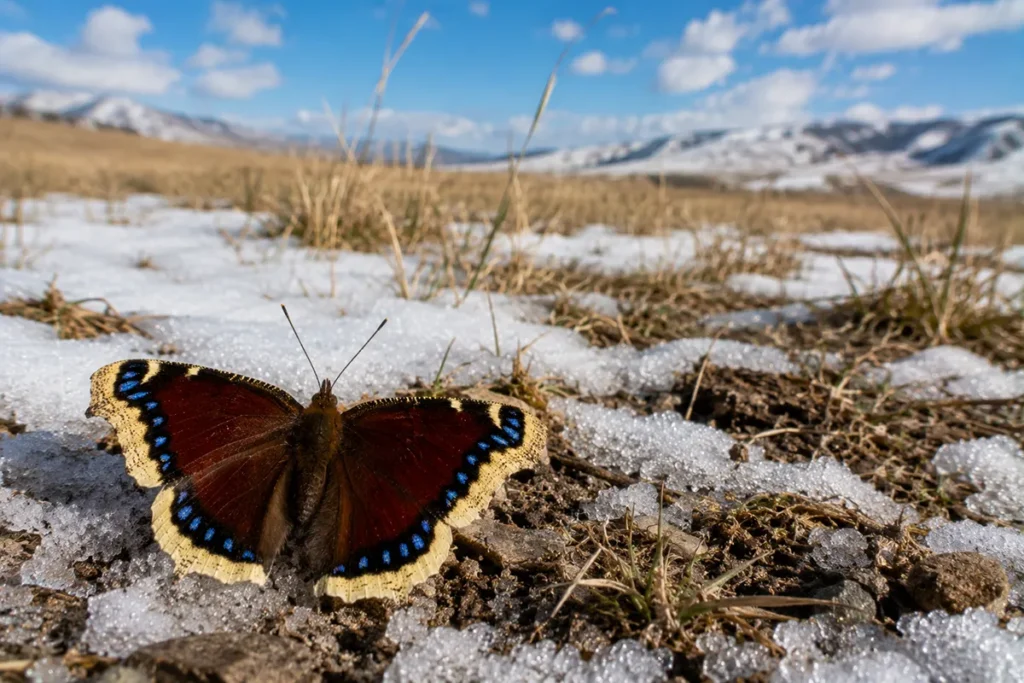
I was hiking along a snow-patched trail in the Rattlesnake Wilderness last March when a flash of dark wings startled me—a butterfly, impossibly alive amid temperatures barely touching 40°F, landed on a sun-warmed boulder just three feet away.
That was my first real encounter with Montana’s state insect, the mourning cloak butterfly, and it completely changed how I think about wildlife viewing in Big Sky Country.
While most visitors come seeking grizzlies, elk, or the Montana state animal, this resilient little creature represents something profoundly Montanan: the ability to thrive where others can’t survive.
Among all the Montana State Symbols, the mourning cloak holds a unique place as the only insect to earn official recognition—and there’s a fascinating story behind why.
- Montana’s state insect is the mourning cloak butterfly (Nymphalis antiopa), adopted in 2001
- Unlike most butterflies, mourning cloaks overwinter as adults and can fly in temperatures as low as 38°F
- Best viewing: early spring (March-April) and late summer (August-September) near willow groves and cottonwood stands
- Top spots: Glacier National Park, Rattlesnake Wilderness, Yellowstone’s northern range, and the Bitterroot Valley
- They’re one of the longest-lived butterflies, surviving up to 11 months
- Fourth-graders from Foothills Elementary in Great Falls championed the legislation
Liked this article?
Add Roaming Montana as a preferred source so you see more of our articles and guides on Google.
Why Montana Chose the Mourning Cloak as Its State Insect
The story of how the mourning cloak became Montana’s official state insect is one of my favorite pieces of Montana legislative history. It wasn’t politicians who pushed for this designation—it was a group of determined fourth-graders from Foothills Elementary School in Great Falls who did all the legwork.
During the spring of 2001, these students researched Montana’s native insects, wrote letters to legislators, and even testified before committees in the Montana State Capitol Building in Helena. They chose the mourning cloak specifically because it embodies Montana’s tough, independent spirit—a butterfly that doesn’t migrate south when winter hits but instead hunkers down and survives.
Governor Judy Martz signed the bill on April 7, 2001, making Montana the 41st state to designate an official state insect. When I visited Helena last summer and toured the capitol grounds, I spent time in the surrounding gardens specifically looking for mourning cloaks—and yes, I spotted three near the elm trees on the east side of the building.
Understanding the Mourning Cloak: More Than Just a Pretty Butterfly
I’ll admit that before I started seriously exploring Montana’s natural history, I assumed all butterflies were fragile, warm-weather creatures that disappeared at the first hint of frost. The mourning cloak shattered that assumption completely.
A Butterfly Built for Montana Winters
The mourning cloak is what biologists call a “winter-surviving” or “overwintering” butterfly. While monarchs famously migrate thousands of miles to Mexico and most other butterfly species die off as adults, leaving eggs or pupae to carry on, mourning cloaks take a radically different approach.
They produce a natural antifreeze—glycerol—in their bodies that allows them to survive temperatures well below zero. I’ve spoken with wildlife biologists in Missoula who have documented mourning cloaks surviving winter temperatures of -20°F while tucked into tree crevices.
This is why encountering one in March feels almost magical. When I saw that first mourning cloak in the Rattlesnake, snow was still everywhere. Yet there it was, basking in the sun, absorbing enough warmth to fly.
Distinctive Appearance You Won’t Mistake
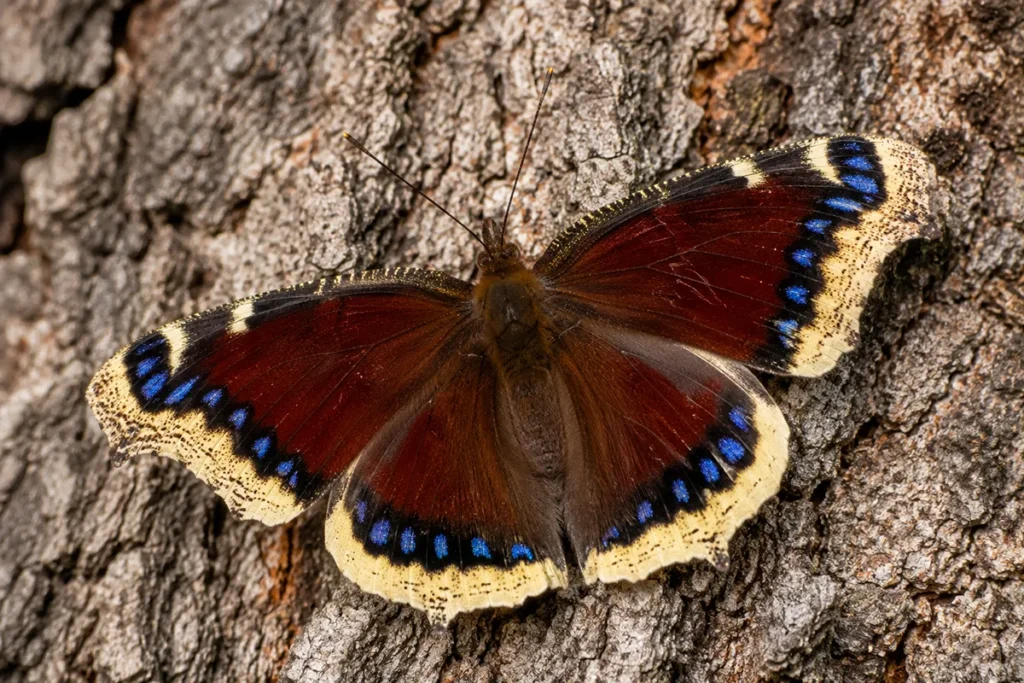
Once you know what to look for, you’ll never confuse a mourning cloak with any other butterfly. The wings are deep maroon to chocolate brown—some describe it as the color of a Victorian mourning cloak, hence the name.
The border is what really sets them apart: a creamy yellow band runs along the outer edge of all four wings, just inside a row of bright blue spots. The underside is darker, almost bark-like, providing excellent camouflage when they rest on tree trunks.
Wingspan ranges from 3 to 4 inches, making them one of Montana’s larger butterfly species. I’ve photographed dozens of them over the years, and I’m still struck by how the yellow border seems almost hand-painted against that dark background.
Lifespan That Defies Expectations
Most adult butterflies live just a few weeks. Mourning cloaks can live up to 11 months, making them one of the longest-lived butterflies in North America.
Here’s how their yearly cycle works in Montana: Adults emerge from chrysalises in June or July. They feed heavily through late summer, building up fat reserves, then enter a dormant state called diapause as temperatures drop in fall.
They spend winter tucked into loose tree bark, woodpiles, or building crevices. On warm winter days—and yes, Montana has them—they’ll sometimes emerge briefly before returning to dormancy. By late February or early March, they’re among the very first butterflies flying, weeks before most other species even emerge from pupae.
Best Places to Spot Mourning Cloaks Across Montana
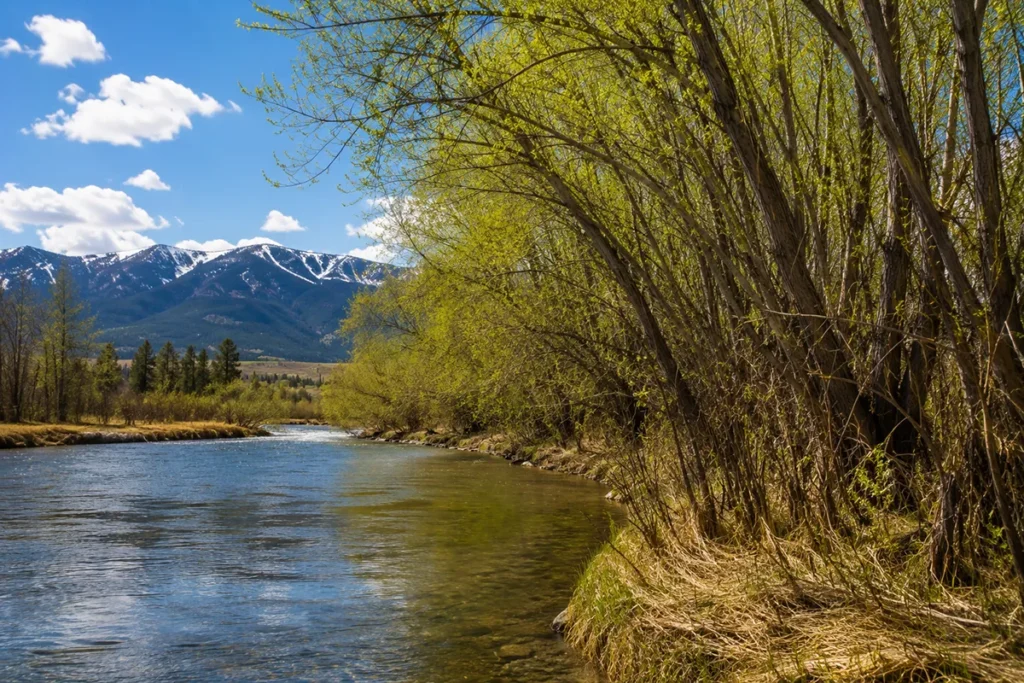
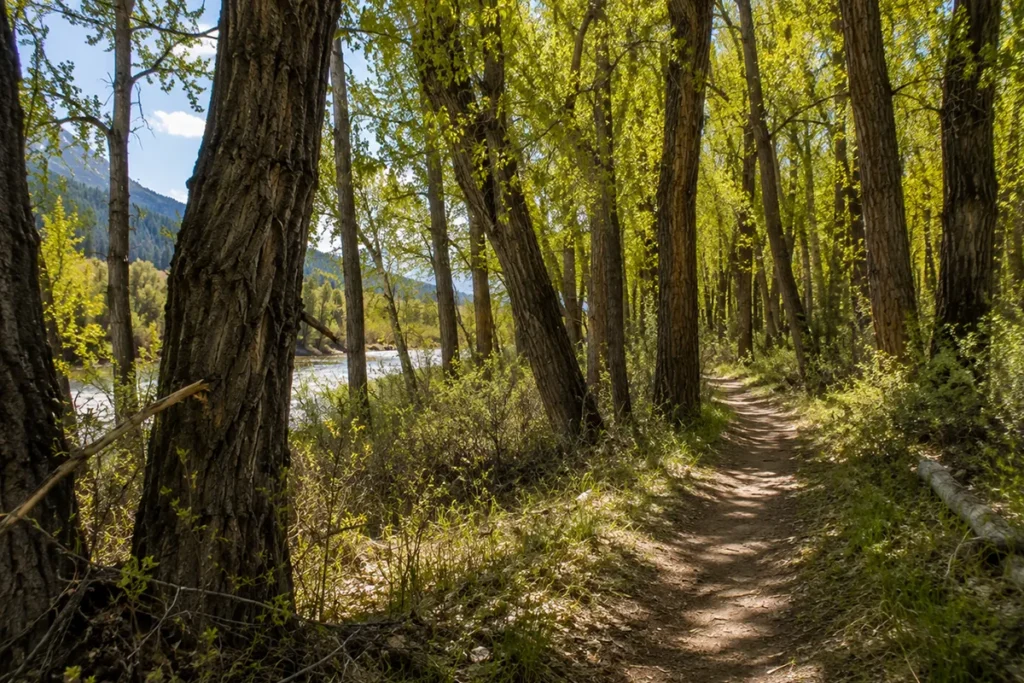
After years of butterfly-hunting trips across the state, I’ve identified several reliable spots where mourning cloaks congregate. These locations share common features: deciduous trees (especially willows, cottonwoods, and aspens), nearby water sources, and adequate sun exposure.
Glacier National Park
Glacier isn’t just about grizzlies and mountain goats. The park’s diverse ecosystems support robust mourning cloak populations, and I’ve had my best luck along the lowland river corridors.
The McDonald Creek area near Apgar is exceptional. During my September trip two years ago, I counted eight mourning cloaks in a single afternoon along the cottonwood-lined shores. The North Fork of the Flathead River corridor is equally productive.
Spring visits (late March through April) offer the unique opportunity to see overwintered adults flying against a backdrop of lingering snow. Last April, I hiked the Avalanche Lake trail before it officially opened and spotted mourning cloaks sunning on every south-facing rocky outcrop.
The Rattlesnake Wilderness (Missoula)
This wilderness area just north of Missoula has become my go-to spot for early-season butterfly viewing. The Rattlesnake Creek corridor provides ideal habitat: willows, alders, and cottonwoods grow thick along the water.
I recommend the main Rattlesnake Creek trail, which stays relatively accessible even when snow lingers. The parking area fills up on nice weekends, so arrive early. During my most recent spring visit, I spotted mourning cloaks within 15 minutes of leaving the trailhead.
Yellowstone’s Northern Range
While most of Yellowstone falls in Wyoming, the northern entrance near Gardiner provides access to prime mourning cloak territory that extends into Montana. The Lamar Valley’s cottonwood groves along the river are particularly productive.
I’ve observed mourning cloaks here during every season except deep winter. The Yellowstone River corridor from Gardiner south into the park combines the willows and cottonwoods these butterflies need with the open, sunny areas they prefer for basking.
The Bitterroot Valley
The Bitterroot River and its tributaries support extensive riparian forests where mourning cloaks thrive. I spent three days last August camping near Hamilton and exploring the valley’s side drainages.
The Lee Metcalf National Wildlife Refuge south of Stevensville is particularly accessible. Well-maintained trails wind through cottonwood bottomlands that provide textbook mourning cloak habitat. I also found them reliably along the Skalkaho Creek drainage west of Hamilton.
Helena’s Mount Helena City Park
For visitors staying in the capital city—perhaps after exploring the state capitol or learning about the Montana State Seal—Mount Helena City Park offers surprisingly good mourning cloak habitat within city limits.
The Prickly Pear Trail and surrounding paths pass through mixed forest where I’ve spotted mourning cloaks from March through September. It’s an easy add-on to a Helena day trip.
Best Times to See Montana’s State Insect
Timing matters enormously when you’re hoping to spot mourning cloaks. Their unusual life cycle creates two distinct viewing windows that differ significantly in character.
The Early Spring Emergence (Late February through April)
This is my personal favorite time to seek out mourning cloaks. Seeing a butterfly flying while snow still covers the ground feels almost surreal.
Overwintered adults emerge on the first truly warm days—typically when temperatures reach the high 40s or above. They’re hungry after months without food and actively seek tree sap, especially from willows and aspens.
I’ve found they’re most active between 10 AM and 3 PM during this period. They’ll be basking on south-facing surfaces: sun-warmed rocks, dark tree bark, even gravel parking lots. On my March Rattlesnake trip, the butterfly I photographed was absorbing heat from a dark boulder that had been in direct sun all morning.
The Late Summer Flight (August through September)
Newly emerged adults appear in July and reach peak numbers by mid-August. During this period, they’re feeding heavily on rotting fruit, tree sap, and occasionally flower nectar (though they prefer sap).
I’ve had excellent luck in late August finding mourning cloaks congregating around fermenting fallen fruit—particularly in areas where wild plum or chokecherry grows. They also gather at mud puddles, a behavior called “puddling” where they extract minerals from moist soil.
The late summer flight is more active and widespread than the spring emergence, but there’s something less magical about seeing a butterfly when every other species is also flying.
Mid-Winter Surprise Sightings
During unusually warm winter days—temperatures in the 50s, which happen occasionally in Montana—mourning cloaks will briefly emerge. I’ve seen them in January in Missoula during temperature inversions when the valleys warm while mountains stay frozen.
These sightings are unpredictable and shouldn’t be counted on, but if you’re visiting during a warm spell in winter, keep your eyes open.
How to Photograph Montana’s State Insect
I’ve photographed mourning cloaks dozens of times, and I’ve learned a few techniques that dramatically improve results.
Approach Strategies That Work
Mourning cloaks are more approachable than many butterflies, but they’re still wary. Move slowly and avoid casting your shadow across them. I’ve found that approaching at a 45-degree angle rather than straight-on produces less flight response.
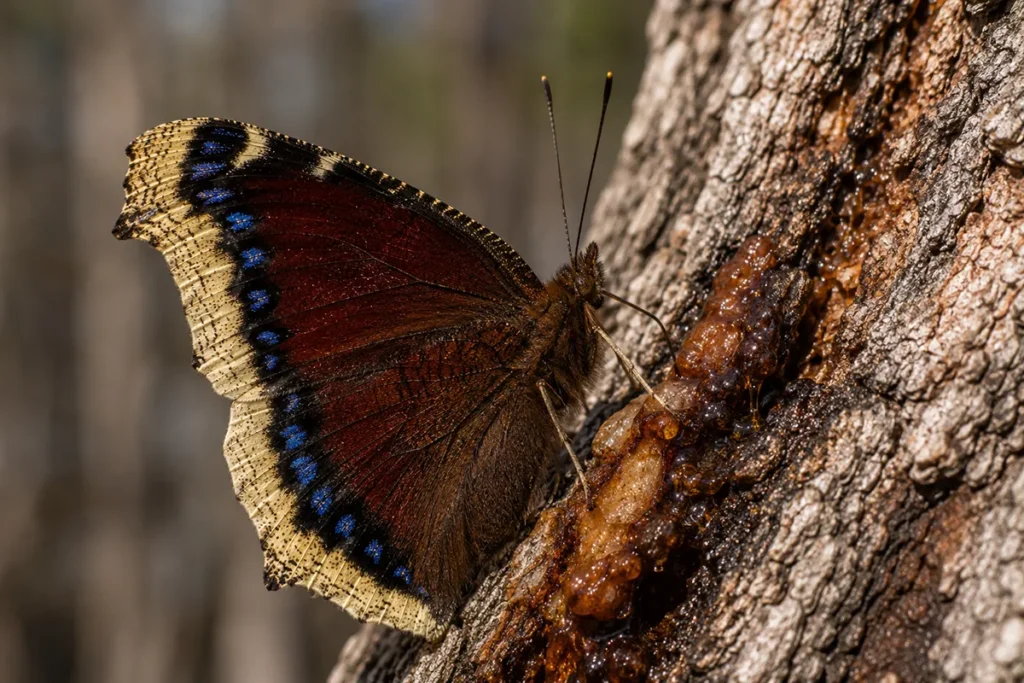
Early morning when temperatures are still cool, they’re often too sluggish to fly and allow closer approach. Similarly, individuals feeding at sap flows are often so absorbed they’ll tolerate close observation.
Camera Settings I Recommend
For basking butterflies, a moderate aperture (f/8 to f/11) gives good depth of field while keeping shutter speed reasonable. I typically shoot at ISO 400-800 in natural light.
A macro lens helps, but I’ve gotten excellent shots with a standard 70-200mm zoom by simply being patient. The butterfly will often stay put if you let it acclimate to your presence.
Overcast days actually work well—they eliminate harsh shadows that can obscure wing details. Some of my best mourning cloak shots came on cloudy September afternoons.
What to Capture Beyond the Obvious
Everyone photographs the top of the wings. I encourage you to wait for other behaviors: feeding, puddling at mud, interacting with other butterflies.
The underwing camouflage pattern is fascinating but rarely photographed because it’s visible only when wings are closed. If you can catch an individual at rest with wings folded, you’ll have a unique image.
The Mourning Cloak’s Role in Montana’s Ecosystem
Understanding how this butterfly fits into Montana’s broader ecological web deepened my appreciation for its designation as a state symbol.
Caterpillar Host Plants
Mourning cloak caterpillars feed communally on willows, cottonwoods, aspens, and elms—all trees that define Montana’s riparian corridors. The relationship is fascinating: female butterflies lay eggs in clusters on the undersides of leaves, and the resulting caterpillars live together in silk tents, feeding en masse.
These same trees that host mourning cloak caterpillars also provide habitat for the Montana state bird and countless other species. The riparian zones where mourning cloaks thrive are biodiversity hotspots.
Adult Feeding Habits
Unlike many butterflies that rely on flower nectar, mourning cloaks primarily feed on tree sap, rotting fruit, and occasionally animal dung. This makes them important nutrient recyclers.
Their preference for sap means they frequent wounded or stressed trees—places where sap flows freely. In autumn, they congregate at fallen fruit, helping break down organic matter.
As Prey
Birds, dragonflies, and other predators hunt mourning cloaks. Their dark coloring and bark-like underwing patterns help with camouflage, but their large size makes them tempting targets.
I’ve watched mountain chickadees flush mourning cloaks from tree trunks, though I’ve never actually seen a successful predation. Their ability to fly in cold temperatures when most predators are still sluggish likely provides significant survival advantage in early spring.
Connecting the Mourning Cloak to Other Montana State Symbols
What strikes me about Montana’s state symbols is how interconnected they are ecologically. The mourning cloak doesn’t exist in isolation—it’s part of a web that includes many other designated symbols.
The Montana state tree—the ponderosa pine—provides shelter for overwintering mourning cloaks in its thick bark. Willows and cottonwoods, common in riparian areas, serve as host plants for caterpillars.
The Montana state flower, the bitterroot, blooms in early spring when mourning cloaks are emerging—though the butterflies rarely visit it, preferring sap to nectar.
I’ve observed mourning cloaks in the same habitats where I’ve photographed the Montana state fish, the blackspotted cutthroat trout. Healthy riparian zones support both species.
Even the Montana state fruit—the huckleberry—connects tangentially: mourning cloaks sometimes feed on overripe fallen berries in late summer.
Planning Your Montana State Insect Experience
If you’re specifically hoping to see mourning cloaks during your Montana trip, here’s how I’d plan it.
Best Overall Trip Timing
Late March through mid-April offers the most rewarding experience. You’ll likely see overwintered adults flying against lingering snow—a sight that epitomizes Montana’s wild character.
August and early September provide more reliable sightings with less weather uncertainty. Fresh adults are numerous and actively feeding.
What to Bring
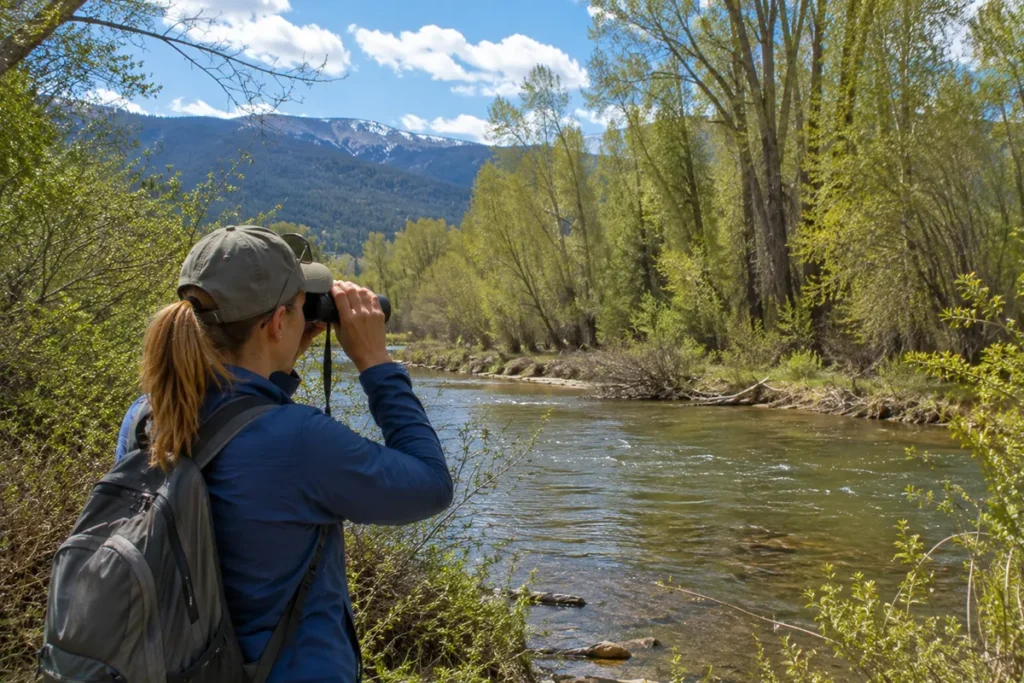
- Binoculars (8×42 is ideal for butterfly observation)
- Camera with at least moderate zoom capability
- Field guide—I recommend “Butterflies of North America” by Jim Brock and Kenn Kaufman
- Patience (most butterfly observation is waiting)
- Layers (spring mornings start cold)
Combining With Other Wildlife Experiences
Mourning cloak habitat overlaps significantly with other wildlife-viewing opportunities. Riparian areas where butterflies concentrate also attract birds, deer, and occasionally moose.
I often combine butterfly-hunting with birding—both activities reward patient observation in the same locations. A morning spent looking for mourning cloaks might also produce sightings of warblers, flycatchers, and kingfishers.
Lesser-Known Facts About Montana’s State Insect
After years of researching and observing mourning cloaks, I’ve accumulated details that rarely appear in standard field guides.
The Name’s Origin
“Mourning cloak” comes from the 18th-century practice of wearing dark cloaks trimmed with white or yellow during periods of mourning. The butterfly’s coloring—dark wings with pale borders—reminded early naturalists of this funeral attire.
In England, the same species is called the “Camberwell Beauty,” named for a London neighborhood where specimens were first collected in 1748. Swedish biologist Carl Linnaeus gave it the scientific name Nymphalis antiopa in 1758.
Global Distribution
The mourning cloak isn’t just Montanan—it ranges across the entire Northern Hemisphere. Populations exist throughout Europe, Asia, and North America. It’s one of the few butterfly species found on multiple continents.
However, Montana’s populations are particularly robust because of the state’s extensive undeveloped riparian habitat. The same wild character that defines Montana—represented in symbols like the Montana state nickname and Montana state motto—also benefits mourning cloaks.
Overwintering Behavior Details
When I spoke with an entomologist at the University of Montana last year, she shared details about mourning cloak overwintering that fascinated me. They select hibernation sites with remarkable precision—typically north-facing crevices in tree bark where they’ll be shaded from winter sun that might trigger premature emergence.
The glycerol antifreeze in their bodies doesn’t prevent freezing entirely. Instead, it controls how ice forms, preventing the sharp ice crystals that would rupture cell membranes. They essentially become frozen butterflies that revive when warmed.
Territorial Behavior
Male mourning cloaks are surprisingly aggressive for butterflies. During breeding season, they establish territories along forest edges and sunny clearings, chasing away any other butterfly—including other mourning cloaks—that enters their space.
I’ve watched territorial males make dozens of sorties in a single hour, spiraling up with intruders before returning to the same perch. Understanding this behavior helps with observation: find a male’s favorite perch, wait nearby, and he’ll keep returning.
Conservation Status and Concerns
The good news: mourning cloaks are not endangered. They’re adaptable generalists that tolerate habitat disturbance better than many butterflies.
However, their reliance on riparian habitat means they’re vulnerable to changes affecting stream corridors. Agricultural conversion, residential development along rivers, and altered stream hydrology all impact mourning cloak populations.
Climate change presents mixed implications. Warmer winters might benefit overwintering survival, but earlier springs could trigger emergence before food sources are available. Scientists I’ve spoken with are monitoring these dynamics.
What can travelers do? Simply supporting Montana’s public lands—including places like the Lee Metcalf National Wildlife Refuge—helps conserve mourning cloak habitat. Staying on designated trails prevents trampling of caterpillar host plants.
Practical Visitor Information
| Category | Details |
|---|---|
| Official Designation | Montana State Insect since April 7, 2001 |
| Scientific Name | Nymphalis antiopa |
| Wingspan | 3-4 inches (7.5-10 cm) |
| Best Viewing Months | March-April; August-September |
| Preferred Habitat | Riparian areas with willows, cottonwoods, aspens |
| Flight Temperature | Active at temperatures as low as 38°F (3°C) |
| Adult Lifespan | Up to 11 months |
| Primary Food (Adult) | Tree sap, rotting fruit, occasionally flower nectar |
Making Mourning Cloak Observation Part of Your Montana Itinerary
Even if butterfly observation isn’t your primary travel goal, keeping an eye out for mourning cloaks adds depth to any Montana trip. They’re a living connection to the state’s official symbols and its wild heritage.
When you’re hiking through cottonwood groves beside the Yellowstone River, fishing for that blackspotted cutthroat, or photographing Montana’s native plants, take a moment to check sunny perches and sun-warmed boulders. That flash of dark wings with the yellow border might just be the fourth-graders’ butterfly—the state insect that symbolizes Montana’s stubborn, resilient spirit.
On my most recent trip, I found myself thinking about those Great Falls students who championed this butterfly back in 2001. Many of them would be in their 30s now. I wonder if they still look for mourning cloaks when March sun warms the mountain slopes and the first brave butterflies emerge from their frozen slumber.
I know I always will. There’s something deeply satisfying about understanding a place through its symbols—not just the obvious ones like the Montana state flag or the Montana state quarter, but the living ones that still fly through the state’s wild places, unchanged from when the first humans arrived here.
The mourning cloak may be Montana’s smallest state symbol, but in many ways, it’s the toughest. It survives what would kill any other butterfly, emerges when snow still covers the ground, and asks nothing from us except the wild places where it’s always lived.
For travelers seeking authentic Montana experiences—beyond the postcard peaks and crowded geysers—seeking out the state insect offers something rare: a genuine encounter with wildness that requires nothing but attention and patience. No entry fee, no reservation, no permit. Just you, a sunny trail, and the chance to see a butterfly that refuses to give up.
That’s about as Montana as it gets.
Frequently Asked Questions
What is the official state insect of Montana?
Montana’s official state insect is the Mourning Cloak butterfly (Nymphalis antiopa), designated in 2001 after a campaign led by schoolchildren. I love spotting these beautiful dark-winged butterflies with their distinctive yellow borders along hiking trails throughout the state.
Where can I see Mourning Cloak butterflies in Montana?
You’ll find Mourning Cloak butterflies throughout Montana, especially in wooded areas, riparian zones, and mountain meadows in places like Glacier National Park, the Bitterroot Valley, and along the Missouri River. I’ve had the best luck spotting them near willow trees and cottonwoods where they feed on tree sap.
What is the best time of year to see Montana’s state butterfly?
The best time to spot Mourning Cloak butterflies in Montana is early spring (March-April) when they emerge from hibernation, and again in late summer (August-September). These are among the first butterflies you’ll see each spring, often appearing when snow is still on the ground.
Why did Montana choose the Mourning Cloak butterfly as its state insect?
Montana chose the Mourning Cloak butterfly because it’s native to the state, survives harsh Montana winters through hibernation, and represents resilience. Fourth-graders from Sobotka Elementary in Great Falls championed the effort, making it a meaningful symbol that connects education and state pride.
What should I bring to photograph Montana’s Mourning Cloak butterfly?
Bring a camera with a zoom lens (200mm or higher works great), binoculars for initial spotting, and wear neutral-colored clothing to avoid startling them. I recommend packing layers since early spring butterfly viewing in Montana means temperatures can range from 30-60°F even during the day.
Are there Montana nature tours or parks focused on butterfly watching?
While Montana doesn’t have dedicated butterfly tours, Glacier National Park, the National Bison Range, and Lee Metcalf National Wildlife Refuge offer excellent butterfly-watching opportunities with ranger programs. Park entrance fees range from free to $35 per vehicle at Glacier, and I suggest asking rangers about current butterfly activity when you arrive.
Can I see other butterfly species alongside the Mourning Cloak in Montana?
Absolutely! Montana is home to over 150 butterfly species, including Western Tiger Swallowtails, Painted Ladies, and various Fritillaries that share habitats with Mourning Cloaks. Summer visits to alpine meadows in Glacier National Park or the Beartooth Highway corridor offer incredible diversity within a single day’s drive.