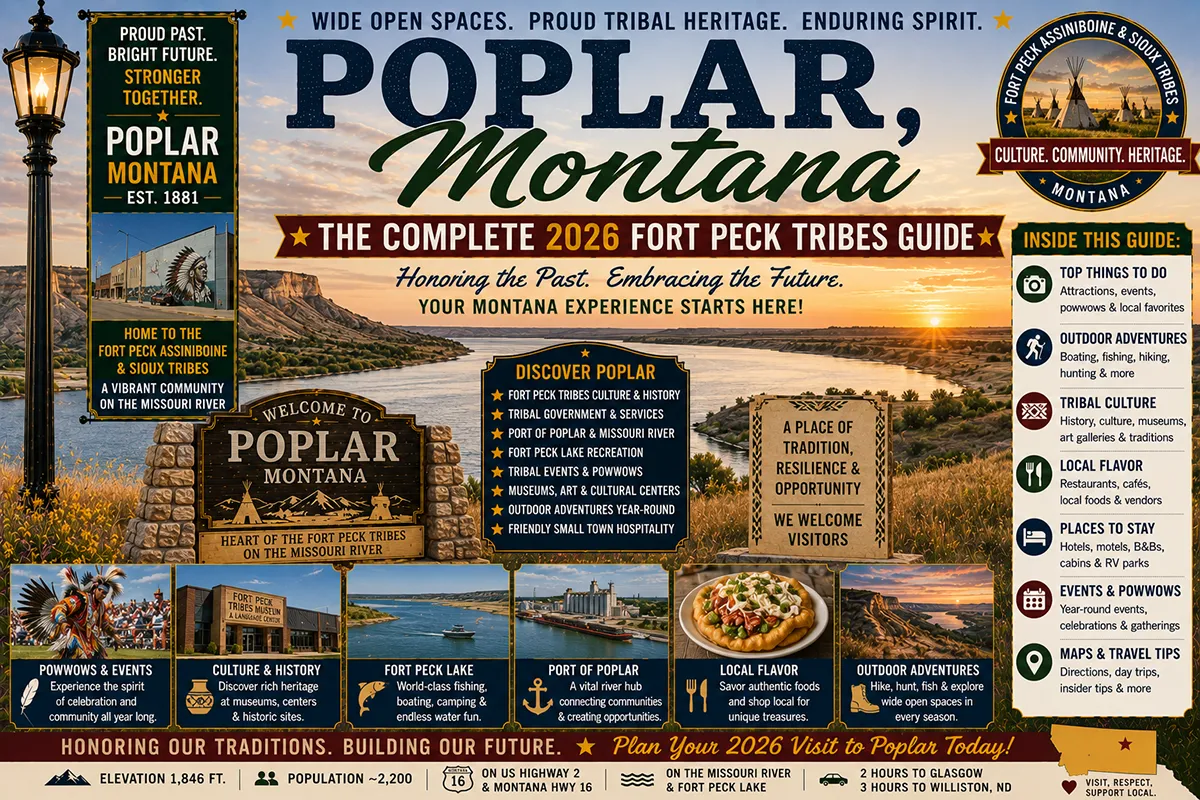
The Fort Peck Community College was founded in 1969 — one of the earliest tribal colleges in the United States — and it sits in Poplar, the governmental and educational heart of the Fort Peck Indian Reservation.
The college’s mission, woven through its programs, is preservation: of the Assiniboine (Nakoda) and Dakota Sioux languages, of traditional knowledge, of the history that formal American education once worked to erase.
Walking through the campus is a reminder that Poplar is not primarily a town for travelers. It’s a functioning community with its own purposes.
TL;DR
- Poplar (~850) is the administrative capital of the Fort Peck Indian Reservation — home to tribal government offices, Fort Peck Community College, and the core institutions of the Assiniboine and Sioux peoples.
- Sits on US-2 between Wolf Point (25 miles west) and the Montana-North Dakota border.
- Fort Peck Community College is one of the earliest tribal colleges in the U.S. and a center of cultural preservation.
- The Missouri River flows a few miles north — accessible for fishing and wildlife viewing.
- Best for: travelers with genuine interest in Indigenous cultural institutions, Hi-Line completionists, and anyone wanting to understand the human geography of northeastern Montana.
- Visitor note: Poplar is a community first, not a tourist destination. Approach with respect and genuine curiosity.
Liked this article?
Add Roaming Montana as a preferred source so you see more of our articles and guides on Google.
Poplar at a Glance
| Population (2020) | ~850 |
|---|---|
| County | Roosevelt County |
| Reservation | Fort Peck Indian Reservation (Assiniboine & Sioux) |
| Region | Northeastern Montana (Hi-Line) |
| Distance to Wolf Point | ~25 miles (~25 min west) |
| Distance to Glasgow | ~70 miles (~1.25 hours west) |
| Distance to North Dakota border | ~50 miles east |
| Amtrak | Yes — Empire Builder |
| Best for | Fort Peck Tribal College, Indigenous cultural institutions, Hi-Line road trips |
What Makes Poplar Different
Poplar is the seat of Fort Peck Tribal government — where the tribal council meets, where tribal services are administered, and where Fort Peck Community College trains the next generation of community members in everything from nursing to Assiniboine language instruction.
The Fort Peck Tribes — the Assiniboine (Nakoda) and Sioux (Dakota) peoples — came to share this reservation not by choice but through federal policy.
The Assiniboine had traditionally ranged across vast portions of present-day Montana, Saskatchewan, and Alberta; the Dakota bands had their homelands further east.
The reservation’s 1888 establishment compressed these distinct peoples into shared space, and the communities have worked for over a century to maintain their separate cultural identities while building shared institutions.
That history is visible in Poplar. The community college teaches Nakoda and Dakota languages alongside nursing, business, and construction technology. The tribal museum documents the specific histories of each group. The annual powwows maintain ceremonial traditions.
For broader trip context, see my Montana cities and towns hub.
Things to Do In & Around Poplar
1. Fort Peck Community College
Founded in 1969 — among the first tribal colleges established in the United States — Fort Peck Community College serves the educational needs of reservation communities and is a center of cultural and linguistic preservation. The campus includes a library with tribal history archives. Visitors are welcome; call ahead to understand what’s appropriate to visit.
2. Tribal Cultural Programs and Museum
The Fort Peck Tribes maintain cultural programs and a museum in Poplar covering the histories of both the Assiniboine and Dakota peoples. The exhibits approach tribal history from Indigenous perspectives. Contact the tribal cultural office for current hours.
3. Missouri River Access
The Missouri River corridor a few miles north of Poplar provides fishing access (walleye, catfish, paddlefish in season), wildlife viewing, and river recreation. The Fort Peck Reservoir — one of the largest in the U.S. — is accessible from this direction.
4. Fort Peck Tribes Powwows (Seasonal)
The Fort Peck Tribes host powwows and traditional gatherings throughout the year. Dates and locations vary — contact the tribal office for current schedule. Public visitors are generally welcome at powwows with appropriate respectful behavior.
5. Hi-Line Drive (US-2)
US-2 east from Poplar approaches the Montana-North Dakota border through open plains. The drive west through Wolf Point and on to Glasgow completes the Hi-Line’s northeastern section. The view from Poplar in any direction — flat agricultural plain to the east, the Missouri River corridor to the north, rolling prairie to the south — is quintessential northeastern Montana.
6. Arrive by Amtrak Empire Builder
Like Wolf Point, Poplar is a stop on Amtrak’s Empire Builder. Arriving by train — watching the northeastern Montana plains slide past the window at dawn — is a distinctly different Montana experience than driving.
7. Fort Peck Lake Eastern Shore (via reservation roads)
The eastern arm of Fort Peck Lake is accessible from the Poplar area via reservation roads. Remote camping and fishing; check with tribal government for current access regulations on reservation lands.
Where to Stay
Poplar has very limited lodging — Wolf Point is the practical base:
| Vibe | Price | Location | |
|---|---|---|---|
| Wolf Point hotels | Full range | $90–170 | 25 min west |
| Glasgow hotels | Full range | $100–190 | 70 min west |
| Fort Peck Lake camping | Basic | $15–30 | Varies |
Where to Eat
- Poplar Bar & Café — basic diner food, local gathering spot
- Community café options — limited; Wolf Point (25 min) is the practical dining base
Getting There
From Wolf Point: 25 miles east on US-2, about 25 minutes.
From Glasgow: 70 miles east on US-2, about 1.25 hours.
By train: Amtrak Empire Builder stops in Poplar daily.
Visitor Protocol
Poplar is a functioning community on a sovereign reservation — not a tourist destination. Visitors should:
- Approach with genuine curiosity and respect, not as spectators
- Ask before photographing any community members
- Respect posted access restrictions on reservation lands
- Contact tribal offices in advance for museum visits or cultural programming
This is someone’s home. The same courtesy you’d extend in any small community applies here, with additional cultural sensitivity appropriate to visiting a sovereign nation.
What Poplar Unlocks
Wolf Point & Wild Horse Stampede (25 min west)
The largest town on the reservation, with the annual Wild Horse Stampede in July. See Wolf Point guide.
Glasgow & Fort Peck Dam (70 min west)
Fort Peck Dam, WPA-era theater, Fort Peck Lake. See Glasgow guide.
North Dakota (50 miles east)
The state border; Williston, ND and the North Dakota Badlands (Theodore Roosevelt NP) beyond.
When to Visit
Summer (June–August) — full access, cultural programs, Missouri River recreation.
During tribal powwows — contact the Fort Peck Tribes for dates of cultural events open to the public.
Year-round for Empire Builder connection — Amtrak runs daily regardless of season.
Personal Tips
Call ahead. If you want to visit the tribal museum or college, contact the relevant offices first. A call in advance shows respect and ensures you visit when programs are available.
Don’t treat this as a stop on a checklist. Poplar deserves genuine engagement, not a drive-through. If your interest is authentic, you’ll find people willing to share their community’s story.
Wolf Point is your base. Stay there (25 miles west) for lodging and dining; make day visits to Poplar.
The Empire Builder arrival at dawn is extraordinary. If logistics permit, take the train east out of Glasgow and arrive in Poplar in the early morning — the northeastern Montana plains at first light from a train window is a particular beauty.
Poplar Quick Facts
| Reservation | Fort Peck Indian Reservation (Assiniboine & Sioux) |
|---|---|
| Fort Peck Community College | Founded 1969 — one of first tribal colleges in U.S. |
| Amtrak | Yes — Empire Builder |
| Average summer high | 85°F |
| Average winter low | -5°F |
Conclusion
Poplar is the institutional heart of the Fort Peck Tribes — a community with its own priorities that isn’t organized around visitor experience. That’s a feature, not a limitation. For travelers willing to approach with genuine respect and curiosity, the tribal college, cultural programs, and Missouri River corridor offer an authentic northeastern Montana experience that no curated tourist destination can replicate.
Have a Poplar question? Drop it in the comments — I read every one.
Frequently Asked Questions
Is Poplar Montana worth visiting?
Yes for travelers with genuine interest in Indigenous cultural institutions and northeastern Montana’s human geography. The Fort Peck Community College (one of the first tribal colleges in the U.S.) and Fort Peck Tribes cultural programs make Poplar the institutional heart of the Fort Peck Reservation. Visitors should approach with respect and contact tribal offices in advance.
What tribe is in Poplar Montana?
Poplar is located within the Fort Peck Indian Reservation, homeland of the Assiniboine (Nakoda) and Sioux (Dakota) peoples — collectively the Fort Peck Tribes. Tribal government offices and Fort Peck Community College are both based in Poplar.
What is Fort Peck Community College?
Fort Peck Community College in Poplar was founded in 1969 — among the earliest tribal colleges established in the United States. The college offers associate and bachelor’s degrees in fields including nursing, business, construction technology, and liberal arts, alongside programs in Nakoda and Dakota language preservation.
Can you take a train to Poplar Montana?
Yes — Poplar is a station stop on Amtrak’s Empire Builder, which provides daily service between Chicago and Portland/Seattle. The train allows travelers to reach Poplar without a car, though a car is useful for exploring the broader area.
How far is Poplar from Wolf Point?
Poplar is approximately 25 miles east of Wolf Point on US-2 — about a 25-minute drive. Wolf Point is the practical lodging base for travelers visiting Poplar.