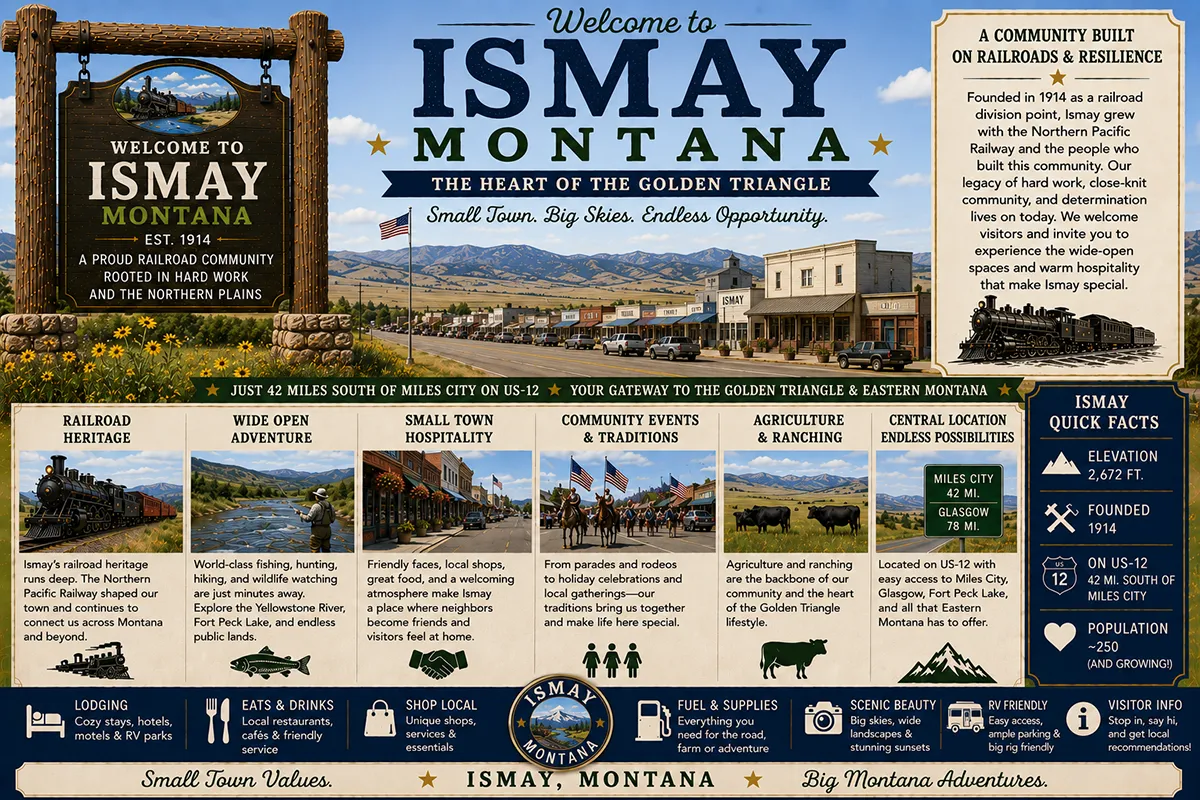
On July 3, 1993, the town of Ismay, Montana legally became Joe, Montana for one football season.
A Kansas City radio station — KYYS — had called the town’s mayor a few weeks earlier with an unusual proposition. Joe Montana, the four-time Super Bowl champion quarterback, had just been traded from the San Francisco 49ers to the Kansas City Chiefs. The radio promoter wanted a Montana town to rename itself “Joe” for publicity.
Ismay had 22 residents at the time.
They voted unanimously.
On July 3, 1993 — the official rename day — Ismay hosted a ranch rodeo, a parade, and a night show. More than 2,000 spectators showed up at the town of 22. By February 1994, the rebranded community had netted approximately $70,000 in merchandise sales and donations.
The money paid for a new fire hall, a fire truck, restoration of the historic jail, and what is now called the Joe Montana Community Center.
Today the town’s official name is Ismay again. The 2020 census recorded a population of 17.
That makes Ismay the smallest incorporated town in the state of Montana.
TL;DR
- Ismay (17) is in Custer County in southeastern Montana — the smallest incorporated town in Montana.
- The town renamed itself “Joe, Montana” for the 1993 football season as a publicity stunt coordinated by Kansas City radio station KYYS to honor Joe Montana’s trade to the Kansas City Chiefs.
- The 22 residents at the time voted unanimously for the rename on July 3, 1993.
- ~$70,000 was raised through the publicity, funding a new fire hall, fire truck, jail restoration, and the Joe Montana Community Center.
- Original name was “Burt” (1907-1908) before being renamed for Isabella and May Earling, daughters of Milwaukee Road president Albert J. Earling.
- Peak population was ~500 in the early 1900s during the homestead era.
- Featured prominently in Jonathan Raban’s Bad Land: An American Romance (1996).
- Best for: smallest-town-in-Montana enthusiasts, Joe Montana fans, Milwaukee Road heritage, far-southeast Montana exploration.
Liked this article?
Add Roaming Montana as a preferred source so you see more of our articles and guides on Google.
Ismay at a Glance
| Population (2020) | 17 (smallest incorporated town in Montana) |
|---|---|
| County | Custer County |
| Region | Far Southeast Montana (O’Fallon Creek) |
| Elevation | 2,536 ft |
| Distance to Baker (closest large town) | ~31 miles southeast |
| Distance to Plevna (nearest bar) | ~14 miles |
| Distance to Miles City (county seat) | ~75 miles northwest |
| Distance to Glendive | ~75 miles northeast |
| Distance to Forsyth | ~85 miles west |
| Founded | 1907-1908 (Milwaukee Road) |
| Original name | Burt |
| Renamed Ismay | After 1908 |
| Briefly renamed “Joe” | July 3, 1993 – January 1994 (publicity stunt) |
| Best for | Smallest town visit, Joe Montana legacy, Milwaukee Road heritage |
What Makes Ismay Different
Almost everything.
The name itself has two competing origin stories.
The most commonly cited version says Ismay is a combination of Isabella and May Earling — daughters of Albert J. Earling, president of the Chicago, Milwaukee, St. Paul and Pacific Railroad. The same Earling is the namesake of Alberton, Montana far to the west on the Milwaukee mainline.
A second origin story credits Isabel and May Peck — daughters of George W. Peck, the Milwaukee Road’s general counsel.
Both versions trace to the railroad’s planning office. The town was platted in 1908 as one of dozens of small communities along the Milwaukee Road’s ambitious new Pacific Coast Extension.
Originally “Burt”
The community wasn’t always called Ismay.
The first settlement at the site was named Burt. When the Milwaukee Road decided to formalize the station, the town was renamed Ismay — the railroad’s preference.
The choice would prove consequential for the town’s identity ever after.
Boom and Bust
In the early 1900s, Ismay peaked at approximately 500 residents.
The Milwaukee Road mainline brought freight and passenger trains daily. Homesteaders flooded into the surrounding country during the 1909-1916 homestead boom.
The town earned a regional nickname — “Little Chicago” — for what the Montana Historical Society described as “bustling business, wicked ways, and itinerant population of cowboys and railroad men.”
Then the bust came.
The drought-driven homestead collapse of 1917-1924. The Great Depression. The 1980 Milwaukee Road bankruptcy. The 1982 abandonment of much of the western Milwaukee mainline. The slow demographic contraction of the entire northern Great Plains.
Ismay lost more than 95% of its peak population over the next century.
The County Politics That Hurt
Ismay’s contemporary distance from its county seat is the result of multiple lost political battles.
When Fallon County was created in 1913, Ismay bid to become the county seat. Baker won instead.
In response, Ismay tried to form its own separate Union County — a proposal that also failed.
As a final protest, Ismay petitioned to be detached from Fallon County entirely and attached to Custer County instead — even though Custer County’s seat at Miles City was much farther away than Baker. The change was approved.
Today Ismay residents drive 75 miles to reach their county seat in Miles City, even though Baker is only 31 miles away in the next county over.
The Highway That Bypassed
In the early 1930s, the state of Montana decided where to place US Highway 12.
The route was placed six miles south of Ismay instead of through the town. Those six miles between Ismay and US-12 remain a dirt road. The town is not on any state or federal highway today.
The 1993 Joe Montana Story
The publicity stunt that put Ismay back on the national map originated in Kansas City, not Montana.
In spring 1993, Joe Montana — the legendary San Francisco 49ers quarterback — was traded to the Kansas City Chiefs. Kansas City radio station KYYS wanted a way to celebrate. A promoter had the idea of finding a Montana town willing to rename itself “Joe” in honor of the quarterback.
Several Montana communities turned the idea down.
Ismay said yes.
All 22 of the town’s residents voted unanimously to conditionally change the town’s name for the duration of the 1993 football season.
The official rename day was July 3, 1993. The town hosted a ranch rodeo, a parade, and a night show. More than 2,000 spectators drove in from across the region for the event. Merchandise — Joe Montana caps, t-shirts, postcards, and souvenirs — sold briskly.
By February 1994, the town had netted approximately $70,000.
The mayor — Gene Nemitz, who has held the office for more than two decades and earns $4 a month for the role — used the funds to build a new fire hall, acquire a fire truck, and restore the historic jail. The community gathering space is still called the Joe Montana Community Center.
The temporary rename to “Joe” expired after the football season. The town legally returned to Ismay.
For broader trip context, see my Montana cities and towns hub.
The Top 6 Things to Do In & Around Ismay
1. Joe Montana Community Center
The signature contemporary attraction.
The community center — built with proceeds from the 1993 rename — is the physical legacy of the publicity stunt. Visit when open; verify access with locals.
2. Ismay Historic Jail
Also restored with Joe Montana fundraising proceeds.
The small jail building is a Montana Historical Society-marked site recalling the “Little Chicago” era when Ismay’s population of cowboys, railroad men, and homesteaders required law enforcement infrastructure.
3. Joe Montana Community Center Photo Op
Even closed, the community center exterior is one of the more unusual small-town landmarks in Montana — the literal physical artifact of a 1993 sports publicity stunt that worked.
4. Day Trip to Baker (31 miles southeast)
The Fallon County seat — and the closest substantial community to Ismay despite being in a different county. Lake Baker, the Old Town Fort museum, restaurants, lodging, and full services.
The natural urban anchor for any Ismay visit.
5. Day Trip to Ekalaka (~60 miles south)
The Carter County seat with the Carter County Museum — a substantively important paleontology museum with hadrosaur, ceratopsian, and Triceratops specimens collected from surrounding Hell Creek Formation badlands.
6. O’Fallon Creek Country Driving
The country around Ismay is genuinely beautiful in a stark, far-southeastern Montana way.
O’Fallon Creek runs through town. The surrounding ranchland stretches to the horizon in every direction. The dirt roads connecting Ismay to US-12 and to the larger communities require careful driving but reward patience with some of the most empty and quiet country in the contiguous United States.
Where to Stay
Ismay has no lodging.
Most travelers visit as a side trip from Baker (31 miles southeast).
| Lodging | Vibe | Price | Best For |
|---|---|---|---|
| Baker hotels (31 mi SE) | Fallon County options | $100–180 | Most travelers |
| Ekalaka lodging (60 mi S) | Carter County options | $90–150 | Museum visitors |
| Miles City hotels (75 mi NW) | Custer County seat | $100–200 | Larger town comforts |
| Glendive lodging (75 mi NE) | I-94 corridor | $100–200 | I-94 travelers |
Where to Eat
Ismay has no restaurants or bars.
The nearest bar is 14 miles away in Plevna.
- Plevna Bar (14 miles east) — closest food
- Baker restaurants (31 mi SE) — broader selection
- Ekalaka dining (60 mi S) — small-town options
Getting There & Around
From Baker: ~31 miles northwest via US-12 and county roads, about 45 minutes. The final 6 miles approaching Ismay are dirt road.
From Miles City: ~75 miles east-southeast, about 1.5 hours via I-94 and county roads.
From Glendive: ~75 miles south, about 1.5 hours.
From Bismarck, ND: ~175 miles west, about 3 hours.
Cell service: Spotty in Ismay and the surrounding area. Bring offline maps.
When to Visit
June (mentioned by locals as best month): Mild weather; the prairie at its visual peak; longest daylight; surrounding country green from spring rain.
Summer (July-August): Warmest weather; hot afternoons; dramatic prairie skies.
Fall (September-October): Outstanding eastern Montana light; harvest activity on surrounding ranches.
Winter (December-March): Severe weather; temperatures below -20°F not uncommon; dirt roads can be impassable.
Spring (April-May): Snowmelt; muddy dirt roads; quiet community.
Personal Tips
Take it seriously. Ismay isn’t a curated tourism destination — it’s a 17-person working community where most visitors are seen as a curiosity. Be respectful. Don’t expect services that aren’t there.
Read Jonathan Raban first. Bad Land: An American Romance (1996) is the most substantive piece of writing about Ismay specifically and about the homestead-era northern Great Plains generally. The book transforms an Ismay visit from quirky novelty into substantive engagement with American history.
Fuel up before going. No services in Ismay. Top off your tank in Baker or Miles City before driving in.
Bring water and food. No restaurants, no convenience stores, no bars. The nearest is 14 miles away in Plevna.
The dirt road approach is part of the experience. Don’t try to avoid it. The six miles of dirt road from US-12 are part of why Ismay still exists as what it is.
Take Joe Montana seriously. The 1993 publicity stunt produced real, lasting community infrastructure. The Joe Montana Community Center, the fire hall, the fire truck, and the restored jail are all genuine outcomes of that summer. Visit them with awareness of what they represent.
Don’t try to find services that don’t exist. Ismay has no gas station, no grocery store, no restaurant, no bar, no motel. The town’s “one and only business” is Ismay Grain Co., owned by longtime mayor Gene Nemitz.
Ismay Quick Facts
| Population (2020) | 17 (smallest in Montana) | | Original name | Burt | | Renamed Ismay | Shortly after 1908 | | Name origin (most common) | Isabella and May Earling (Milwaukee Road president’s daughters) | | Alternate name origin | Isabel and May Peck (Milwaukee Road counsel’s daughters) | | Peak population | ~500 (early 1900s) | | Briefly renamed “Joe, Montana” | July 3, 1993 | | Joe Montana rename radio station | KYYS, Kansas City | | Spectators at July 3, 1993 celebration | 2,000+ | | Funds raised by February 1994 | ~$70,000 | | Outcomes funded | Fire hall, fire truck, jail restoration, Joe Montana Community Center | | Mayor’s monthly salary | $4 | | Town’s only business | Ismay Grain Co. | | Nearest bar | Plevna (14 miles east) | | Featured prominently in | Bad Land: An American Romance by Jonathan Raban (1996) | | Average summer high | 86°F | | Average winter low | -2°F |
Conclusion
Ismay is a 17-person town in southeastern Montana that became internationally famous for renaming itself “Joe, Montana” in 1993 to honor an NFL quarterback.
The stunt worked. The town raised $70,000, built a community center and fire hall, restored the historic jail, and bought a fire truck. The publicity also brought lasting national attention to a community that would otherwise have disappeared from the contemporary American conversation.
Today, Ismay still has 17 residents. The Joe Montana Community Center still stands. The original Milwaukee Road tracks still run through town. And the surrounding O’Fallon Creek country still represents some of the most empty, quiet, and authentically Western American landscape in the contiguous United States.
For travelers willing to drive the dirt road, Ismay is worth the trip.
Have an Ismay question? Drop it in the comments — I read every one.
Frequently Asked Questions
Is Ismay Montana worth visiting?
Ismay is worth visiting primarily for its distinction as the smallest incorporated town in Montana (population 17 per the 2020 census), the Joe Montana Community Center legacy of the 1993 publicity rename, the historic Milwaukee Road station heritage, and the broader southeastern Montana O’Fallon Creek country. It is not a traditional tourism destination — there are no services, restaurants, bars, hotels, or gas stations in town.
Why is Ismay Montana called Joe Montana?
Ismay was temporarily renamed “Joe, Montana” from July 3, 1993 through approximately February 1994 as a publicity stunt coordinated by Kansas City radio station KYYS. The stunt celebrated NFL quarterback Joe Montana’s trade from the San Francisco 49ers to the Kansas City Chiefs. All 22 of Ismay’s residents at the time voted unanimously to approve the conditional name change. The rebranded town hosted a celebration on July 3, 1993 that drew more than 2,000 spectators and ultimately raised approximately $70,000 through merchandise sales. The funds were used to build a new fire hall, buy a fire truck, restore the historic jail, and build the Joe Montana Community Center. The town legally returned to the Ismay name after the football season.
How many people live in Ismay Montana?
Ismay had a population of 17 at the 2020 U.S. Census, making it the smallest incorporated town in the state of Montana. At its early-1900s peak during the homesteading boom, Ismay had approximately 500 residents.
Where did Ismay Montana get its name?
The most commonly cited origin is that Ismay was named after Isabella and May Earling — daughters of Albert J. Earling, president of the Chicago, Milwaukee, St. Paul and Pacific Railroad (the Milwaukee Road). The same Earling is the namesake of Alberton, Montana far to the west on the Milwaukee mainline. An alternate origin story credits Isabel and May Peck, daughters of Milwaukee Road general counsel George W. Peck. The original settlement at the site was called Burt before the Milwaukee Road renamed it Ismay around 1908.
What is Bad Land: An American Romance about?
Bad Land: An American Romance is a 1996 book by British-American travel writer Jonathan Raban. The book uses Ismay, Montana and the surrounding southeastern Montana ranching country as a focal point for a broader examination of the boom-and-bust homestead era on the northern Great Plains. Raban documents the settlement, drought-driven failure, and gradual depopulation of the region — using Ismay’s contemporary population of fewer than 25 residents as a contemporary marker of what the homestead-era boomers expected versus what actually happened.
How do you get to Ismay Montana?
Ismay is located on O’Fallon Creek in southeastern Custer County, Montana — not on any state or federal highway. The most common approach is from Baker (31 miles southeast in Fallon County), driving northwest on US Highway 12 and then approximately 6 miles of dirt road into town. Ismay can also be approached from Miles City (75 miles northwest, the Custer County seat) or Glendive (75 miles north). Cell service is unreliable in the area; bring offline maps. There are no services in town.
Is there anything to do in Ismay Montana?
Ismay’s contemporary attractions are limited but substantive: the Joe Montana Community Center (the lasting legacy of the 1993 publicity rename), the historic Ismay jail (Montana Historical Society marked, restored with Joe Montana fundraising proceeds), the original Milwaukee Road station site, and the broader O’Fallon Creek country surrounding town. Most travelers spend 30-60 minutes in town and then continue to nearby Baker, Ekalaka, or other southeastern Montana destinations.