In 1864, two prospectors named William Sprague and Fred Jones found a substantial chunk of gold in a Jefferson County gulch south of Helena.
The discovery wasn’t enough to launch a major rush. Heavy gold lodes never materialized. But the lump of gold was striking enough to give the gulch its name: Lump Gulch. The mining district that grew up around it became the Clancy Mining District.
And the small farming and railroad community that emerged downhill — at the point where the Northern Pacific Railroad line and the road from Helena to Boulder met the Lump Gulch trail — became Clancy.
That sequence is worth understanding because it explains the contemporary community.
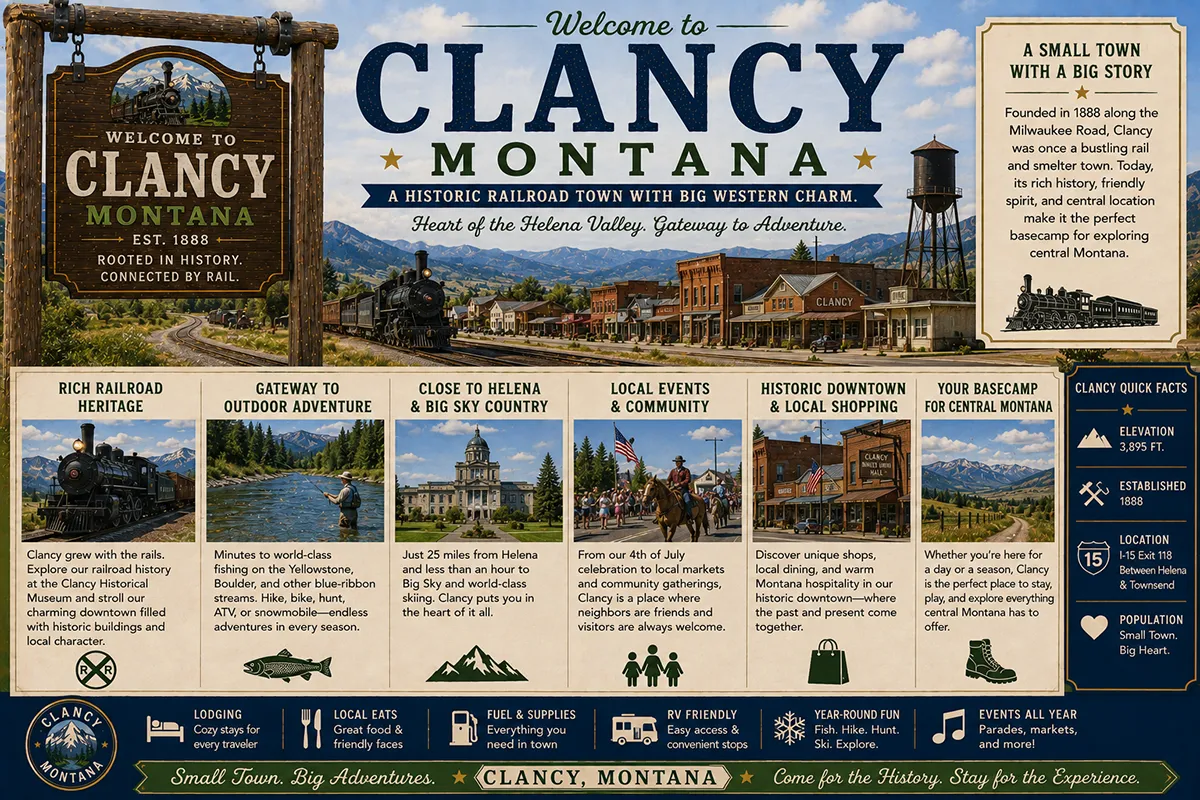
Clancy today is a small unincorporated village of about 1,856 residents in Jefferson County. It sits on Interstate 15, fifteen miles south of Helena and twenty miles north of Boulder.
The community has the layered character of a place that was once a mining service town, became a quiet ranching settlement after the mines closed, and is now slowly transforming into a Helena bedroom community as the state capital’s growth pushes south.
The mining heritage is still visible in the surrounding country.
The Lump Gulch Mining Company was incorporated in 1906. The Lump Gulch Silver Mines Company followed in 1919. The Liverpool Mine — the district’s most productive operation — produced more than a million dollars’ worth of silver ore at its peak (1907 dollars, which would be substantially more today).
Mining historians count Lump Gulch, Clancy Gulch, Strawberry Gulch, Shingle Gulch, and Warm Springs Gulch as the five productive gulches of the Clancy district — covering roughly 32 square miles of mountain country east of town.
Most of those mine sites are now in the Beaverhead-Deerlodge National Forest. Many are accessible to careful explorers.
TL;DR
- Clancy (~1,856) sits on I-15 in Jefferson County, 15 miles south of Helena and 20 miles north of Boulder (county seat).
- The Clancy Mining District (aka Lump Gulch) was discovered in 1864 by William Sprague and Fred Jones, who named it after a lump of gold.
- The Liverpool Mine was the district’s most lucrative — over $1 million in silver ore at peak.
- The Jefferson County Museum at 5 North Main Street is housed in the 1898 Old Red Schoolhouse, restored and reopened as a museum in 2000.
- Tizer Botanic Gardens & Arboretum is in the Elkhorn Mountains south of town.
- Clancy Days is the annual community festival.
- The 2020 Lump Gulch Fire burned 1,073 acres after a downed power line started the fire during a wind storm.
- Best for: mining heritage explorers, Jefferson County Museum visitors, Helena-area travelers, abandoned mining camp seekers in the Beaverhead-Deerlodge National Forest.
Liked this article?
Add Roaming Montana as a preferred source so you see more of our articles and guides on Google.
Clancy at a Glance
| Population (2020) | ~1,856 |
|---|---|
| County | Jefferson County |
| Status | Unincorporated community |
| Region | Central-West Montana (I-15 corridor) |
| Elevation | 4,150 ft |
| Distance to Helena | ~15 miles north (~20 min on I-15) |
| Distance to East Helena | ~12 miles northeast |
| Distance to Boulder (county seat) | ~20 miles south |
| Distance to Montana City | ~5 miles north |
| Distance to Jefferson City | ~5 miles south |
| Distance to Townsend | ~30 miles east via Crow Creek Road |
| Distance to Bozeman | ~85 miles east (~1.5 hours via I-90) |
| Best for | Mining heritage, Jefferson County Museum, abandoned silver camps, Helena bedroom community context |
What Makes Clancy Different
The geography is the first thing to understand.
Clancy sits on the I-15 corridor between Helena and Butte, in a narrow stretch of the Prickly Pear Valley. The Elkhorn Mountains rise dramatically to the east; the Boulder Mountains form the western horizon.
The surrounding country was Indigenous land — Salish, Pend d’Oreille, and Blackfeet peoples all used the valley seasonally — before the 1860s gold rush brought European-American prospectors into the area.
The 1864 discovery of the Lump Gulch placer (gold deposit in a stream bed) didn’t immediately produce a major rush. Hard-rock lode mining came later, primarily silver rather than gold. The most productive period for the Clancy Mining District was roughly 1880-1925.
The Five Productive Gulches
Mining historians count five named gulches as the productive area of the Clancy district:
- Lump Gulch — the namesake; named for the 1864 gold lump
- Clancy Gulch — closer to the community itself
- Strawberry Gulch — to the south
- Shingle Gulch — northeast
- Warm Springs Gulch — east
The five gulches together cover roughly 8 miles east-west and 4 miles north-south. The most productive single mine in the district was the Liverpool Mine, which produced over a million dollars’ worth of silver ore during its peak operating years — substantial money in early 20th century terms.
The Lump Gulch Mining Company was incorporated in 1906 to consolidate operations. The Lump Gulch Silver Mines Company followed in 1919. Multiple smaller operators worked the area into the 1920s, and dredge operations on Little Prickly Pear Creek continued into the mid-20th century.
Most of the mine sites are now within the Beaverhead-Deerlodge National Forest, accessible via Forest Service roads from Clancy.
The 1898 Old Red Schoolhouse
The community’s most architecturally significant building is the 1898 Old Red Schoolhouse on Main Street.
Built to serve the growing mining-era community, the schoolhouse welcomed its first class in 1899 and served Clancy children for generations. After the school closed, the building was restored and reopened as the Jefferson County Museum in 2000.
Sherry Carlson has served continuously as a museum trustee since the opening — one of the longest-running volunteer commitments in Jefferson County.
The museum’s two galleries cover Jefferson County mining, ranching, railroading, and pioneer life. The recreated schoolroom inside the original schoolhouse building is a particular highlight. Hours are limited — typically Fridays and Saturdays during operating season — so verify before visiting.
The Helena Bedroom Community
Contemporary Clancy is increasingly a Helena commuter community.
Helena is fifteen minutes north on I-15. Many Clancy residents work in the state capital but choose to live in the smaller community for lower housing costs, more space, and quieter character. The trend has accelerated over the past decade as Helena property prices have risen.
This shift has changed Clancy’s character. The community remains rural in feel, but the working ranches and mining-era families have increasingly given way to suburban subdivision development and commuter households.
The pattern echoes what’s happened in East Helena, Montana City, and other Helena-area communities — see the pros and cons of living in Montana guide for broader context.
The 2020 Lump Gulch Fire
In 2020, a downed power line during a wind storm ignited the Lump Gulch area.
The Lump Gulch Fire burned approximately 1,073 acres before being contained. Several homes and outbuildings were lost. The fire was a sharp reminder of the wildfire risk in the dry forested foothills surrounding Clancy — a risk that’s grown with climate change and expanded residential development in the wildland-urban interface.
Visitors today see most of the fire scar healed over with new growth, though some areas remain visibly affected.
For broader trip context, see my Montana cities and towns hub.
The Top 10 Things to Do In & Around Clancy
1. Jefferson County Museum
The town’s signature attraction. The museum is housed in the 1898 Old Red Schoolhouse at 5 North Main Street.
Two galleries cover Jefferson County mining, ranching, railroading, hot springs, and pioneer life through hands-on exhibits and rotating displays. The recreated schoolroom is a particular highlight.
Open Fridays and Saturdays during operating season; verify current hours before visiting. Phone: (406) 224-5106. Donations appreciated.
2. Lump Gulch Mining District Exploration
The historic Clancy Mining District east of town offers genuine abandoned mining heritage for careful explorers.
Forest Service roads access multiple old mine sites. Tailings piles, foundation remnants, and a few standing structures remain in the Beaverhead-Deerlodge National Forest backcountry. The Liverpool Mine area is the district’s historical centerpiece.
Safety note: Abandoned mine sites carry real hazards including unstable shafts, contaminated water, and unstable structures. Never enter any abandoned mine. Stay on roads and trails. Many mine sites are on private property; respect closures.
3. Tizer Botanic Gardens & Arboretum
A short drive south of Clancy in the Elkhorn Mountains, this is one of the most unexpected garden destinations in Montana.
The arboretum features extensive landscaped gardens, native Montana plant collections, and tours during the growing season. Open seasonally; check current schedule. A genuinely substantive stop for travelers interested in horticulture or simply scenic small-mountain landscapes.
4. Day Trip to Helena (20 minutes north)
The state capital with the Montana State Capitol, Cathedral of St. Helena, Last Chance Gulch historic district, Montana Historical Society, and significantly more services and dining than Clancy itself.
Many Clancy travelers use Helena as their dining and entertainment base while staying in the quieter community to the south.
5. Clancy Days Community Festival
The annual community festival celebrates Clancy’s heritage with food, music, local crafts, and community gathering events. Check current dates with Jefferson County or the Jefferson County Museum.
A genuine small-town Montana event for travelers who want authentic local character.
6. Broadwater Hot Spring (Helena area, 25 minutes north)
The historic Helena-area hot spring is among the closest hot springs to Clancy. See my broader Montana hot springs and best natural hot springs in Montana guides for additional options across the region.
7. Continental Divide & MacDonald Pass Hiking
The Continental Divide passes within easy driving distance of Clancy. MacDonald Pass on US-12 west of Helena provides access to the divide trail.
Day hikes and longer backpacking trips are available in the Helena-Lewis & Clark National Forest. Verify current trail conditions before going.
8. Day Trip to Boulder (20 minutes south)
The Jefferson County seat with the historic Boulder Hot Springs Inn (Montana’s largest mineral hot springs resort by some measures), the Old Jail Museum, and the radon health mines that have drawn visitors for arthritis treatment since the 1950s.
9. Elkhorn Mountains Exploration
The Elkhorn Mountains rise immediately east of Clancy and contain some of central Montana’s most rewarding low-traffic hiking, fishing, and wildlife viewing.
Elkhorn Wildlife Management Area is a notable destination for bird-watching and elk viewing in fall.
10. Beaverhead-Deerlodge National Forest
The Forest Service unit surrounding Clancy provides access to over 3 million acres of public land for hiking, fishing, hunting, camping, and exploration of mining heritage. Forest Service roads from Clancy access multiple recreation sites and old mine sites.
Where to Stay
Clancy has limited dedicated lodging. Most travelers base in Helena, East Helena, or Boulder.
| Hotel | Vibe | Price | Best For |
|---|---|---|---|
| Alhambra RV Park (Clancy) | Established RV park | $40–60 | RV travelers |
| Lee’s Bunkhouse on Saddle Mountain | Local lodging option | $130–220 | Mountain experience |
| Vacation rentals (Clancy area) | Cabins and homes | $130–280 | Families, longer stays |
| Helena hotels (20 min N) | Full city selection | $130–280 | Most travelers |
| Boulder Hot Springs Inn (20 min S) | Historic hot springs hotel | $140–280 | Hot springs base |
Where to Eat
- Lariat Bar & Grill (Clancy) — local community gathering spot
- Frontier Town & Restaurant (north of Clancy on US-12) — kitschy frontier-themed restaurant
- Helena dining (20 min N) — significantly more variety
- Boulder restaurants (20 min S) — Boulder Hot Springs dining room and local options
Getting There & Around
From Helena: 15 miles south on I-15, about 20 minutes.
From Helena Regional Airport (HLN): 18 miles south, about 20 minutes.
From Boulder: 20 miles north on I-15, about 25 minutes.
From Bozeman: ~85 miles via I-90 west and US-287/I-15, about 1.5 hours.
From Missoula: ~115 miles east via I-90 and I-15, about 2 hours.
Cell service: Generally good in Clancy and along I-15. Reduced on Beaverhead-Deerlodge National Forest backroads.
What Clancy Unlocks
Helena (20 min N)
State capital with full attractions and services.
Clancy Mining District / Lump Gulch (east)
Historic abandoned silver camps in the Beaverhead-Deerlodge National Forest.
Boulder & Boulder Hot Springs (20 min S)
Historic hot springs resort and Jefferson County seat.
Elkhorn Mountains (immediate east)
Low-traffic hiking, fishing, and wildlife viewing.
Tizer Botanic Gardens (south in Elkhorns)
One of Montana’s unexpected garden destinations.
East Helena (12 min NE)
ASARCO smelter heritage and Prickly Pear Park.
Continental Divide & MacDonald Pass
Via Helena and US-12 west.
When to Visit
Summer (June–August): Best Lump Gulch and Forest Service exploration; Jefferson County Museum on full hours; Tizer Botanic Gardens at peak.
Fall (September–October): Outstanding fall colors in the Prickly Pear Valley; elk rut in the Elkhorn Wildlife Management Area; hunting season for travelers with proper permits.
Winter (December–March): Cross-country skiing in surrounding Beaverhead-Deerlodge backcountry; quieter community character; museum on reduced winter hours.
Spring (April–May): Snowmelt brings high water; quieter shoulder season.
Personal Tips
Time the Jefferson County Museum carefully. Hours are limited — typically Fridays and Saturdays during operating season. Calling ahead before driving from Helena is the right approach.
The Lump Gulch district rewards research. Travelers interested in mining heritage will get significantly more from the site visit if they read the Western Mining History resources beforehand. The basic story is genuinely substantive.
Tizer Botanic Gardens is the surprise. Most travelers don’t expect a serious botanic garden in the Elkhorn Mountains. The arboretum has earned national recognition; it’s worth the detour.
Don’t enter abandoned mine sites. This bears repeating. Old shafts can be unstable, contaminated, and dangerous in ways that aren’t visible from the surface. Stay on roads. Photograph from a distance. The legal liability and the safety risk both matter.
Pair Clancy with Boulder. The two communities together form a substantive Jefferson County itinerary — Clancy for the mining heritage and Jefferson County Museum, Boulder for the hot springs and the county seat. Half a day for each makes a satisfying day trip from Helena.
For relocation research, drive the surrounding subdivisions. Clancy represents the contemporary Helena-area pattern — a small community absorbing commuters from the state capital as Helena housing prices rise. For broader relocation context, see the best places to live, Montana cost of living, and pros and cons of living in Montana guides.
Clancy Quick Facts
| Lump Gulch named | 1864 (William Sprague and Fred Jones, after a gold lump) | | Clancy Mining District also known as | Lump Gulch, Buffalo Creek | | Liverpool Mine peak production | $1 million+ in silver ore | | Lump Gulch Mining Co. incorporated | 1906 | | Lump Gulch Silver Mines Co. incorporated | 1919 | | Old Red Schoolhouse built | 1898 (first class 1899) | | Jefferson County Museum opened | 2000 | | Museum address | 5 North Main Street, Clancy | | Lump Gulch Fire | 2020 (1,073 acres; downed power line) | | Productive gulches | Lump, Clancy, Strawberry, Shingle, Warm Springs | | Average summer high | 80°F | | Average winter low | 11°F |
Conclusion
Clancy is one of those quietly substantive Montana communities that rewards travelers willing to slow down for the specifics.
The 1864 gold lump that gave Lump Gulch its name, the Liverpool Mine that produced over a million dollars in silver ore, the 1898 Old Red Schoolhouse that’s now the Jefferson County Museum, and the contemporary transition from mining-era ranching community to Helena bedroom community all add up to genuine local character.
Most travelers blow through Clancy on I-15 between Helena and Butte without realizing what’s here. The Jefferson County Museum is open Fridays and Saturdays. The mining district is just up the road. The hot springs at Boulder are twenty minutes south. There’s more here than the freeway exit suggests.
Have a Clancy question? Drop it in the comments — I read every one.
Frequently Asked Questions
Is Clancy Montana worth visiting?
Yes — Clancy is worth visiting for the Jefferson County Museum (housed in the 1898 Old Red Schoolhouse), the historic Lump Gulch Mining District in the surrounding Beaverhead-Deerlodge National Forest, the Tizer Botanic Gardens & Arboretum in the Elkhorn Mountains south of town, and as a quieter base or stop on the Helena-Butte I-15 corridor. The mining heritage and historic schoolhouse-museum make it a genuine half-day destination.
What is the Clancy Mining District?
The Clancy Mining District — also known as the Lump Gulch Mining District or Buffalo Creek Mining District — is a historic mining area east of Clancy in Jefferson County. The district was discovered in 1864 by prospectors William Sprague and Fred Jones, who named Lump Gulch after a large lump of gold they found. While the placer gold deposits proved limited, the district later became a significant silver producer through hard-rock mining. The most productive operation was the Liverpool Mine, which produced over a million dollars’ worth of silver ore at its peak. The district covers five named gulches: Lump, Clancy, Strawberry, Shingle, and Warm Springs.
What is the Jefferson County Museum?
The Jefferson County Museum is a local history museum located at 5 North Main Street in Clancy. It’s housed in the Old Red Schoolhouse — a building constructed in 1898 that welcomed its first class in 1899 and served the Clancy community for generations as a school. After the school closed, the building was restored and reopened as a museum in 2000.
The museum features two galleries — one covering Jefferson County mining, ranching, railroading, and pioneer life, and a second hosting traveling exhibits. Hours are limited, typically Fridays and Saturdays during operating season. Phone: (406) 224-5106.
How was Lump Gulch named?
Lump Gulch was named in 1864 after a substantial lump of gold found by prospectors William Sprague and Fred Jones. Gold miners flooded the area looking for additional lode deposits, but heavy gold lodes were never found. The area became more significant later for silver, galena, and zinc sulphide mining through hard-rock operations that continued into the 1920s.
What was the 2020 Lump Gulch Fire?
The 2020 Lump Gulch Fire was a wildfire in the Lump Gulch area east of Clancy. Started by a downed power line during a wind storm, the fire burned approximately 1,073 acres. Several homes and outbuildings were lost. Most of the fire scar has healed over with new growth in subsequent years, though some areas remain visibly affected.
How far is Clancy from Helena Montana?
Clancy is 15 miles south of Helena on Interstate 15 — about a 20-minute drive. From Helena Regional Airport (HLN), Clancy is approximately 18 miles south, also about 20 minutes.