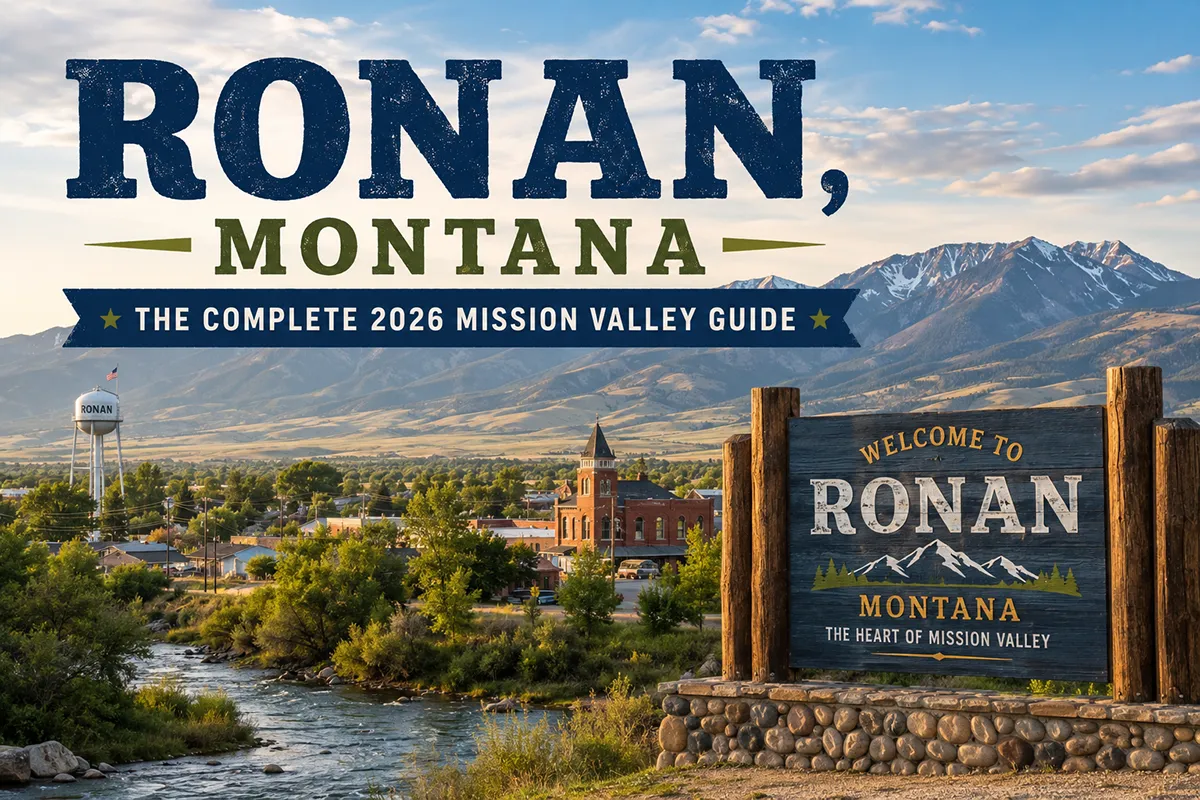
The Mission Mountains rise sharply on the east side of the Mission Valley — a 10,000-foot wall of rock and snow visible from the entire valley floor — and Ronan sits in the middle of that valley looking up at them.
The town’s iconic Main Street Arch frames the mountains exactly. It’s one of those Montana views that you don’t quite believe until you see it.
And Ronan, despite being one of Lake County’s larger communities, gets a fraction of the tourism attention Polson and Bigfork receive 20 minutes north.
TL;DR
- Ronan (~2,100) is the agricultural and commercial heart of the Mission Valley — within the Flathead Indian Reservation, homeland of the Confederated Salish and Kootenai Tribes (CSKT).
- The Mission Mountains dominate the eastern skyline; the Mission Mountain Wilderness Area requires a tribal permit for access.
- Ninepipe National Wildlife Refuge — 800+ pothole lakes and over 200 bird species — is 5 miles south.
- Home to the Mission Mountain Golf Course, consistently rated one of Montana’s most scenic public courses.
- The most affordable base in the Mission Valley — significantly cheaper than Polson, with the same views and access.
- Best for: budget Flathead Lake travelers, birders, golfers, and travelers interested in Mission Valley culture.
Liked this article?
Add Roaming Montana as a preferred source so you see more of our articles and guides on Google.
Ronan at a Glance
| Population (2020) | ~2,100 |
|---|---|
| County | Lake County |
| Reservation | Flathead Indian Reservation (CSKT homeland) |
| Region | Northwest Montana (Glacier Country) |
| Elevation | 3,041 ft |
| Distance to Polson | ~15 miles (~20 min north) |
| Distance to Missoula | ~45 miles (~50 min south) |
| Distance to Pablo | ~7 miles (~10 min north) |
| Best for | Mission Valley views, Ninepipe NWR, budget Flathead base, Mission Mountain Golf |
What Makes Ronan Different
The Mission Valley is one of Montana’s most striking landscapes — a broad agricultural valley framed by the Mission Mountains to the east and the rolling foothills toward Flathead Lake.
The valley is sacred to the Salish and Kootenai people, who have lived here for centuries and whose homeland this remains.
The 1855 Hellgate Treaty established the Flathead Indian Reservation that includes the entire valley; the reservation today is a sovereign nation co-administered by the Confederated Salish and Kootenai Tribes.
Ronan grew as the agricultural service town for the southern Mission Valley after the 1910 opening of reservation lands to homesteading — a policy with profound and painful consequences for tribal sovereignty that still shapes the region. The town today is genuinely multiethnic, with significant tribal, agricultural, and working-class populations.
For travelers, Ronan offers the same spectacular Mission Mountain views and Flathead Valley proximity as Polson at significantly lower prices, with cultural context that the more tourist-focused towns largely don’t engage with.
For broader trip context, see my Montana cities and towns hub.
The Top 10 Things to Do In & Around Ronan
1. Mission Mountain Golf Course
A genuinely exceptional 18-hole public course just west of Ronan, consistently rated among Montana’s most scenic. The Mission Mountains form the eastern backdrop on every hole. Reasonably priced for the quality. Open May through October.
2. Ninepipe National Wildlife Refuge
5 miles south of Ronan on US-93 — over 800 pothole lakes and a 1,770-acre reservoir, with more than 200 documented bird species. Great blue herons and double-crested cormorants nest in significant colonies visible from the west-side road. Spring and fall migrations bring waterfowl in massive numbers. Free.
3. Ninepipes Museum of Early Montana
Across US-93 from the refuge — an 8,000+ square-foot museum opened in 1998 covering the Flathead Reservation’s history, CSKT culture, and Mission Valley pioneer heritage. Four rooms of artifacts, historical photographs, beadwork, weapons, and a diorama room with mounted wildlife and a circa-1880 American Indian camp. The short nature trail behind the museum has one of the best Mission Mountain views in the valley.
4. Garden of the Rockies Museum
Ronan’s local pioneer museum, housed in the city’s first church (built in the early 1900s). Reservation pioneer and Native American exhibits — stagecoaches, buggies, daily-living artifacts. Home to a Flathead Lake Monster exhibit, the area’s famous cryptid tradition.
5. Pablo National Wildlife Refuge (15 minutes north)
Adjacent to Ronan and Pablo — another wetland complex with hiking, biking, fishing, cross-country skiing, and snowshoeing depending on season. See Pablo guide.
6. Visit the Three Chiefs Culture Center (Pablo)
15 minutes north in Pablo — formerly called The People’s Center, this is the CSKT’s own cultural and educational center, presenting Salish, Kootenai, and Pend d’Oreille history and culture from Indigenous perspectives. Essential for understanding the Mission Valley’s cultural context.
7. Mission Mountain Wilderness Hiking (Tribal Permit Required)
The Mission Mountain Wilderness Area east of Ronan is managed by the CSKT and requires a tribal recreation permit for non-tribal access. Permits available at tribal offices and many local outlets. The wilderness has extraordinary alpine terrain, glacial lakes, and significant grizzly bear habitat. Multiple trailheads accessible from county roads east of Ronan.
8. Pioneer Days Rodeo & Pancake Breakfast (July)
Ronan’s biggest annual weekend — professional rodeo, community parade, and the legendary community pancake breakfast. One of the more authentic small-town rodeos in northwest Montana.
9. Lake County Fair (August)
A classic Montana county fair with 4-H exhibits, carnival rides, livestock judging, and night entertainment shows.
10. Day Trip to Polson & Flathead Lake (15 minutes)
Polson at the south end of Flathead Lake — Wild Horse Island boat trips, KwaTaqNuk Resort, cherry orchards, lake water sports. See Polson guide.
Where to Stay
| Hotel | Vibe | Price | Best For |
|---|---|---|---|
| Lakeshore Motel (Ronan) | Local, basic | $80–130 | Budget travelers |
| Ronan Visitor Center area motels | Budget options | $90–140 | Most travelers |
| Polson hotels (15 min north) | More variety, lakeside | $130–250 | Lake-focused travelers |
| Vacation rentals (Mission Valley) | Cabins, ranch settings | $130–300 | Families, longer stays |
| Pablo lodging | Few options | $90–150 | Cultural visitors |
Ronan is consistently $30–60 cheaper per night than Polson for comparable accommodations.
Where to Eat
- Dobson Creek Coffee Company — fresh doughnuts and excellent lattes; the area’s reliable breakfast stop
- Allegra’s Cafe — casual breakfast and lunch
- Pour House — bar food and beer
- Mission Bay Grill — solid dinner option
- Polson dining (15 min) — more variety; see Polson guide
Visitor Protocol
Ronan is within the Flathead Indian Reservation, sovereign CSKT territory. Visitors should:
- Approach with respect and genuine curiosity — this is a homeland, not a tourist construct
- Purchase tribal permits if accessing reservation recreation lands (Mission Mountains, certain fishing waters)
- Ask before photographing community members or events
- Support tribally-owned businesses when possible
Getting There & Around
From Polson: 15 miles south on US-93, about 20 minutes.
From Missoula: 45 miles north on US-93, about 50 minutes.
From Pablo: 7 miles south on US-93, about 10 minutes.
By plane: Missoula Montana Airport (MSO) is the nearest major airport, 50 minutes south. Glacier Park International (FCA) is about 1.25 hours north.
What Ronan Unlocks
Mission Valley Scenic Drive
Ronan is the midpoint of the US-93 corridor through the Mission Valley — drive north for Pablo, Polson, and Flathead Lake; south for St. Ignatius and the southern reservation.
Polson & Flathead Lake (15 min north)
Wild Horse Island, KwaTaqNuk Resort, cherry season. See Polson guide.
Missoula (50 min south)
University city, full services, airport. See Missoula guide.
Mission Mountain Wilderness (east, tribal permit required)
Genuine alpine wilderness.
National Bison Range (30 min south)
One of America’s last free-roaming bison herds, on the Flathead Reservation.
When to Visit
Summer (June–August): Mission Mountain Golf Course open, Ninepipe NWR active, Pioneer Days in July.
Spring (April–May): Best for spring bird migration at Ninepipe.
Fall (September–October): Fall colors in the cottonwoods, fall waterfowl migration, golf course open through October.
Winter: Quiet; cross-country skiing and snowshoeing at the wildlife refuges.
Personal Tips
Ninepipe NWR at dawn or sunset. The light on the Mission Mountains reflected in the pothole lakes is extraordinary at first or last light.
Mission Mountain Golf Course is the right call. Even non-golfers should drive the course access road for the views. The course itself is one of Montana’s most scenic public courses.
Stay in Ronan, day-trip to Polson. The savings are real and the Mission Mountain views from Ronan are arguably better than from Polson.
Visit the Ninepipes Museum. It’s small but well-curated, and provides essential context for the Mission Valley before you explore the rest of the reservation.
Tribal permits before wilderness access. If you plan to hike in the Mission Mountains, get the tribal recreation permit first. It’s inexpensive and required.
Ronan Quick Facts
| Founded | 1883 (as Spring Creek trading post) |
|---|---|
| Named for | Peter Ronan, Indian agent who served the Flathead Reservation 1873–1892 |
| Reservation | Flathead Indian Reservation (CSKT) |
| Mission Mountains | 10,000+ ft peaks; wilderness requires tribal permit |
| Average summer high | 82°F |
| Average winter low | 19°F |
Conclusion
Ronan offers the Mission Valley’s most authentic experience — agricultural rhythms, dramatic mountain views, deep tribal cultural context, and accessible wildlife refuges, all at prices significantly below Polson and the Flathead Lake resort towns. For travelers wanting genuine Mission Valley immersion at honest cost, this is the right base.
Have a Ronan question? Drop it in the comments — I read every one.
Frequently Asked Questions
Is Ronan Montana worth visiting?
Yes — Ronan is worth visiting for the Mission Mountain views (genuinely spectacular), the Ninepipe National Wildlife Refuge (one of Montana’s best birding sites), the Mission Mountain Golf Course (rated among Montana’s most scenic public courses), and as a budget-friendly base for the Mission Valley and Flathead Lake. The Ninepipes Museum and proximity to the Three Chiefs Culture Center in Pablo provide essential Flathead Reservation cultural context.
What is Ronan Montana known for?
Ronan is known as the agricultural and commercial heart of the Mission Valley, the dramatic Mission Mountain views, Ninepipe National Wildlife Refuge (5 miles south), the Mission Mountain Golf Course, and its position within the Flathead Indian Reservation. The annual Pioneer Days rodeo in July is the town’s signature event.
Is Ronan on the Flathead Indian Reservation?
Yes — Ronan is located within the Flathead Indian Reservation, the homeland of the Confederated Salish and Kootenai Tribes (CSKT). The reservation was established by the 1855 Hellgate Treaty and remains a sovereign nation. Visitors should approach the area with respect for tribal sovereignty.
How far is Ronan from Polson?
Ronan is approximately 15 miles south of Polson on US-93 — about a 20-minute drive. The two towns are connected by the main Mission Valley corridor and represent the southern and northern anchors of Lake County.
What is the Ninepipe National Wildlife Refuge?
Ninepipe National Wildlife Refuge is a 2,000+ acre wetland complex 5 miles south of Ronan on US-93, featuring over 800 pothole lakes and a 1,770-acre reservoir. The refuge supports over 200 documented bird species including significant nesting colonies of great blue herons and double-crested cormorants. Free admission; portions are closed during nesting season (spring) and hunting season (fall).
Do I need a permit to hike in the Mission Mountains near Ronan?
Yes — the Mission Mountain Wilderness Area east of Ronan is managed by the Confederated Salish and Kootenai Tribes and requires a tribal recreation permit for non-tribal access. Permits are inexpensive and available at tribal offices in Pablo and many local outlets. They cover hiking, fishing, and most non-motorized recreation on reservation lands.