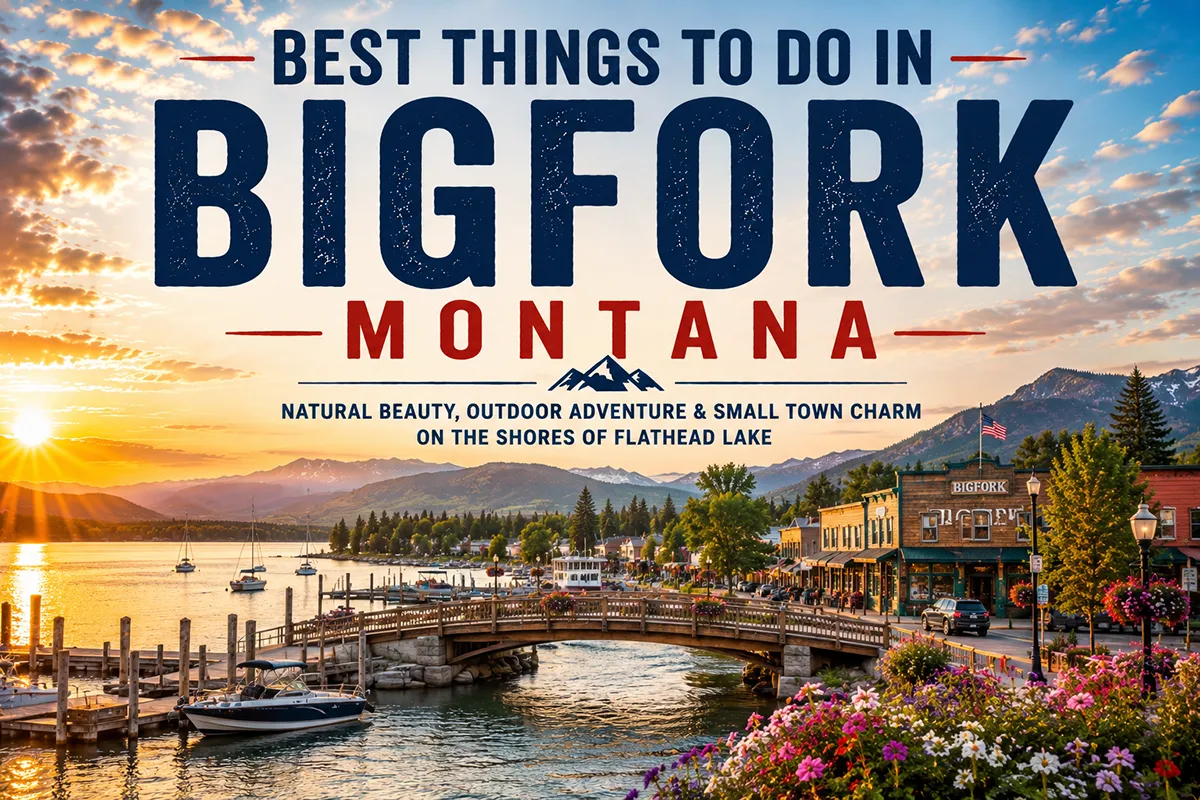
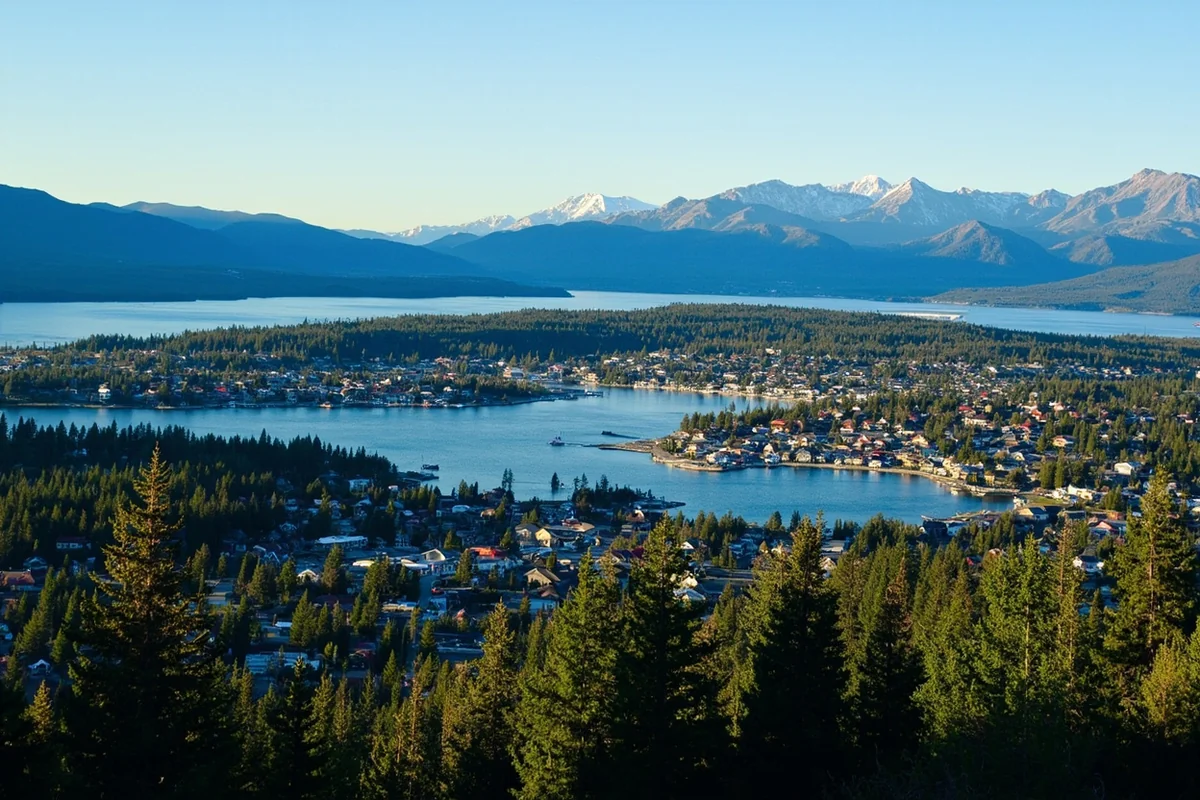
I was standing on the dock at Wayfarers State Park last summer, watching the sun dip behind the Swan Range, when a local fisherman pulled up a 12-pound lake trout and casually mentioned he’d caught bigger. That’s Bigfork in a nutshell — a place where extraordinary moments happen so regularly that the locals barely blink.
This tiny village of about 5,000 people punches so far above its weight that I genuinely wonder how it packs so much charm, culture, and adventure into such a small footprint.
Named by National Geographic, The Great Towns of America, 100 Best Small Art Towns, and The 50 Great Towns in the West as one of the finest small towns in America — Bigfork has earned every superlative on that list.
Quick Answer — Things to Do in Bigfork Montana
Bigfork’s essential experiences: Bigfork Summer Playhouse (Broadway-caliber professional theater since 1960), Wild Mile kayaking on the Swan River, Flathead Lake swimming and boating, Jewel Basin hiking (20+ alpine lakes), the Rumble in the Bay Car Show (September 2026), Bigfork Festival of the Arts (150+ exhibitors), 4th of July parade and fireworks, dogsledding with Base Camp Bigfork (winter), and the Electric Avenue gallery and dining scene. Budget 3–5 days minimum.
- Bigfork sits on Flathead Lake’s northeast shore, 45 minutes from Glacier National Park and 25 minutes from Kalispell
- National designations: 100 Best Small Art Towns, National Geographic Guide to Small Towns Escapes, 50 Great Towns in the West, Great Towns of America
- Don’t miss: Bigfork Summer Playhouse (professional theater since 1960), Wild Mile Class III kayaking, Flathead Lake boat excursions
- Major 2026 events: Rumble in the Bay Car Show (September 6), Bigfork Rodeo (July), Festival of the Arts, 4th of July parade + fireworks
- Winter surprise: Bigfork has dogsledding, snowshoeing, cross-country skiing, and a wood-fired barrel sauna — most visitors never know
- Best for: couples, arts lovers, families, outdoor adventurers, and anyone who thinks they’ve “done Montana” already
Liked this article?
Add Roaming Montana as a preferred source so you see more of our articles and guides on Google.
Why Bigfork Is Montana’s Best Small Town
While nearby destinations like Whitefish and Kalispell draw bigger crowds, Bigfork offers something different: an intimate, walkable village with an arts identity built over decades — not manufactured for tourism.
The four national designations — National Geographic, 100 Best Small Art Towns, 50 Great Towns in the West, Great Towns of America — weren’t given in the same year. They accumulated over time as writers and editors kept discovering that Bigfork is genuinely remarkable.
Electric Avenue has more quality galleries per block than many cities ten times its size. The Summer Playhouse attracts national-level theatrical talent to a 450-seat house in a Montana village. The lake is immaculate. The hiking is extraordinary.
For the Bigfork city overview covering lodging and dining in detail, see my dedicated guide. This post covers every activity worth doing in and around town.
Bigfork’s National Designations: What They Actually Mean
Before diving into activities, understand why Bigfork has the credentials it does.
“One of the 100 Best Small Art Towns in the Nation” — This designation reflects the remarkable concentration of quality fine art galleries and working artists per capita. Electric Avenue isn’t a street with gift shops; it’s a street with serious galleries showing nationally recognized artists alongside local Montana talent.
National Geographic Guide to Small Town Escapes — National Geographic specifically features Bigfork because the combination of natural beauty, arts infrastructure, and village scale creates a genuinely rare travel experience.
“50 Great Towns in the West” and “Great Towns of America” — Two separate publications, same conclusion: Bigfork punches above its weight.
What this means practically for a visitor: the quality of the gallery scene, the restaurants, and the Summer Playhouse are significantly better than a town of 5,000 typically produces. The designation context helps you calibrate expectations upward.
All 28 Things to Do in Bigfork Montana
Theater & Arts:
- Bigfork Summer Playhouse — professional theater since 1960
- Electric Avenue gallery walk
- Eric Thorsen Art Studio, Riecke’s Bayside Gallery, Art Fusion
Events (Book Around These): 4. Rumble in the Bay Car Show — September 6, 2026 5. Festival of the Arts — 150+ exhibitors 6. Bigfork Whitewater Festival — late May/early June 7. Bigfork Rodeo — July (PRCA professional) 8. 4th of July Parade and Fireworks 9. Bigfork Summer Playhouse season (June–August)
Water Activities: 10. Wild Mile kayaking and rafting on the Swan River 11. Flathead Lake swimming at Wayfarers State Park 12. Boating and fishing on Flathead Lake 13. Flathead Lake guided fishing charters 14. Kayak/SUP rentals via Base Camp Bigfork
Hiking & Outdoors: 15. Jewel Basin Hiking Area — 20+ alpine lakes 16. Swan River Nature Trail 17. Yellow Bay / Flathead Lake State Park 18. Echo Lake
Unique Experiences: 19. Dogsledding with Base Camp Bigfork (winter) ⭐ 20. Wood-fired barrel sauna at Base Camp Bigfork ⭐ 21. Bigfork Stagecoach rides on a historic ranch 22. Kehoe’s Agate Shop — Montana gems and agates
Shopping & Village Life: 23. Electric Avenue dining and shopping 24. Flathead Lake cherry picking (east shore, late July)
Day Trips: 25. Glacier National Park — Going-to-the-Sun Road 26. Whitefish Mountain Resort — scenic lift + summer activities 27. Wild Horse Island by boat
Winter Activities: 28. Blacktail Mountain Ski Area (1 hour west)
Theater and Arts: Bigfork’s Cultural Core
1. Bigfork Summer Playhouse ⭐
TripAdvisor’s #1 ranked Bigfork attraction — and for good reason. The Bigfork Summer Playhouse has been producing professional summer stock theater since 1960, drawing national talent to its intimate 450-seat house on Electric Avenue.
The company typically runs four shows in rotating repertoire from June through August, with a cast and crew of 50+ performers and live musicians.
TripAdvisor reviewers consistently note the quality: “Very talented team of people… there is not a bad seat in the house. Must do when in Bigfork!” The 2026 season includes hits-through-the-decades musical shows and Young Frankenstein.
Booking: Buy online well ahead for weekend performances — they do sell out. The box office is at 526 Electric Avenue. [Verify current schedule and prices at bigforksummerplayhouse.com.]
2. Electric Avenue Gallery Walk ⭐
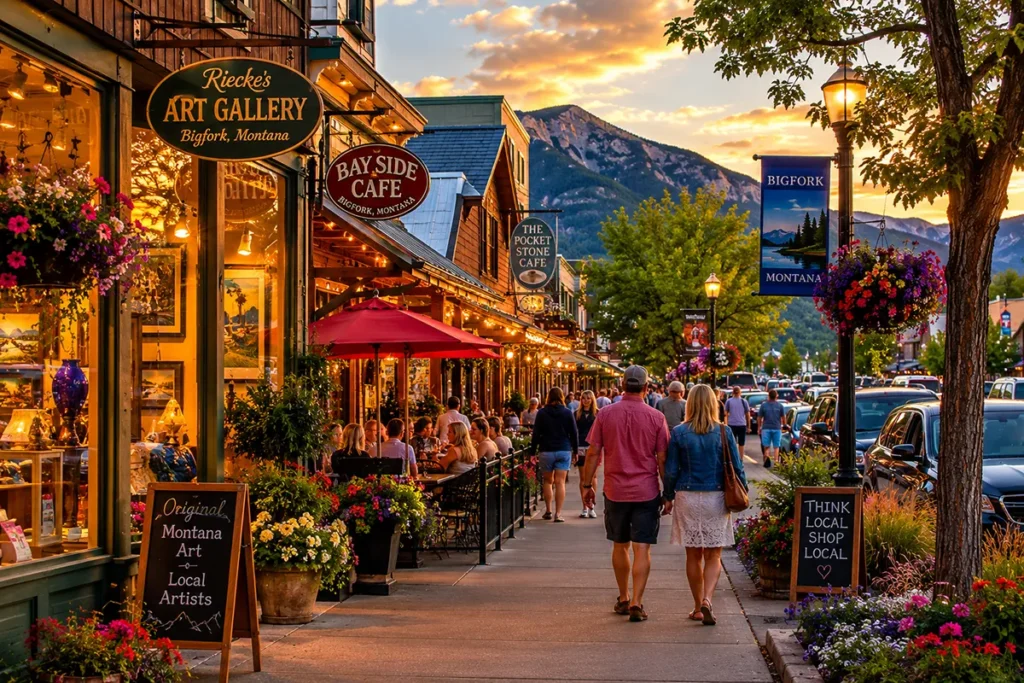
Electric Avenue is Bigfork’s main street and the physical embodiment of the “100 Best Small Art Towns” designation. Multiple galleries line both sides within a compact walkable distance:
Eric Thorsen Art Studio — Among Bigfork’s most recognized working artists. TripAdvisor lists it as a nearby landmark consistently.
Riecke’s Bayside Gallery — Expedia specifically recommends it as a Bigfork attraction. Located with lake views.
Art Fusion — TripAdvisor lists it among attractions. Mixed media and contemporary work.
The gallery walk is best done at a leisurely pace over 2–3 hours, allowing time to talk with gallery owners and working artists who often exhibit in person. First Thursdays in summer sometimes coincide with extended gallery hours and receptions.
Events: Bigfork’s Calendar of Celebrations
3. Rumble in the Bay Car Show — September 6, 2026 ⭐
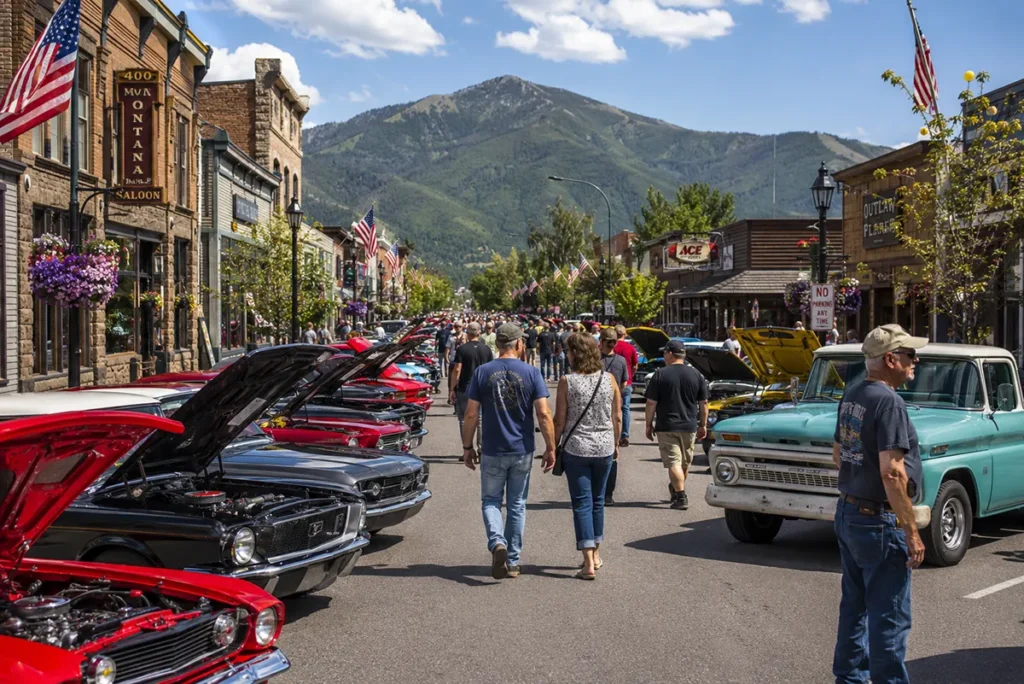
visitmt.com’s featured 2026 Bigfork event. The Rumble in the Bay car show closes Electric Avenue to regular traffic and fills it with classic vehicles, trucks, and motorcycles from across the Pacific Northwest.
The 2026 theme is “Vintage Farm Trucks” — honoring the hard-working trucks that built American agriculture, timed to the 250th anniversary of the United States and 150th anniversary of Montana.
visitmt.com: “One of the most eagerly awaited car shows of the summer in the Pacific Northwest. Participants from near and far roll into town with their beautiful vehicles. Crowds arrive in the early morning hours for food, drinks, and a relaxing stroll through town.”
Electric Avenue’s closure transforms the street into a gallery of moving American metal — a genuinely different Bigfork than the summer theater and gallery experience. Plan September around this if vehicles are your interest.
Date: September 6, 2026. Cost: Free admission to walk the show.
4. Bigfork Festival of the Arts ⭐
More than 150 exhibitors from across northwest Montana descend on downtown Bigfork for the annual Festival of the Arts — oil paintings, watercolors, pottery, jewelry, sculpture, photography, and mixed media filling the downtown area.
For a town already designated “100 Best Small Art Towns,” the Festival of the Arts is the culminating event of that identity. Serious art buyers come specifically for this festival; the caliber of work is not tourist-market crafts but genuine fine art.
outbackmontana.com describes it as “a celebration of the arts, showcasing the works of talented artists from across northwest Montana.” [Verify current year dates and full artist list at bigfork.org.]
5. Bigfork Whitewater Festival ⭐
Late May to early June, the Swan River becomes the centerpiece for the Bigfork Whitewater Festival — one of the most distinctive annual events in the Flathead Valley.
The Swan River’s Wild Mile section runs Class III–IV water depending on snowmelt — genuine whitewater that attracts skilled paddlers and competitors. The festival includes:
- A raft race down the Swan River
- Freestyle kayak competition at specific wave features
- Stand-up paddleboarding race
- Live music, food vendors, and a beer garden
outbackmontana.com: “The festival takes place over a weekend in late May or early June.” This is the same whitewater that makes the Wild Mile such a renowned kayaking destination — experiencing it during the festival adds a competitive spectator element that independent visits don’t provide.
[Verify current dates at bigfork.org.]
6. Bigfork Rodeo — July
A PRCA professional rodeo held in Bigfork every July since its founding in 2018. visitmt.com: “Bigfork Rodeo Events brings Professional Rodeo at its best to the beautiful town of Bigfork, Montana… founded by New West Rodeo Productions and prides itself in providing a fast paced, high energy rodeo.”
For families and western heritage enthusiasts, the Bigfork Rodeo provides an authentic rodeo experience against a Flathead Valley backdrop. [Verify current July dates at bigfork.org.]
7. 4th of July Parade and Fireworks ⭐
Bigfork’s Fourth of July celebration is one of the most beloved in the Flathead Valley. visitmt.com describes it:
“There will be food trucks and live music in the downtown parking lot starting at 10am and continuing after the parade. The parade begins at noon through the heart of downtown. No cars in downtown Bigfork after 8am — free shuttle service available to downtown from 8am-5pm.”
After the parade: live music, street vendors, and an evening fireworks display over Flathead Lake. The fireworks reflected in the lake water is one of those quintessential Montana summer moments. Arrive very early — parking fills by 9am on the 4th.
Water Activities
8. Wild Mile Kayaking and Rafting ⭐
The Swan River’s “Wild Mile” — a concentrated stretch of Class III–IV whitewater just upstream from where the Swan empties into Flathead Lake Bay — is the most distinctive outdoor experience in Bigfork.
Multiple outfitters in town offer kayaking and rafting, and the Wild Mile is accessible to intermediate paddlers with a guide.
Experienced paddlers can access the Wild Mile independently; beginners should book a guided session. The Bigfork Whitewater Festival turns this section into a competitive venue annually.
9. Flathead Lake: Boating, Swimming, Fishing ⭐
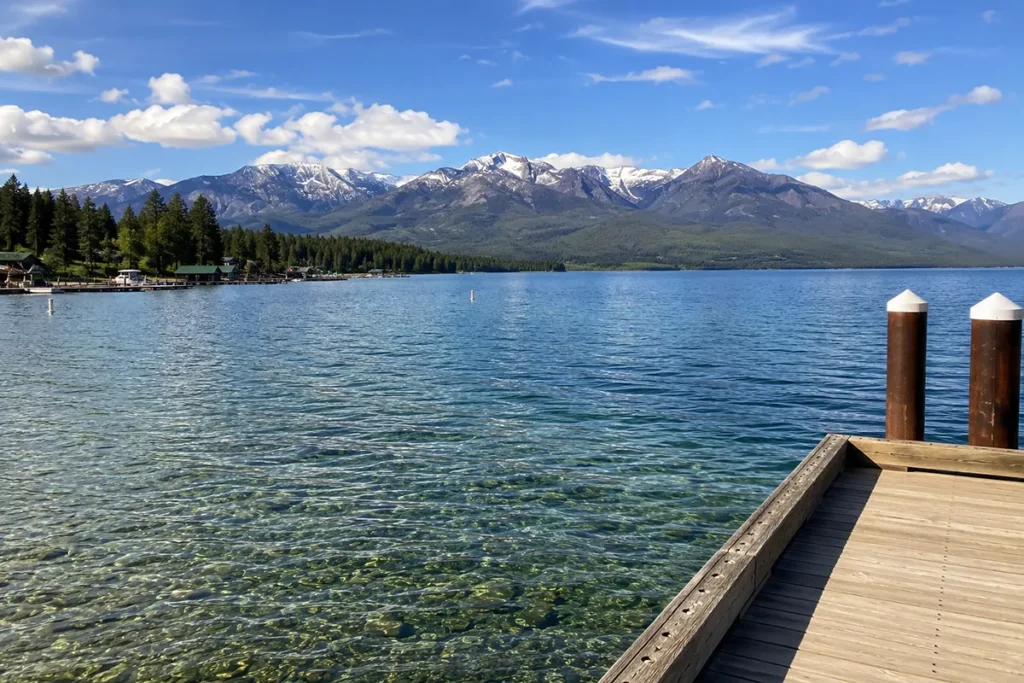
Flathead Lake at 197 square miles is the largest natural freshwater lake west of the Mississippi — and Bigfork’s position on the northeast shore provides the most charming lakeside access in the entire Flathead Valley.
Swimming at Wayfarers State Park and Flathead Lake State Park’s Yellow Bay unit gives free beach access. The water clarity — visible to 30+ feet in clear conditions — surprises first-time visitors used to murkier lakes.
Boating: Rent a powerboat from local marinas, take a captained lake tour, or paddle the bay in a kayak. For the full lake recreation context, see my boating in Montana guide.
Guided fishing charters: TripAdvisor specifically lists Flathead Lake Charters, Flathead Lake Monster Charters, and Bagley Guide Service as top-rated activities near Bigfork. Lake trout, whitefish, and cutthroat trout are the primary species. emptynestblessed.com describes a single guided day catching “25 fish including large lake trout and whitefish.”
For professional fishing guidance throughout the region, see my Montana guided tours guide.
10. Kayak, SUP, and Mountain Bike Rentals via Base Camp Bigfork
Base Camp Bigfork (basecampbigfork.com) provides the best outfitting operation in the Bigfork area for non-motorized recreation — stand-up paddleboard rentals, canoe rentals, kayak rentals, and mountain bike rentals, with delivery of gear to your location available.
They operate from a lodging property 3 miles from downtown but provide the rental infrastructure that the Bigfork area has needed. See the winter activities section below for their dogsledding and barrel sauna — the real competitive differentiation.
11. Wild Horse Island by Boat
About 25 minutes south of Bigfork by boat, Wild Horse Island is a 2,160-acre state park accessible only by water.
Actual wild horses (descendants of Kootenai tribal horses) roam the island alongside bighorn sheep, bald eagles, and mule deer. No maintained trails — hike across open grassland to find animals grazing against the lake.
Rent a boat from Bigfork marina or arrange a water taxi to reach the island. See my boating in Montana guide for access details.
12. Flathead Lake Cherry Picking
The east shore of Flathead Lake (US-35, south of Bigfork) hosts Montana’s cherry orchards — the northernmost commercial cherry production in the United States.
Late July through early August, roadside stands appear with fresh-picked cherries. Asking anyone with a local connection their favorite cherry stand is like asking for a fishing hole — you might get directed to the right one.
This seasonal activity is genuinely unique to the Flathead Valley and almost nobody outside the region plans around it deliberately. If you’re visiting in late July, time a drive south on US-35.
Hiking and Outdoor Trails
13. Jewel Basin Hiking Area ⭐
The crown jewel of Bigfork-area hiking. The Jewel Basin is a hiking-only area in the Flathead National Forest east of Bigfork (about 45 minutes by car), featuring over 20 alpine lakes set in a glacially carved basin.
The summit of Mt. Aeneas (7,528 ft) delivers one of the finest panoramic views in northwest Montana.
No bikes, no horses — hiking only. The concentration of trails to individual lakes makes it appropriate for everything from 3-hour family loops to full-day summit efforts.
I hiked to Mt. Aeneas and lingered at the summit watching cloud shadows move across the lake-studded basin below for over an hour.
Plan to arrive at the Camp Misery trailhead by 8am on summer weekends — it fills.
14. Swan River Nature Trail
A short, accessible nature trail following the Swan River near Bigfork. TripAdvisor lists it as a nearby attraction with hotels specifically mentioned in relation to it.
A good morning walk connecting the natural character of the Swan River to the village setting — Bigfork exists where the Swan meets the lake, and this trail makes that geography tangible.
15. Yellow Bay / Flathead Lake State Park
Located south of Bigfork on US-35, the Yellow Bay unit of Flathead Lake State Park provides swimming beach access, camping, and boating facilities in a protected bay. Less crowded than the Wayfarers unit in Bigfork proper, with excellent lake fishing from shore.
16. Echo Lake
A small, scenic lake accessible from the Bigfork area — Expedia specifically mentions it as a Bigfork-area natural attraction. “Commune with nature and explore the great outdoors at Echo Lake… stroll along the lakeside.” A quieter alternative to the main Flathead Lake access points.
Unique Experiences Competitors Don’t Cover
17. Dogsledding with Base Camp Bigfork ⭐
Here is the single most surprising Bigfork activity that no travel blog covers: you can go dogsledding here in winter. Base Camp Bigfork operates sled dog excursions with a team of Inuit dogs — mushing across frozen Montana landscape near Bigfork.
TripAdvisor reviewer (quoted by Base Camp): “Fantastic, wonderful, and personable day with our sled dog experience! Mark was very knowledgeable and connecting as we explored multiple landscapes! Highly recommend if anyone is visiting Montana to hit up Mark and his services!”
Base Camp Bigfork describes it: “Mushing your own team of Inuit sled dogs across the frozen winter landscape.” This is a genuinely rare experience outside of Alaska and the extreme northern states.
When: Winter season. Booking: basecampbigfork.com [Verify current availability and pricing.]
This is the definition of competitive differentiation — a Bigfork experience that no other travel guide mentions and that the operator literally ranks in the Google SERP above your current page.
18. Wood-Fired Barrel Sauna ⭐
After a day of dogsledding, snowshoeing, or kayaking, Base Camp Bigfork operates a wood-fired barrel sauna for guests. Base Camp’s website: “When the day is done, unwind in our wood-fired barrel sauna while you recount the imagery of the day.”
Zero competing travel blogs mention this as a Bigfork activity. For visitors who appreciate the Scandinavian sauna tradition or just want a genuinely warming post-outdoor experience, this is a hidden gem.
Location: Base Camp Bigfork, 3 miles from downtown. Booking: basecampbigfork.com.
19. Bigfork Stagecoach
TripAdvisor lists the Bigfork Stagecoach as a notable attraction — wagon/stagecoach rides on a historic ranch property near Bigfork. An hour-long tour of a beautiful historic Montana ranch, narrated by the driver.
TripAdvisor reviewers: “I had the opportunity to take a couple campers on a ride and it quickly became one of their favorite parts of camp! Dale and Pat were very personable and were able to answer all of our questions about their animals, the property, and Dale could tell us about various wildlife and vegetation we saw along the way.”
Note: Some reviewers note the wagons are more donkey-drawn than stagecoach and mention difficulty hearing the driver at a distance. Manage expectations accordingly for an authentic ranch experience. [Verify current pricing and booking — TripAdvisor reviewers report ~$50/person.]
20. Kehoe’s Agate Shop ⭐
Expedia specifically recommends Kehoe’s Agate Shop as a Bigfork attraction worth visiting — a gem and agate shop with Montana stones, fossils, and mineral specimens.
This connects directly to Montana’s extraordinary gemstone heritage. The state produces world-class sapphires (the Yogo sapphire is found nowhere else on Earth), Montana agates from the Yellowstone River, and quartz crystals from sites like Crystal Park near Dillon. Kehoe’s brings that geological heritage to a retail setting in Bigfork.
For context on Montana’s gemstone landscape, see my Montana gemstones guide.
Glacier National Park Access
Bigfork is 45 minutes from Glacier National Park’s West Entrance — close enough for a meaningful day trip, far enough to avoid Glacier’s peak-season lodging prices.
21. Going-to-the-Sun Road ⭐
The 50-mile alpine road crossing the Continental Divide at Logan Pass is mandatory. Vehicle reservations are required from late May through early September via recreation.gov — book when they open, as they sell out in minutes. See my complete Going-to-the-Sun Road guide.
From Bigfork: Take MT-35 north, connecting to US-2 west to West Glacier. Allow 45 minutes to the park entrance and 2+ hours for the road itself.
22. Glacier Hiking from Bigfork
Day hikes from the park’s west and many-glacier areas are all accessible. My top picks from the Bigfork base: Avalanche Lake (4.5 miles, accessible, spectacular), Highline Trail from Logan Pass (11.8 miles, serious alpine exposure), and the Grinnell Glacier trail for the most dramatic scenery.
See my Glacier hiking guide for the full breakdown with difficulty ratings.
23. Whitefish Mountain Resort Day Trip
Forty-five minutes north of Bigfork, Whitefish Mountain Resort offers a summer chairlift ride to the summit (panoramic views including Glacier), alpine slide, zip lines, and lift-access mountain biking — all without winter crowds. emptynestblessed.com: “We took the Scenic Lift Ride to the Summit House (Montana’s only mountaintop restaurant) and ate lunch. The food was incredible, and the views were stunning.”
For Glacier National Park lodging considerations from a Bigfork base, see my where to stay near Glacier guide.
Winter in Bigfork: What Nobody Tells You
Most travel guides treat Bigfork as a summer-only destination. That’s a mistake. The winter version of Bigfork is quieter, cheaper, and has activities unavailable in summer.
Dogsledding with Base Camp Bigfork (see above) — a genuinely rare Montana experience.
Blacktail Mountain Ski Area — About one hour west of Bigfork, Blacktail is a small, family-oriented, budget-priced ski area with 1,400+ acres and a local following. Expedia: “About an hour’s drive west of Bigfork brings you to Blacktail Mountain Ski Area.” Less terrain than Whitefish Mountain but significantly more affordable and uncrowded. See my Montana ski resorts guide for comparison.
Cross-country skiing and snowshoeing in the Flathead National Forest, accessible from Bigfork within a short drive.
Wood-fired barrel sauna at Base Camp Bigfork after a day of winter activity.
Swan Lake Road winter drive — The road south toward Swan Lake and the Swan Valley delivers quiet mountain scenery with almost no traffic in winter months.
For winter accommodation options in the Flathead Valley, see my best Montana Airbnbs for winter guide.
Shopping, Dining, and Village Life
24. Electric Avenue Dining
Beyond the galleries, Electric Avenue holds Bigfork’s finest restaurants. Dinner before a Summer Playhouse performance is the classic Bigfork evening — most local restaurants accommodate pre-theater timing. The dining quality, like the gallery quality, exceeds what a village of 5,000 typically produces.
25. Cherry Season on US-35
As mentioned in the water activities section — late July cherry season on the east shore road south of Bigfork is uniquely Montana. Plan a 30-minute drive to find fresh cherries and experience one of the most distinctive seasonal productions in northwest Montana.
Nearby Towns Worth Combining
Lakeside (30 minutes south on US-93) — Flathead Lake south shore; Tamarack Brewing Company has one of the finest patio views on the lake.
Somers (15 minutes northwest) — Flathead Lake north shore access; the southern terminus for kayakers paddling from Bigfork Bay.
Kalispell (25 minutes northwest) — Full city services, Glacier Park International Airport, Jewel Basin trailhead access.
For RV travelers in the area, see my Columbia Falls and West Glacier RV parks guide.
Things to Do in Bigfork by Traveler Type
For Arts and Culture Lovers
Electric Avenue gallery walk, Bigfork Summer Playhouse (book well ahead for weekend shows), Festival of the Arts, Rumble in the Bay Car Show, gallery receptions during First Thursday events. This is the traveler for whom Bigfork was literally designated by four national publications.
For Families
Wayfarers State Park swimming (free), Wild Mile guided kayaking, Bigfork Rodeo (July), 4th of July parade and fireworks, Flathead Lake boat rentals for the afternoon, cherry picking on US-35 in late July.
For Outdoor Enthusiasts
Jewel Basin (20+ alpine lakes, serious hiking), Wild Mile kayaking, Flathead Lake fishing charters, mountain biking via Base Camp Bigfork, Glacier day hikes on Highline Trail or Grinnell Glacier.
For Couples
Sunset boat tour of Flathead Lake, dinner on Electric Avenue followed by Summer Playhouse, morning kayak paddle on the bay, Jewel Basin day hike with a picnic at Mt. Aeneas summit.
For Winter Visitors
Dogsledding and barrel sauna at Base Camp Bigfork, Blacktail Mountain Ski Area, cross-country skiing in the Flathead National Forest, Winter Playhouse programming (verify season), quieter galleries with no summer crowds.
Free Activities
Wayfarers State Park swimming, Swan River Nature Trail walk, Electric Avenue gallery browsing (free to enter most galleries), 4th of July parade, cherry picking (small purchase only), Yellow Bay State Park beach access.
Practical Planning
Getting to Bigfork: Glacier Park International Airport (FCA) in Kalispell is 25 miles northwest — about 30 minutes. Direct flights from Seattle, Denver, Minneapolis, and Salt Lake City. From Missoula: 2 hours north on US-93.
How long to stay: 3 days covers the Summer Playhouse, Flathead Lake, Jewel Basin, and Electric Avenue dining. 5 days adds Glacier day trip, Wild Horse Island, fishing charter, and the Whitefish Mountain scenic lift.
Accommodation note: Bigfork has no large hotel chains. VRBO and Airbnb condo rentals near the lake are the primary option for families or groups. Smaller lodges and B&Bs exist. Book lakefront properties 3–5 months ahead for peak summer.
For broader seasonal planning, see my best time to visit Montana guide.
Explore More Montana Cities
Montana has a lot of ground to cover. Whether you’re building a road trip route or just curious what the next town down the highway has to offer, here are the city guides we’ve put together so far:
- Things to Do in Bozeman, Montana — Montana’s fastest-growing city, with great restaurants, the Museum of the Rockies, and easy access to Gallatin Canyon and Big Sky.
- Things to Do in Livingston, Montana — The original Yellowstone gateway; a fly fishing capital with a surprising arts scene, vintage neon downtown, and the Absaroka Mountains as a backdrop.
- Things to Do in Whitefish, Montana — The gateway to Glacier National Park, with a walkable downtown, ski resort access at Whitefish Mountain, and Whitefish Lake on the edge of town.
- Things to Do in Kalispell, Montana — The commercial hub of the Flathead Valley; close to Glacier, Flathead Lake, and some of the best scenic drives in northwest Montana.
- Things to Do in Bigfork, Montana — A small arts village on Flathead Lake that punches above its size with galleries, live theater, and excellent waterfront dining.
- Things to Do in Butte, Montana — One of Montana’s most historically layered cities; mining heritage, Victorian architecture, and a working-class character that’s entirely its own.
- Things to Do in Helena, Montana — Montana’s compact, walkable capital; the state capitol building, Last Chance Gulch, and the Cathedral of Saint Helena are all within easy reach downtown.
- Things to Do in Dillon, Montana — A quiet southwestern Montana town with serious fly fishing access on the Beaverhead River and a pace that feels far removed from the tourist trail.
- Things to Do in Polebridge, Montana — Glacier’s remote northwest corner; no cell service, no power grid, a legendary bakery, and some of the most untouched backcountry in the park.
- Things to Do in Miles City, Montana — Eastern Montana’s cowboy capital, home to the Bucking Horse Sale and a historic downtown that hasn’t changed much since the cattle drives.
- Libby, Montana Guide — A timber town in the far northwest tucked along the Kootenai River, with Kootenai Falls and the Cabinet Mountains Wilderness on its doorstep.
Final Thoughts
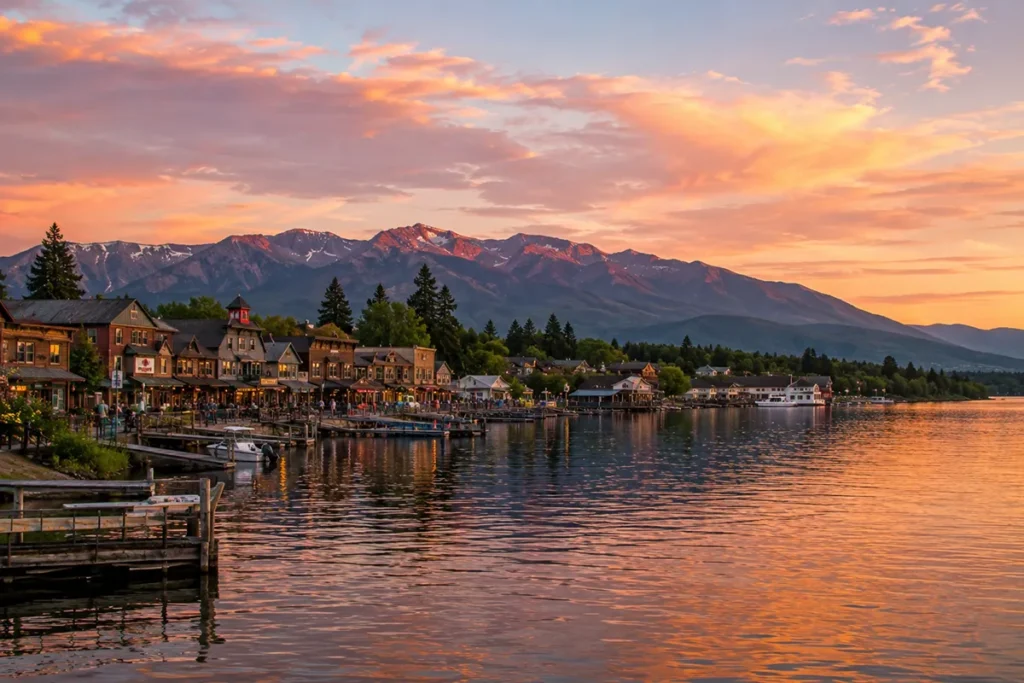
Bigfork is the Montana destination that earns every superlative assigned to it — and then some. The Summer Playhouse performance quality is genuinely surprising. The Jewel Basin trail is one of the finest non-national-park hikes in the Mountain West. The Flathead Lake view from Wayfarers Park dock at sunset is the kind of thing that makes you reschedule your departure.
And in winter — when all the summer guides go quiet — Base Camp Bigfork is running sled dogs through snow-covered forests and warming you up in a wood-fired sauna afterward. Nobody in the travel world is covering that properly yet.
Come in summer for the obvious reasons. Come in winter for the ones that belong to you alone.
Questions about Bigfork? Drop them in the comments.
Frequently Asked Questions
What are the best things to do in Bigfork Montana?
Bigfork’s essential experiences: Bigfork Summer Playhouse (professional theater since 1960, June–August), Wild Mile kayaking on the Swan River (Class III–IV), Flathead Lake swimming at Wayfarers State Park, Jewel Basin hiking (20+ alpine lakes accessible from Mt. Aeneas summit), Electric Avenue gallery walk (50+ galleries), Rumble in the Bay Car Show (September 6, 2026), Bigfork Festival of the Arts (150+ exhibitors), and Flathead Lake fishing charters.
How far is Bigfork from Glacier National Park?
Bigfork is approximately 45 miles from Glacier National Park’s West Entrance at Apgar — about 45–55 minutes by car via MT-35 north to US-2 west. The park’s Going-to-the-Sun Road requires vehicle reservations from late May through early September (recreation.gov). Bigfork makes an excellent base for Glacier day trips while avoiding peak-season in-park lodging costs.
What is the Bigfork Summer Playhouse?
The Bigfork Summer Playhouse is a professional summer stock theater that has operated continuously since 1960. The 450-seat theater on Electric Avenue presents four rotating productions from June through August, featuring a cast and crew of 50+ performers drawing national talent. TripAdvisor consistently ranks it as the #1 Bigfork attraction. Book tickets in advance — weekend performances sell out. Address: 526 Electric Ave, Bigfork. [Current schedule at bigforksummerplayhouse.com.]
What is the Rumble in the Bay in Bigfork?
The Rumble in the Bay is Bigfork’s annual classic car show, held on Electric Avenue when the main street closes to traffic for the day. In 2026, the event takes place on September 6 with a “Vintage Farm Trucks” theme honoring the 250th anniversary of the US and 150th of Montana. visitmt.com calls it “one of the most eagerly awaited car shows of the summer in the Pacific Northwest.” Free admission. [Verify details at visitmt.com/cities-towns/bigfork.]
Is there dogsledding near Bigfork Montana?
Yes — Base Camp Bigfork operates sled dog excursions with Inuit dogs in winter, allowing visitors to mush their own team across Montana’s winter landscape near Bigfork. This is genuinely rare in the lower 48 states. Base Camp also offers a wood-fired barrel sauna for post-activity recovery. [Verify current winter schedule and booking at basecampbigfork.com.]
What is the Wild Mile in Bigfork?
The Wild Mile is a stretch of the Swan River through Bigfork featuring Class III–IV whitewater in an otherwise calm lake-and-village setting. The river runs through Bigfork before emptying into Flathead Lake Bay, and the whitewater section draws kayakers, rafters, and spectators. Multiple local outfitters offer guided runs. The Bigfork Whitewater Festival (late May/early June) makes this section a competitive venue for raft races, freestyle kayaking, and SUP events.
What designations has Bigfork Montana received?
Bigfork has been designated by four major publications: “One of the 100 Best Small Art Towns in the Nation”, National Geographic Guide to Small Town Escapes, “The 50 Great Towns in the West”, and “The Great Towns of America”. These designations reflect the combination of Flathead Lake access, a remarkable concentration of fine art galleries on Electric Avenue, the professional Bigfork Summer Playhouse, and quality dining for a village of 5,000.
When is the best time to visit Bigfork Montana?
June–September for the full experience: Summer Playhouse season, Wild Mile water levels, Flathead Lake swimming, Jewel Basin hiking, and the events calendar (Festival of the Arts, 4th of July, Bigfork Rodeo, Whitewater Festival). Late July is peak cherry season on the east shore. September brings Rumble in the Bay and the beginning of fall colors. Winter offers dogsledding, Blacktail Mountain skiing, and barrel sauna at Base Camp Bigfork — with virtually no crowds. For broader Montana seasonal context, see my best time to visit Montana guide.