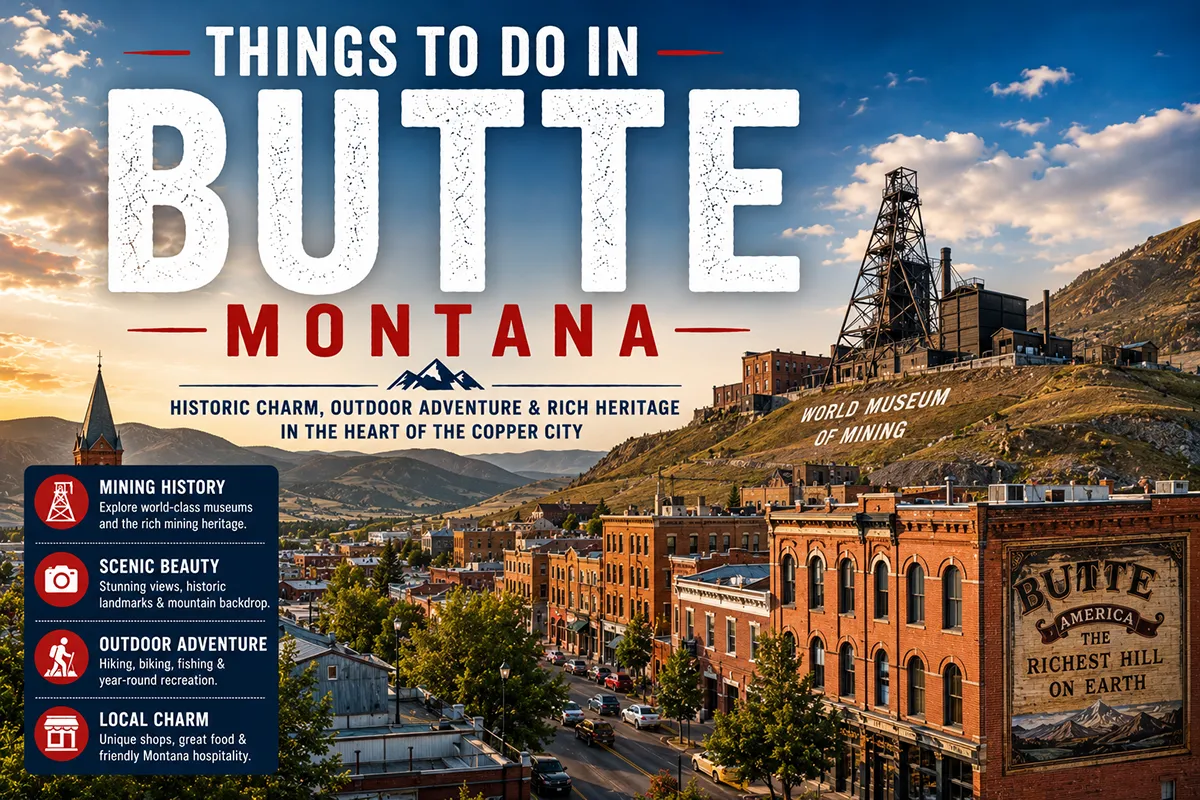
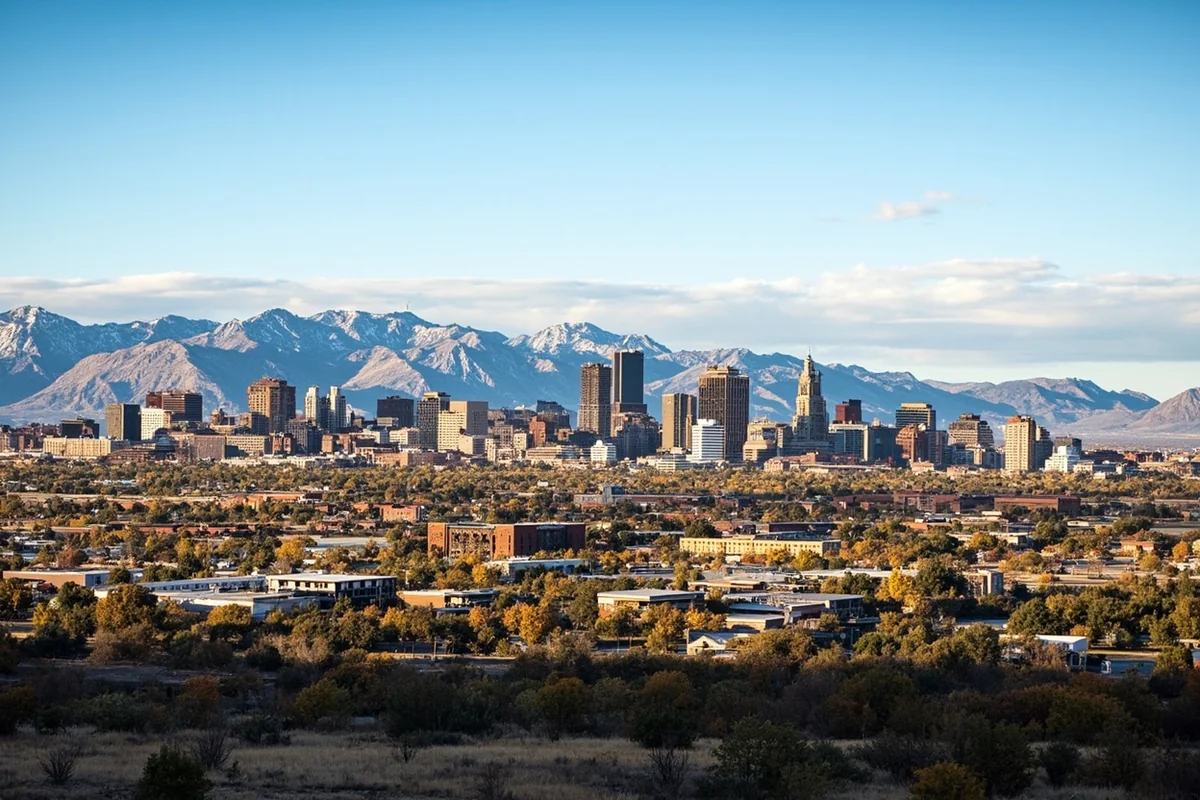
The first time I drove into Butte on Interstate 90, the massive headframes dotting the hillside stopped me mid-sentence. My travel companion asked what was wrong, but nothing was wrong — I was just overwhelmed by a skyline unlike anything else in America.
This former copper mining capital wears its gritty industrial past like a badge of honor, and after spending considerable time exploring its depths across multiple seasons, I can confidently say Butte is Montana’s most underrated destination.
Quick Answer — Things to Do in Butte MT
Butte’s top activities center on its extraordinary copper mining history (World Museum of Mining, Berkeley Pit, underground mine tours), its nationally significant Victorian architecture district, and a remarkably deep food and culture scene. Don’t miss: the Butte Trolley Tour, the Mai Wah Museum (Chinese heritage), Pekin Noodle Parlor (America’s oldest continuously-operating Chinese restaurant), Mother Lode Theatre, Pork Chop John’s sandwiches, the “1923” TV show filming locations, and the grave of hometown legend Evel Knievel. Budget 2–3 days minimum.
- Butte offers 38 activities from summer hiking to winter skiing at Discovery Ski Area
- The World Museum of Mining, Berkeley Pit, and underground mine tour are non-negotiable
- Uptown Butte’s National Historic Landmark District has some of the finest Victorian architecture in the American West
- Don’t miss the food: Pork Chop John’s, Pasties (Joe’s or Gamer’s), and Pekin Noodle Parlor (open since 1911)
- St. Patrick’s Day in Butte is arguably Montana’s biggest annual celebration
- Best times: June–September for full access; December–March for Discovery Ski Area
Liked this article?
Add Roaming Montana as a preferred source so you see more of our articles and guides on Google.
Understanding Butte: A Quick Primer
Before diving into the activities, you need context. Butte sits at 5,538 feet elevation in the northern Rocky Mountains, built directly on the Continental Divide — which means weather can shift dramatically and quickly.
The town earned the nickname “The Richest Hill on Earth” during its copper mining heyday, producing over 20 billion pounds of copper.
Butte once powered America’s electrical grid: as telephones and electric lights spread through cities like New York and San Francisco in the late 1800s, copper demand exploded, and Butte’s mines answered.
That history permeates everything here — from the architecture to the street names to the stories locals share over beers at historic saloons.
Butte is officially designated as one of the nation’s largest National Historic Landmark Districts — its Victorian and early 20th-century architecture is among the best preserved in the American West. Walking Uptown Butte is genuinely different from any other city in Montana.
For RV travelers, see my Butte RV parks guide. For broader context on when to visit, see my best time to visit Montana guide.
All 38 Things to Do in Butte MT: At a Glance
History & Museums:
- World Museum of Mining + Hell Roarin’ Gulch
- Orphan Girl Underground Mine Tour
- Berkeley Pit — the world’s most famous toxic lake
- Copper King Mansion (William Andrews Clark’s home)
- Mai Wah Museum — Chinese heritage
- Clark Chateau — historic mansion + cultural center
- Dumas Brothel Museum — uniquely honest history
- Montana Tech Mineral Museum — gems and geology
- Butte-Silver Bow Public Archives
Tours:
10. Butte Trolley Tour (summer, 2 hours)
11. Old Butte Historical Adventures speakeasy tour
12. Self-guided “1923” TV show filming locations walk
Culture & Arts:
13. Mother Lode Theatre — performing arts
14. Our Lady of the Rockies — 90-ft statue on the Continental Divide
15. Uptown Butte National Historic District walking tour
16. Evel Knievel grave, Mountain View Cemetery
Food & Drink:
17. Pork Chop John’s — the legendary sandwich
18. Pasties at Joe’s Pasty Shop or Gamer’s Café
19. Pekin Noodle Parlor — oldest Chinese restaurant in America (1911)
20. M&M Cigar Store — legendary bar, 24/7 for over 100 years
21. Cleveland Market — Historic Cleveland Building (1916)
22. Uptown Irish pubs on Mercury Street
Outdoor Adventures:
23. Continental Divide National Scenic Trail (13 trailheads)
24. Copperway Trail — Butte to Anaconda to Fairmont Hot Springs
25. Hiking the East Ridge and surrounding mountains
26. Fly fishing the Clark Fork, Big Hole, and Silver Bow Creek
27. Horseback riding — guided trail rides in the Butte area
Day Trips from Butte:
28. Anaconda Smelter Stack State Park (just 25 min west)
29. Fairmont Hot Springs Resort (25 min west, off I-90)
30. Lewis and Clark Caverns State Park (45 min east)
31. Granite Ghost Town (via Philipsburg, ~1 hour west)
32. Montana Zipline Adventures (near Anaconda)
Winter Activities:
33. Discovery Ski Area — uncrowded, affordable, excellent terrain
34. Snowmobiling on Continental Divide trails
35. Ice fishing on Georgetown Lake and area reservoirs
Events:
36. St. Patrick’s Day — Montana’s biggest celebration (March 17)
37. An Ri Ra Irish Festival (August)
38. Ridge Waters Water Park — Butte’s family water park (summer)
For the Butte city overview with lodging, dining, and full city context, see my dedicated guide.
History & Museums
1. World Museum of Mining
This museum ranks among my favorite attractions in all of Montana. Located on the original Orphan Girl mine yard, it features over 50 historic buildings arranged as a replica 1890s mining town called Hell Roarin’ Gulch.
The buildings aren’t recreations — many were relocated from actual mining camps throughout the region. I spent nearly three hours wandering through the general store, Chinese herbalist shop, funeral parlor, and schoolhouse.
The volunteer docents, many descended from Butte mining families, share stories you won’t find in any guidebook. This is genuinely one of the few museums in the world located on an actual mine yard. Allow 2–3 hours minimum. Cost: ~$10–15/adult.
2. Orphan Girl Underground Mine Tour
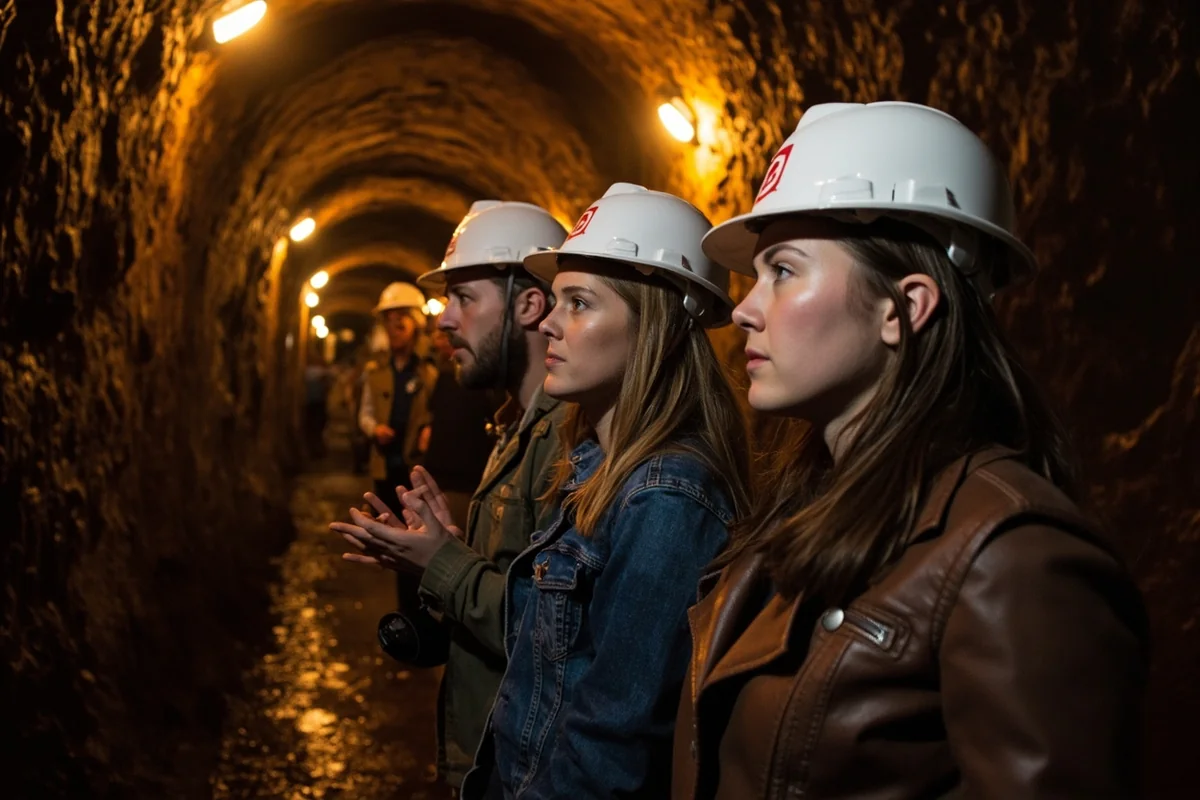
Operating from the museum grounds, this tour is worth every penny. Don hard hats and descend into an actual mine shaft where guides demonstrate drilling equipment and explain daily life for the thousands of men who worked in darkness.
Temperature underground hovers around 47°F year-round — bring a jacket even in August. Our guide, a former miner himself, described cave-ins, labor disputes, and the camaraderie that developed among workers. Sobering and fascinating in equal measure.
3. Berkeley Pit
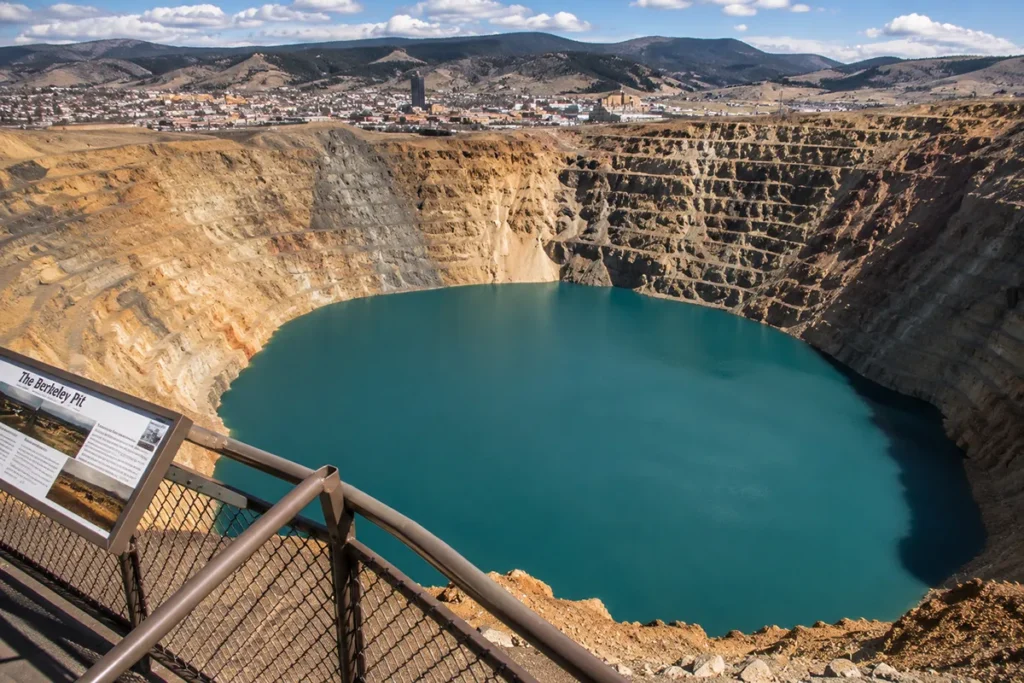
The Berkeley Pit is a former open-pit copper mine that is now one of the most surreal sights in America — a lake shining blue-green with copper compounds and heavy metals, filling slowly within scoured rust-colored walls. It’s officially a Superfund site and a genuine testament to the cost of industrial extraction.
For a modest viewing fee, you walk to an observation stand and look straight down into what is now a 900-foot-deep toxic lake. Snow geese that land on it die. The pit continues to fill.
The state of Montana monitors it 24/7 to prevent it from reaching groundwater levels. It’s riveting and thought-provoking in ways that no conventional tourist attraction can be.
Cost: ~$3/adult viewing fee
Best time: Year-round
4. Copper King Mansion
William Andrews Clark’s personal Butte home — built in 1888 when copper made him one of the wealthiest men in the world. At one point his monthly income was recorded at $17 million.
The Copper King Mansion is now a B&B with guided tours; some rooms are available to stay overnight, which makes it uniquely immersive.
The library, ballroom, and original furnishings give a visceral sense of Gilded Age excess.
Cost: ~$10/tour
5. Mai Wah Museum ⭐
One of the most distinctive museums in Montana, the Mai Wah Museum occupies two historic buildings from Butte’s original Chinatown — the Mai Wah Noodle Parlor and the adjacent Wah Chong Tai mercantile and apothecary, which date to the 1890s and 1900s.
Though discriminatory laws prevented Chinese immigrants from working the mines during Butte’s heyday, the city nonetheless had a vibrant Chinese community that is honestly and thoroughly explored here.
The museum includes the original apothecary shelves and display cases, exhibition spaces on the Chinese immigrant experience in Montana, and an original noodle shop setup.
The Mai Wah Society also hosts an annual Chinese New Year celebration in February that draws visitors from across the region. Southwestmt.com specifically calls this out as a must-see; Atlas Obscura rates it among Butte’s best experiences.
Cost: Free/donation
Hours: [Verify current hours at maiwah.org.]
6. Clark Chateau
A historic mansion in Uptown Butte that now serves as a community cultural center with rotating historical exhibits and public programming.
Built during Butte’s copper boom, the Clark Chateau offers a more intimate architectural and social history experience compared to the Copper King Mansion’s sheer opulence.
Cost: Small admission fee
7. Dumas Brothel Museum
Butte’s history includes its red-light district, and the Dumas Brothel — open from 1890 to 1982 — is now one of the most historically candid museums in the West.
The original cribs, parlor, and furnishings have been preserved as a genuinely educational look at an aspect of frontier life that most cities have erased. TripAdvisor consistently lists it among Butte’s top ten attractions.
Cost: ~$10/adult
8. Montana Tech Mineral Museum
At Montana Tech (Montana Technological University) on the hill above Uptown, the Mineral Museum houses a significant collection of gems and minerals with particular emphasis on Montana’s extraordinary geological wealth.
The display of copper minerals, gold specimens, and gems is genuinely impressive for a university museum. Free to visitors.
Hours: [Verify at mtech.edu.]
Tours Worth Taking
9. Butte Trolley Tour ⭐
Every guide to Butte agrees: take the trolley tour first. The Butte Trolley runs daily during summer and is hosted by local history experts who provide a 2-hour circuit of Uptown Butte’s most significant sites — including the Berkeley Pit, the Copper King Mansion neighborhood, Uptown’s Victorian architecture, and key historical points that would take a full day to piece together independently.
The trolley format is specifically valuable in Butte because Uptown’s streets “run straight up and down” (southwestmt.com) — climbing them on foot in summer heat while also navigating the history is significantly more taxing than experiencing it from a trolley.
Take this on your first morning in town; it creates a mental map that makes every subsequent activity more meaningful.
Season: Summer (typically Memorial Day through Labor Day). Cost: ~$15–20/adult. [Verify current schedule at visitbutte.com.]
10. Old Butte Historical Adventures
A separate tour operation from the World Museum, Old Butte Historical Adventures runs underground and speakeasy tours of Butte’s historic district at 117 N. Main St. The speakeasy portion — following the illicit drinking establishments that thrived during Prohibition in this largely Irish Catholic mining town — is particularly distinctive.
TripAdvisor reviewers note the tour’s early segments can be slow, but the later underground and speakeasy sections deliver.
Contact: (406) 498-3424
11. Self-Guided “1923” TV Show Filming Locations
The Paramount TV series 1923 (starring Harrison Ford and Helen Mirren) and its predecessor Yellowstone use Butte as a filming location because the city “literally feels as though you’ve stepped back to the 1920s” — the preserved Victorian and early 20th-century architecture is unmatched.
Fake building fronts installed for production filming remain in place in parts of Uptown, and a self-guided walk identifying filming locations has become a popular visitor activity.
The town’s authentic period character means you’re essentially touring a natural film set. This is a significant tourism draw for fans of the Dutton universe who may not realize Butte is involved, and it’s worth folding into any Uptown walking tour.
Cost: Free
Time: 1–2 hours
Culture, Arts & Iconic Stops
12. Mother Lode Theatre ⭐
Originally built as the Masonic Temple during Butte’s post-World War I boom and later converted to a movie house, the Mother Lode Theatre was reimagined as a performing arts venue in 1996.
Its ornate interior, excellent acoustics, and intimate scale make it one of the finest live performance venues in Montana — hosting the Butte Symphony, Montana Repertory Theatre, Orphan Girl Children’s Theatre, and a rotating lineup of touring performances.
Southwestmt.com calls it “one of the best places in the state to catch live entertainment and traditional movies.”
If there’s a performance during your Butte visit, this is worth planning around. Check the events calendar at motherlodemontana.com.
Location: 316 W. Park St.
13. Our Lady of the Rockies
A 90-foot illuminated Virgin Mary statue on the Continental Divide ridge 3,500 feet above Butte, built entirely by volunteer labor over five years and completed in 1985.
Bus tours run from June to October from 3100 Harrison Ave. The view from the statue’s base — looking down at Butte and the valley — is extraordinary.
The story of how it was built (welding equipment airlifted by helicopter, concrete mixed at altitude) is equally impressive.
Cost: Tour ~$20–25/adult
Season: June–October
14. Evel Knievel — Mountain View Cemetery ⭐
Evel Knievel was born in Butte on October 17, 1938, and died in 2007. He is buried at Mountain View Cemetery, alongside his son Robbie, who was also a professional stuntman.
For fans of the Knievel legend — or anyone interested in uniquely American cultural history — a visit to pay respects has become a recognized Butte pilgrimage.
Butte has long embraced Knievel as a hometown hero. The city’s working-class grit and his reckless showmanship are a natural fit.
Cost: Free
Food & Drink: The Butte Essentials
Butte has a food culture unlike any other Montana city — shaped by 19th-century immigration from Cornwall, Ireland, China, Eastern Europe, and the Balkans, with specific dishes that have survived for over 100 years.
15. Pork Chop John’s ⭐
“You simply cannot visit Butte without grabbing a Pork Chop John’s sandwich. It’s a Butte institution and their Pork Chop sandwich is legendary in Montana.” (luxlifelondon.com) The original uptown location is a takeaway hole-in-the-wall; there’s a proper dine-in restaurant on Harrison Ave. The sandwich doesn’t photograph well. Order it anyway.
16. Pasties at Joe’s or Gamer’s
The pasty — a Cornish meat pie brought to Butte by miners from Cornwall, England — is the most distinctively Butte food experience. Joe’s Pasty Shop and Gamer’s Café are the two institutions. A pasty is filling, inexpensive, and connects directly to the immigrant working class history that shaped this city.
17. Pekin Noodle Parlor ⭐
The Pekin Noodle Parlor has been operating continuously since 1911, making it the oldest continuously-operating Chinese restaurant in the United States — a designation verified by Atlas Obscura, which rates it as one of Butte’s top unusual attractions.
The restaurant is reached by a long flight of stairs leading to a hallway of curtained booths. Each booth has a privacy curtain.
The menu serves classic Chinese-American dishes from the 1960s era — sweet or salty sauce preparations, noodles, and dishes that are simultaneously old-fashioned and completely authentic to what they’ve always been.
This is not a trendy restaurant. It’s living history. Go.
18. M&M Cigar Store
A Butte legend that first opened in 1890 and operated 24 hours a day, 7 days a week for over 100 years — only recently reducing hours.
The M&M is the quintessential Butte bar: functional, democratic, unpretentious, and layered with history.
The original building burned down but has reopened in a different space. Listed on the National Register of Historic Places.
19. Cleveland Market
A 2025 addition to Butte’s food scene that southwestmt.com now recommends as an essential stop.
Housed in the historic Cleveland Building (1916), the Cleveland Market brings together: The Local (coffee shop and café, breakfast/lunch), Dancing Rainbow Natural Grocery, and Black Dog Creamery.
A good decompression point between museums and mine tours.
20. Uptown Irish Pubs on Mercury Street
Butte’s Irish heritage — roughly a quarter of Butte’s historic mining population was Irish — lives on in the bars and pubs of Uptown. Mercury Street is the center of this tradition.
The Silver Dollar Saloon and other Irish establishments on and around Mercury Street carry forward a community identity that goes back to the 1870s.
St. Patrick’s Day in Butte ⭐
No list of Butte activities is complete without mentioning St. Patrick’s Day, which AAA’s travel publication describes as being “as big a deal as Christmas” here. The iconic parade on March 17 draws crowds 10 deep, includes floats, horses, and a pipe and drum band.
After the parade, revelers spill from every Uptown bar. In the evening, Irish dancers perform at Handing Down the Heritage, a family event with spirited high-stepping that reflects the Callahan and Shea families who once made up a quarter of the city’s population.
If you’re visiting Montana in March, build your trip around this. There is no comparable event in the state.
Outdoor Adventures
21. Continental Divide National Scenic Trail
Butte is surrounded by the Continental Divide, and visitbutte.com counts 13 trailheads for day and overnight treks within easy reach.
The terrain offers panoramic vistas, distinctive geologic formations, and wilderness access that most Butte visitors never reach because they’re focused on the historic district.
For serious hikers, the CDT corridor around Butte provides genuine backcountry experience close to an urban base. See my Montana guided tours guide for outfitters who run CDT-adjacent trips.
22. Copperway Trail ⭐
The Copperway Trail connects Butte, Anaconda, and Fairmont Hot Springs Resort on a mix of paved and packed dirt surfaces suitable for walking, cycling, and year-round use. Dog-friendly, well-maintained, and popular with locals year-round as a non-motorized route.
The trail’s endpoint at Fairmont Hot Springs makes it particularly appealing — hikers and cyclists can soak at the hot springs after the journey. Anaconda is worth a stop along the route for the historic Washoe Theatre and Anaconda Smelter Stack.
23. Fly Fishing
The Clark Fork River, Big Hole River, and Silver Bow Creek are all accessible from Butte. The Big Hole in particular is one of Montana’s most celebrated trout fisheries, known for its native Arctic grayling population — the only self-sustaining wild grayling fishery outside Alaska in the lower 48.
For guided trips, see my Montana guided tours guide.
24. Horseback Riding
Multiple outfitters in the Butte area offer guided horseback trail rides through the surrounding mountains. Options range from 2-hour scenic rides to full-day trips with meals.
The landscape — Continental Divide peaks, open meadows, historic mining terrain — creates a setting unlike typical Montana horseback experiences.
Day Trips From Butte
25. Anaconda and Smelter Stack State Park (25 min west)
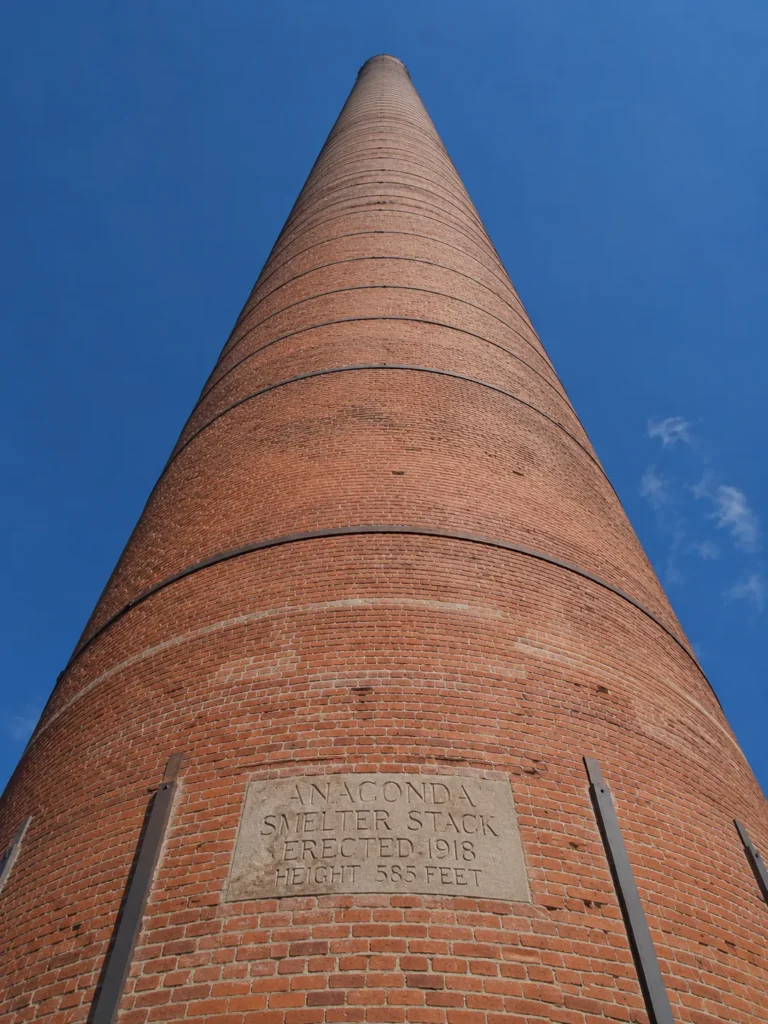
Anaconda was the company town built by Marcus Daly (one of Butte’s three “Copper Kings”) to process Butte’s ore. The Anaconda Smelter Stack — standing 585 feet tall, the tallest masonry structure in the world at the time of construction — now anchors a state park.
The Washoe Theatre in Anaconda (1936 Art Moderne architecture) is one of the most beautiful movie theaters remaining in the Mountain West. The whole town is a remarkable industrial heritage experience.
26. Fairmont Hot Springs Resort (25 min west)
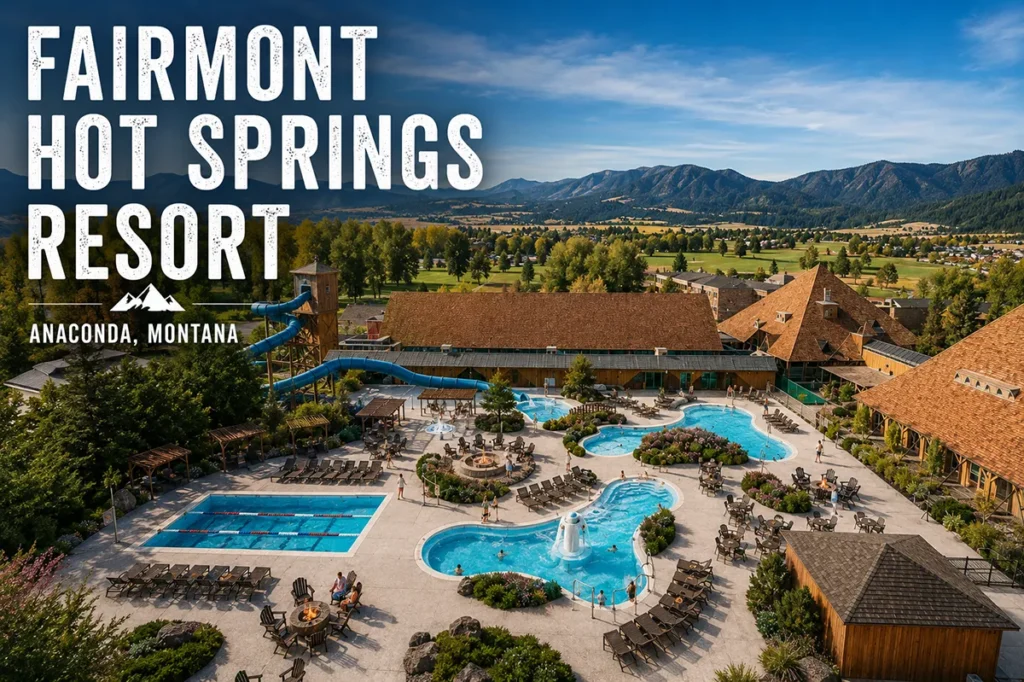
The most developed hot springs near Butte, Fairmont Hot Springs Resort offers four pools (ranging from cool to hot), two waterslides, full resort accommodations, and golf. It connects to Butte via the Copperway Trail and to Anaconda by a short drive.
Not rustic — this is a proper resort — but an excellent decompression option after days of urban history in Butte.
27. Lewis and Clark Caverns State Park (45 min east)
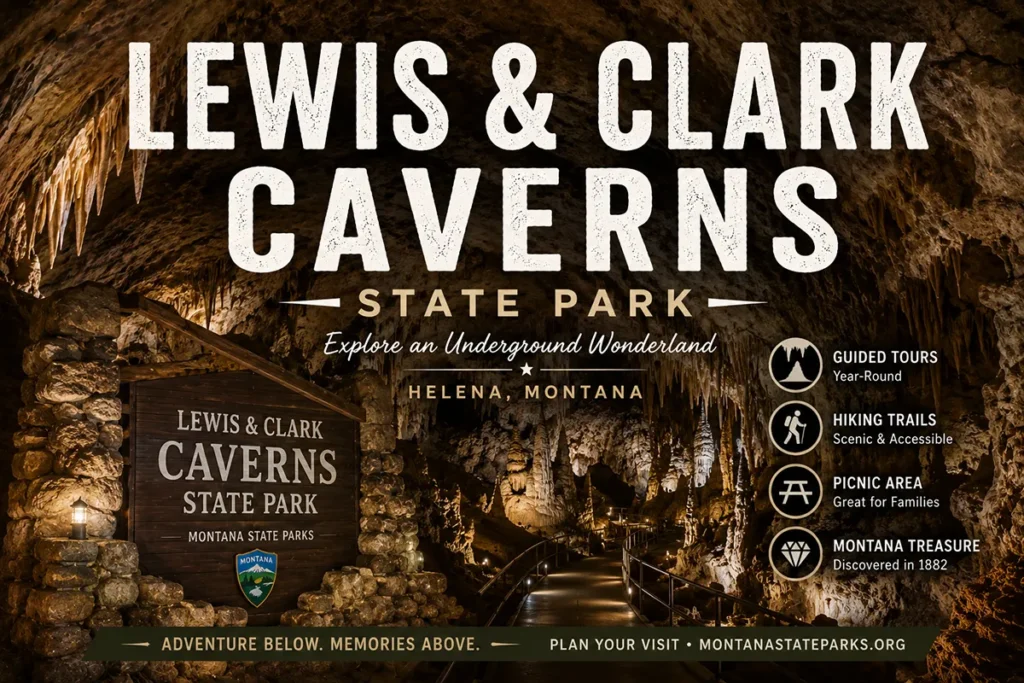
One of Montana’s finest cave systems, with guided cave tours from late April through October. The limestone caverns formed over millions of years and were named for Lewis and Clark’s passage through the area. The contrast between Butte’s industrial landscape and the cavern’s geological delicacy is striking.
See my Montana ghost towns guide for context on the region’s broader history.
28. Montana Zipline Adventures (near Anaconda)
Seven zipline courses ranging from 650 to 2,100 feet, with views of the Pintler Wilderness. Located just outside Anaconda — 30 minutes from Butte. Good for families and groups who want active adventure outside the historic district.
Larger groups should expect 2+ hours. [Verify current availability and booking at montanaziplines.com.]
Winter Activities in Butte
29. Discovery Ski Area
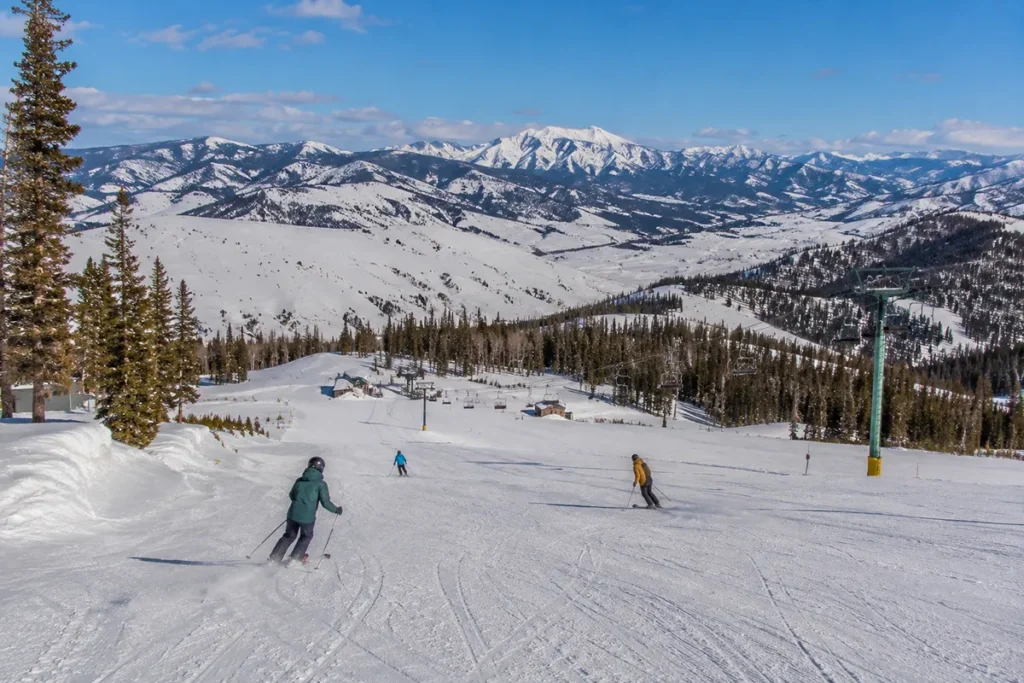
Butte’s local mountain is one of Montana’s best-kept skiing secrets. Discovery Ski Area offers 2,200 acres of skiable terrain, over 600 vertical feet of expert-level drops, and lift ticket prices that are a fraction of Montana’s better-known resorts.
The crowd density reflects the city’s modest tourism profile — on a Saturday in January you can ski runs that would have hour-long lift lines at Big Sky.
Discovery is an independent resort with strong local loyalty and a no-frills approach that serious skiers appreciate.
For the full Montana ski comparison, see my Montana ski resorts guide.
30. Snowmobiling and Winter Trails
The Continental Divide trail system around Butte opens up significant snowmobiling terrain in winter. 13 trailheads accessible year-round also serve winter users for snowshoeing and cross-country skiing.
31. Ice Fishing
Georgetown Lake (45 minutes west of Butte near Anaconda) and several area reservoirs offer winter ice fishing. A quieter Butte-area experience that locals treat as an essential cold-weather ritual.
Things to Do in Butte by Traveler Type
For History Enthusiasts
- World Museum of Mining + underground tour (non-negotiable)
- Berkeley Pit (non-negotiable)
- Mai Wah Museum (Chinese heritage)
- Copper King Mansion
- Butte Trolley Tour (first, to orient)
- Dumas Brothel Museum (unflinching history)
- “1923” TV filming locations walk
For Families
- World Museum of Mining (kid-friendly, outdoor exploration)
- Our Lady of the Rockies bus tour
- Montana Tech Mineral Museum (free, engaging for curious kids)
- Ridge Waters Water Park (summer)
- Montana Zipline Adventures
For Food Lovers
- Pork Chop John’s (required)
- Pekin Noodle Parlor (historic institution)
- Pasties at Joe’s or Gamer’s
- Cleveland Market (coffee + local food)
- M&M Cigar Store (history + a beer)
For Outdoor Adventurers
- Copperway Trail (Butte to Anaconda to Fairmont Hot Springs)
- Continental Divide trail system (13 trailheads)
- Fly fishing the Big Hole River
- Discovery Ski Area (winter)
- Montana Zipline Adventures (near Anaconda)
For Rainy Days
- World Museum of Mining (largely sheltered)
- Copper King Mansion tour (indoor)
- Mother Lode Theatre (check performance schedule)
- Mai Wah Museum
- Pekin Noodle Parlor + afternoon at the M&M Cigar Store
- Clark Chateau and the Archives
For Budget Travelers (Free or Very Low Cost)
- Berkeley Pit observation ($3)
- Walking Uptown Historic District (free)
- Montana Tech Mineral Museum (free)
- “1923” filming locations self-guided walk (free)
- Evel Knievel grave, Mountain View Cemetery (free)
- Continental Divide trailheads (free)
Practical Planning
Getting to Butte: Butte is at the junction of I-90 and I-15 — the single most important highway intersection in Montana. From Missoula: 1.5 hours east on I-90. From Bozeman: 1 hour west on I-90. From Helena: 65 miles south on I-15 (1 hour).
Butte Logan International Airport (BTM) has limited commercial service; most visitors drive in or fly into Bozeman or Missoula and drive.
How long to stay: 2 days minimum to cover the World Museum, Berkeley Pit, Uptown historic district, and at least one excellent meal. 3 days adds day trips to Anaconda, Fairmont Hot Springs, and Lewis and Clark Caverns.
Where to stay: Uptown Butte has the Copper King Mansion B&B for history-focused travelers; the Finlen Hotel (1924) is another historic option. Chain hotels cluster near the I-90/I-15 interchange.
A car is required. Butte’s attractions spread across the city and surrounding area.
For seasonal context, see my best time to visit Montana guide.
Explore More Montana Cities
Montana has a lot of ground to cover. Whether you’re building a road trip route or just curious what the next town down the highway has to offer, here are the city guides we’ve put together so far:
- Things to Do in Bozeman, Montana — Montana’s fastest-growing city, with great restaurants, the Museum of the Rockies, and easy access to Gallatin Canyon and Big Sky.
- Things to Do in Livingston, Montana — The original Yellowstone gateway; a fly fishing capital with a surprising arts scene, vintage neon downtown, and the Absaroka Mountains as a backdrop.
- Things to Do in Whitefish, Montana — The gateway to Glacier National Park, with a walkable downtown, ski resort access at Whitefish Mountain, and Whitefish Lake on the edge of town.
- Things to Do in Kalispell, Montana — The commercial hub of the Flathead Valley; close to Glacier, Flathead Lake, and some of the best scenic drives in northwest Montana.
- Things to Do in Bigfork, Montana — A small arts village on Flathead Lake that punches above its size with galleries, live theater, and excellent waterfront dining.
- Things to Do in Butte, Montana — One of Montana’s most historically layered cities; mining heritage, Victorian architecture, and a working-class character that’s entirely its own.
- Things to Do in Helena, Montana — Montana’s compact, walkable capital; the state capitol building, Last Chance Gulch, and the Cathedral of Saint Helena are all within easy reach downtown.
- Things to Do in Dillon, Montana — A quiet southwestern Montana town with serious fly fishing access on the Beaverhead River and a pace that feels far removed from the tourist trail.
- Things to Do in Polebridge, Montana — Glacier’s remote northwest corner; no cell service, no power grid, a legendary bakery, and some of the most untouched backcountry in the park.
- Things to Do in Miles City, Montana — Eastern Montana’s cowboy capital, home to the Bucking Horse Sale and a historic downtown that hasn’t changed much since the cattle drives.
- Libby, Montana Guide — A timber town in the far northwest tucked along the Kootenai River, with Kootenai Falls and the Cabinet Mountains Wilderness on its doorstep.
Final Thoughts on Butte
Butte is the Montana that most Montana visitors never reach, which is exactly why it’s worth seeking out. The headframes on the hillside. The curtained booths at Pekin Noodle Parlor.
The sobering walk to the Berkeley Pit observation stand. The Irish pubs on Mercury Street in March. A pork chop sandwich from a takeaway window that’s been serving the same thing for decades.
Butte doesn’t perform its history for tourists. It just lives it. That authenticity is increasingly rare, and it’s the reason people who go to Butte once keep going back.
Questions about Butte? Drop them in the comments.
Frequently Asked Questions
What are the best things to do in Butte MT?
Butte’s essential experiences: the World Museum of Mining and underground Orphan Girl Mine tour (allow 3+ hours), the Berkeley Pit observation ($3), a 2-hour Butte Trolley Tour (summer), Copper King Mansion, the Mai Wah Museum, Pekin Noodle Parlor (open since 1911), Pork Chop John’s sandwich, Our Lady of the Rockies bus tour (summer), the “1923” TV show filming locations walk, and Discovery Ski Area in winter.
How many days do I need in Butte MT?
Plan at least 2 days: Day 1 for the World Museum, Berkeley Pit, and Uptown historic district. Day 2 for the Butte Trolley Tour, Copper King Mansion, food circuit (Pork Chop John’s, Pekin Noodle Parlor, M&M Cigar Store), and Mother Lode Theatre in the evening. A third day allows for day trips to Anaconda, Fairmont Hot Springs, or Lewis and Clark Caverns.
What is Butte MT known for?
Butte is known as “the Richest Hill on Earth” — the copper mining capital that helped power America’s electrification in the late 1800s. Today it’s known for its extraordinary National Historic Landmark District (Victorian architecture), the Berkeley Pit Superfund site, the World Museum of Mining, Montana’s strongest St. Patrick’s Day celebration (its population was historically 25% Irish), and as the birthplace of Evel Knievel. The Paramount TV series 1923 films here because the city “literally feels like the 1920s.”
What is the Berkeley Pit in Butte MT?
The Berkeley Pit is a former open-pit copper mine that operated from 1955 to 1982, creating a 900-foot-deep excavation that is now slowly filling with toxic water containing copper compounds, arsenic, zinc, and heavy metals. It’s officially a Superfund site monitored 24/7 to prevent groundwater contamination. A viewing platform costs about $3 to access. Snow geese that land on the water die. It’s a riveting, honest testament to industrial extraction’s legacy and consistently among Butte’s most-visited attractions.
Is Butte Montana worth visiting?
Yes — emphatically. Butte is Montana’s most historically distinctive city and one of the most honest industrial heritage destinations in the American West. It’s not polished for tourists; it doesn’t need to be. The World Museum of Mining, Berkeley Pit, Pekin Noodle Parlor (the oldest continuously-operating Chinese restaurant in the US), Copper King Mansion, and the sheer scale of the Victorian architecture are experiences genuinely unavailable elsewhere. Budget 2–3 days.
What is the oldest Chinese restaurant in America?
The Pekin Noodle Parlor in Butte, Montana, which has been in continuous operation since 1911, is recognized as the oldest continuously-operating Chinese restaurant in the United States. It’s reached by a long flight of stairs, with curtained booth seating and a classic Chinese-American menu that hasn’t changed substantially in decades. Atlas Obscura rates it among Butte’s top unusual attractions.
Does Butte Montana have good skiing?
Yes — Discovery Ski Area outside Butte offers 2,200 acres of terrain, expert-level drops, and lift ticket prices significantly below Montana’s better-known resorts. The lack of major tourism infrastructure means the slopes are genuinely uncrowded by major-resort standards. For the full Montana ski comparison, see my Montana ski resorts guide.