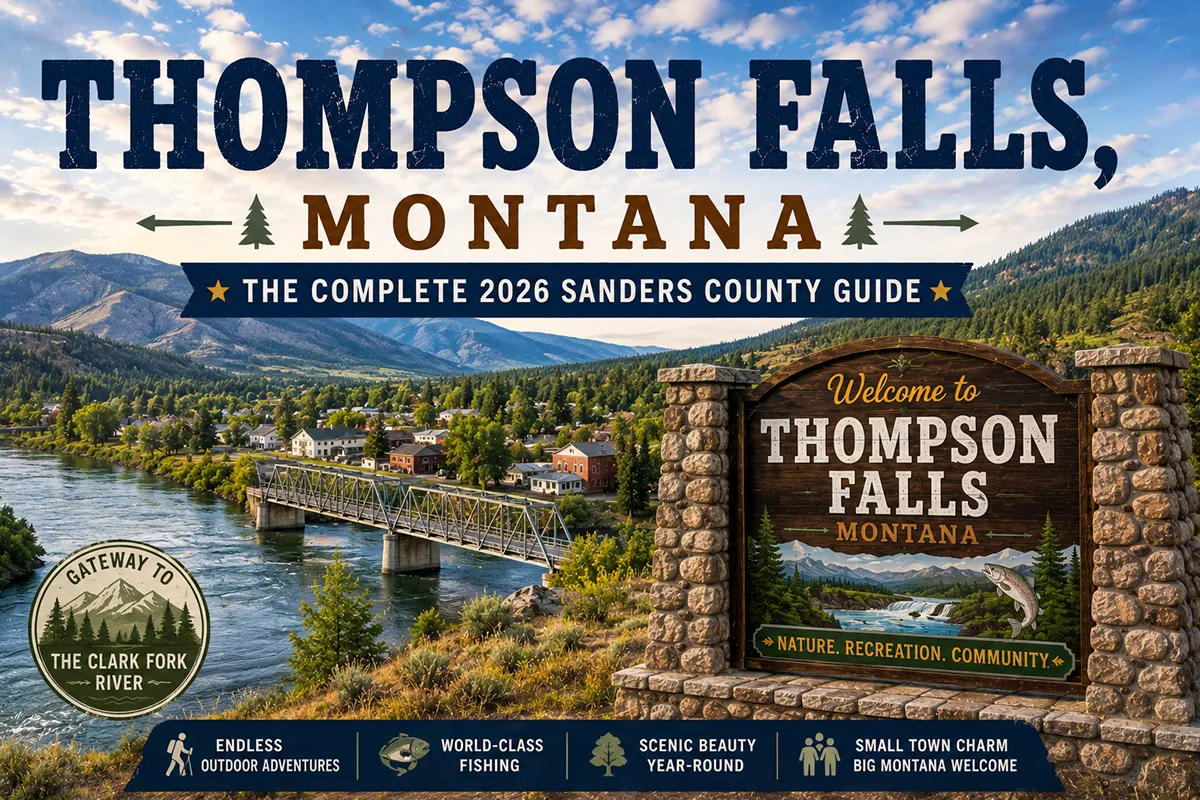
David Thompson — the British-Canadian fur trader, surveyor, and mapmaker — passed through this stretch of the Clark Fork River in 1809, more than 80 years before the railroad arrived and a town developed at the falls he documented.
The town that eventually formed at his namesake falls became the county seat of Sanders County and a hydroelectric power center after the 1915 construction of the Thompson Falls Dam.
Today it’s a quiet northwest Montana community on Highway 200 between Missoula and Idaho — a gateway, not a destination, but with a quiet character that rewards travelers who stop.
TL;DR
- Thompson Falls (~1,300) is the county seat of Sanders County in northwest Montana, on Highway 200 along the Clark Fork River.
- Named for David Thompson, the legendary British-Canadian explorer and mapmaker who documented the area in 1809.
- Thompson Falls Dam (built 1915, one of the oldest hydroelectric dams on the Clark Fork) shaped the modern town.
- Thompson Falls State Park offers camping, river access, and excellent wildlife viewing.
- The Old Jail Museum (1908) is a distinctive small-town history experience.
- Best for: Highway 200 travelers between Missoula and Idaho, anglers, history travelers, and quiet northwest Montana road trippers.
Liked this article?
Add Roaming Montana as a preferred source so you see more of our articles and guides on Google.
Thompson Falls at a Glance
| Population (2020) | ~1,300 |
|---|---|
| County | Sanders County (county seat) |
| Region | Northwest Montana |
| Elevation | 2,464 ft |
| River | Clark Fork River |
| Distance to Missoula | ~100 miles east (~1.75 hours) |
| Distance to Idaho border | ~25 miles west |
| Distance to Sandpoint, ID | ~75 miles west (~1.25 hours) |
| Best for | Highway 200 road trips, Clark Fork fishing, Sanders County history, quiet northwest Montana base |
What Makes Thompson Falls Different
Sanders County is one of Montana’s least-developed counties — a long, narrow county strip along the Clark Fork River corridor between Missoula and the Idaho border, dominated by national forest and tribal lands.
Thompson Falls grew as the natural service center for this corridor and as the operational base for the hydroelectric facilities on the Clark Fork.
The river here is shaped by dams. Thompson Falls Dam (1915), Noxon Rapids Dam (1959), and Cabinet Gorge Dam (1952, just over the Idaho border) together created a series of reservoirs that transformed the once-wild river corridor into a managed hydroelectric system.
The dams provide significant clean power to the Northwest grid; they also fundamentally altered the river’s character and significantly impacted fisheries.
The town today has a relaxed Pacific Northwest character — wetter and milder than most of Montana, with dense forests and a low-elevation valley that’s notably warmer than typical Montana winters.
For broader trip context, see my Montana cities and towns hub.
The Top 10 Things to Do In & Around Thompson Falls
1. Thompson Falls State Park
A 38-acre park on the Clark Fork River — camping, fishing access, hiking, and excellent wildlife viewing. A signature feature is the fish ladder at Thompson Falls Dam (the only fish ladder in Montana), built to allow native bull trout to pass the dam. Visitors can sometimes watch fish moving through the ladder during migration season.
2. The Old Jail Museum
Sanders County’s original 1908 jail, repurposed as the county history museum. Excellent collection covering Sanders County’s frontier era, the railroad, the dam construction, and Indigenous heritage. The historic jail cells are part of the museum experience. Free admission. Plan an hour.
3. Clark Fork River Fishing
The Clark Fork above and below Thompson Falls Dam offers different fishing experiences. The tailwater below the dam is the most productive section for rainbow trout and bull trout (the latter catch-and-release only). Multiple public fishing access sites along Highway 200.
4. Wild Horse Plains (Plains, Montana — 30 minutes east)
The community of Plains, 30 minutes east of Thompson Falls, was named for the herds of wild horses that grazed in the valley before settlement. Worth a short visit; the Old Jail Museum in Plains complements the one in Thompson Falls.
5. Cabinet Gorge & Noxon Reservoir
The reservoirs created by Noxon Rapids Dam (Noxon Reservoir) and Cabinet Gorge Dam (Cabinet Gorge Reservoir) west of Thompson Falls toward the Idaho border offer boating, fishing, and scenic drives. Highway 200 follows the reservoirs through dramatic forested mountain terrain.
6. Cabinet Mountains Wilderness Access (north)
The Cabinet Mountains Wilderness is accessible via Forest Service roads north of Thompson Falls — 94,000+ acres of rugged peaks and grizzly bear habitat. Serious wilderness; requires preparation. See Libby guide for full Cabinet Mountains context.
7. Lower Clark Fork Watershed Scenic Drive
Highway 200 from Thompson Falls west to the Idaho border follows the Clark Fork through a series of reservoirs and forest. One of Montana’s quieter scenic drives — dramatic mountain scenery with minimal traffic.
8. Bald Eagle Watching (Winter)
The reservoirs around Thompson Falls attract significant bald eagle populations in winter — sometimes hundreds of eagles concentrated along the open water below the dams. December and January are peak.
9. Saint Paul Lake (north on FS roads)
A small alpine lake in the Cabinet Mountains north of Thompson Falls — accessible via Forest Service roads and a short hike. Quiet, beautiful, undeveloped.
10. Day Trip to Sandpoint, ID (1.25 hours)
Sandpoint on Lake Pend Oreille is the major regional center to the west — full town amenities, lake recreation, Schweitzer Mountain ski resort. An easy day trip from Thompson Falls.
Where to Stay
| Hotel | Vibe | Price | Best For |
|---|---|---|---|
| Falls Motel (Thompson Falls) | Local motel, basic | $90–140 | Most travelers |
| River’s Bend Motel | Riverside setting | $100–160 | Couples |
| Thompson Falls State Park | Camping/RV sites | $20–35 | Campers |
| Vacation rentals (Sanders County) | Cabins, lake access | $130–280 | Families, longer stays |
| Sandpoint, ID (1.25 hours) | Full city options | $120–250 | More variety |
Where to Eat
- Granny’s Cafe — local breakfast/lunch institution
- Thompson Falls Bar & Grill — community gathering spot
- Lucky Lil’s Casino & Restaurant — casual American
- The Black Bear Diner — diner classics
Getting There
From Missoula: 100 miles west on Highway 200, about 1.75 hours.
From Sandpoint, ID: 75 miles east on Highway 200, about 1.25 hours.
From Kalispell: ~125 miles southwest via US-93 and Highway 200, about 2.25 hours.
When to Visit
Summer (June–August): Best for camping at Thompson Falls State Park, river recreation, full museum hours.
Fall (September–October): Excellent fishing season, fall colors in the river corridor, cooler weather.
Winter (December–February): Best for bald eagle viewing (concentrations of dozens to hundreds at the reservoirs). Mild compared to typical Montana winters.
Spring (April–May): Wildflowers, runoff conditions in the Clark Fork.
Personal Tips
The fish ladder is worth seeing. It’s the only one in Montana, and during migration periods you can sometimes watch native bull trout passing through. The state park interpretive signs explain the engineering and ecology.
Plan Highway 200 deliberately. This is one of Montana’s most scenic and least-traveled highways. Allow time for stops — the reservoirs, the Cabinet Mountains views, small communities along the route.
Winter is underrated for eagle watching. The concentration of bald eagles below the dams in December and January is extraordinary and rarely featured in Montana travel content.
Combine Thompson Falls with Plains. 30 minutes east, with complementary historical character and the Wild Horse Plains heritage.
Sandpoint is the urban escape. When Thompson Falls feels too small, Sandpoint to the west provides full Pacific Northwest town amenities and Lake Pend Oreille — one of the most beautiful lakes in the Inland Northwest.
Thompson Falls Quick Facts
| Named for | David Thompson, explorer/mapmaker (visited 1809) |
|---|---|
| Thompson Falls Dam | Built 1915, one of Montana’s oldest hydroelectric facilities |
| Old Jail Museum | 1908 original jail building |
| Fish ladder | The only one in Montana, at Thompson Falls Dam |
| Average summer high | 84°F |
| Average winter low | 19°F |
Conclusion
Thompson Falls is one of those northwest Montana towns that doesn’t try to be anything other than what it is — a small county seat on a working river, in a quiet corner of the state most travelers will never see. The state park, the Old Jail Museum, the bald eagle concentrations in winter, and the Highway 200 scenic corridor all reward the deliberate visitor. For travelers between Missoula and Idaho, it’s a worthy break.
Have a Thompson Falls question? Drop it in the comments — I read every one.
Frequently Asked Questions
Is Thompson Falls Montana worth visiting?
Worth a stop for travelers on Highway 200 between Missoula and Idaho. Thompson Falls State Park (with Montana’s only fish ladder), the Old Jail Museum, Clark Fork River fishing, and winter bald eagle concentrations at the reservoirs make it a genuinely worthwhile pause. As a standalone destination, it’s quieter than most travelers expect — best for travelers who appreciate small-town northwest Montana character.
Who was Thompson Falls named for?
Thompson Falls is named for David Thompson, a British-Canadian fur trader, surveyor, and mapmaker who explored the Clark Fork River region in 1809 — over 80 years before the actual town developed. Thompson is one of the most significant European explorers of the Pacific Northwest interior, having mapped vast portions of present-day British Columbia, Idaho, Montana, and Washington.
What is the Old Jail Museum in Thompson Falls?
The Old Jail Museum is housed in Sanders County’s original 1908 jail building, repurposed as the county history museum. Exhibits cover frontier-era settlement, the Northern Pacific Railroad, hydroelectric dam construction, and Indigenous heritage. The historic jail cells are part of the museum experience. Free admission.
How far is Thompson Falls from Missoula?
Thompson Falls is approximately 100 miles west of Missoula on Montana Highway 200 — about a 1.75-hour drive along the Clark Fork River corridor.
Does Thompson Falls have a fish ladder?
Yes — Thompson Falls Dam has the only fish ladder in Montana, built to allow native bull trout (a threatened species in the Pacific Northwest) to pass the dam during migration. The fish ladder is viewable from Thompson Falls State Park, and during migration periods, visitors can sometimes observe fish moving through the structure.
When is the best time to see bald eagles near Thompson Falls?
December and January typically bring the highest concentrations of bald eagles to the reservoirs near Thompson Falls. The open water below the hydroelectric dams attracts dozens to hundreds of eagles during these months. The viewing is best at the reservoir tailwaters and along Highway 200.