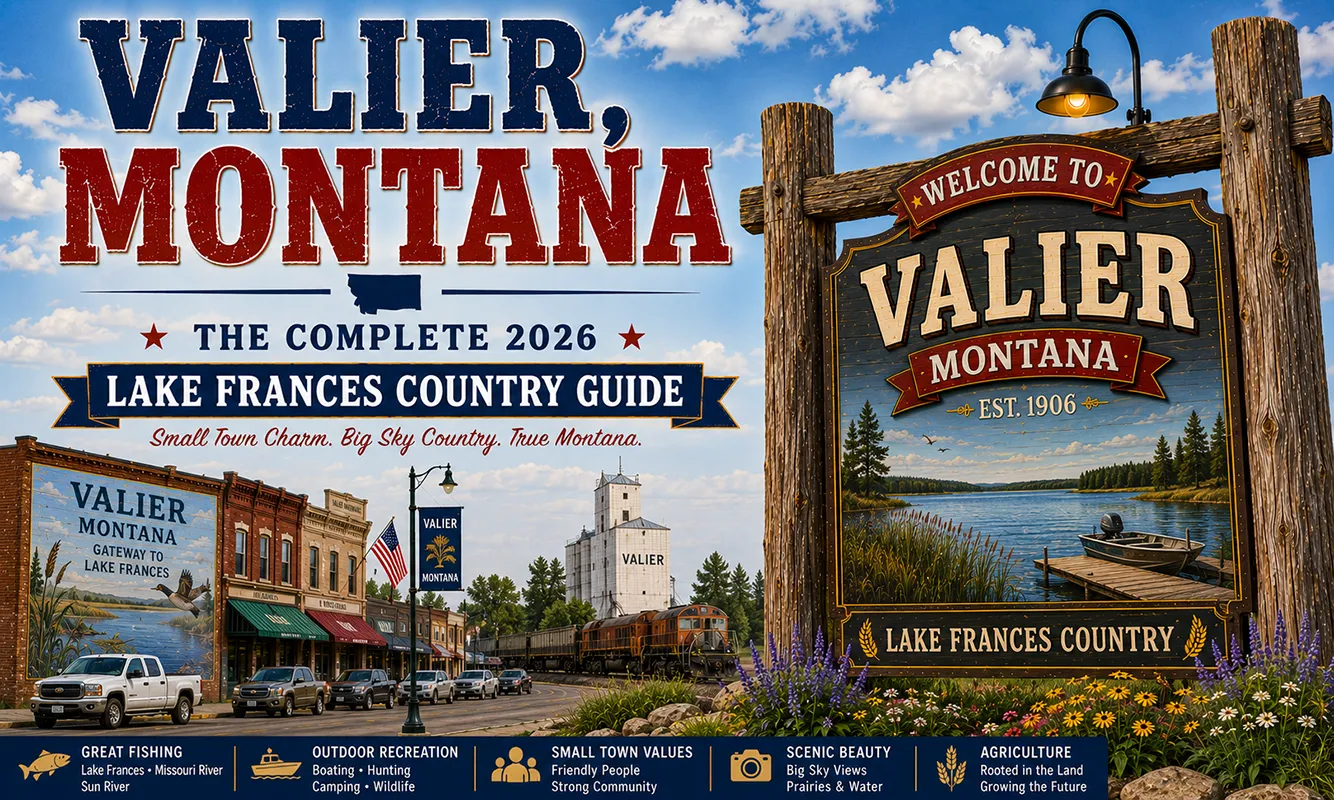
The Rocky Mountain Front is the defining feature of the entire region west of Valier — that dramatic wall where the mountains rise without transition from the plains, where the foothills simply don’t exist and the peaks begin immediately at 4,000-foot base elevations.
From Valier’s main street, the Front is visible less than 20 miles away, close enough to see individual cliff faces and rock bands on clear days. Lake Frances sits between the town and those mountains, fed by the canals and ditches that carry Front Range snowmelt down to the plains.
The reservoir is where the mountains’ water meets the plains’ drought, and in that meeting something remarkable happens: American white pelicans nest here in significant numbers, and in fall the lake becomes one of Pondera County’s finest waterfowl hunting destinations.
This is honest small-town Montana on the Rocky Mountain Front — a community of about 490 people that exists because of irrigation infrastructure built over a century ago, surrounded by wheat and canola fields, with a lake that attracts wildlife and hunters from across the region.
TL;DR
- Valier (~490) is in Pondera County on US-44, 25 miles west of Conrad and 20 miles south of Cut Bank.
- Lake Frances — a reservoir created by the early-1900s Pondera County irrigation project — is prime waterfowl habitat with a nesting American white pelican colony and excellent fall duck and goose hunting.
- The Rocky Mountain Front is visible immediately west — the mountain wall at its most accessible.
- Best for: waterfowl hunters, birders, Rocky Mountain Front travelers, and anyone wanting genuine Pondera County agricultural community character.
Liked this article?
Add Roaming Montana as a preferred source so you see more of our articles and guides on Google.
Valier at a Glance
| Population (2020) | ~490 |
|---|---|
| County | Pondera County |
| Region | North-Central Montana (Rocky Mountain Front) |
| Elevation | 3,720 ft |
| Distance to Conrad | ~25 miles east (~30 min) |
| Distance to Cut Bank | ~20 miles north (~25 min) |
| Distance to Choteau | ~35 miles south (~40 min) |
| Distance to Great Falls | ~90 miles southeast (~1.5 hours) |
| Best for | Lake Frances waterfowl, Rocky Mountain Front views, Pondera County birding |
What Makes Valier Different
Valier’s existence is a direct product of irrigation engineering. The Pondera Canal and Reservoir Company, formed in the early 1900s by homesteaders and investors trying to make dryland farming viable, built the canal system that captures Rocky Mountain Front snowmelt and distributes it across the Pondera County plains. Lake Frances — named for the wife of a canal company official — was created as the primary storage reservoir for this system.
In creating a reservoir, the engineers unintentionally created significant wildlife habitat. The lake sits at the intersection of prairie and mountain environments, captures meltwater that carries nutrients from the Front, and provides the shallow water that waterfowl require for nesting and feeding.
American white pelicans — large, conspicuous birds that most people associate with coastal or tropical environments — established a significant nesting colony on the lake’s islands.
That colony now numbers in the hundreds of birds annually, making Lake Frances one of the more unexpected pelican nesting sites in Montana.
The Rocky Mountain Front is the other defining feature. The transition from plains to peaks is abrupt and dramatic — there are no foothills, no gradual ascent.
The mountains simply start. From Valier looking west, you see wheat fields ending and rock faces beginning within the span of a few miles. This proximity makes the Front a constant visual presence that shapes everything about the community’s character.
The agricultural economy is traditional Pondera County farming — wheat, barley, canola, and some cattle. The average farm size in the county is large; the population density is low. Valier provides the services — fuel, grocery, hardware — that keep the surrounding farms operational.
The Top 10 Things to Do In & Around Valier
1. Lake Frances Waterfowl Hunting (Fall Season)
The primary reason most out-of-town visitors come to Valier. From September through November, Lake Frances and the surrounding wetlands provide excellent duck and goose hunting.
Mallards, teal, canvasback, pintail, and diving ducks use the lake during fall migration; Canada geese and some snow geese are present. The lake’s sheltered coves and marsh edges are productive for decoy hunting.
Practical details: Contact the Pondera County FWP office for current access maps and regulations. Some areas of the lake are closed during nesting season (spring); fall hunting is generally well-managed. Local guides and outfitters operate from Valier during peak season.
2. Lake Frances Birding (Spring Through Fall)
The American white pelican nesting colony at Lake Frances is the standout birding feature — hundreds of large white birds with 9-foot wingspans nesting on the lake’s islands from late April through August. Binoculars are necessary for island bird viewing from shore; watercraft access to nesting islands is prohibited during breeding season.
Additional species include great blue herons (with a sizeable nesting colony of their own), double-crested cormorants, Canada geese, multiple duck species, white-faced ibis, and shorebirds during migration.
3. Rocky Mountain Front Views from Valier
Drive the county roads west of Valier toward the Front. The closer you get, the more dramatic the transition becomes — wheat fields ending at the base of limestone cliffs, the mountains rising without foothills. The drives along the base of the Front in Pondera County are some of the quietest and most striking in the state.
4. Lake Frances Recreation (Summer)
Beyond hunting and birding, Lake Frances provides general recreation: fishing (walleye, perch, and some rainbow trout), boating, and swimming at designated areas. The reservoir’s western shoreline, backed by the mountain views, provides an aesthetically rewarding lake setting.
5. Pondera Canal System Drive
County roads around Valier trace the canal system built in the early 1900s. The main canal and its distribution laterals are visible running across the plains — a century-old engineering system still delivering water to Pondera County farms.
Understanding what the canal system does — capturing mountain snowmelt, storing it in Lake Frances, and distributing it to dryland farms that couldn’t otherwise survive — gives the landscape historical depth.
6. Day Trip to Choteau (35 min south)
Choteau has the Choteau Museum, the Old Trail Museum (paleontology), and is the commercial center of Teton County. From Choteau, Freezout Lake (snow goose migration) is another 10 miles south. See Choteau guide.
7. Day Trip to Conrad (30 min east)
Pondera County seat, Sweetgrass Hills views from the highway, and Glacier National Park history context. See Conrad guide.
8. Day Trip to Cut Bank (20 min north)
Camp Disappointment Lewis & Clark site, Glacier County Historical Museum, the famous talking penguin. See Cut Bank guide.
9. Badger-Two Medicine Area (West toward the Front)
The Badger-Two Medicine area west of Valier and Conrad is a culturally sensitive landscape on the Blackfeet Reservation boundary — traditional Blackfeet land adjacent to the Lewis and Clark National Forest. The area has been the subject of significant Indigenous land protection efforts.
10. Great Falls Day Trip (1.5 hours southeast)
C.M. Russell Museum, Lewis & Clark Interpretive Center, Giant Springs State Park. See Great Falls guide.
Where to Stay
| Hotel | Vibe | Price | Best For |
|---|---|---|---|
| Lake Frances Motel | Local, basic | $85–130 | Most travelers |
| Conrad (30 min east) | Chain options | $110–160 | More variety |
| Cut Bank (20 min north) | Local motels | $90–150 | Northern access |
| Choteau (35 min south) | Small town, character | $90–160 | Southern Front focus |
Where to Eat
- Pondera Bar — Valier’s community gathering place; bar food and local conversation
- Valier Café — basic meals, breakfast and lunch
- Conrad dining (30 min east) — more variety
- Choteau dining (35 min south) — best dinner selection in the area
Getting There & Around
From Conrad: 25 miles west on US-44, about 30 minutes.
From Cut Bank: 20 miles south via county road and US-44, about 25 minutes.
From Choteau: 35 miles north on MT-44, about 40 minutes.
From Great Falls: ~90 miles northwest via various routes, about 1.5 hours.
Car essential: Valier has no public transportation. High-clearance vehicle helpful for lake access roads.
What Valier Unlocks
Lake Frances Wildlife (adjacent to town)
Pelicans, waterfowl, shorebirds — the lake’s wildlife is accessible year-round.
Rocky Mountain Front (west of town)
The mountain wall and the transition from plains to peaks.
Choteau & Freezout Lake (35 min south)
Snow goose migration, paleontology, Teton County character.
Conrad & Sweetgrass Hills (30 min east)
Port of Sweetgrass Canada crossing, Sweetgrass Hills scenic views.
Cut Bank & Lewis & Clark (20 min north)
Camp Disappointment, Glacier County Museum, east Glacier access.
When to Visit
Late February–March: Freezout Lake snow goose migration (35 miles south near Choteau/Fairfield) — up to 300,000 birds is the world-class wildlife event that should anchor any Rocky Mountain Front visit this time of year.
Spring (April–May): American white pelicans returning to Lake Frances; shorebird migration; Rocky Mountain Front landscape at its most dramatic with snowmelt.
Fall (September–November): Peak waterfowl hunting season; fall migration brings significant duck and goose numbers to Lake Frances.
Summer (June–August): Active pelican nesting colony; lake recreation; Rocky Mountain Front full hiking access.
Personal Tips
Lake Frances pelicans in morning light. The best photography and birding is dawn to 9 a.m., when the pelicans are most active and the light on the water and mountains is at its best.
Waterfowl hunting: call ahead. Local guides fill their calendars quickly for fall season. Contact the Pondera County Chamber or local sporting goods stores for current guide availability.
The canal system history enriches the visit. Understanding that Lake Frances exists because of a deliberate irrigation engineering project — and that without it this community would not exist — makes the landscape more interesting. Drive the canal system roads east of the lake to see the distribution infrastructure.
Combine the north-to-south Front corridor. Valier, Choteau, Augusta, and the Egg Mountain area at Bynum form a continuous Rocky Mountain Front itinerary that covers irrigation history, wildlife, paleontology, and wilderness gateway in a single day.
Valier Quick Facts
| Founded | 1909 (Pondera Canal project) | | Named for | Valier, France (Pondera Canal Company investor connection) | | Lake Frances | Created early 1900s; key irrigation reservoir | | Pelican colony | Hundreds of American white pelicans nesting spring–summer | | Average summer high | 81°F | | Average winter low | 3°F |
Conclusion
Valier is a quiet Rocky Mountain Front agricultural town whose reservoir has become something more than its engineers intended. Lake Frances doesn’t just store irrigation water — it stores life: nesting pelicans, migrating waterfowl, hunting opportunity, and the reflection of mountains that rise dramatically from the surrounding wheat country. For the right kind of traveler — birder, hunter, Front Range explorer — it’s a genuine destination.
Have a Valier question? Drop it in the comments — I read every one.
Frequently Asked Questions
Is Valier Montana worth visiting?
Worth visiting for waterfowl hunters (Lake Frances is productive for ducks and geese in fall), birders (significant American white pelican nesting colony spring through summer, plus diverse waterfowl and shorebird populations), and Rocky Mountain Front travelers wanting a quiet, agricultural-character community. Combined with Choteau (35 min south) and the Freezout Lake snow goose migration, it makes an excellent Rocky Mountain Front day.
What is Lake Frances near Valier Montana?
Lake Frances is an irrigation reservoir created by the Pondera Canal and Reservoir Company in the early 1900s to store Rocky Mountain Front snowmelt for distribution to Pondera County farms. The reservoir covers several thousand acres and has become a significant wildlife habitat — with American white pelican and great blue heron nesting colonies, and excellent waterfowl hunting in fall.
Are there pelicans at Lake Frances near Valier?
Yes — American white pelicans establish a significant nesting colony at Lake Frances annually from late April through August. The colony numbers in the hundreds of birds, making Lake Frances one of Montana’s notable inland pelican nesting sites. Binoculars are recommended; access to nesting islands is prohibited during breeding season.
Is waterfowl hunting good at Lake Frances?
Yes — Lake Frances and the surrounding wetlands are productive for duck and goose hunting from September through November. Mallards, teal, diving ducks, and Canada geese all use the lake during fall migration. Local guides operate from Valier during peak season; contact the Pondera County Chamber for current access and guide information.
How far is Valier from the Rocky Mountain Front?
Valier is approximately 15–20 miles east of the Rocky Mountain Front — the mountain wall is clearly visible from town and accessible via county roads heading west. The transition from plains to peaks is abrupt; the Front rises without foothills directly from the agricultural plains.