The opening of the Gallatin Gateway Inn on June 27, 1927 was a bigger deal in Gallatin County than Lindbergh’s flight across the Atlantic.
That’s not hyperbole. The crossing happened on May 20-21, 1927 — about a month before the Inn’s opening. By the time the Milwaukee Road’s new Spanish Colonial Revival hotel cut its ribbon, local newspapers had moved on. Ten thousand people came for lunch that day. Two thousand attended the gala ball that evening. Gallatin County reportedly had its first traffic jam.
The Inn was the most ambitious single piece of tourist architecture built in Montana in the 1920s.
The Milwaukee Road — formally the Chicago, Milwaukee, St. Paul and Pacific Railroad — built it to compete for Yellowstone-bound passenger traffic. The Northern Pacific had the park’s North Entrance. The Union Pacific had West Yellowstone.
The Milwaukee had nothing closer than its mainline 100+ miles north at Three Forks. The solution was to build an electrified branch line from Three Forks south to a sawmill town called Salesville, build a luxury hotel there, and run motor coaches from the hotel up the spectacular Gallatin Canyon to the park’s west entrance.
The hotel opened. The branch line ran. The Milwaukee’s Olympian and Columbian trains brought passengers from Chicago, Minneapolis, and Seattle. For about a decade, Gallatin Gateway worked exactly as planned.
Then automobiles and buses replaced trains for Yellowstone tourism. The Milwaukee Road declared bankruptcy in 1980 — by coincidence, just one month after the Gallatin Gateway Inn was listed on the National Register of Historic Places.
The Inn changed hands multiple times, closed in 2013, reopened, closed again, and reopened again. As of 2026, it operates as a “Historic Hotels of America” property, restored to most of its 1927 grandeur.
The community of Gallatin Gateway today has about 789 residents.
It sits 12 miles southwest of Bozeman at the entrance to Gallatin Canyon — the doorway to the US-191 corridor that leads south to Big Sky (35 miles) and continues to West Yellowstone (80 miles), Yellowstone National Park’s west entrance.
TL;DR
- Gallatin Gateway (~789) sits at the entrance to Gallatin Canyon, 12 miles southwest of Bozeman on US-191.
- The community was originally called Slabtown (1865 sawmill nickname), then Salesville (1883, for owner Zachariah Sales), then renamed Gallatin Gateway in 1927.
- The Gallatin Gateway Inn — built by the Milwaukee Road in 1927 to serve Yellowstone-bound passengers — is Spanish Colonial Revival architecture by Seattle’s Schack, Young & Myers.
- NRHP listed January 24, 1980. Designated a “Historic Hotels of America” property.
- The Inn was the first hotel built and operated by the Milwaukee Road, with Philippine mahogany finish work and phone service in every room.
- US-191 south through Gallatin Canyon is one of America’s most scenic mountain highways, leading to Big Sky (35 mi) and West Yellowstone (80 mi).
- The Gallatin River runs through Gallatin Canyon with world-class fly fishing.
- Best for: Bozeman corridor travelers, Yellowstone-bound visitors, Big Sky-bound skiers, historic railroad hotel enthusiasts, and Gallatin River anglers.
Liked this article?
Add Roaming Montana as a preferred source so you see more of our articles and guides on Google.
Gallatin Gateway at a Glance
| Population (2020) | ~789 |
|---|---|
| County | Gallatin County |
| Status | Unincorporated community (CDP) |
| Region | Southwest Montana (Gallatin Valley) |
| Elevation | 4,941 ft |
| Distance to Bozeman | ~12 miles northeast (~15 min) |
| Distance to Big Sky | ~35 miles south via US-191 (~50 min) |
| Distance to West Yellowstone | ~80 miles south via US-191 (~1.75 hours) |
| Distance to Three Forks | ~20 miles west (~25 min) |
| Distance to Manhattan | ~25 miles northwest |
| Distance to Bozeman Yellowstone International Airport (BZN) | ~22 miles northeast |
| Best for | Yellowstone-bound travelers, Gallatin Canyon corridor, Bozeman alternative, historic Inn |
What Makes Gallatin Gateway Different
The town’s name evolution tells the whole story.
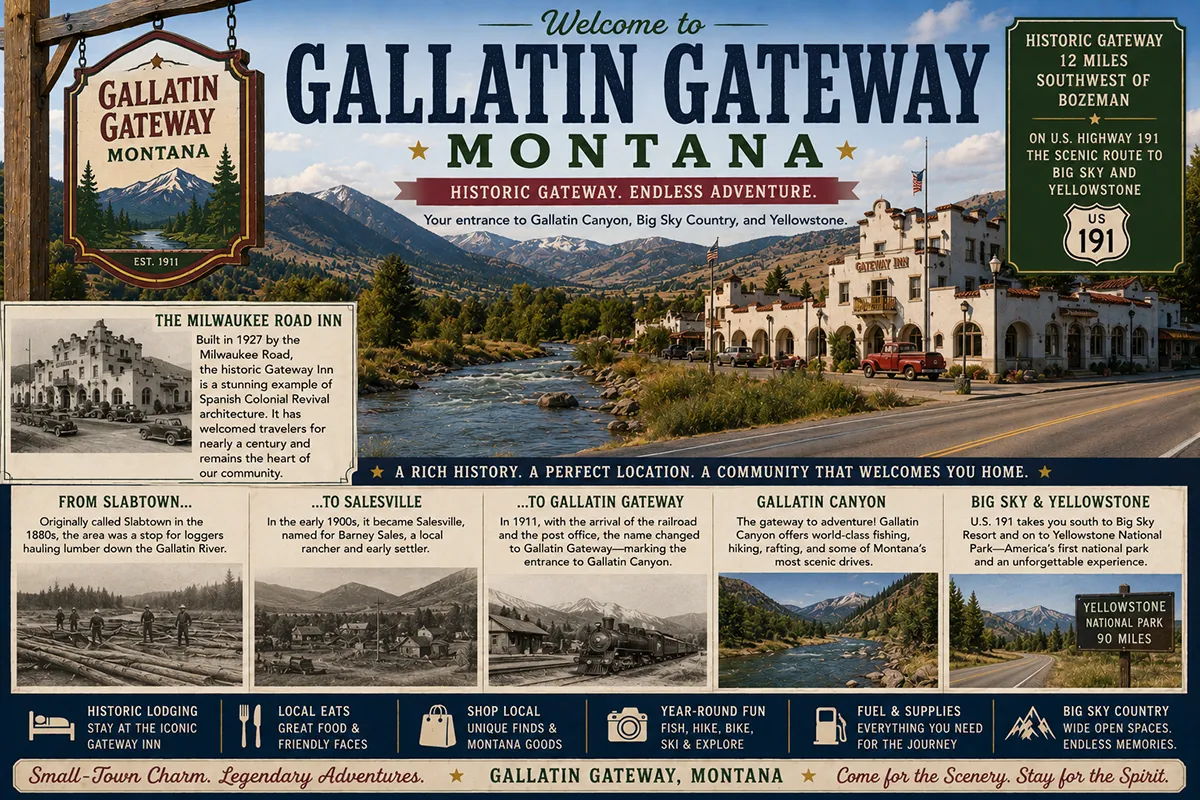
In 1865, a Wisconsin lumberman named Zachariah Sales came over the Bozeman Trail by wagon train and settled near the entrance to Gallatin Canyon. He built a sawmill at the canyon’s mouth, floating logs down from the Gallatin Canyon timber stands to his mill. A small community grew up around the operation. Locals called it Slabtown for the sawmill’s wood slab byproducts.
In 1883, the town formalized its name to Salesville, honoring Sales himself.
The community church was built in 1885 and used the Gallatin River for baptisms. A small post office had opened in 1880. The first school operated out of a log cabin near Wilson Creek beginning around 1884. By the 1920s, Salesville was a quiet farming and sawmilling community of a few hundred residents — exactly the kind of place a railroad could redefine.
The Milwaukee Road’s Yellowstone Play
The Milwaukee Road needed a Yellowstone strategy.
Its mainline route ran through Three Forks and Bozeman but never came closer than 100 miles to Yellowstone National Park. The Northern Pacific had the park’s North Entrance covered through Livingston and Gardiner. The Union Pacific had built the entire town of West Yellowstone at the West Entrance specifically to compete for Yellowstone passenger traffic.
The Milwaukee’s solution was elegant: build a 28-mile electrified branch line south from Three Forks to Salesville. Build a luxury hotel at the line’s terminus. Run motor coaches from the hotel up the Gallatin Canyon — one of the most scenic drives in North America — to the West Entrance.
The plan required serious money. The Inn’s construction alone cost approximately $250,000 in 1927 dollars. Seattle architects Schack, Young & Myers designed it in Spanish Colonial Revival style, which was decidedly unusual for Montana in that era.
Opening Day and Beyond
The Inn opened on June 27, 1927.
Ten thousand people came for lunch. Two thousand attended the gala ball that evening. Photographers documented the event. Gallatin County experienced what local papers described as its first traffic jam.
The Inn featured Philippine mahogany finish work, beamed ceilings, a grand ballroom, a dining room with narrow oak flooring, and stone fireplaces throughout.
The kitchen included an ice-cube cutter that made cubes precisely sized to the water glasses on the dining room tables. The Inn was among the first hotels in Montana to offer telephones in every guest room.
For about a decade, the operation succeeded. Then automobile travel and bus tourism replaced railroad passengers. The Milwaukee Road struggled financially through the Depression and World War II. By the 1950s, the Inn was deteriorating. It changed ownership multiple times through the 20th century.
The Inn was listed on the National Register of Historic Places on January 24, 1980 (NRHP reference 80002417). The Milwaukee Road declared bankruptcy approximately one month later.
The hotel has been restored extensively and currently operates as a “Historic Hotels of America” property. The original 1926 wooden archway that gave the town its name once stood at the canyon’s entrance just south of the Inn.
For broader trip context, see my Montana cities and towns hub.
The Top 10 Things to Do In & Around Gallatin Gateway
1. Gallatin Gateway Inn (Stay or Visit)
The signature attraction. Whether you stay overnight, eat in the restored dining room, walk the grounds, or simply photograph the exterior, the 1927 Spanish Colonial Revival hotel is worth time.
The dining room and lounge are typically open to the public during operating periods. Lodging rates vary by season; the hotel is significantly less expensive than equivalent-quality properties in Big Sky or downtown Bozeman.
Reservations recommended for dinner. Verify current operating status before traveling.
2. US-191 Gallatin Canyon Scenic Drive
The drive from Gallatin Gateway south through Gallatin Canyon to West Yellowstone is one of America’s most spectacular mountain highways.
The road follows the Gallatin River through dramatic canyon scenery for 80 miles, passing through Big Sky (35 miles south) and continuing to Yellowstone’s west entrance. Allow a full day for the round trip with stops.
3. Gallatin River Fly Fishing
The Gallatin is one of Montana’s classic trout rivers. Brown trout, rainbow trout, cutthroat, and whitefish are all present in good numbers.
Multiple public access sites along US-191 provide wade fishing. Local guides from Bozeman and Big Sky offer drift-boat trips on the lower sections. Montana fishing license required.
4. Day Trip to Bozeman (15 minutes northeast)
Montana’s fastest-growing city is just 15 minutes away.
Attractions include the Museum of the Rockies, Main Street historic district, Bozeman Hot Springs, and one of Montana’s best craft beer scenes — see Bozeman breweries and the best pizza in Bozeman guides.
For comprehensive Bozeman planning, see the Bozeman guide.
5. Big Sky Resort Day Trip (50 minutes south)
The largest ski resort in Montana — and one of the largest in the United States — is 35 miles south via US-191 through Gallatin Canyon.
In winter, world-class skiing on 5,800+ acres. In summer, mountain biking, hiking, scenic chairlift rides, and the access road to Yellowstone backcountry. See Big Sky guide.
6. Yellowstone National Park (West Entrance, 80 miles)
The full drive to Yellowstone via US-191 takes about 1.75 hours one way. The west entrance opens onto the geyser basins, including Old Faithful and the Grand Canyon of the Yellowstone.
The Grizzly and Wolf Discovery Center in West Yellowstone is a worthwhile stop for travelers who want guaranteed wildlife viewing. For wolf watchers, the Lamar Valley is accessible via the park’s northern loop, with details in my Yellowstone wolf watching guide.
7. Three Forks Day Trip (25 minutes west)
The community where the Madison, Jefferson, and Gallatin Rivers join to form the Missouri — the original Milwaukee Road mainline town where the Gallatin Gateway spur line originated.
Missouri River Headwaters State Park is here, with significant Lewis and Clark history. The Sacajawea Hotel is one of Montana’s most historic accommodations.
8. Hyalite Canyon Recreation (~45 minutes east via Bozeman)
The recreation area south of Bozeman in the Custer Gallatin National Forest. Multiple lakes, hiking trails, ice climbing in winter, and the Hyalite Reservoir.
One of the most-used recreation corridors in southwest Montana.
9. Norris Hot Springs (~45 minutes northwest)
A small historic hot springs west of Gallatin Gateway, near Norris on MT-84. Outdoor pool, restaurant, and live music on weekends.
See my Norris Hot Springs guide and the broader best natural hot springs in Montana overview.
10. Day Trip to Manhattan (25 minutes northwest)
The agricultural community at the heart of the Dutch Amsterdam-Churchill heritage corridor. The Manhattan Potato Festival in mid-August draws 7,000 visitors.
See Manhattan guide for full details.
Where to Stay
| Hotel | Vibe | Price | Best For |
|---|---|---|---|
| Gallatin Gateway Inn | Historic 1927 Spanish Colonial Revival | $200–400 | Historic hotel experience |
| Vacation rentals (Gallatin Gateway area) | Mix of ranch homes, cabins | $200–500 | Families, longer stays |
| Bozeman hotels (15 min NE) | Full selection | $150–350 | Most travelers |
| Big Sky lodging (50 min S) | Resort and condo options | $250–800+ | Skiers, mountain travelers |
| West Yellowstone lodging (1.75 hrs S) | Park gateway hotels | $180–400 | Yellowstone visitors |
| Gallatin Canyon RV parks | See Bozeman RV parks and Big Sky RV parks | $40–80 | RV travelers |
For broader RV options, see best RV parks in Montana.
Where to Eat
- Gallatin Gateway Inn dining room — historic setting; verify current operations and reservations
- Stacey’s Bar (Gallatin Gateway) — local gathering spot
- Bozeman dining (15 min NE) — extensive variety; see Bozeman pizza guide and best steakhouses in Montana
- Big Sky dining (50 min S) — mountain resort options
- Bozeman breweries — for craft beer enthusiasts
Getting There & Around
From Bozeman: 12 miles southwest on US-191, about 15 minutes.
From Bozeman Yellowstone International Airport (BZN): 22 miles southwest, about 25 minutes.
From Big Sky: 35 miles north on US-191, about 50 minutes through Gallatin Canyon.
From West Yellowstone: 80 miles north on US-191, about 1.75 hours.
From Three Forks: 20 miles east, about 25 minutes.
Cell service: Excellent in Gallatin Gateway. Reduced in some sections of Gallatin Canyon as you head south.
What Gallatin Gateway Unlocks
Gallatin Canyon & US-191 (immediate south)
One of America’s most scenic mountain highways.
Bozeman (15 min NE)
Montana’s fastest-growing city; full attractions, restaurants, and services.
Big Sky (50 min S)
The largest ski resort in Montana; year-round mountain destination.
West Yellowstone (1.75 hrs S)
Yellowstone National Park’s west entrance.
Three Forks & Missouri River Headwaters (25 min W)
Lewis and Clark history; Sacajawea Hotel.
Norris Hot Springs (45 min NW)
Historic small hot springs with live music.
Lamar Valley & Yellowstone interior
Via West Yellowstone entrance and the park’s northern route.
When to Visit
Summer (June–August): Peak Gallatin Canyon conditions; Yellowstone fully accessible; warmest weather; book lodging months ahead during Yellowstone-tourist season.
Fall (September–October): Outstanding fall colors in the Gallatin Canyon cottonwoods and aspens; quieter; ideal photography light.
Winter (December–March): Big Sky ski season; Gallatin Canyon US-191 generally open year-round with winter maintenance; the Gallatin Gateway Inn in winter has particular character with snow on the Spanish Colonial Revival rooflines.
Spring (April–May): Quieter shoulder season; valley greens up; high water on the Gallatin affects fishing.
Personal Tips
Stay at the Inn at least once. Even if you only have one night to spare, an overnight at the Gallatin Gateway Inn is genuinely meaningful for travelers who appreciate historic architecture. The Spanish Colonial Revival styling and Philippine mahogany finishes remain remarkably preserved.
Use Gallatin Gateway as a Yellowstone base. The Inn is significantly cheaper than equivalent-quality lodging in West Yellowstone, and the drive to the West Entrance is genuinely beautiful — not a chore.
The Gallatin Canyon drive deserves its own day. Don’t treat US-191 as a transit corridor. Allow time to pull off, fish the river, photograph the canyon, and visit the small towns and recreation areas along the way.
Bozeman is the practical urban anchor. Bozeman is 15 minutes away with full services, restaurants, the Museum of the Rockies, and an international airport. Many Gallatin Gateway visitors do a 2-3 day Bozeman trip with the Inn as one anchor night.
Time the Manhattan Potato Festival if possible. Mid-August brings the Manhattan Potato Festival 25 minutes northwest — one of the most authentic small-town Montana events in the Gallatin Valley.
Combine with Lewis & Clark country. Pair Gallatin Gateway with Three Forks and the Missouri River Headwaters for a full day of southwest Montana history.
Gallatin Gateway Quick Facts
| Original name | Slabtown (1865-1883) | | Renamed Salesville | 1883 (for Zachariah Sales) | | Renamed Gallatin Gateway | 1927 | | Wooden Gateway Arch built | August 1, 1926 | | Gallatin Gateway Inn opened | June 27, 1927 | | Inn architects | Schack, Young & Myers (Seattle) | | Inn architectural style | Spanish Colonial Revival | | NRHP listing date | January 24, 1980 (ref 80002417) | | Inn original cost | ~$250,000 (1927 dollars) | | Branch line length | 28 miles (Three Forks to Gallatin Gateway) | | Milwaukee Road bankruptcy | February 1980 (one month after Inn’s NRHP listing) | | Average summer high | 79°F | | Average winter low | 12°F |
Conclusion
Gallatin Gateway is one of the most architecturally and historically substantive small communities in southwest Montana.
The combination of the 1927 Gallatin Gateway Inn — built as the Milwaukee Road’s ambitious bid to capture Yellowstone tourism — and the spectacular position at the entrance to Gallatin Canyon makes it a meaningful destination in its own right. Add immediate access to Bozeman, Big Sky, West Yellowstone, and Three Forks, and you have one of the best base-camp positions in the entire Gallatin Valley.
Most travelers blow through on US-191 without realizing what’s here. The next time you’re heading south to Yellowstone, plan a night at the Inn instead.
Have a Gallatin Gateway question? Drop it in the comments — I read every one.
Frequently Asked Questions
Is Gallatin Gateway Montana worth visiting?
Yes — Gallatin Gateway is worth visiting primarily for the historic 1927 Gallatin Gateway Inn (Spanish Colonial Revival, NRHP listed, Historic Hotels of America property), the US-191 Gallatin Canyon scenic drive south to Big Sky and Yellowstone, Gallatin River fly fishing, and as a quieter base for visiting Bozeman (12 miles northeast) or making Yellowstone day trips.
What is the Gallatin Gateway Inn?
The Gallatin Gateway Inn is a Spanish Colonial Revival railroad hotel built in 1927 by the Milwaukee Road (Chicago, Milwaukee, St. Paul and Pacific Railroad) at the southern terminus of a 28-mile electrified branch line from Three Forks. Designed by Seattle architects Schack, Young & Myers, the Inn was the first hotel built and operated by the Milwaukee Road and was intended to serve passengers traveling to Yellowstone National Park via park buses through Gallatin Canyon.
The Inn opened June 27, 1927. It was added to the National Register of Historic Places on January 24, 1980. The hotel has been restored extensively and operates as a “Historic Hotels of America” property.
What was Gallatin Gateway Montana originally called?
Gallatin Gateway has had three names. The community was first called Slabtown beginning in 1865, when Wisconsin lumberman Zachariah Sales established a sawmill at the canyon’s entrance. In 1883, the town was renamed Salesville to honor Sales himself. In 1927, the name was changed to Gallatin Gateway to coincide with the opening of the Milwaukee Road’s railroad hotel.
How far is Gallatin Gateway from Bozeman?
Gallatin Gateway is 12 miles southwest of Bozeman on US-191 — about a 15-minute drive. From Bozeman Yellowstone International Airport (BZN), Gallatin Gateway is approximately 22 miles, about 25 minutes.
How far is Gallatin Gateway from West Yellowstone?
Gallatin Gateway is 80 miles north of West Yellowstone (Yellowstone National Park’s West Entrance) via US-191 through Gallatin Canyon — about a 1.75-hour drive. The route passes through Big Sky, the largest ski resort in Montana, approximately 35 miles south of Gallatin Gateway.
Can you stay at the Gallatin Gateway Inn?
Yes — the Gallatin Gateway Inn currently operates as a hotel and is part of the “Historic Hotels of America” program. The Inn has gone through multiple ownership changes and brief closures over the past four decades; verify current operating status and make reservations before traveling. The hotel offers historic guest rooms, a dining room, and event spaces.
What is the Milwaukee Road connection to Gallatin Gateway?
The Milwaukee Road — formally the Chicago, Milwaukee, St. Paul and Pacific Railroad — built the Gallatin Gateway Inn in 1927 as part of its strategy to compete for Yellowstone-bound tourist traffic. The railroad constructed a 28-mile electrified branch line south from Three Forks to Gallatin Gateway, connecting the Inn to the Milwaukee’s transcontinental mainline. Park buses then transported passengers from the Inn up Gallatin Canyon to the West Entrance of Yellowstone National Park.
The Milwaukee Road’s Olympian and Columbian passenger trains brought guests from Chicago, Minneapolis, Seattle, and other points on the railroad’s route. The Milwaukee Road declared bankruptcy in February 1980, approximately one month after the Inn was listed on the National Register of Historic Places.