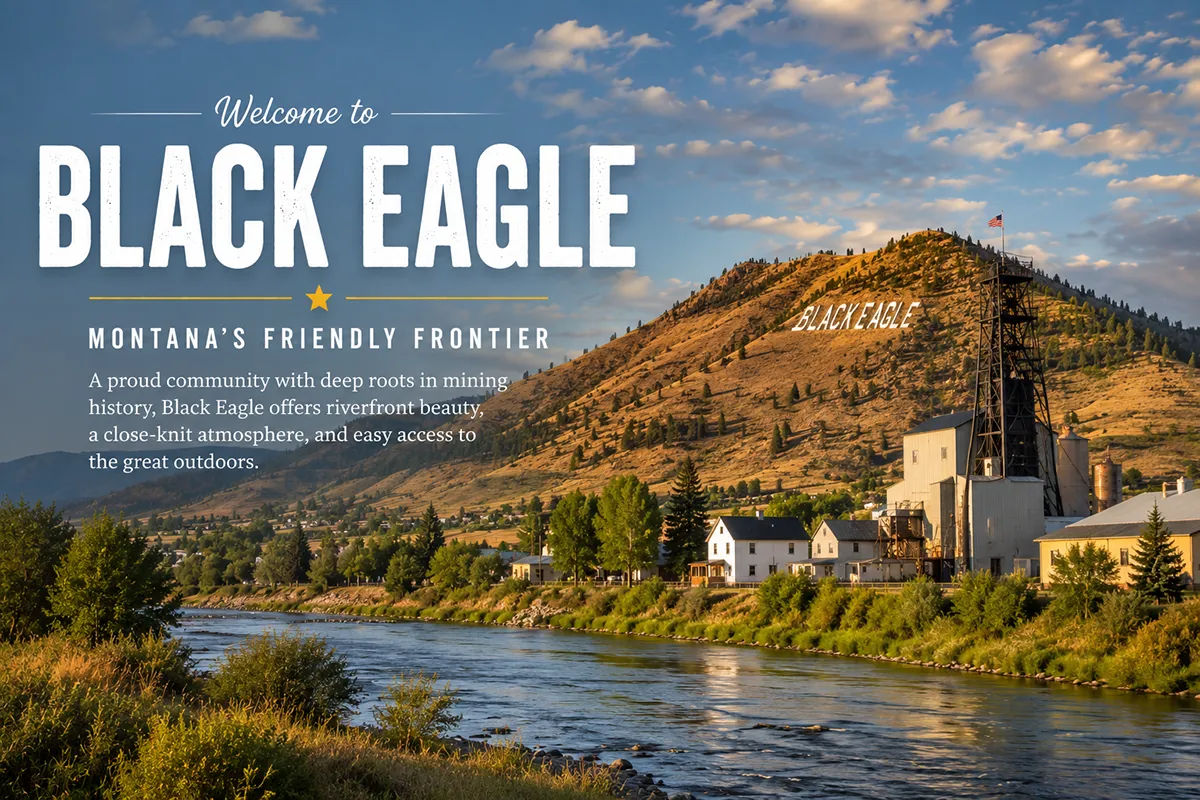
Between 1908 and 1914, the tallest smokestack in the world stood at Black Eagle, Montana.
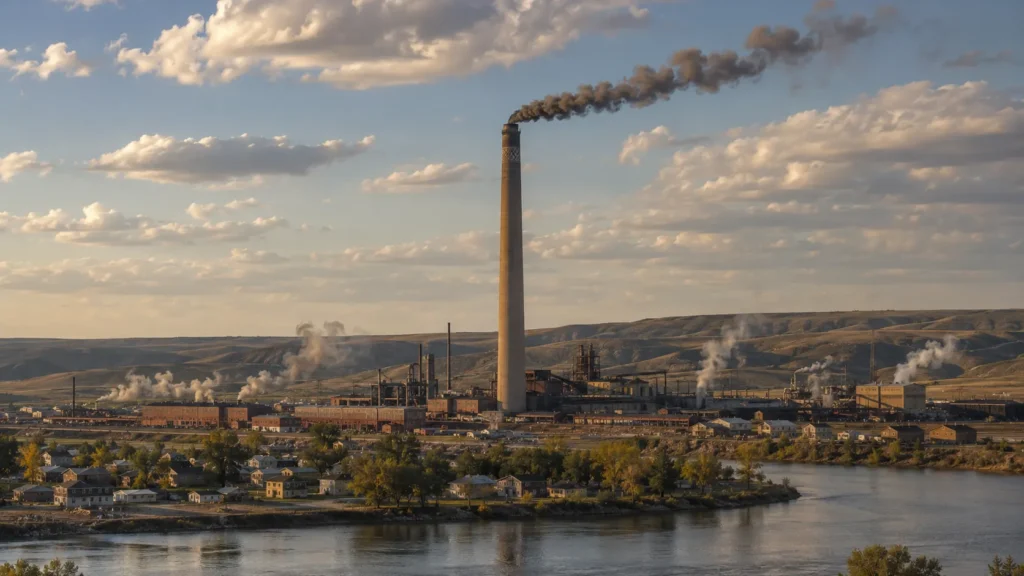
The Black Eagle Big Stack rose 506 feet above the Missouri River. It was built by the Boston & Montana Consolidated Copper and Silver Mining Company to vent the toxic gases from the company’s smelter operations. The first smoke rose from the new stack on June 12, 1909.
For five years, no industrial structure in the world stood taller.
In 1914, the Big Stack was dethroned by the Hitachi Smelter Stack in Ibaraki, Japan. In 1919, the title passed back to Montana when the Anaconda Copper Mining Company completed its even taller Washoe Smelter stack at Anaconda — built specifically to top the Black Eagle structure.
The two stacks together symbolized one of the most consequential industrial operations in American history: the smelting and refining of Montana’s vast copper output that, in the words of one Anaconda Company veteran, “wired the world” with the first electric wires that powered the lightbulb era.
The Black Eagle smelter operations began in 1893. They continued for 87 years. The last operating shift ended on September 29, 1980.
The Big Stack came down a few years later.
The town that grew up around the smelter has approximately 860 residents today. Most are descendants of the Italian and Croatian immigrants whom the Anaconda Copper Mining Company recruited from Europe to staff the smelter operations between the 1890s and the 1920s.
Black Eagle has retained substantively important ethnic-heritage character ever since — distinct from the broader American culture of nearby Great Falls across the Missouri River.
TL;DR
- Black Eagle (~860) is an unincorporated CDP in Cascade County, just north of Great Falls across the Missouri River.
- The community was founded 1882 by workers at the nearby Great Falls Refinery.
- The Boston & Montana Consolidated Copper and Silver Mining Company built the first smelter starting 1892; operations began 1893.
- The Black Eagle Big Stack (506 feet tall) was the tallest smokestack in the world from 1908 to 1914, dethroned by the Hitachi Smelter Stack in Japan.
- In 1910, the Anaconda Copper Mining Company acquired the property and renamed it the Great Falls Reduction Department.
- The Big Stack stopped smoking on August 7, 1972.
- The smelter closed permanently on September 29, 1980 after 87 years of operation.
- The site is now part of the ACM Smelter and Refinery Superfund — 2,400 acres including a 40-mile stretch of the Missouri River.
- Black Eagle has substantively important Italian American and Croatian American working-class heritage from the smelter era.
- Best for: industrial heritage travelers, Italian/Croatian heritage visitors, Missouri River corridor, Great Falls area exploration.
Liked this article?
Add Roaming Montana as a preferred source so you see more of our articles and guides on Google.
Black Eagle at a Glance
| Population (estimated) | ~860 |
|---|---|
| County | Cascade County |
| Status | Unincorporated CDP |
| Region | North-Central Montana (Missouri River) |
| Elevation | 3,304 ft |
| Distance to Great Falls downtown | ~2 miles south (across the Missouri) |
| Distance to Belt | ~30 miles east |
| Distance to Cascade | ~30 miles southwest |
| Distance to Helena | ~95 miles south |
| Distance to Anaconda | ~150 miles southwest (sister smelter town) |
| Founded | 1882 |
| First smelter operations | 1893 |
| Smelter closed | September 29, 1980 |
| Best for | Industrial heritage, Italian/Croatian heritage, Great Falls area exploration |
What Makes Black Eagle Different
Three distinct stories define Black Eagle’s character: the smelter, the Big Stack, and the immigrant communities.
The 1882 Founding
The earliest white settlement at what would become Black Eagle traces to 1882 — workers at the recently established Great Falls Refinery built modest homes on the north bluff overlooking the Missouri River.
The location was practical. The Black Eagle Falls of the Missouri provided water power and access to the broader railroad and milling infrastructure that Paris Gibson and the Great Northern Railway were rapidly developing at the much larger Great Falls settlement immediately to the south.
A small community of refinery workers and their families established itself on the north bluff. The community had no formal incorporation. It has remained unincorporated to this day — a Census Designated Place rather than a chartered municipality.
The 1892-1893 Smelter Construction
The Boston & Montana Consolidated Copper and Silver Mining Company chose Black Eagle in 1892 as the site for what would become one of the most consequential copper smelters in American industrial history.
The reasons were practical:
- Cheap hydroelectric power from Black Eagle Falls and the broader Missouri River dam complex
- Direct railroad access to the Butte copper mines via the Great Northern
- Substantial flat land for the enormous smelter complex
- A workforce-supporting community already established
Construction began in 1892. Operations began the next year. Ore from the Butte mines was concentrated, smelted, and refined into blister copper at Black Eagle. Electrolytic and furnace refineries operated alongside the primary smelter.
The Boston & Montana Consolidated continued operations under multiple corporate transitions. In 1910, the Anaconda Copper Mining Company acquired the property and renamed it the Great Falls Reduction Department.
The Big Stack
The signature physical feature of the Black Eagle smelter was the famous Big Stack — completed in 1908 and first smoking on June 12, 1909.
At 506 feet tall, the Big Stack was the tallest smokestack in the world from 1908 until 1914. It was dethroned by the Hitachi Smelter Stack in Ibaraki, Japan in 1914.
In 1919, the title passed back to Montana when the Anaconda Copper Mining Company completed an even taller Washoe Smelter stack at Anaconda (Montana) — built specifically to top the Black Eagle structure.
By the time the Big Stack was built, the Anaconda Company had constructed approximately 6,000 industrial chimneys worldwide. The Black Eagle stack was the company’s signature achievement.
The Big Stack continued operating for 63 years.
In the summer of 1956, iron bands were added for structural support. In 1957, the top 150 feet was painted to help seal against moisture. The stack continued smoking through the postwar industrial era.
On August 7, 1972, the Big Stack gave its last puff. The zinc plant had been the first part of the smelter to close as the broader operation contracted in the face of changing environmental standards and aging infrastructure.
The 1980 Closure and the Stack Demolition
In 1977, Anaconda Company assets were sold to Atlantic Richfield Company (ARCO).
ARCO maintained limited operations until September 29, 1980 — when the entire Black Eagle smelter closed permanently. Eighty-seven years of continuous operation came to an end.
The Big Stack — having lost its purpose and its physical supports — was eyed for demolition. Cracks began to appear. ARCO determined the structure was unstable.
The citizens of Black Eagle and Great Falls rallied. A campaign to save the stack — called S.O.S. (Save Our Stack) — was launched under Greg Kecskes.
The effort ultimately failed. The Big Stack was demolished.
The site continued in industrial use through the 1980s and 1990s as ARCO conducted voluntary cleanup activities. In March 2011, the EPA added the ACM Smelter and Refinery to the federal Superfund National Priorities List.
The contaminated area covers approximately 2,400 acres and includes a 40-mile stretch of the Missouri River downstream from the smelter site. Heavy metals contamination includes antimony, arsenic, cadmium, chromium, cobalt, copper, iron, lead, manganese, mercury, nickel, silver, sodium, and zinc.
The Italian and Croatian Communities
The Anaconda Copper Mining Company recruited large numbers of immigrant workers from southern and central Europe to staff the smelter operations between the 1890s and the 1920s.
Italian Americans and Croatian Americans formed the largest immigrant communities at Black Eagle. The Montana History Portal’s research collection includes substantial oral history holdings under subject categories like “Italian Americans—Montana—Black Eagle” and “Croatian Americans—Montana—Black Eagle” — reflecting the depth of the ethnic-heritage scholarship that has been conducted in the community.
The cultural character that emerged was distinct from the broader American culture of nearby Great Falls. Black Eagle developed Catholic parish churches, ethnic social halls, working-class neighborhoods, and a community identity that traced directly to the homelands of the smelter workers.
Many of those families remained in Black Eagle for multiple generations. Many still live there today.
The Managers’ Houses
Mid-1890s, Boston & Montana Consolidated built 17 managers’ houses on the bluff overlooking the smelter — for the smelter superintendents, engineers, and other senior staff. The largest was a substantial Queen Anne style residence completed circa 1893.
The first resident manager of the largest house was Charles W. Goodale (1902-1913). A later manager, Al Wiggin (1918-1941), had trees planted on the previously barren Smelter Hill — transforming the landscape into the shaded neighborhood that exists today.
Managers continued using the residences until the 1980 closure. When the refinery closed, the future of the company houses was uncertain. Most were saved and moved to new locations through community preservation efforts.
The largest Queen Anne residence — weighing 120 tons — was moved by Richard and Carol Ecke in 1983 to a new site in Great Falls. The home features oak floors, carved ceiling beams, and rain gutters made of copper (a material readily available at the refinery).
For broader trip context, see my Montana cities and towns hub and Montana history overview.
The Top 6 Things to Do In & Around Black Eagle
1. Black Eagle Falls & Hydroelectric Dam
The signature physical feature.
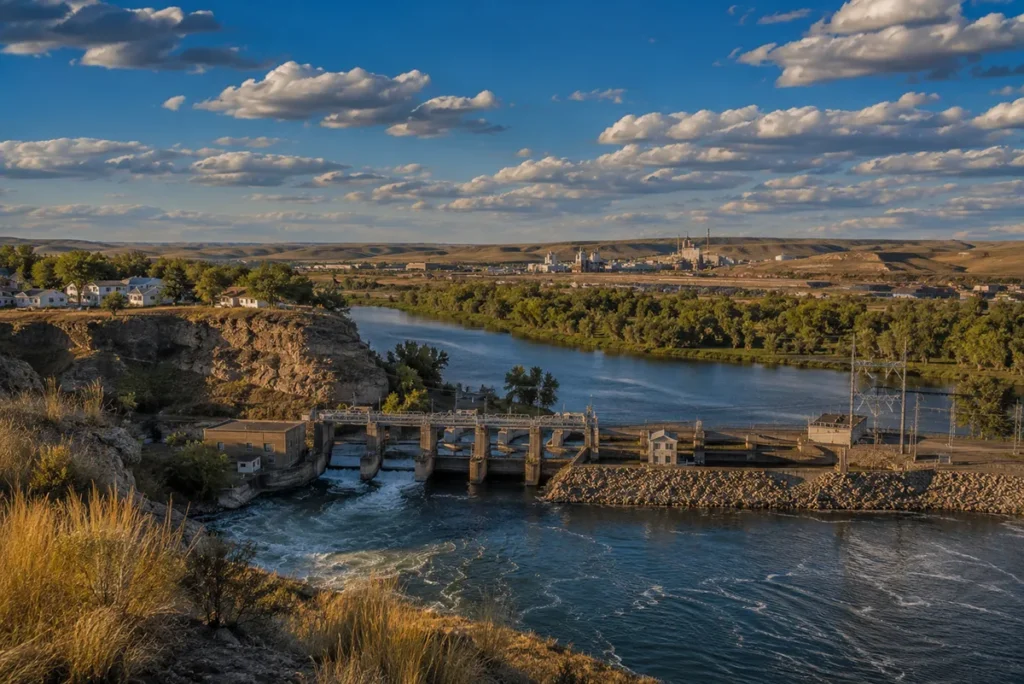
The Missouri River drops through Black Eagle Falls at Black Eagle — one of the famous “Great Falls of the Missouri” that Lewis & Clark had to portage in 1805. The Black Eagle Dam (hydroelectric) sits at the falls.
Multiple public viewing platforms provide spectacular access. River Edge Trail along the Missouri River connects Black Eagle and Great Falls for hiking and biking.
2. Former ACM Smelter Site
The former smelter site is now a Superfund cleanup area accessed primarily for industrial heritage interpretation.
The Big Stack is gone. The smelter buildings are largely demolished. But the cleared site itself — bordered by the Missouri River and visible from public roads — represents the physical legacy of one of America’s most consequential copper smelting operations.
Don’t enter the Superfund boundary; photograph from public viewpoints.
3. Italian and Croatian Heritage Walking
Black Eagle’s small commercial strip and the surrounding residential neighborhoods retain substantively important Italian and Croatian community heritage.
Catholic parish churches, working-class housing built between the 1890s and 1920s, and the broader streetscape all tell the immigrant story. The Cascade County Historical Society in Great Falls holds substantial archives documenting the Black Eagle ethnic communities.
4. Day Trip to Great Falls (2 miles south)
The closest major Montana city — separated from Black Eagle only by the Missouri River.
Attractions include the C.M. Russell Museum (one of the most substantively important Western art museums in the United States), the Lewis and Clark Interpretive Center, Giant Springs State Park, the History Museum (which holds the Black Eagle archives), and full city services.
5. River Edge Trail
The Missouri River Trail connects Black Eagle and Great Falls via a substantial multi-use path along the river.
Hiking and biking access to multiple historical sites, river overlooks, and the broader Great Falls area attractions.
6. C.M. Russell Museum (Great Falls)
The Charles M. Russell Museum in nearby Great Falls is one of the most substantively important Western art museums in the United States.
Russell — the cowboy artist who painted Square Butte and many other central Montana landmarks — has substantial original works and personal artifacts at the museum. A natural pairing with any Black Eagle visit.
Where to Stay
Black Eagle has limited dedicated lodging.
Most travelers base in Great Falls (2 miles south, across the Missouri).
| Lodging | Vibe | Price | Best For |
|---|---|---|---|
| Great Falls hotels (2 min S) | Full city selection | $130–280 | Most travelers |
| Vacation rentals (Black Eagle) | Historic neighborhood character | $130–250 | Heritage-focused travelers |
| Cascade lodging (30 min SW) | Smaller community options | $100–180 | Quieter base |
Where to Eat
Black Eagle has very limited dining within the community itself.
- Italian-American restaurants in Black Eagle — verify current operations; the community’s culinary heritage remains substantive
- Great Falls dining (2 min S) — full city restaurant selection
Getting There & Around
From Great Falls downtown: 2 miles north across the Missouri River, about 5 minutes.
From Cascade: 30 miles northeast, about 35 minutes.
From Belt: 30 miles west, about 35 minutes.
From Helena: 95 miles north, about 1.5 hours.
From Anaconda: ~150 miles northeast, about 2.5 hours.
Cell service: Generally available throughout Black Eagle.
When to Visit
Summer (June-August): Best for River Edge Trail recreation; warmest weather; Missouri River corridor at peak visual character.
Fall (September-October): Outstanding Missouri River corridor light; cottonwood color; cooler temperatures.
Winter (December-March): Severe central Montana weather; some outdoor activities limited.
Spring (April-May): Quieter shoulder season; snowmelt; the Missouri at higher flows.
Personal Tips
Combine with Great Falls. Black Eagle is functionally a neighborhood of Great Falls separated only by the Missouri River. A combined visit is the natural approach. Spend a morning at the C.M. Russell Museum in Great Falls, then drive over to Black Eagle for the smelter heritage and Italian-Croatian community context.
Read about the Big Stack before visiting. Understanding what the 506-foot smokestack represented — the world’s tallest industrial chimney for six years; the symbol of one of America’s most consequential copper smelting operations — substantively enriches the visit even though the structure itself is gone.
Take the Italian and Croatian heritage seriously. The ethnic communities that built Black Eagle into a working-class smelter town remain substantively important to the community’s contemporary identity. Don’t dismiss it as historical curiosity.
Stop at the History Museum in Great Falls. The museum holds substantial Black Eagle archives and has produced recent documentary work on the Anaconda Company history. A natural pairing with a Black Eagle visit.
Respect the Superfund site boundaries. The former smelter site is genuinely contaminated. Don’t enter posted areas. Photograph from public viewpoints only.
Walk the River Edge Trail. The multi-use path along the Missouri River between Black Eagle and Great Falls provides substantively meaningful access to one of America’s most historically important river corridors.
Black Eagle Quick Facts
| Population (estimated) | ~860 | | County | Cascade County | | Status | Unincorporated CDP | | Founded | 1882 | | First smelter construction | 1892 (Boston & Montana Consolidated) | | Smelting operations began | 1893 | | Big Stack first smoke | June 12, 1909 | | Big Stack height | 506 ft | | World’s tallest smokestack | 1908-1914 | | Dethroned by | Hitachi Smelter Stack (Ibaraki, Japan) | | Anaconda Copper Mining Co. acquired site | 1910 | | 17 managers’ houses built | Mid-1890s | | Big Stack last smoke | August 7, 1972 | | ARCO purchased Anaconda assets | 1977 | | Smelter closed permanently | September 29, 1980 | | Operation duration | 87 years | | EPA Superfund listing | March 2011 | | Superfund area | 2,400 acres + 40-mile Missouri River stretch | | Adjacent community area | 427 acres | | Ethnic communities | Italian American, Croatian American | | Save Our Stack (S.O.S.) leader | Greg Kecskes | | Largest manager’s house moved by | Richard and Carol Ecke (1983) — 120 tons | | Average summer high | 84°F | | Average winter low | 13°F |
Conclusion
Black Eagle is a 860-person unincorporated community with substantively important American industrial heritage.
The 1882 founding by Great Falls Refinery workers. The 1892-1893 construction of the Boston & Montana Consolidated Copper and Silver Mining Company’s smelter. The 1909-1972 reign of the Big Stack as the world’s tallest smokestack from 1908 to 1914.
The 1910 transition to Anaconda Copper Mining Company ownership. The 1980 closure after 87 years of continuous operation.
The 2011 EPA Superfund designation. And throughout all of it, the substantively important Italian American and Croatian American working-class communities that the Anaconda Company built and that have remained in Black Eagle for multiple generations.
The Big Stack is gone. The smelter buildings are gone. The contaminated Missouri River below the site is still being cleaned up.
But Black Eagle remains. Drive across the Missouri River bridge from Great Falls and spend an hour.
Have a Black Eagle question? Drop it in the comments — I read every one.
Frequently Asked Questions
Is Black Eagle Montana worth visiting?
Yes — Black Eagle is worth visiting for the substantively important industrial heritage of the former Anaconda Copper Mining Company smelter site (operations 1893-1980, where the world’s tallest smokestack stood from 1908 to 1914), the Italian American and Croatian American working-class community heritage that defines the contemporary town, easy access to Black Eagle Falls and the Missouri River corridor, and the proximity to Great Falls and its substantial city attractions including the C.M. Russell Museum.
What was the Black Eagle Big Stack?
The Black Eagle Big Stack was a 506-foot industrial smokestack built by the Boston & Montana Consolidated Copper and Silver Mining Company in 1908 to vent the toxic gases from the company’s Black Eagle smelter operations. The Big Stack first smoked on June 12, 1909. From 1908 to 1914, it was the tallest smokestack in the world, dethroned by the Hitachi Smelter Stack in Ibaraki, Japan in 1914. In 1919, the title returned to Montana when the Anaconda Copper Mining Company completed an even taller Washoe Smelter stack at Anaconda, built specifically to top the Black Eagle structure. The Big Stack continued operating until August 7, 1972. After the 1980 closure of the entire smelter, the Big Stack was demolished despite citizen efforts to save it (the “Save Our Stack” campaign under Greg Kecskes).
When did the Black Eagle smelter operate?
The Black Eagle smelter operated from 1893 to September 29, 1980 — a continuous run of 87 years. The smelter was constructed starting in 1892 by the Boston & Montana Consolidated Copper and Silver Mining Company and began operations the next year. In 1910, the Anaconda Copper Mining Company acquired the property and renamed it the Great Falls Reduction Department. Anaconda operations continued until 1977, when Atlantic Richfield Company (ARCO) purchased the assets. ARCO maintained limited operations for three more years before closing the smelter permanently on September 29, 1980. The site is now part of the ACM Smelter and Refinery Superfund — 2,400 acres including a 40-mile contaminated stretch of the Missouri River.
What is the Italian heritage in Black Eagle Montana?
Black Eagle has substantively important Italian American (and Croatian American) heritage dating to the Anaconda Copper Mining Company’s recruitment of immigrant workers from southern and central Europe to staff the smelter operations between the 1890s and 1920s. Italian Americans formed one of the largest immigrant communities in Black Eagle. The cultural character that emerged was distinct from the broader American culture of nearby Great Falls. Black Eagle developed Catholic parish churches, ethnic social halls, working-class neighborhoods, and a community identity that traced directly to the homelands of the smelter workers. The Montana History Portal includes substantial oral history holdings under the subject category “Italian Americans—Montana—Black Eagle” reflecting the depth of ethnic-heritage scholarship in the community.
How far is Black Eagle from Great Falls Montana?
Black Eagle is approximately 2 miles north of downtown Great Falls — separated from the larger city only by the Missouri River. The drive between the two communities is about 5 minutes via the Missouri River bridges. Functionally, Black Eagle operates as a neighborhood of Great Falls while retaining its distinctive community identity as a former Anaconda Company smelter town.
What is the ACM Smelter and Refinery Superfund Site?
The ACM Smelter and Refinery Superfund Site is a federal Superfund cleanup area in Cascade County, Montana, encompassing the former Anaconda Copper Mining Company smelter operations at Black Eagle. The site covers approximately 2,400 acres, including a 427-acre former facility area immediately adjacent to the Black Eagle community and a 40-mile stretch of the Missouri River downstream from the smelter site. EPA added the site to the National Priorities List on March 8, 2011. Contamination includes antimony, arsenic, cadmium, chromium, cobalt, copper, iron, lead, manganese, mercury, nickel, silver, sodium, and zinc — heavy metals released by smelting operations over the 87 years the facility operated. Cleanup activities are ongoing.
What other Anaconda smelter towns exist in Montana?
Anaconda, Montana is the most significant Anaconda Copper Mining Company smelter town in the state. Located approximately 150 miles southwest of Black Eagle, Anaconda was home to the Washoe Smelter — which surpassed the Black Eagle Big Stack in 1919 as the tallest smokestack in the world. The Anaconda Smelter Superfund Site covers approximately 300 square miles of soil and water contaminated with heavy metals. The two communities — Black Eagle and Anaconda — together represent the most substantial American industrial heritage related to the Anaconda Copper Mining Company’s operations between the 1890s and the 1980 final closures.