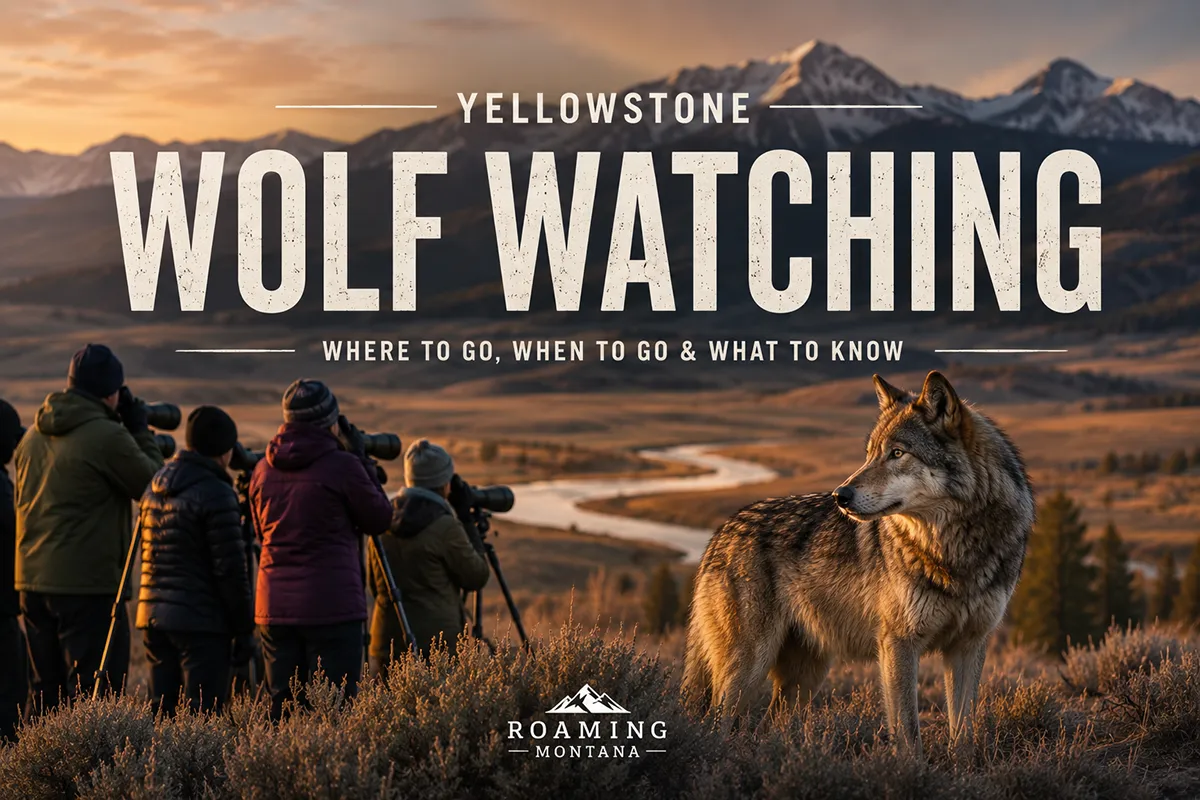
In the predawn dark of a February morning a few years back, standing in the snow at a pullout near Slough Creek with the temperature hovering at -12°F, I heard a wolf howl rise out of the valley and felt something in my chest that no amount of nature documentary watching had prepared me for. That, right there, is why people travel from every continent to stand in the cold at a roadside pullout in Wyoming.
- Yellowstone is the single best place in the lower 48 to see wild wolves — more than 100 wolves live in the Greater Yellowstone Ecosystem, organized into roughly 8–10 packs.
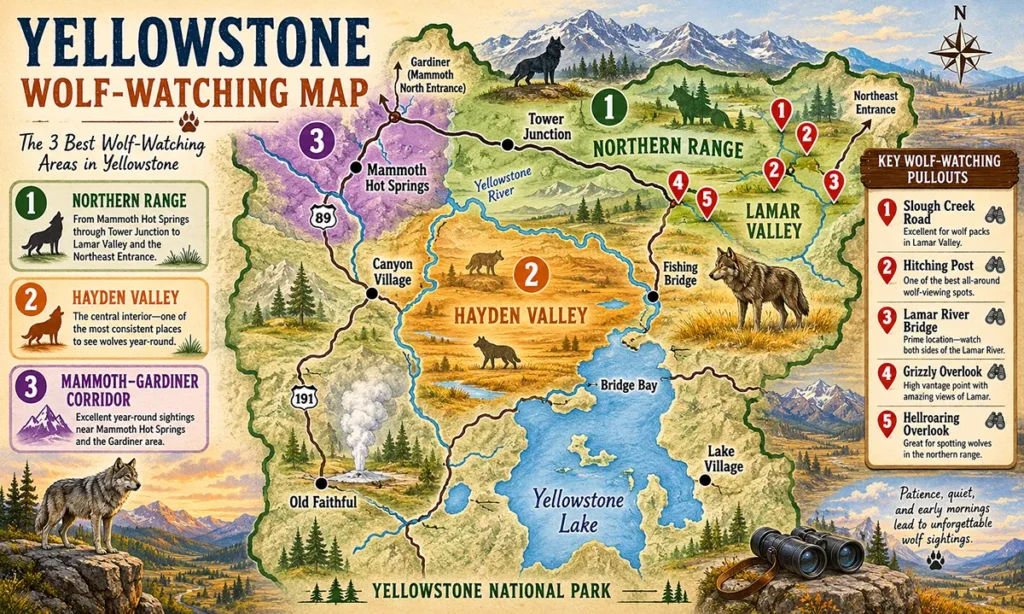
- The two best wolf-watching zones are the Northern Range (especially Lamar Valley, Slough Creek, and the Blacktail Plateau) and Hayden Valley in the park’s interior.
- Best season: winter (December–March) for visibility against snow; spring (April–May) for pup activity and easier viewing without snow gear.
- Best time of day: 30 minutes before sunrise is the only window that consistently produces sightings.
- You can do it DIY with binoculars and patience, or book a biologist-led tour ($150–500/day for group day tours, $2,000–4,000 for multi-day expeditions).
- Realistic success rate without a guide: about 30–50% on a single morning, climbing toward 80%+ with three consecutive mornings or a professional guide.
Liked this article?
Add Roaming Montana as a preferred source so you see more of our articles and guides on Google.
A Short History: Why Wolves Are Even Here
For nearly 70 years, there were no wolves in Yellowstone. The last native wolves in the park were killed in 1926 as part of a federal predator-extermination program. For seven decades the ecosystem ran without its apex predator, and the consequences — overgrazed willows along streambanks, declining beaver populations, eroded river systems — became one of the most-studied case studies in modern ecology.
In January 1995, 14 gray wolves captured in Canada were released into the park. A second group of 17 was added in 1996. By 2000, there were nine packs. By 2007, the wolf population in the Greater Yellowstone Ecosystem peaked at around 170 animals. Today the park population fluctuates between roughly 95 and 110 wolves across 8–10 packs, with the broader ecosystem holding a few hundred more.
Yellowstone is now home to the most-studied wild wolf population on Earth, and the only place in the contiguous U.S. where any person with a vehicle, binoculars, and a 4:30 a.m. alarm can reasonably expect to see wolves in the wild.
The Current Yellowstone Wolf Packs (2026)
Pack composition changes constantly — wolves die, pups grow up and disperse to form new packs, and territories shift. The Yellowstone Wolf Project publishes an annual report with detailed numbers. Here’s the rough lay of the land as of 2026 ([verify current pack roster] against the latest Wolf Project report before your trip):
| Pack | Approximate Territory | Best Pullouts to Watch From |
|---|---|---|
| Junction Butte | Northern Range, Slough Creek to Lamar | Slough Creek, Hitching Post, Lamar River Bridge |
| Lamar Canyon | Eastern Lamar Valley | Soda Butte Creek, Lamar River Bridge |
| Wapiti Lake | Hayden Valley & central interior | Grizzly Overlook, Trout Creek |
| Mollie’s Pack | Pelican Valley (remote) | Difficult to access — typically guide-only |
| 8 Mile | Northwest corner / Blacktail Plateau | Blacktail Plateau Drive, Hellroaring Overlook |
| Rescue Creek | Mammoth area and Gardiner basin | Stephens Creek, Black Canyon area |
| Cougar Creek | West-central interior | Madison and Gibbon River corridors |
A few packs deserve special mention even though they’re gone:
- The Druid Peak Pack was the most famous wolf pack in history. At their peak in 2001, the Druids had 37 members — the largest pack ever recorded — and ruled Lamar Valley for over a decade. The pack collapsed by 2010 due to disease and territorial conflict. If you spend any time with the wolf-watcher community, you’ll hear stories about the Druids the way other people talk about old bands.
- The original 1995 reintroduction wolves founded most of the lineages still in the park today. Their genetic legacy is still tracked by the Wolf Project.
Where to See Wolves in Yellowstone
There are three reliable zones for wolf watching, ranked roughly by ease of sightings.
1. The Northern Range (Best Overall)
The Northern Range stretches from Mammoth Hot Springs east through Tower Junction and into Lamar Valley before exiting via the Northeast Entrance at Cooke City. This is wolf-watching headquarters.
The single best section is Lamar Valley, which I cover in extreme detail (pullout-by-pullout, hour-by-hour, lodging breakdown) in my dedicated Lamar Valley Montana guide. If wolves are your main objective, start there.
Beyond Lamar, the rest of the Northern Range offers excellent wolf watching:
- Slough Creek — Take the 2-mile dirt access road off the main highway to the Slough Creek campground. The Junction Butte pack often dens in this area, and spring through early summer is exceptional. Climb to a small rise above the parking area for a wide-angle view.
- Blacktail Plateau Drive — A seasonal one-way gravel road between Mammoth and Tower that takes you above the main highway corridor. The 8 Mile pack moves through this area. Slow driving and frequent stops are the key.
- Hellroaring Overlook — A viewpoint east of Tower Junction looking down into the Yellowstone River canyon. Wolves cross this corridor frequently. Solid spotting scope territory.
- Little America — The basin between Slough Creek and Junction Butte itself. Easy roadside scanning, often productive at dawn.
2. Hayden Valley (Best Interior Option)
In the park’s interior, Hayden Valley runs along the Yellowstone River between Canyon Village and Lake Yellowstone. It’s the home territory of the Wapiti Lake pack and a second-best to Lamar for wolf watching during summer.
Hayden’s wolves behave differently than Lamar’s. The terrain is more broken — rolling hills, thermal features, river bends — which means wolves use stealthier hunting patterns and can disappear into the topography quickly. They occasionally target bison calves in spring, an unusual hunting behavior for wolves.
Best pullouts: Grizzly Overlook, Trout Creek, Alum Creek, and the unmarked pullouts along the Yellowstone River bend.
Hayden has one major advantage over Lamar: it’s open to interior tour traffic in summer, making it easier to combine with a Yellowstone geyser-basin day. Its major disadvantage: in winter, the interior roads close to private vehicles, so winter Hayden wolf watching requires a snowcoach tour.
3. The Mammoth-to-Gardiner Corridor (Easy Winter Option)
If you’re staying in Gardiner or Mammoth, you don’t have to drive deep into the park to see wolves. The Rescue Creek pack and occasionally the 8 Mile pack roam the lower elevations near Stephens Creek, the Black Canyon, and the area just inside the North Entrance.
This zone shines in winter, when wolves follow elk and bison down to lower-elevation pastures for easier hunting. Less spectacular than Lamar, but a real option if you’re staging out of Gardiner and don’t want a 90-minute predawn drive.
The Best Time to Watch Wolves in Yellowstone
By Season
| Season | Pros | Cons | Verdict |
|---|---|---|---|
| Winter (Dec–Mar) | Dark wolves contrast against snow; wolves follow prey to lower elevations; less competition from other tourists | -20°F mornings; interior roads closed; gear-intensive | Best for serious wolf watchers |
| Spring (Apr–May) | Pups visible; bears emerging (lots of action); good wolf activity around den sites | Some snow remains; unpredictable weather | Best for beginners and photographers |
| Summer (Jun–Aug) | Long daylight; comfortable temperatures; all roads open | Wolves disperse to higher elevations; heavy crowds | Worst season for wolf-specific trips |
| Fall (Sep–Oct) | Elk rut brings wolves into the open; fewer crowds than summer | Activity less concentrated; early snow possible | Excellent for combined wildlife trips |
If you can swing it, early February through mid-April is the gold-standard window. Visibility is high, prey is concentrated, and wolves are most active during daylight hours.
By Time of Day
This part is non-negotiable: arrive 30 minutes before sunrise. Wolf activity in the Northern Range peaks between roughly 5:30 a.m. and 8:00 a.m. in summer (shifted earlier or later in winter), and again in the 90 minutes before sunset.
Midday (10 a.m. to 3 p.m.) is the worst time to look — wolves are bedded down in tree cover, usually invisible. If you only have time for a single drive-through and that drive-through happens at noon, you’ll see bison and not much else.
For broader trip-timing context, see my guide to the best time to visit Montana.
How to See Wolves in Yellowstone: A 5-Step DIY Approach
Here’s the exact process I follow on a DIY wolf morning.
Step 1: Stage Within 30 Minutes of a Wolf Zone
Your lodging choice determines whether you can make a predawn arrival. The closer the better — Cooke City and Silver Gate, MT put you at Lamar pullouts in 15–25 minutes. Gardiner, MT is 60–75 minutes. Mammoth Hot Springs Hotel is about 50 minutes. Bozeman is 3+ hours — too far for daily predawn arrivals.
Step 2: Pack and Pre-Position the Night Before
Coffee ready in a thermos. Optics, layers, snacks, bear spray, and a folding chair already in the car. Headlamp by the door. You will not be making good decisions at 4:30 a.m. — do them at 9 p.m.
Step 3: Drive Slowly and Watch for Indicators
This is the most-overlooked technique in DIY wolf watching. Wolves themselves are hard to spot, but their effects on the rest of the ecosystem are obvious:
- Groups of ravens, magpies, or crows circling or perched in one area — almost always means a carcass. Where there’s a carcass, there are often wolves nearby.
- A coyote barking aggressively in alarm — coyotes give alarm calls when wolves are around. Stop, listen, scan.
- Bison or elk staring intensely in one direction — herd animals notice predators long before you do. Look the way they’re looking.
- Cars already pulled over with scopes deployed — the most reliable indicator of all. Wolf watchers don’t stop for nothing.
Step 4: Use the Pullouts Properly
Pull completely into the pullout, never on the road shoulder. Get out quietly. Set up away from people who are already there if possible. Don’t slam doors. If you join an existing group, ask quietly: “Anything good?” Nine times out of ten they’ll let you look through their scope and tell you what they’re seeing.
Step 5: Stay Longer Than You Think You Should
This is what separates the people who see wolves from the people who don’t. New visitors typically watch for 15–30 minutes, decide nothing is happening, and move on. Regulars set up for 2–4 hours at a single pullout. Wolves are patient hunters; observation requires the same patience.
If you’ve been at a pullout for an hour with no activity, move to a different pullout — don’t give up entirely.
Wolf Watching Gear: What You Actually Need
You don’t need to spend $10,000 to see wolves. You also can’t really see them with no equipment. Here’s a realistic three-tier breakdown.
Tier 1: Bare Minimum ($100–250)
- 8×42 or 10×42 binoculars ($100–200) — Nikon Prostaff or Vortex Diamondback are solid budget choices
- Warm layered clothing including a wool hat and gloves
- Bear spray (~$45)
This tier will let you confirm wolves and watch them as small but identifiable shapes. You won’t see facial expressions but you’ll see hunting and pack behavior.
Tier 2: Intermediate ($500–1,500)
- Better binoculars (10×50 or 12×50, ~$300–500) — Vortex Viper or Nikon Monarch
- Budget spotting scope ($300–600) — Celestron Ultima or Vortex Diamondback
- Sturdy tripod ($100–200)
- Folding camp chair ($30)
This is the sweet spot for most wolf-watching enthusiasts. You’ll see clear behavior, identify individual wolves by markings, and watch hunts at distance.
Tier 3: Serious / Photography ($3,000+)
- High-end spotting scope (Swarovski STX, Zeiss Conquest Gavia — $2,000–3,500)
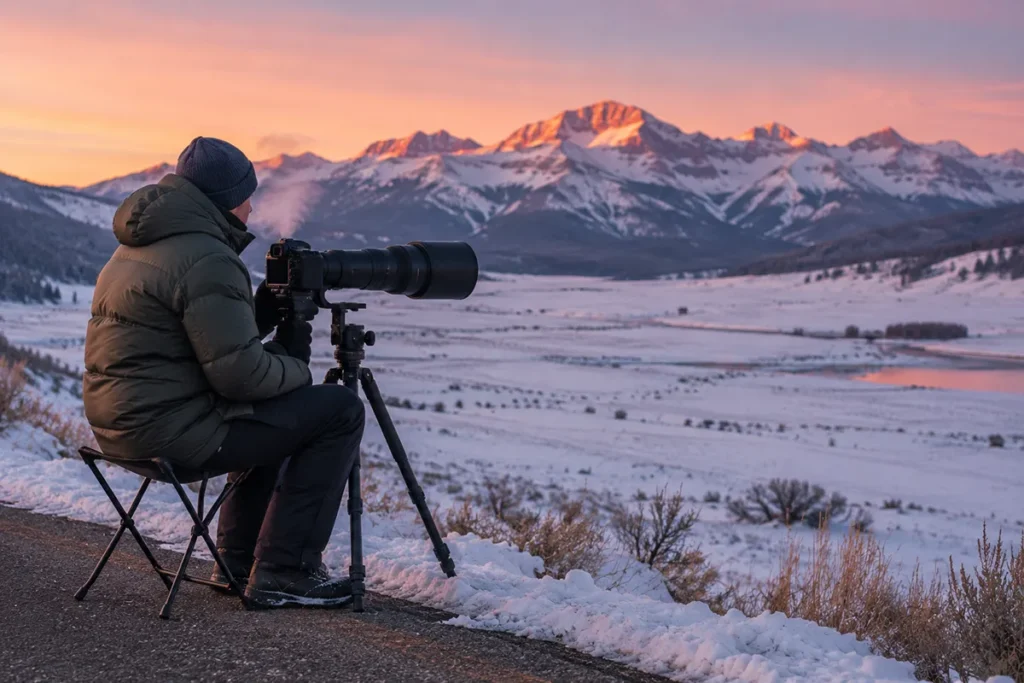
- DSLR or mirrorless camera with 500mm+ telephoto ($2,000–5,000+)
- Camera tripod or gimbal head ($300–800)
- Multiple sets of warm gloves (you’ll switch between thin gloves for operating equipment and thick ones for warmth)
For photographers: anything under 400mm focal length is realistically useless at the legal 100-yard wolf distance. Most serious shooters use 600mm primes or 200–600mm zooms.
Guided Tour Options: Comparison
If you have one or two mornings and want to maximize your odds, a biologist-led guide is genuinely worth it. Guides have radios, current pack location information, top-tier scopes, and decades of pattern knowledge. Here’s the honest comparison of major operators:
| Operator | Type | Typical Duration | Price Range (per person) | Notes |
|---|---|---|---|---|
| Yellowstone Wolf Tracker | Biologist-led day & multi-day | 1–6 days | $300–500/day, $3,000+ multi-day | Wolf-Project-affiliated guides; strong reputation |
| In Our Nature Guiding Services | Private biologist tours | 6–8 hours | $1,000+ for private group | Small groups (1–6); biologist guides |
| Yellowstone Safari Co | Group & private | Day to 3-day winter | $200–500/day | Long-established Bozeman operator |
| Yellowstone Wild Tours | Multi-day winter | 5–7 days | $3,000–4,500 | Comprehensive winter packages |
| Jackson Hole Wildlife Safaris | Multi-day winter, Jackson-based | 3-day winter | ~$3,500 | Departs from Jackson Hole side |
| Yellowstone National Park Lodges (in-park) | Group bus tours | 4.5 hours | ~$150–200 | Easiest entry-level option |
| Yellowstone Forever / Lamar Buffalo Ranch | Multi-day field seminars | 3–5 days | $700–1,500+ | Educational programs at Lamar |
Verify all current pricing before booking — these rates change annually.
A couple of honest notes from someone who’s used a few of these:
- For a single morning to maximize odds, the in-park lodge tours (Wake Up to Wildlife) are good value at the price point
- For a serious learning experience, the Yellowstone Forever Lamar Buffalo Ranch programs are extraordinary
- For photographers, look for “photography-specific” tours that include longer stops and slower movement
- For the absolute best chance of sightings, the multi-day Wolf Tracker and Yellowstone Wild Tours winter packages are the gold standard — but they’re priced accordingly
For more vetted operator options across Montana, see my roundup of the best guided Montana tours.
Wolf Behavior: A 5-Minute Primer for First-Timers
Knowing a little about wolf biology dramatically improves the experience of watching them. The key concepts:
Pack structure. Most Yellowstone packs include a breeding pair (the historical “alpha” terminology is now contested by biologists — the breeding pair is typically just the parents of most of the pack), their adult offspring from prior years, and the current year’s pups. Pack sizes range from 4 to 20+ animals.
Hunting. Wolves hunt cooperatively, primarily elk in Yellowstone, with occasional bison (especially calves in spring), deer, and small mammals. A wolf needs roughly 5 pounds of meat per day on average; a successful elk kill feeds the pack for several days.
Dispersal. Young wolves (usually 1–3 years old) leave their birth pack to find mates and territories of their own. Dispersers are the most vulnerable wolves and the most commonly killed when they leave park boundaries.
Communication. Wolves use howls, scent marking, and body language to coordinate within the pack and warn rival packs. A group howl serves to assemble pack members and announce territory.
Pup season. Pups are born in late April, kept at den sites for the first 3 months, then introduced to a “rendezvous site” where the rest of the pack provisions them while they grow. Pups become functional pack members by their first winter.
For broader wildlife context, see my Montana wildlife guide.
The Wolf-Watcher Community: Rick McIntyre, Druid Legends, and Pullout Culture
The most overlooked aspect of Yellowstone wolf watching is the community of people who do it daily. A group of researchers, retirees, photographers, and lifelong enthusiasts gather at the same pullouts year after year, sharing scopes and sightings, tracking pack genealogies across multiple generations.
The most legendary of these is Rick McIntyre, a retired Yellowstone naturalist who has watched wolves in the park nearly every single day since 1995 — a streak of over 8,000 consecutive days as of 2026. His books on the Druid Peak pack (“The Rise of Wolf 8,” “The Reign of Wolf 21,” “The Redemption of Wolf 302,” “The Alpha Female Wolf”) have made specific named wolves into household names for thousands of readers.
If you see an older gentleman at a Lamar pullout with a scope and a notebook, surrounded by other people taking notes, there’s a real chance it’s Rick or one of his peers. Approach respectfully — most of these folks are remarkably generous with their time and knowledge, but they’re also doing serious observation work.
Etiquette in the wolf-watcher community:
- Speak quietly at pullouts; never shout when wolves are visible
- Don’t crowd people who already have scopes set up
- Never run toward wildlife
- Ask before borrowing a scope view
- Share your own sightings with other watchers
- Bring extra coffee in the cold
Photography & Ethics
A short version of the rules:
- 100 yards minimum from wolves and bears at all times
- No baiting, no audio playback, no approaching dens — all illegal
- Stay on roads, in pullouts, and on designated trails
- Telephoto lens minimum 400mm for any usable photo at legal distances
- Manual exposure mode in low light — auto modes will over-expose backlit fur
- Continuous AF with eye-detection if available
- High shutter speed (1/1000+) for moving wolves
The best wildlife photographers in Yellowstone never break the distance rules — and their photos win contests. The “selfie with wildlife” approach lands people in the hospital, the ER, or the news for the wrong reasons.
Realistic Success Rates (What to Actually Expect)
Let me set honest expectations. In my experience and based on conversations with guides over many years:
| Approach | Realistic Wolf Sighting Probability |
|---|---|
| Single midday drive-through, no plan | <10% |
| Single morning at Lamar pullout, no scope | ~30% |
| Single morning at Lamar pullout, with binoculars + asking watchers | ~50% |
| Three consecutive mornings at Lamar | ~80% |
| Single morning with a professional guide | ~70% |
| 3-day guided winter wolf tour | 90%+ |
| Anywhere midday in summer | <5% |
“Seeing a wolf” can also mean different things. A distant dot moving across a hillside is a sighting. A pack of 8 wolves tracking elk across an open meadow at 200 yards is a different experience entirely. Adjust your expectations to your time investment and gear.
Where to Stay for Wolf Watching
Where you sleep determines whether you can actually do a predawn arrival.
| Base | Drive to Best Pullouts | Vibe | Price | Best For |
|---|---|---|---|---|
| Silver Gate / Cooke City, MT | 15–25 min to Lamar | Tiny, rustic | $100–180/night | Wildlife purists |
| Gardiner, MT | 60–75 min to Lamar; 30 min to Mammoth | Lively gateway | $130–250/night | Most travelers |
| Mammoth Hot Springs Hotel (in-park) | 50 min to Lamar | Historic lodge | $250–450/night | Splurge stays |
| Bozeman, MT | 3+ hours one-way | Real city | $150–300/night | Combining with other Montana travel |
| Slough Creek / Pebble Creek campgrounds (in-park) | 5–10 min to Lamar | Primitive camping | $20–30/night | Hardcore wildlife watchers |
For a complete state itinerary including wolf country, see my guide to the 27 best things to do in Montana, and the full Lamar Valley Montana guide for granular pullout-by-pullout detail.
What I Wish I’d Known on My First Trip
After years of Yellowstone wolf mornings, here’s what I’d tell my younger self:
You will see wolves smaller than you imagine. Most sightings are at 400 yards to a mile. A wolf at that distance is the size of a dog at the end of a city block. The intimacy comes from observing behavior, not from physical closeness.
Borrow a scope before buying one. A good spotting scope is a $500–3,000 investment. Try a friend’s first, or rent one from outfitters in Gardiner or Cooke City before committing.
The wolf watchers are an irreplaceable resource. If you only do one thing, walk up politely to a group with scopes and ask what they’re seeing. Bring coffee. Be willing to listen. You’ll learn more in 30 minutes than from any guidebook.
The cold is harder than you think. Yellowstone winters can drop below -30°F. Standing motionless at a pullout in that cold is brutal. Invest in real winter gear: insulated boots rated to -40°F, thick mittens (not gloves), a balaclava, hand warmers in pockets.
A wolf-watching trip is not the same as a “see Yellowstone” trip. If you want to see Old Faithful, the Grand Canyon of the Yellowstone, and the geyser basins, plan extra days. Trying to combine serious wolf watching with sightseeing means doing neither well.
Cell service is essentially zero in most wolf country. Download offline maps. Tell someone where you’re going. Carry emergency supplies if you’re driving the Northeast Entrance road in winter.
For more practical advice, see my full Montana travel tips guide.
Wolf Watching at a Glance
| Best Season | Winter (Dec–Mar) for serious watchers; spring (Apr–May) for accessibility |
|---|---|
| Best Time of Day | 30 minutes before sunrise; 90 minutes before sunset |
| Best Locations | Lamar Valley, Slough Creek, Hayden Valley, Blacktail Plateau |
| Park Entrance Fee | $35 per vehicle (7-day pass) |
| DIY Realistic Success Rate | 30–50% per morning; 80%+ over 3 mornings |
| Guided Tour Range | $150–500/day (group); $2,000–4,500 (multi-day) |
| Minimum Useful Gear | 8×42 binoculars, warm layers, bear spray |
| Ideal Gear | Spotting scope on tripod, warm layers, camp chair |
| Wolf Population (approx.) | ~95–110 wolves in 8–10 packs |
| Cell Service | Essentially none in wolf country |
How Wolf Watching Fits Into a Larger Trip
Most people who travel for wolf watching pair it with other Yellowstone or Montana experiences. The natural combinations:
- Wolves + Yellowstone geysers — Spend dawn in Lamar, midday in the Old Faithful area, evening back in Lamar. Requires either a Gardiner or in-park lodge base.
- Wolves + Glacier National Park — Two parks in one trip. Plan a full day of driving between them; see my full guide to the 27 best things to do in Montana for a sensible Glacier-to-Yellowstone itinerary.
- Wolves + hot springs recovery — After a 4 a.m. wake-up and cold pullout morning, a soak at Chico Hot Springs in Paradise Valley is exactly the right kind of midday reward.
- Wolves + Beartooth Highway — Drive the Beartooth from Red Lodge, descend into Cooke City, and start wolf watching the next morning. The drive is itself one of the best in America.
For broader route planning, my Montana travel map helps with distances and orientation.
Conclusion
Watching wild wolves is one of the genuinely transformative experiences left in the lower 48. You don’t get to see what most people see in zoos or documentaries — you see wolves doing wolf things, in the place they belong, doing it because they choose to and not because anyone is making them.
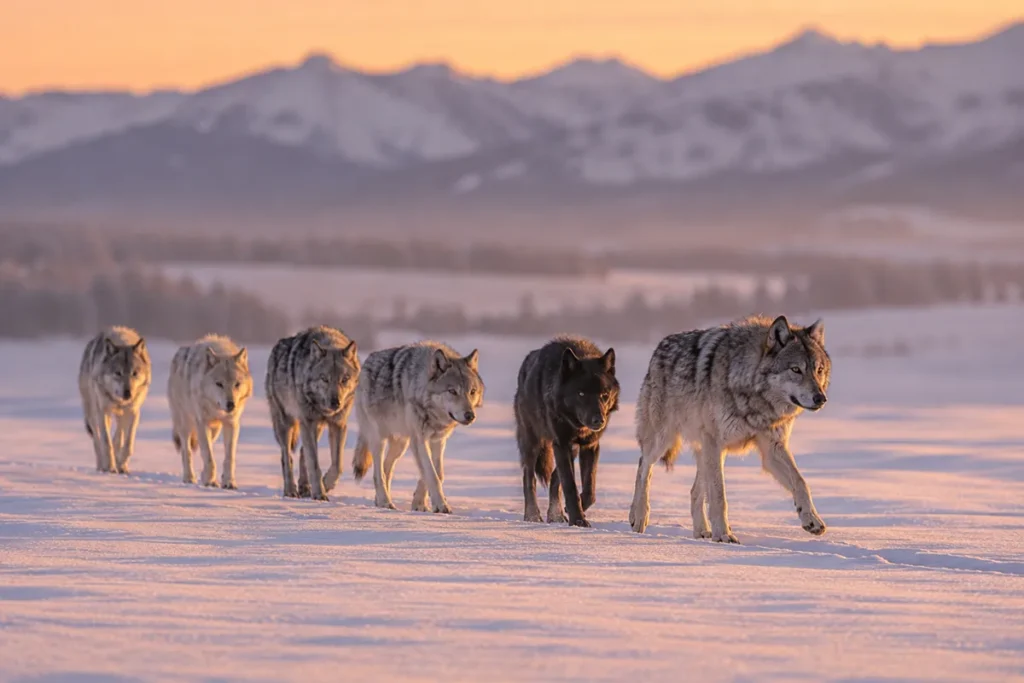
That experience requires real effort. You’ll be cold. You’ll get up too early. You might watch for hours and see nothing more than ravens circling a ridge. But when you do see them — when a pack moves across the snow in formation, or when a howl rises out of the dark and a second pack answers from miles away — every cold morning was worth it.
Save this guide, share it with the friend you’re dragging on this trip, and drop your wolf-watching questions in the comments — I read every one.
Frequently Asked Questions
How many wolves are in Yellowstone National Park?
Yellowstone is home to approximately 95–110 wolves organized into 8–10 packs as of 2026, though numbers fluctuate annually due to natural mortality, pack reorganization, and territorial conflicts. The Greater Yellowstone Ecosystem (which extends beyond park boundaries into Montana, Wyoming, and Idaho) holds several hundred more wolves. The Yellowstone Wolf Project publishes detailed annual reports tracking population changes and pack compositions.
Where is the best place to see wolves in Yellowstone?
Lamar Valley in the park’s northeast corner is the single best place to see wolves in Yellowstone. The wide-open terrain, established pack territories, and numerous paved pullouts make it the most reliable wolf-watching location. Hayden Valley in the park’s interior is a second-best option, especially in summer when interior roads are open to private vehicles.
What time of day are wolves most active in Yellowstone?
Wolves are most active in Yellowstone within 30 minutes before sunrise to about 2 hours after sunrise, and again in the 90 minutes before sunset. Midday viewing (10 a.m. to 3 p.m.) is the least productive time because wolves typically bed down in tree cover during warm daylight hours. Winter mornings can produce wolf sightings later into the day because temperatures stay cold and wolves remain active.
What is the best month to see wolves in Yellowstone?
February and March are arguably the best months for wolf watching in Yellowstone — wolves are highly visible against snow cover, prey animals are concentrated in lower elevations, and packs are typically active in daylight. Late April and May are also excellent for spring wolf-pup activity and bear sightings. Summer is the worst season for wolf-specific trips because wolves disperse to higher elevations and crowds peak.
Can you see wolves in Yellowstone without a guide?
Yes — you can see wolves in Yellowstone without a guide, but realistic success rates are about 30–50% on a single morning at Lamar Valley with binoculars, climbing to 80%+ if you spend three consecutive mornings. A guide raises single-morning odds to roughly 70%, and a multi-day guided tour can push success rates above 90%. DIY wolf watching works best for travelers who can dedicate multiple early mornings and are willing to learn from the watcher community.
How much do Yellowstone wolf tours cost?
Yellowstone wolf tour pricing ranges from about $150 for half-day in-park lodge tours up to $4,500 for premium multi-day winter expeditions with biologist guides. Day tours from Bozeman or Gardiner typically cost $300–500 per person, while private 6–8 hour tours start around $1,000 per group. Multi-day winter packages from operators like Yellowstone Wolf Tracker and Yellowstone Wild Tours generally fall in the $3,000–4,500 range per person.
Are there still wolves in Yellowstone in 2026?
Yes — Yellowstone has a healthy and well-monitored wolf population of approximately 95–110 wolves as of 2026, distributed across 8–10 packs. The population has been continuously present since the 1995–1996 reintroduction and is the most studied wild wolf population in the world. Wolves can be observed daily by visitors who know where to look and arrive at appropriate times.
What equipment do I need to see wolves in Yellowstone?
At minimum you need 8×42 or 10×42 binoculars, warm layered clothing including a hat and gloves even in summer, and bear spray. The ideal setup adds a spotting scope on a tripod and a folding camp chair for extended observation sessions. Photographers need at least a 400mm telephoto lens (600mm preferred) given the legal 100-yard minimum distance from wolves.
Is it safe to watch wolves in Yellowstone?
Yes — wolf watching in Yellowstone is safe when you follow park regulations. Wolves rarely approach humans and have caused zero documented attacks on visitors since the 1995 reintroduction. Greater risks come from other wildlife (bison cause more injuries than any other animal in the park), winter driving conditions, and exposure to cold during predawn observation sessions. Always maintain the 100-yard minimum distance from wolves and bears.
What’s the difference between a wolf and a coyote in Yellowstone?
A wolf is roughly twice the size of a coyote — adult Yellowstone wolves weigh 80–130 pounds, while coyotes weigh 25–40 pounds. Wolves have shorter, more rounded ears, broader muzzles, and shorter, blockier tails compared to coyotes’ pointed ears and longer, fox-like snouts. Wolves typically appear in packs of 4–20 animals; coyotes are usually alone or in pairs. From a distance, watch the body proportions — wolves have noticeably longer legs and look more powerful in build.