Teddy Roosevelt once slept in this house. It’s still standing exactly as he left it, right down to roughly nine out of every ten pieces of furniture in it.
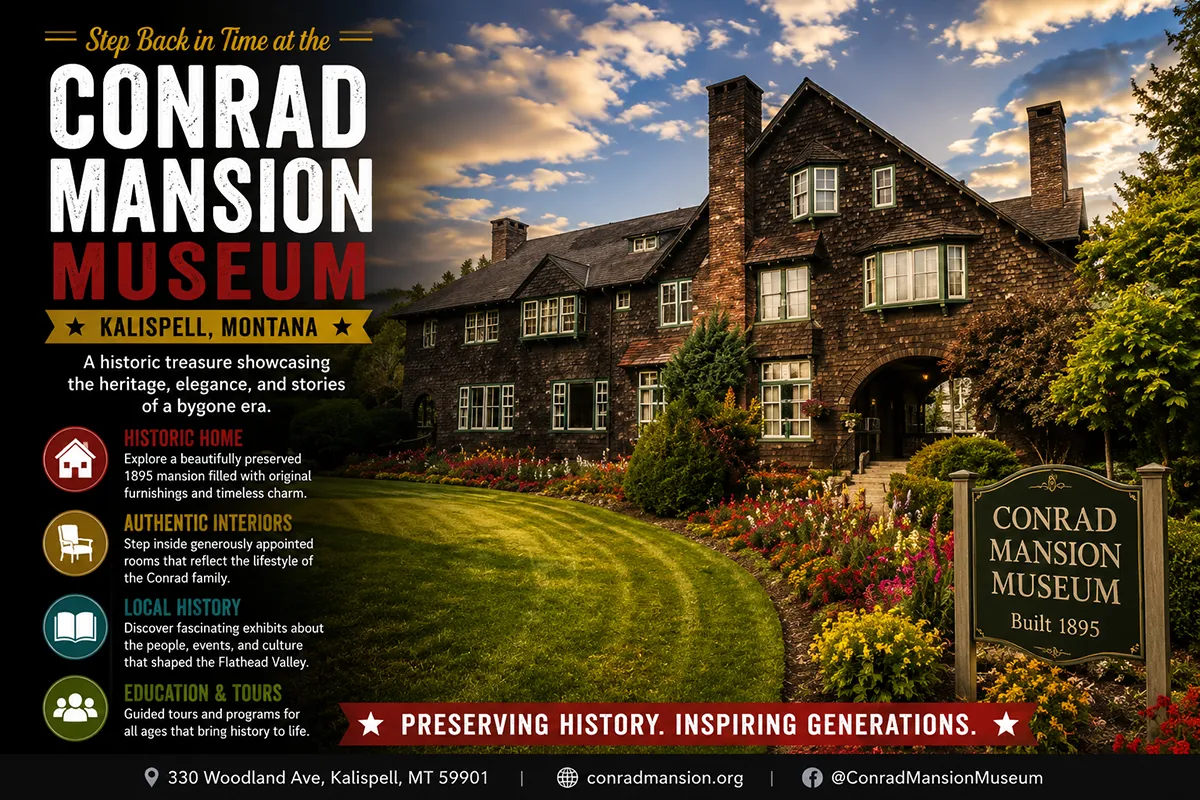
- Conrad Mansion Museum preserves the 1895 home of Charles and Lettie Conrad, founders of Kalispell, with about 90% of the original furnishings still in place
- The 26-room house was designed by renowned architect Kirtland Cutter and includes surprisingly advanced 1890s technology like a dumbwaiter and freight elevator
- Docent-led tours run at 11 a.m., Tuesday through Saturday, with self-guided access available 10 a.m. to 4 p.m. the same days
- The grounds and gardens are free to walk year-round, even outside tour hours
- This is one of the best museums in Montana where the building itself is as much the exhibit as anything inside it
Liked this article?
Add Roaming Montana as a preferred source so you see more of our articles and guides on Google.
Who the Conrads Were, and Why Kalispell Exists Because of Them
Charles E. Conrad made his fortune as a freighter and trader working the Missouri River during Montana’s territorial era.
He wasn’t a passive investor watching money grow from a distance — this was hands-on frontier commerce, moving goods across a genuinely difficult stretch of the country before railroads made it easy.
Conrad and his wife, Lettie, eventually settled in the Flathead Valley and founded the town of Kalispell itself. Their 1895 home wasn’t just a personal residence. It was a statement about what a prosperous Montana pioneer family could build in what was still, functionally, wilderness.
They hired Kirtland Cutter, one of the most respected architects working in the Pacific Northwest at the time, to design it. The result is still considered one of the most outstanding examples of luxurious period architecture anywhere in the Northwest United States.
<!– wp:image –> <!– IMAGE PLACEHOLDER Position: Hero image, top of post before TL;DR Alt text: “Exterior of the historic Conrad Mansion in Kalispell, Montana” Caption: “Charles and Lettie Conrad, founders of Kalispell, built this 26-room home in 1895.” “Realistic travel photography, grand Victorian-era mansion with wraparound porch and turret, landscaped garden in the foreground, Montana mountains visible in the background, warm afternoon light, wide-angle architectural composition, no visible people, editorial travel photography style” –> <!– /wp:image –>
Ninety Percent Original, Which Is a Genuinely Rare Number
Most historic house museums fill their rooms with period-appropriate reproductions or donated pieces from other families. This one doesn’t have to.
Roughly 90 percent of the furnishings and personal effects on display belonged to the Conrad family directly. That’s an unusually high preservation rate for a house museum of this age, and it changes the entire feel of a visit — you’re not looking at a curated approximation of Victorian life, you’re looking at the actual objects a specific family used every day.
The collection includes an extensive assortment of dolls and toys spanning three generations of Conrad children, along with meticulously preserved clothing dating from the late 19th century through the 1940s.
Walking through room after room of genuine family possessions, rather than staged period pieces, is exactly what visitors consistently describe as the mansion’s most striking quality.
Technology That Was Ahead of Its Time
For a house built in 1895 in what was still frontier Montana, the Conrad Mansion had some genuinely surprising engineering built in.
A working dumbwaiter moved food and goods between floors without servants hauling everything by hand up staircases.
An intercom system let household members communicate between rooms decades before that became a common home feature. A freight elevator handled heavier loads that even a dumbwaiter couldn’t manage.
None of this was standard in 1890s American homes, let alone ones built this far from major manufacturing centers.
It’s a reminder that the Conrads weren’t just wealthy — they were specifically interested in cutting-edge domestic technology, and they had the resources to import it to remote northwest Montana.
<!– wp:image –> <!– IMAGE PLACEHOLDER Position: After the Technology That Was Ahead of Its Time section Alt text: “Interior of the Conrad Mansion showing original Victorian-era furnishings in Kalispell, Montana” Caption: “About 90 percent of the mansion’s furnishings and personal effects belonged directly to the Conrad family.” “Realistic photography, ornate Victorian-era parlor room interior with original antique furniture and period wallpaper, warm natural light through lace curtains, editorial documentary photography style, no visible people” –> <!– /wp:image –>
The Teddy Roosevelt Connection
One detail comes up in nearly every conversation about this house, and for good reason. President Theodore Roosevelt stayed here as a guest during a visit to the Flathead Valley.
Standing in the actual rooms where a sitting U.S. president once slept adds a different kind of weight to the tour than a standard historic-house visit. It’s the kind of detail that turns a “nice old mansion” stop into something visitors genuinely remember and talk about afterward.
Docent Tours vs. Self-Guided: Which One to Pick
You’ve got two real options here, and they suit different kinds of visits.
Docent-led tours run at 11 a.m., Tuesday through Saturday, groups capped at 40 people, lasting roughly an hour and fifteen minutes.
Guides walk you through the family’s history and the house’s specific architectural details room by room — genuinely worth it if you want the full story rather than just the visual experience.
Self-guided tours run 10 a.m. to 4 p.m. the same days, no reservation required. This is the better choice if you’re on a tighter schedule or prefer exploring at your own pace rather than moving with a group.
Either way, no food, beverages, or flash photography are permitted inside, and phones need to be off during the tour.
Tickets for the guided tour run around $30 per person as of this writing. [verify current pricing at conradmansion.com, since older sources cite lower figures and rates have clearly changed over time]
<!– wp:image –> <!– IMAGE PLACEHOLDER Position: After the Docent Tours vs. Self-Guided section Alt text: “Docent-led tour group inside the historic Conrad Mansion in Kalispell, Montana” Caption: “Docent-led tours run at 11 a.m. Tuesday through Saturday and last about an hour and fifteen minutes.” “Realistic photography, small group tour walking through a grand Victorian mansion staircase and entryway, warm interior lighting, historic architectural details visible, editorial documentary photography style” –> <!– /wp:image –>
Kirtland Cutter’s Broader Legacy
It’s worth knowing a bit more about the architect behind this house, because his reputation extended well beyond Kalispell.
Kirtland Cutter was one of the defining architects of the Pacific Northwest during the late 19th and early 20th centuries, known for blending European-influenced grandeur with materials and forms suited to the rugged Western landscape his clients actually lived in.
His work shows up across the region in grand private homes and prominent public buildings, and the Conrad Mansion stands as one of his most complete and well-preserved residential commissions.
That matters for how you should look at the house. This isn’t just a wealthy family’s home — it’s a genuine work of period architecture by a nationally significant designer, executed with a level of craftsmanship and attention that a lot of “historic homes” built by less prominent architects simply can’t match.
Cutter’s design choices throughout the mansion, from room proportions to exterior massing, reflect a deliberate architectural vision rather than a generic Victorian template applied without much thought.
<!– wp:image –> <!– IMAGE PLACEHOLDER Position: After the Kirtland Cutter’s Broader Legacy section Alt text: “Architectural detail of the Conrad Mansion’s exterior design in Kalispell, Montana” Caption: “Architect Kirtland Cutter designed the Conrad Mansion, blending European-influenced grandeur with Western materials.” “Realistic photography, close-up architectural detail of a Victorian mansion’s exterior trim, turret, and porch railings, warm afternoon light, editorial architectural photography style, no visible people” –> <!– /wp:image –>
The Funding Story Behind the Education Programs
Here’s a detail I find genuinely charming: some of the mansion’s educational history tours are funded through unclaimed capital credits from Flathead Electric Cooperative.
Under Montana law, when a nonprofit electric cooperative returns excess revenue to members as “capital credits” and some of that money goes unclaimed for five years or more — usually because members moved without updating their address — the cooperative can redirect those unclaimed funds toward educational purposes.
Flathead Electric Cooperative has specifically directed some of that money toward the Conrad Mansion’s school field trip programming.
It’s a small, easy-to-miss detail, but it says something about how this museum has stayed afloat as a nonprofit relying almost entirely on tours, events, and donations rather than steady tax-funded support. Every creative funding source matters when you’re maintaining a 130-year-old wooden mansion.
Visiting With Kids
The mansion itself doesn’t formally exclude young children, but I’d set realistic expectations if you’re bringing kids under 10. The pace of a docent-led tour, with its detailed room-by-room historical commentary, tends to test younger attention spans more than a hands-on children’s museum would.
That said, older kids with any interest in history tend to respond well to the mansion’s genuinely tangible details — real toys, real clothing, real technology from over a century ago rather than replicas behind glass.
The dumbwaiter and freight elevator in particular tend to catch kids’ curiosity in a way that furniture and paintings alone don’t.
School field trips are specifically supported through the museum’s education programming, with groups of 10 to 22 students and a maximum of two adult chaperones per group, booked at least 14 days in advance.
If you’re a teacher or homeschooling family in the region, this is a genuinely well-organized program to tap into.
Quick Questions I Get Asked
Is the mansion wheelchair accessible?
Partially. There’s no interior elevator, but a wheelchair lift on the northwest side of the porch provides access to the first floor. An informational video showing the full house is available for visitors who can’t manage the stairs to upper floors.
Can we just walk the grounds without paying for a tour?
Yes — the grounds and gardens are free and open to the public year-round, independent of the paid house tour schedule.
Is parking easy to find?
Generally yes, with free parking surrounding the mansion, though the city has periodically done utility construction along Woodland Avenue that temporarily affects street parking directly in front. The mansion itself stays open and accessible from other entrances during any such work.
How does this compare to other historic Montana mansions, like the Daly Mansion in Hamilton?
Both are genuinely worthwhile stops built by wealthy Montana pioneer families, but they represent different fortunes and eras — Conrad made his money in frontier freighting and founded the town the mansion sits in, while other Montana mansion museums typically reflect fortunes built in mining or ranching. Visiting more than one gives you a broader sense of how differently Montana’s early wealth actually got built.
- Current pricing rarely gets updated. Several older sources still cite guided tour prices well below what the mansion currently charges — confirm before you budget your visit.
- The free, year-round grounds access rarely gets separated from the paid house tour. You can walk the gardens anytime without paying for a house tour, and that’s worth knowing if your schedule or budget is tight.
- Nearby construction and parking disruptions aren’t always current. The city has periodically done utility work along Woodland Avenue that affects street parking directly in front of the mansion — check current conditions before you go, since the mansion itself stays open regardless.
- The 90% original-furnishings statistic almost never gets mentioned, despite being the single most distinctive fact about this specific house museum compared to others.
Personal Tips: What I Wish I Knew
- Kids under 10 aren’t really the target audience here. The mansion doesn’t prohibit young children, but the pace and content are genuinely better suited to older kids and adults.
- Check the season before you drive out. Regular tour season runs May 15 through October 15; outside that window, tours are by appointment only.
- Ask about the Lettie Conrad tour if it’s currently offered. It focuses specifically on Lettie’s own life and the experience of an Edwardian-era woman in early Montana — a genuinely different angle than the standard house tour.
- Bring cash or a card; both are accepted. But don’t expect food service on-site — plan to eat before or after your visit in downtown Kalispell.
- Pair this with a walk through Woodland Park and Heritage Park, both an easy stroll from the mansion grounds.
How This Fits a Kalispell Visit
The Conrad Mansion sits just a five-minute drive — or an easy walk or bike ride — east of downtown Kalispell’s town center. That makes it simple to combine with the rest of a Kalispell museum day.
It’s within easy reach of the Glacier Art Museum, formerly the Hockaday, if you want to pair Kalispell’s history and art scenes on the same visit.
Kalispell also functions as a natural gateway town for travelers heading into Glacier National Park’s west side, so this mansion works well as a rainy-day or arrival-day stop before you head deeper into the park.
Our Kalispell things-to-do guide covers the rest of what’s worth doing in town, and our Montana museums guide maps how this stop fits into the state’s broader museum landscape.
If historic mansions and pioneer-era wealth interest you as a specific travel theme, our Montana history overview provides broader context for how fortunes like the Conrads’ actually got built across the territorial and early statehood periods.
Practical Info
| Address | Woodland Ave, between 3rd and 4th Streets E, Kalispell, MT |
| Phone | 406-755-2166 |
| Season | May 15–October 15; off-season by appointment |
| Self-guided hours | 10 a.m.–4 p.m., Tuesday–Saturday |
| Docent tour | 11 a.m., Tuesday–Saturday, about 75 minutes |
| Admission | Around $30/person for guided tours [verify current pricing]; grounds free year-round |
| Time needed | 1–2 hours for the house; add extra for the gardens |
| Good for | History and architecture enthusiasts, adults and older kids |
| Nearby pairing | Glacier Art Museum, Woodland Park, Heritage Park |
Final Thoughts
Conrad Mansion Museum works because it doesn’t have to fake anything. Ninety percent original furnishings, a president who actually slept there, and 1890s technology that still feels ahead of its time — this is one of the rare historic homes where the “wow” factor isn’t exaggerated for the brochure.
If you’re building out a broader tour of Montana’s historic pioneer-era homes, this pairs naturally with our Montana ranches guide and other preserved estates around the state, each telling a different version of how early Montana wealth actually got built and spent.
Pin this for your Kalispell trip planning, and budget more time than you think you’ll need. If you’ve taken the Lettie Conrad tour, I’d love to hear how it compares to the standard house tour in the comments.