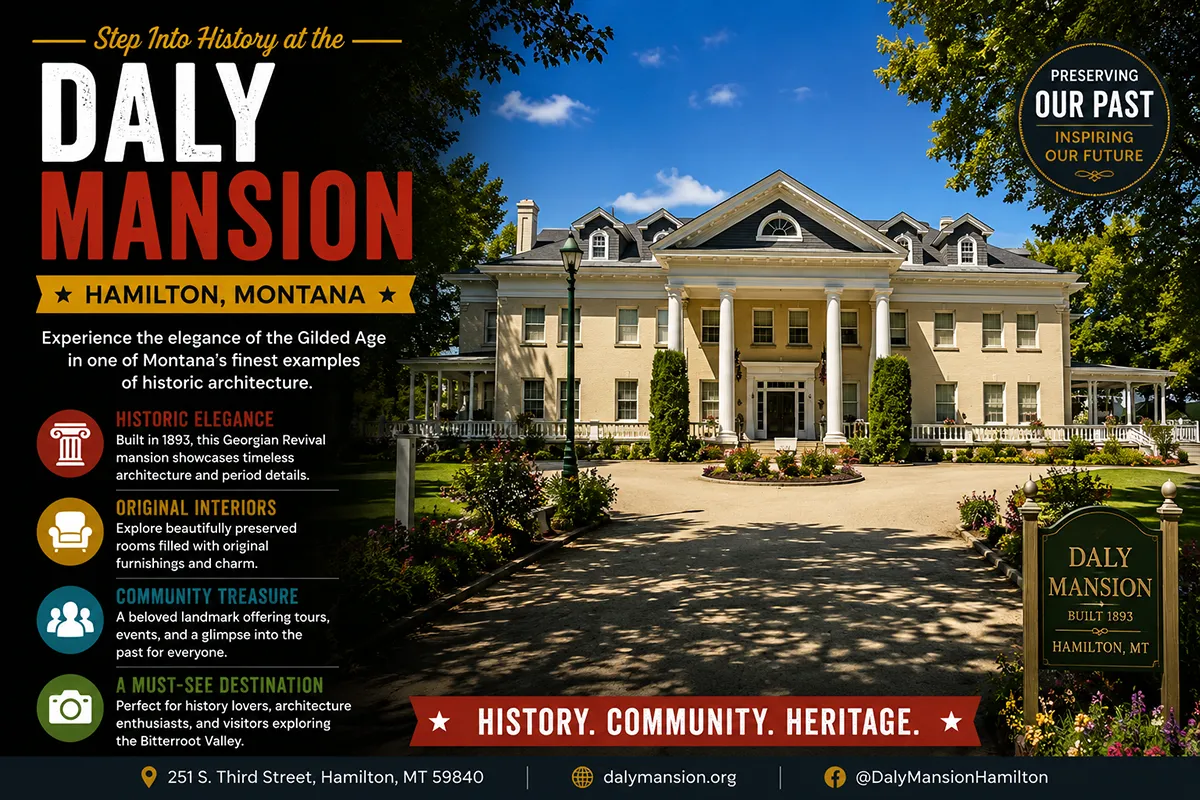
Marcus Daly once kept more than 300 racehorses on these grounds — the largest stable in the entire country, on what started as an ordinary Bitterroot Valley farmhouse.
- Daly Mansion in Hamilton was the summer home of Marcus Daly, one of Montana’s three legendary “Copper Kings,” expanded from a modest 1880s farmhouse into a 24,000-square-foot Georgian Revival estate
- The current form of the mansion was actually completed in 1910, a decade after Daly’s death, when his widow Margaret oversaw the final renovation
- Roughly 46 acres of grounds include the Margaret Daly Memorial Arboretum, Montana’s first professionally designed residential landscape
- The Preservation Trust is currently fundraising to replace a century-old water line and continue restoring the historic third floor
- This is one of the best museums in Montana where the family’s actual story is more complicated, and more interesting, than the mansion’s grandeur alone suggests
Liked this article?
Add Roaming Montana as a preferred source so you see more of our articles and guides on Google.
From Irish Immigrant to Copper King
Marcus Daly’s path to owning a 24,000-square-foot Montana mansion started about as far from wealth as you can get. Born in Ireland in 1841, he immigrated to New York at just 15 years old with essentially nothing.
By 20, he’d headed to California to start a mining career, then moved on to Nevada before arriving in Butte, Montana in 1876. That’s where his story actually took off. In 1880, backed by financial partners, Daly bought the Anaconda Mine expecting to find silver.
He found copper instead — an enormous, genuinely world-class deposit that helped earn Butte its famous nickname, the Richest Hill on Earth.
Daly became one of Montana’s three legendary Copper Kings, alongside William A. Clark and F. Augustus Heinze, in a rivalry that shaped Montana’s early economic and political history for decades.
<!– wp:image –> <!– IMAGE PLACEHOLDER Position: Hero image, top of post before TL;DR Alt text: “Exterior of the historic Daly Mansion in Hamilton, Montana surrounded by expansive grounds” Caption: “Daly Mansion in Hamilton was Copper King Marcus Daly’s summer retreat from his Butte mining empire.” “Realistic travel photography, grand Georgian Revival mansion with white columns and symmetrical facade, expansive green lawn and mature trees in the foreground, Bitterroot Mountains visible in the background, warm afternoon light, wide-angle architectural composition, no visible people, editorial travel photography style” –> <!– /wp:image –>
A Farmhouse That Grew in Stages
The mansion’s evolution happened in three genuinely distinct phases, and understanding them clears up some real confusion about who actually built what.
In 1886, Daly purchased the Anthony Chaffin Homestead, roughly 22,000 acres in the Bitterroot Valley, which included an unremarkable existing farmhouse.
In 1889, he remodeled that farmhouse into something grander. Then in 1897, he upgraded it again into a full Queen Anne-style Victorian mansion, which served as his family’s summer retreat from the heat and industrial grit of Butte.
Daly died in 1900, before the estate reached the form you’ll see today. A decade later, in 1910, his widow, Margaret Daly, commissioned famed Missoula architect A.J. Gibson to convert the mansion into the Georgian Revival style that still stands now.
So while Marcus Daly built the foundation of this estate, quite literally, the polished, symmetrical mansion visitors tour today is really Margaret’s finishing vision, completed after his death.
That’s a detail most casual mentions of the mansion skip entirely, and it changes how you should think about whose “taste” you’re actually touring.
<!– wp:image –> <!– IMAGE PLACEHOLDER Position: After the A Farmhouse That Grew in Stages section Alt text: “Interior grand staircase of Daly Mansion showing Georgian Revival architectural details in Hamilton, Montana” Caption: “Margaret Daly commissioned the 1910 Georgian Revival renovation that gives the mansion its current appearance.” “Realistic photography, elegant Georgian Revival interior staircase with ornate wood railings and period furnishings, warm natural light through tall windows, editorial documentary photography style, no visible people” –> <!– /wp:image –>
Fifty Rooms, Seven Fireplaces, and a Third-Floor Billiard Hall
The finished mansion is genuinely enormous. At roughly 24,000 square feet across three stories, it holds somewhere around 50 rooms, including 24 to 25 bedrooms and about 15 bathrooms. [verify current official room count, as sources vary slightly]
Seven fireplaces are scattered throughout the house, five of them finished with imported Italian marble — a level of imported luxury that says a lot about the money flowing out of Butte’s copper mines in this era.
True to the Gilded Age habits of the very wealthy, the mansion also includes a third-floor billiard hall, because no serious turn-of-the-century estate was complete without one.
Walking through room after room of that scale, it’s easy to forget this started as an ordinary farmhouse less than 25 years earlier.
Three Hundred Racehorses and Montana’s First Landscaped Estate
The grounds tell their own story, separate from the house itself. At roughly 46 acres, the property once supported more than 300 racehorses — reportedly the largest single stable in the entire country at the time.
Daly bred racehorses seriously, not as a passing rich man’s hobby, and the scale of that operation gives you a sense of just how much wealth Butte’s copper was generating during these years.
Today, the Margaret Daly Memorial Arboretum and Botanic Garden covers much of that former horse country. It holds the distinction of being the first professionally designed residential landscape built anywhere in Montana, and it remains one of the widest and rarest collections of tree varieties in the state.
<!– wp:image –> <!– IMAGE PLACEHOLDER Position: After the Three Hundred Racehorses section Alt text: “Margaret Daly Memorial Arboretum grounds at Daly Mansion in Hamilton, Montana” Caption: “The Margaret Daly Memorial Arboretum was Montana’s first professionally designed residential landscape.” “Realistic travel photography, expansive landscaped arboretum with mature specimen trees and manicured lawns, historic mansion visible in the distance, golden hour lighting, wide-angle composition, no visible people, editorial travel photography style” –> <!– /wp:image –>
A More Complicated Legacy Than the Mansion Alone Suggests
I try to give Daly’s story its full complexity rather than just admiring the architecture, and it’s worth doing the same on your visit.
By multiple accounts, including museum staff who’ve researched his history directly, Daly took care of his workers more than most mine owners of his era. If a miner died on the job, Daly reportedly made sure that family was provided for — a genuinely different approach than the era’s typical industrial indifference toward labor.
That reputation shifted after Daly’s death, when the Anaconda Company he’d built was eventually taken over by Standard Oil.
Museum staff have specifically noted that the practices and priorities changed under that new ownership, and much of what people associate today with Anaconda copper’s harsher industrial and environmental legacy traces to that later corporate era, not to Daly’s own tenure running the operation.
It’s a meaningful distinction, and one this small Bitterroot Valley museum handles more honestly than you might expect.
Margaret Daly’s own legacy deserves separate mention too. After Marcus’s death, she donated land for a library in Hamilton and built the Marcus Daly Memorial Hospital, funding real civic infrastructure the town still relies on today.
She died in 1941, and in 1986, the family’s final heir deeded the mansion and grounds to the State of Montana specifically in exchange for the inheritance taxes owed on the estate.
A Preservation Project Happening Right Now
Before you plan your visit, it’s worth knowing the mansion is in the middle of an active fundraising campaign for genuinely urgent infrastructure work.
The estate’s century-old water line, critical to daily operations, needs replacing. The Preservation Trust has secured a $100,000 Montana Historical Preservation Grant toward the project, but needs to raise a matching $20,000 to unlock it and continue restoration of the mansion’s historic third floor. [verify current campaign status and whether the matching goal has been met]
Small nonprofit house museums like this one run on exactly this kind of grant-matching fundraising, year after year, just to keep a 115-plus-year-old building functional for daily tours.
<!– wp:image –> <!– IMAGE PLACEHOLDER Position: After the Preservation Project section Alt text: “Historic third floor billiard hall interior at Daly Mansion in Hamilton, Montana undergoing restoration” Caption: “The Preservation Trust is currently raising funds to replace a century-old water line and continue restoring the historic third floor.” “Realistic photography, historic third-floor room mid-restoration with period wood paneling and vintage billiard table, soft natural light, editorial documentary photography style, no visible people” –> <!– /wp:image –>
Visiting With Kids
A 50-room mansion tour is a lot to ask of very young children, and I’d set expectations accordingly. That said, the sheer scale of the place — a third-floor billiard hall, seven fireplaces, room after room of preserved period furnishings — tends to genuinely impress older kids and teenagers in a way a smaller historic house often doesn’t.
The grounds offer an easy release valve if a full house tour feels like too much for younger visitors. Forty-six acres of arboretum and open lawn give kids room to move and explore between the more structured, indoor portions of a visit.
If you’re building a full Bitterroot Valley day with kids, I’d treat the mansion tour as one component of a longer outing rather than the entire day’s plan — pair it with time outdoors elsewhere in the valley to balance the more structured, historically dense house tour.
Quick Questions I Get Asked
Is the mansion accessible for visitors with mobility limitations?
Yes, the property is ADA-compliant, which is genuinely notable for a historic building this old — accommodating modern accessibility standards in a 1910-era mansion took real, deliberate renovation work.
Can we visit just the grounds without touring the house?
Yes, the arboretum and lawns are generally open during posted grounds hours even outside guided or self-guided house tour times, making this a flexible stop if you’re short on time or budget.
Is the mansion available for weddings and private events?
Yes, and it’s a genuinely popular regional wedding venue — expect the possibility that a private event could affect general tour access on certain dates, which is another reason to call ahead.
How does this compare to Conrad Mansion Museum in Kalispell?
Both are excellent historic Montana homes built by wealthy pioneer-era families, but they represent genuinely different fortunes and eras. Conrad Mansion reflects freighting and trading wealth tied directly to founding a town; Daly Mansion reflects one of the largest copper-mining fortunes in American history. Visiting both gives you a broader sense of how differently Montana’s earliest large fortunes actually got built.
Is there a gift shop?
Yes, located at the end of the tour route, featuring items connected to the mansion’s history and the broader Bitterroot Valley.
- The mansion’s three-phase construction history rarely gets untangled. Most guides credit Marcus Daly alone, missing that the current Georgian Revival form is actually Margaret’s 1910 vision, completed after his death.
- Daly’s genuinely different treatment of his workers rarely gets mentioned, flattening a more complicated historical figure into a generic “wealthy robber baron” stereotype.
- The 300-horse racing operation is almost never highlighted, despite being a genuinely remarkable detail about the property’s original scale and purpose.
- Current admission pricing is inconsistently reported. Some sources list lower online prices than what’s actually charged at the door or over the phone — confirm before you budget your visit.
- The active preservation fundraising rarely gets flagged, even though it’s a meaningful, current part of the mansion’s ongoing story.
Personal Tips: What I Wish I Knew
- Call ahead for guided tours specifically. They run on volunteer guide availability rather than a guaranteed fixed schedule, so confirming in advance avoids disappointment.
- Self-guided tours are the more flexible option if your schedule doesn’t align with the guided tour times, and they let you move at your own pace through 50 rooms of history.
- Budget real time for the grounds, not just the house. The arboretum alone is worth a slow walk, especially if you’re visiting during peak fall color or spring bloom.
- Confirm current pricing by phone rather than trusting the website alone, given documented discrepancies visitors have reported between listed and quoted prices.
- Check the event calendar before you go. Weddings, yoga sessions, murder mystery dinners, and outdoor concerts all use the grounds regularly, and a private event may affect general tour access on certain dates.
How This Fits a Bitterroot Valley Visit
Hamilton sits in the heart of the Bitterroot Valley, and the drive out from Missoula is genuinely scenic regardless of season. From Hamilton, head east on E Main Street; the road turns north and the mansion sits on your left.
If Montana’s copper-mining history interests you beyond just this one estate, pairing a visit here with the World Museum of Mining in Butte gives you both ends of Marcus Daly’s story — the actual working mine that built his fortune, and the summer home where he spent it.
Our Hamilton guide covers the rest of what’s worth doing in town, and our Montana museums guide maps how this stop fits into the state’s broader museum landscape.
Practical Info
| Address | 251 Eastside Hwy, Hamilton, MT 59840 |
| Phone | 406-363-6004 |
| Season | Roughly June through late September/early October [verify current season dates] |
| Grounds hours (summer) | 10 a.m.–5 p.m., all week |
| Guided tours | Tuesday–Saturday, 11 a.m.–2 p.m., hourly (subject to volunteer guide availability) |
| Self-guided tours | Tuesday–Saturday 10 a.m. & 3 p.m.; Sunday 10 a.m.–3 p.m. |
| Admission | Roughly $15 adults, $8 youth, free for kids 5 and under [verify current pricing before visiting] |
| Time needed | 1.5–2.5 hours, including the grounds |
| Good for | History enthusiasts, architecture and garden lovers, Bitterroot Valley road trippers |
| Nearby pairing | World Museum of Mining in Butte, rest of our Hamilton guide |
Final Thoughts
Daly Mansion tells a genuinely layered Montana story: an Irish immigrant’s rags-to-riches copper fortune, a widow’s finishing architectural vision, a labor legacy more complicated than the standard robber-baron narrative, and a preservation trust still actively fighting to keep a century-old water line running today.
The grandeur is real, but it’s the specifics behind it that make this worth more than a quick drive-by photo.
Pin this for your Bitterroot Valley trip planning, and consider a small donation toward the current preservation campaign if the mansion’s story moves you the way it did me.
Montana’s early mining fortunes left behind a genuinely mixed legacy across the state — some of it visible in places like our Montana gold rush guide, some of it in grand estates like this one — and understanding both sides makes a visit here more meaningful than admiring the architecture alone.
If you’ve toured the third floor billiard hall, I’d love to hear what stood out in the comments.