Builders in 1896 drove 100 sheep around this building’s foundation 100 times to compact the backfill before construction. That’s the kind of detail that tells you everything about how differently things got built in Montana before modern equipment existed.
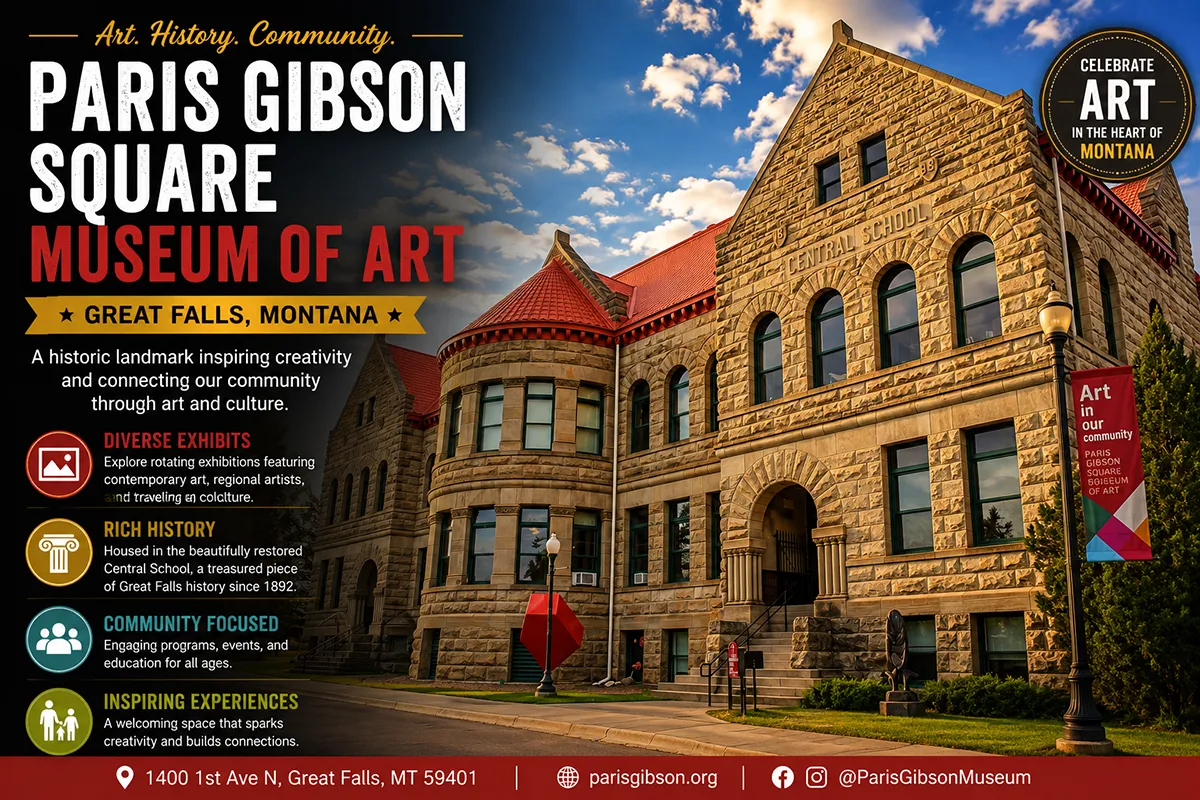
- Paris Gibson Square Museum of Art occupies Great Falls’ original 1896 high school building, a Richardsonian Romanesque sandstone structure on the National Register of Historic Places
- The museum’s original clock tower was removed in 1916 after engineers confirmed it was too heavy for the building to support
- The permanent collection includes 243 sculptures by self-taught Montana folk artist Lee Steen
- Admission is completely free, sponsored by Farmer’s Union Insurance
- This is one of the best museums in Montana that turns a genuinely strange piece of construction history into part of its charm
Liked this article?
Add Roaming Montana as a preferred source so you see more of our articles and guides on Google.
A High School Built to Announce a City’s Ambitions
Great Falls was barely a decade old when construction started on this building in 1896. It wasn’t a modest project.
The city commissioned a three-story sandstone structure designed in a deliberately imposing, almost cathedral-like style — a clear architectural statement that a young frontier town took public education seriously.
Native gray sandstone was quarried between Helena and Great Falls and hauled to the site by mule team and wagon, then shaped by hand once it arrived.
The building’s walls tell you how seriously the construction crew took permanence. They’re four to five feet thick at the base, load-bearing, and extend a full 16 feet underground to shale bedrock. This wasn’t a building meant to need replacing anytime soon.
<!– wp:image –> <!– IMAGE PLACEHOLDER Position: Hero image, top of post before TL;DR Alt text: “Historic sandstone Paris Gibson Square Museum building in Great Falls, Montana” Caption: “Paris Gibson Square occupies Great Falls’ original 1896 high school, a Richardsonian Romanesque sandstone landmark.” “Realistic travel photography, imposing historic sandstone school building with Romanesque architectural details, downtown Great Falls Montana street setting, warm afternoon light, wide-angle architectural composition, no visible people, editorial travel photography style” –> <!– /wp:image –>
The Sheep, the Clock Tower, and a Prediction That Came True
Two construction details from this building’s history are genuinely worth knowing before you visit, because they explain a lot about the finished structure you’ll see today.
Before construction began, crews needed to compact the foundation backfill. Their solution: drive 100 sheep around the building’s perimeter 100 times. It’s a wonderfully low-tech engineering solution, and it worked well enough that the building has stood for well over a century since.
The roof told a different story. A four-faced clock tower originally dominated the structure, rising nearly as high as the main building itself — a genuine visual statement, symbolizing both industrial-era precision and a not-so-subtle message to students about making good use of their time.
Some engineers at the time predicted the tower’s weight would eventually become a structural problem.
They were right. Twenty years after construction, in 1916, the tower was removed because its crushing weight had become exactly the issue those early skeptics warned about.
<!– wp:image –> <!– IMAGE PLACEHOLDER Position: After the Sheep and Clock Tower section Alt text: “Historic photograph-style view of Paris Gibson Square’s original architecture in Great Falls, Montana” Caption: “The building’s original four-faced clock tower was removed in 1916 due to structural weight concerns.” “Realistic archival-style photography, sepia-toned historic sandstone school building exterior with architectural detail, early 1900s aesthetic, warm nostalgic lighting, wide-angle composition, editorial documentary photography style” –> <!– /wp:image –>
From Classroom to Junior High to Nearly Empty Building
The building served as Central High School for 34 years before the high school relocated in 1931. From that point through 1975, it operated as Paris Gibson Junior High School — 45 years of middle-school students filling the same halls that once held Great Falls’ original teenagers.
When the junior high finally moved to a new building in 1975, this landmark structure sat empty. That’s when the Junior League of Great Falls, led by community organizer Jean Warden Dybdal, stepped in with a plan to save it.
Starting in 1974, a volunteer task force spent more than two years organizing, cleaning, painting, and fundraising.
Through a unique inter-local agreement between the Great Falls School District and the Cascade County Commissioners, Paris Gibson Square officially opened in 1977 — starting with a single volunteer director and a budget of just $20,000.
What Got Saved, and What Got Covered
The renovation team made some genuinely thoughtful preservation choices, and a few practical compromises worth knowing about.
Original brass doorknobs and hinges, carved door frames, and ornate iron grating over the air vents all survived the transition intact. Those details are still visible throughout the building today, giving visitors a real sense of the original 1896 craftsmanship.
Other original features didn’t fare quite as well, though not through neglect. Three-foot-high oak wainscoting and the building’s historic slate blackboards got covered over with drywall — a decision that protected them from damage while also creating much-needed gallery display space the museum genuinely needed.
It’s a practical trade-off rather than a loss, and it’s part of why the museum functions as well as it does today as an actual art space rather than just a preserved relic.
<!– wp:image –> <!– IMAGE PLACEHOLDER Position: After the What Got Saved section Alt text: “Preserved original brass doorknobs and carved door frames inside Paris Gibson Square Museum in Great Falls” Caption: “Original brass hardware and carved door frames survived the museum’s 1977 renovation intact.” “Realistic photography, close-up detail of ornate vintage brass doorknob and carved wood door frame, warm interior lighting, historic preservation photography style, no visible people” –> <!– /wp:image –>
Lee Steen and the Museum’s Signature Collection
Late in 1976, before the museum had even officially opened, it acquired 243 sculptures by Lee Steen, a self-taught folk artist from Roundup, Montana who’d developed a genuinely national reputation despite no formal art training.
That acquisition became the museum’s founding collection and remains one of its permanent, always-on-view displays today, alongside two other standing exhibitions, “Three Thousand and Counting” and “Ruins I-IV.” Steen’s work anchors the museum’s broader identity as a place that takes self-taught and folk artists seriously, not just formally trained ones.
In 1988, curator Mark Leach organized one of the first exhibitions anywhere of artwork by Robert De Niro Sr. — the actor’s father, an accomplished abstract painter in his own right. The show actually debuted first at the Everson Museum of Art in Syracuse, New York, before making its way to Great Falls, a genuinely surprising credential for a small Montana museum operating out of a converted junior high.
The Sculpture Garden and Outdoor Grounds
The museum inaugurated an outdoor sculpture garden in 1993. Robert Harrison’s piece “Gibson Gateway,” installed that same year, became the garden’s first permanent work.
Today the grounds offer a genuinely pleasant walk regardless of whether you’re visiting the indoor galleries, landscaped specifically to complement the historic building rather than compete with it visually.
The Tax Dispute That Tested the Museum’s Finances
Not every chapter of this museum’s history has been smooth sailing, and it’s worth knowing about one specific rough patch.
In 2003, shortly after Lynne Spriggs was hired as the museum’s permanent executive director, a property tax dispute created real financial uncertainty for the institution.
PPL Montana, the company that owned Black Eagle Dam in the county, challenged the property tax assessments tied to the dam across several years — disputing a portion of the 2000, 2001, and 2002 assessments.
Museums like Paris Gibson Square rely partly on local tax-funded support structures, so disputes like this one, even when they don’t directly target the museum itself, can ripple into genuine budget uncertainty for small cultural nonprofits operating on thin margins.
It’s a reminder that a museum’s survival often depends on financial and political currents most visitors never think about while they’re admiring the art on the walls.
Visiting With Kids
Paris Gibson Square runs genuinely accessible education programming, and it’s worth knowing about if you’re traveling with kids.
The museum partners directly with Great Falls Public Schools to provide free tours and a related hands-on art activity to every third grader in the district — a meaningful, sustained civic education commitment rather than a one-off outreach event.
For visiting families, the folk-art focus of the Lee Steen collection tends to hold kids’ attention better than more abstract contemporary work might, since Steen’s self-taught sculptural style often reads as more approachable and playful than formally trained fine art.
The outdoor sculpture garden also gives younger visitors a chance to move around physically between denser gallery time, which helps on a longer Great Falls museum day that might also include the C.M. Russell Museum.
<!– wp:image –> <!– IMAGE PLACEHOLDER Position: After the Visiting With Kids section Alt text: “Outdoor sculpture garden with contemporary artwork at Paris Gibson Square Museum in Great Falls, Montana” Caption: “The museum’s sculpture garden, inaugurated in 1993, gives visitors an outdoor complement to the indoor galleries.” “Realistic travel photography, landscaped outdoor sculpture garden with contemporary art pieces on a lawn, historic sandstone building visible in the background, warm afternoon light, wide-angle composition, no visible people, editorial travel photography style” –> <!– /wp:image –>
Quick Questions I Get Asked
Is Paris Gibson Square the same as the C.M. Russell Museum?
No — they’re entirely separate institutions covering different eras and styles of art. The Russell museum focuses on one specific frontier-era Western artist; Paris Gibson Square covers contemporary and folk art from a broader range of regional artists.
Is the museum accessible for visitors with mobility limitations?
The building has undergone renovations over the decades, though as with any converted 19th-century structure, it’s worth calling ahead if accessibility is a specific concern for your visit.
Is there a gift shop?
Yes, and it specifically features work by local and Montana artists rather than generic souvenirs, making it a genuinely good stop for a meaningful gift or keepsake.
Does the museum host events beyond exhibitions?
Yes — the museum hosts an annual art auction fundraiser supporting its operations, along with lectures, classes, and workshops throughout the year. If you’re researching other under-the-radar Montana stops worth building a trip around, our Montana bucket list post covers more ideas in the same spirit.
- The sheep foundation story almost never makes it into general Montana travel content, despite being one of the more delightfully strange construction details you’ll find at any museum in the state.
- The clock tower’s removal gets treated as a footnote, if mentioned at all, losing a genuinely good story about engineering prediction and consequence.
- The Robert De Niro Sr. connection is rarely flagged, even though it’s a legitimately surprising claim to fame for a museum this size.
- Free admission being sponsored specifically by Farmer’s Union Insurance rarely gets credited, though it’s a nice example of Montana-brand support for Montana culture.
Personal Tips: What I Wish I Knew
- Budget an hour, more if the current rotating exhibition interests you. The permanent Lee Steen collection alone is worth a slow walk-through rather than a rushed pass.
- Pair this with the C.M. Russell Museum on the same Great Falls day. They’re different enough in focus — contemporary and folk art here, frontier Western art there — that visiting both rounds out a genuinely full picture of the city’s art scene.
- Walk the sculpture garden even if you’re short on time. It’s outdoor, free, and doesn’t require the same time commitment as the full indoor galleries.
- Ask about the building’s architecture while you’re there. Staff and docents tend to know the construction history well, and it adds real context you won’t get from just reading wall placards.
- Check current exhibition schedules before a repeat visit. Beyond the three permanent displays, gallery content rotates regularly.
How This Fits a Great Falls Visit
Great Falls earned its nickname, the Electric City, from the hydroelectric dams built along the Missouri River’s series of waterfalls just outside downtown. Paris Gibson Square sits within that same walkable downtown core, making it easy to combine with the rest of a Great Falls museum day.
Our Great Falls guide covers the rest of what’s worth doing in town, and pairing this stop with the C.M. Russell Museum gives you a genuinely complete sense of the city’s range, from frontier cowboy art to contemporary folk sculpture housed in a converted 1896 schoolhouse.
If you’re mapping out museums across the whole state, our Montana museums guide shows how this stop fits into the bigger picture.
Practical Info
| Address | 1400 First Avenue North, Great Falls, MT |
| Admission | Free, courtesy of Farmer’s Union Insurance |
| Hours | [verify current hours at the-square.org] |
| Time needed | 1–1.5 hours |
| Good for | Contemporary and folk art enthusiasts, history and architecture buffs, budget-conscious travelers |
| Nearby pairing | C.M. Russell Museum, rest of our Great Falls guide |
Final Thoughts
Paris Gibson Square is proof that a building’s construction history can be just as compelling as anything hanging on its gallery walls.
A hundred sheep, a doomed clock tower, and a volunteer-led rescue in the 1970s all led to a museum that now houses one of Montana’s most significant folk-art collections inside a converted 1896 schoolhouse.
I keep coming back to how much of this museum’s identity is genuinely bottom-up rather than top-down.
A junior league, a volunteer director, a $20,000 starting budget, sheep doing foundation work instead of heavy machinery — none of it reads like a museum built by outside experts parachuting in with a master plan. It reads like a city that decided its own history was worth saving and figured out how to do it themselves.
Pin this for your Great Falls trip planning, and take a minute to appreciate those original brass doorknobs on your way through. If you’ve spotted the Robert De Niro Sr. connection or spent real time with the Lee Steen sculptures, I’d love to hear what stood out in the comments.