On June 25–26, 1876, Lieutenant Colonel George Armstrong Custer led the 7th Cavalry into a valley on the Little Bighorn River expecting to surprise a Lakota and Northern Cheyenne encampment.
Instead, he and 268 soldiers were killed in the most decisive Native American victory over U.S. forces in the history of the Plains Wars. The battlefield where this happened is 15 miles south of Hardin.
It’s one of the most consequential sites in American history — and one of the most sobering to visit.
TL;DR
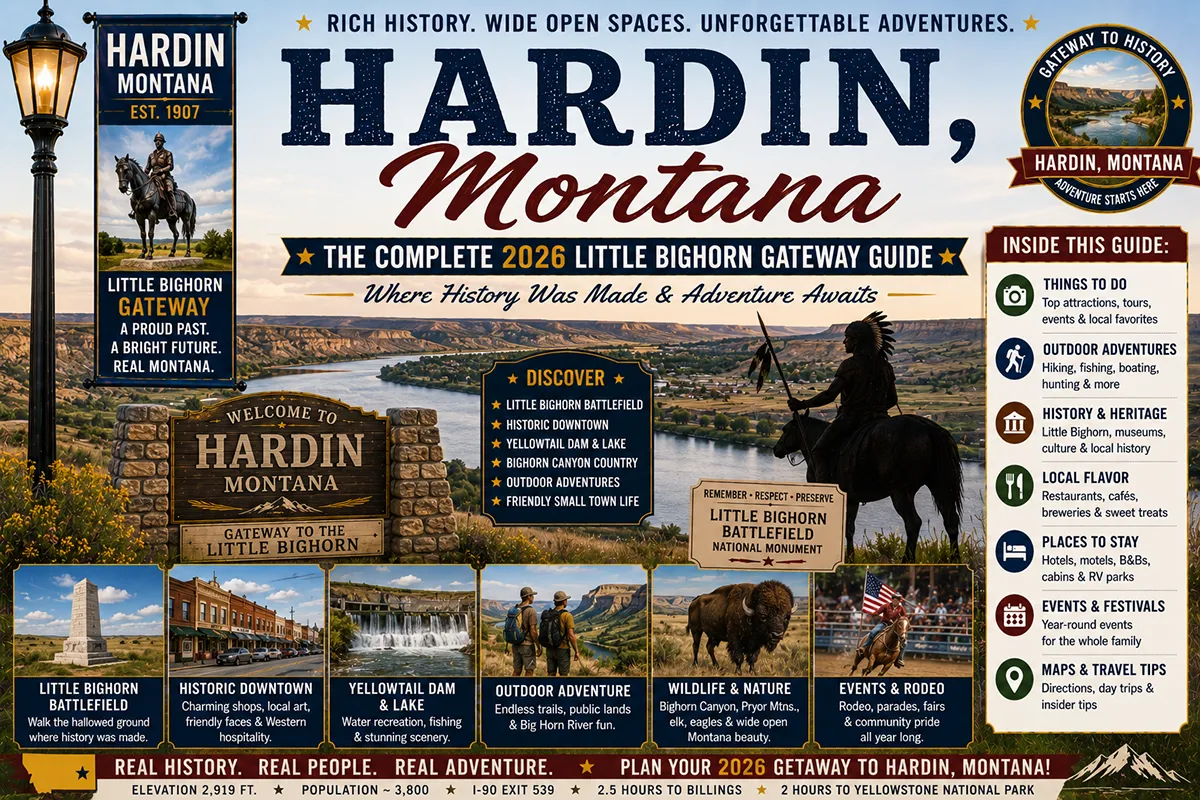
- Hardin (~3,700) is the county seat of Big Horn County and the practical gateway to Little Bighorn Battlefield National Monument, 15 miles south.
- The Little Bighorn Battlefield National Monument is operated by the NPS on the Crow Indian Reservation — one of the most historically significant battlefield sites in the U.S.
- The Crow Nation has lived in this region for generations — Hardin is adjacent to the Crow Indian Reservation (Apsáalooke), and Crow cultural context is essential to understanding the battlefield.
- Crow Fair (third week of August) is one of the largest Native American celebrations in the country — a genuine cultural event open to respectful public visitors.
- Best for: American history travelers, anyone interested in the Plains Wars and Native American history.
Liked this article?
Add Roaming Montana as a preferred source so you see more of our articles and guides on Google.
Hardin at a Glance
| Population (2020) | ~3,700 |
|---|---|
| County | Big Horn County (county seat) |
| Region | Southeast Montana (Custer Country) |
| Elevation | 2,902 ft |
| Distance to Little Bighorn Battlefield | ~15 miles (~20 min south) |
| Distance to Billings | ~46 miles (~45 min) |
| Distance to Miles City | ~110 miles (~1.5 hours) |
| Best for | Little Bighorn Battlefield, Crow Nation culture, Bighorn Canyon |
What Makes Hardin Different
Hardin sits within Big Horn County, which has one of the highest percentages of Native American residents of any Montana county — the Crow Indian Reservation borders the town to the south and west.
This proximity to Crow Nation land and culture gives Hardin a character distinct from other southeast Montana towns.
Understanding the Crow Nation’s perspective on the Little Bighorn battle — they actually served as scouts for Custer, and the land is Crow territory — adds enormous depth to the battlefield visit.
The battlefield monument is situated on the Crow Indian Reservation and is jointly interpreted with input from Crow, Lakota, Cheyenne, and Arapaho tribes.
The Indian Memorial, dedicated in 2003, honors the Indigenous warriors who fought here. A visit that includes both the battlefield and the tribal context is substantially more meaningful than a visit focused solely on the cavalry side.
For broader trip context, see my Montana cities and towns hub.
The Top 10 Things to Do in Hardin & Surroundings
1. Little Bighorn Battlefield National Monument
The primary draw. The 5-mile self-guided auto tour along Battlefield Tour Road covers the main sites: Last Stand Hill (where Custer fell), the Indian Memorial, the Reno-Benteen Defense Site, and multiple interpretive pullouts. Ranger-led programs (seasonal) provide the most nuanced historical interpretation, including multiple tribal perspectives.
Note on visitor center: The main visitor center was under renovation as of 2025. Check the NPS website (nps.gov/libi) for current facilities and hours before visiting.
2. Apsaalooke (Crow) Nation Tours
The Crow Tribe Tourism Office operates bus tours of the battlefield led by Crow Nation members — offering the Indigenous perspective on the battle and the Crow Scouts who served with Custer. One of the most distinctive and historically important tour experiences in Montana.
3. Big Horn County Historical Museum (Hardin)
Located in Hardin itself, this regional museum covers the full history of Big Horn County — Crow culture, homestead era, and the battle history. Worth a visit before heading to the battlefield for context.
4. Crow Fair (Third Week of August)
The Crow Nation’s annual celebration — one of the largest Native American pow-wows in the United States. Open to respectful public visitors. Includes traditional dance competitions, horse racing, tipi camps, rodeo, and cultural demonstrations. Visitor protocol: ask before photographing anyone; follow posted guidelines; approach with genuine respect.
5. Little Bighorn Days (around June 25 annually)
Hardin’s commemoration of the battle anniversary, held each year around June 25. Events include a Custer’s Last Stand reenactment (held in Hardin, not at the monument), parade, symposia, and historical programming.
6. Bighorn Canyon National Recreation Area (1 hour south)
The Bighorn River cuts through a 70-mile canyon with walls up to 1,000 feet high. A National Recreation Area spanning Montana and Wyoming, with excellent boating, fishing, and hiking. The south unit in Wyoming has Pryor Mountain Wild Horse Range adjacent to it.
7. Chief Plenty Coups State Park (Pryor, 1 hour southwest)
The preserved homestead of Chief Plenty Coups, the last traditional chief of the Crow Nation, donated by him to the people of Montana at his death in 1932. A significant cultural site managed jointly with the Crow Nation.
8. Pryor Mountains & Wild Horse Range (1 hour)
The Pryor Mountains south of Billings protect one of the few legally protected wild horse herds in the U.S. A high-clearance 4WD vehicle is needed for the upper range access; the lower viewing areas are more accessible.
9. Fly Fish the Bighorn River (Downstream from Bighorn Canyon)
The Bighorn River below Yellowtail Dam near Fort Smith is one of Montana’s most productive trophy trout fisheries — consistent 20+ inch brown and rainbow trout in a tailwater fishery. A 45-minute drive south.
10. Drive the Rims Country (South of Billings)
The drive from Hardin south through the Little Bighorn Valley toward the Wyoming border passes through classic southeastern Montana landscape — rolling grasslands, cottonwood-lined river bottoms, and the occasional ranch that looks unchanged from the 1880s.
Where to Stay
| Hotel | Vibe | Price | Best For |
|---|---|---|---|
| Lariat Motel | Local character, basic | $90–130 | Budget |
| Super 8 Hardin | Chain standard | $100–150 | Road trippers |
| American Inn Hardin | Reliable, local | $90–140 | Most travelers |
| Billings hotels (45 min) | Full selection | $130–250 | Those wanting more options |
Hardin is very affordable by Montana standards.
Where to Eat
- Purple Cow Restaurant — Hardin institution, breakfast and lunch
- Cassidy’s Eatery — casual American
- Big Horn Casino & Restaurant — full-service dining
- Country Kitchen — diner basics
- Billings (45 min) has full dining variety
Getting There
From Billings: 46 miles southeast on I-90, about 45 minutes.
From Miles City: ~110 miles west on I-90, about 1.5 hours.
By plane: Billings Logan International Airport (BIL) is the nearest major airport, 45 minutes away.
What Hardin Unlocks
Little Bighorn Battlefield (15 min south on US-212)
The primary reason to stop in Hardin.
Bighorn Canyon (1 hour south)
Dramatic canyon recreation area in Montana and Wyoming.
Chief Plenty Coups State Park (1 hour west)
Crow Nation cultural site.
Billings (45 min west)
Montana’s largest city, full services. See Billings guide.
Bighorn River Trophy Trout (45 min south, Fort Smith)
One of Montana’s premier tailwater fisheries.
When to Visit
Late June (around June 25) — Little Bighorn Days, battle anniversary programming.
August (third week) — Crow Fair, one of the largest Native American celebrations in the U.S.
Summer generally (June–August) — Best weather, full battlefield access.
Spring and fall — Fewer crowds at the battlefield; comfortable temperatures.
Personal Tips
Take the Apsaalooke (Crow Nation) tour. The tribal interpretation changes the entire meaning of the battlefield visit. Don’t just do the self-guided auto tour.
Read about the battle before you go. The more context you bring, the more the site delivers. “Son of the Morning Star” by Evan S. Connell is the definitive narrative account.
Crow Fair visitor protocol matters. This is a cultural event, not a tourist show. Follow all posted guidelines, ask before photographing, and approach with genuine respect and curiosity.
Battlefield ranger programs are the best interpretation. The seasonal ranger talks at Last Stand Hill are the most nuanced presentations of the battle’s complexity.
Verify visitor center status. The main visitor center was undergoing reconstruction in 2025. Check nps.gov/libi before your visit.
Hardin Quick Facts
| Founded | 1906 (Chicago, Burlington & Quincy Railroad) |
|---|---|
| Named for | Samuel Hardin, early settler |
| Battle of Little Bighorn | June 25–26, 1876 |
| Crow Nation | Apsáalooke — sovereign nation whose territory includes the battlefield |
| Average summer high | 89°F |
| Average winter low | 9°F |
Conclusion
Hardin’s reason for being on a Montana travel itinerary is singular: Little Bighorn Battlefield. But the depth available there — Crow Nation tours, the Indian Memorial, the Reno-Benteen site, seasonal ranger interpretation — is far greater than most visitors realize. Plan a full morning, take the tribal tour, and approach the site with the weight it deserves.
Have a Hardin question? Drop it in the comments — I read every one.
Frequently Asked Questions
Is Hardin Montana worth visiting?
Yes — Hardin is worth visiting specifically as the gateway to Little Bighorn Battlefield National Monument, one of the most historically significant sites in the American West. The 1876 battle between the 7th Cavalry and a coalition of Lakota, Northern Cheyenne, and Arapaho warriors is one of the defining events of the Plains Wars. The Apsaalooke (Crow Nation) guided tours add an Indigenous perspective unavailable in most battlefield visits.
How far is the Little Bighorn Battlefield from Hardin?
Little Bighorn Battlefield National Monument is approximately 15 miles south of Hardin on US-212 — about a 20-minute drive. The battlefield is operated by the NPS on the Crow Indian Reservation.
What is Crow Fair in Montana?
Crow Fair is the annual celebration of the Crow Nation (Apsáalooke), held the third week of August near Crow Agency, 15 miles south of Hardin. One of the largest Native American pow-wows in the United States, it includes traditional dance competitions, horse racing, tipi camps, rodeo, and cultural demonstrations. Public visitors are welcome with respectful behavior — follow all posted guidelines and ask before photographing anyone.
What happened at the Battle of Little Bighorn?
On June 25–26, 1876, Lt. Colonel George Armstrong Custer led the 7th U.S. Cavalry in an attack on a large Lakota Sioux, Northern Cheyenne, and Arapaho encampment in the Little Bighorn Valley. Custer split his forces and attacked from multiple directions; the combined tribal forces, led by war leaders including Crazy Horse and Sitting Bull (who directed from behind the lines), overwhelmed the soldiers. Custer and all 210 men under his immediate command were killed — the largest U.S. military defeat in the Plains Wars.
Is the Little Bighorn Battlefield visitor center open?
The main visitor center at Little Bighorn Battlefield National Monument was undergoing reconstruction as of 2025. Hours and available facilities may be limited. Check the official NPS website (nps.gov/libi) for the most current information before your visit.
How far is Hardin from Billings?
Hardin is approximately 46 miles southeast of Billings on I-90 — about a 45-minute drive. Billings Logan International Airport (BIL) is the nearest major airport for travelers visiting Hardin and the Little Bighorn Battlefield.