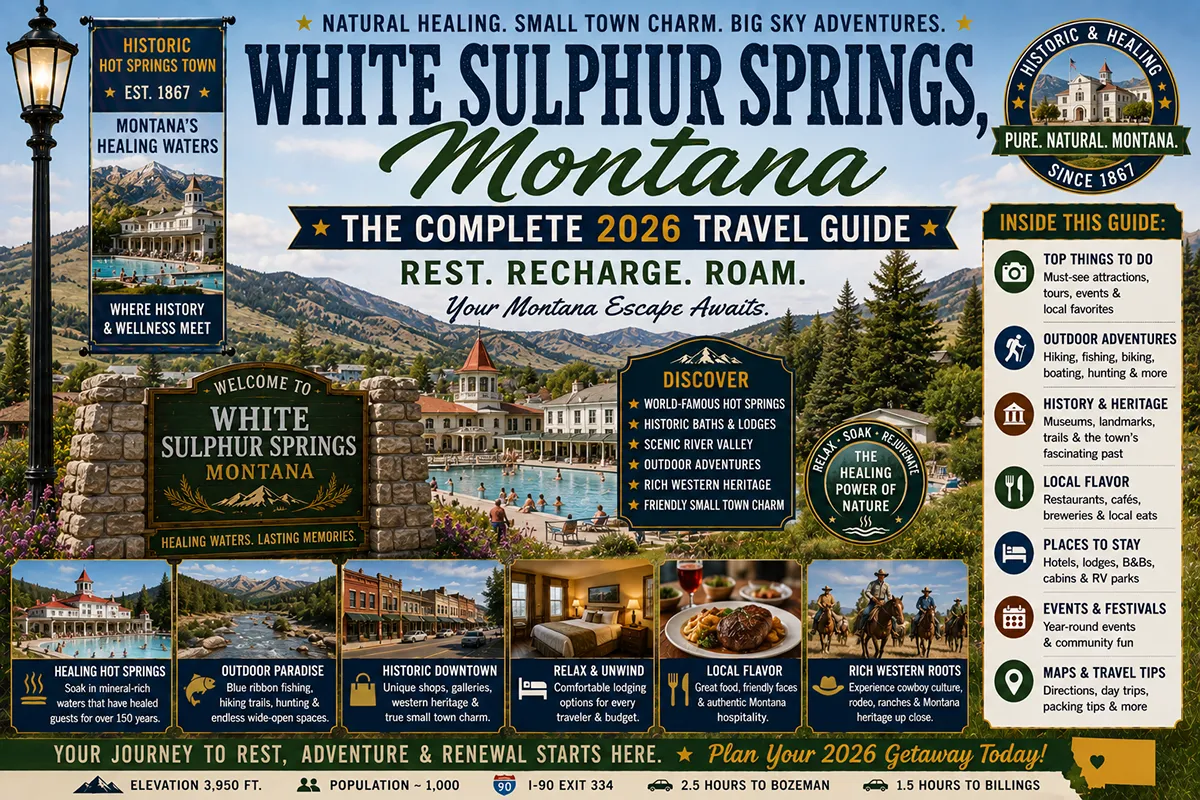
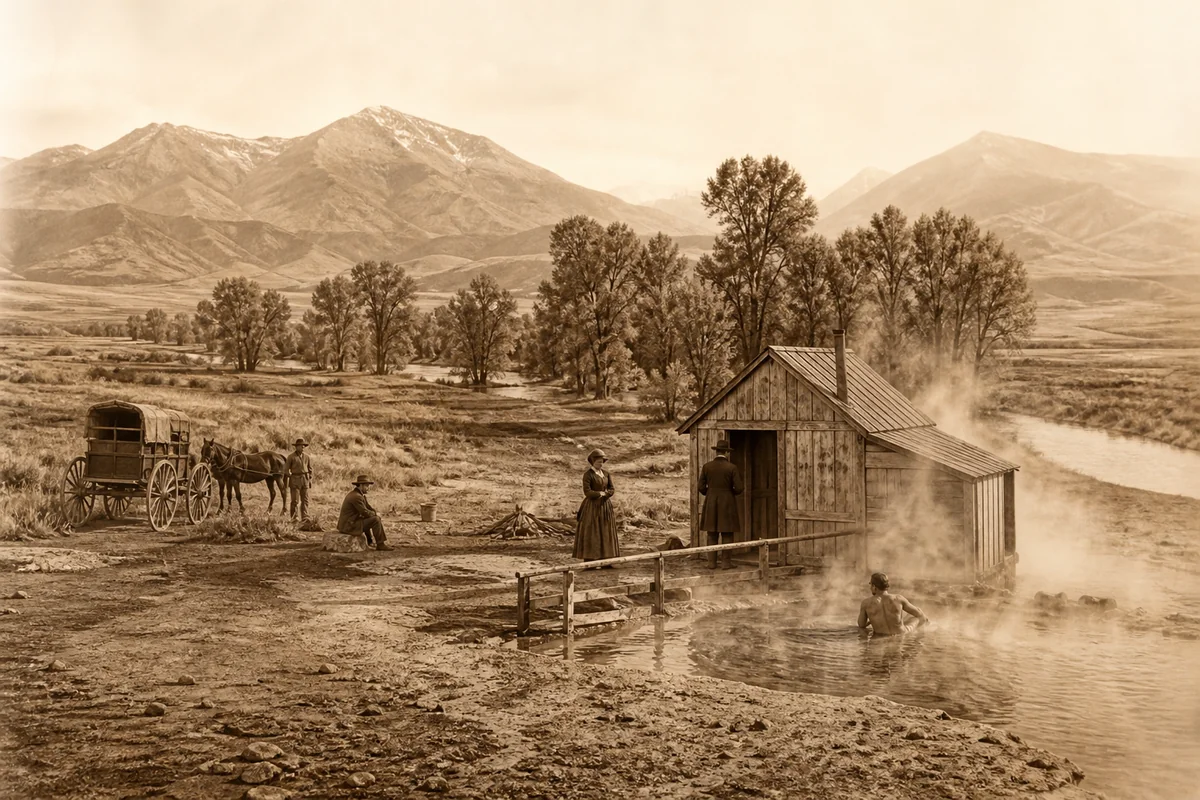
In White Sulphur Springs, the town’s first commercial business was a bath house, and the springs that fed it still flow through the middle of Main Street.
TL;DR
- White Sulphur Springs is the Meagher County seat, with 955 residents (2020 census), set at the crossroads of U.S. 12 and U.S. 89 in the Smith River Valley.
- Core stops are Spa Hot Springs, The Castle (a granite mansion finished around 1892), the Kings Hill Scenic Byway and the Red Ants Pants Music Festival.
- The Smith River float is a permit lottery, not a walk-up trip, and the application window closes each February.
- Winter driving and short museum seasons shape when a visit works best.
Plenty of Montana towns have a hot spring. Few have one that gave the town its name, a mansion hauled stone by stone out of the Castle Mountains by ox team, and a river that most people see only after winning a drawing. The combination, set in a valley ringed by four separate mountain ranges, is what gives this small county seat its weight.
The town’s story starts with a prospector’s claim in 1866, runs through a military post, a lost mining boomtown and a cattleman’s showpiece home, and ends in a downtown that now hosts one of the better-known music festivals in the state. A visit works as a day trip from Helena or Great Falls, but the town rewards an overnight stay in the water.
This guide is part of the Montana cities and towns directory and belongs to Central Montana. It covers location and distances, the town’s history, the main attractions, the Smith River lottery, the seasons and a few sample plans.
Liked this article?
Add Roaming Montana as a preferred source so you see more of our articles and guides on Google.
Where White Sulphur Springs Sits
The town lies at about 5,060 feet (Wikipedia) in the Smith River Valley, a basin that Into the Little Belts describes as framed by the Little Belt, Big Belt, Castle and Crazy Mountains. Hot Springs Creek rises in the middle of town, and the North Fork of the Smith River crosses its northwest corner. The town covers under one square mile.
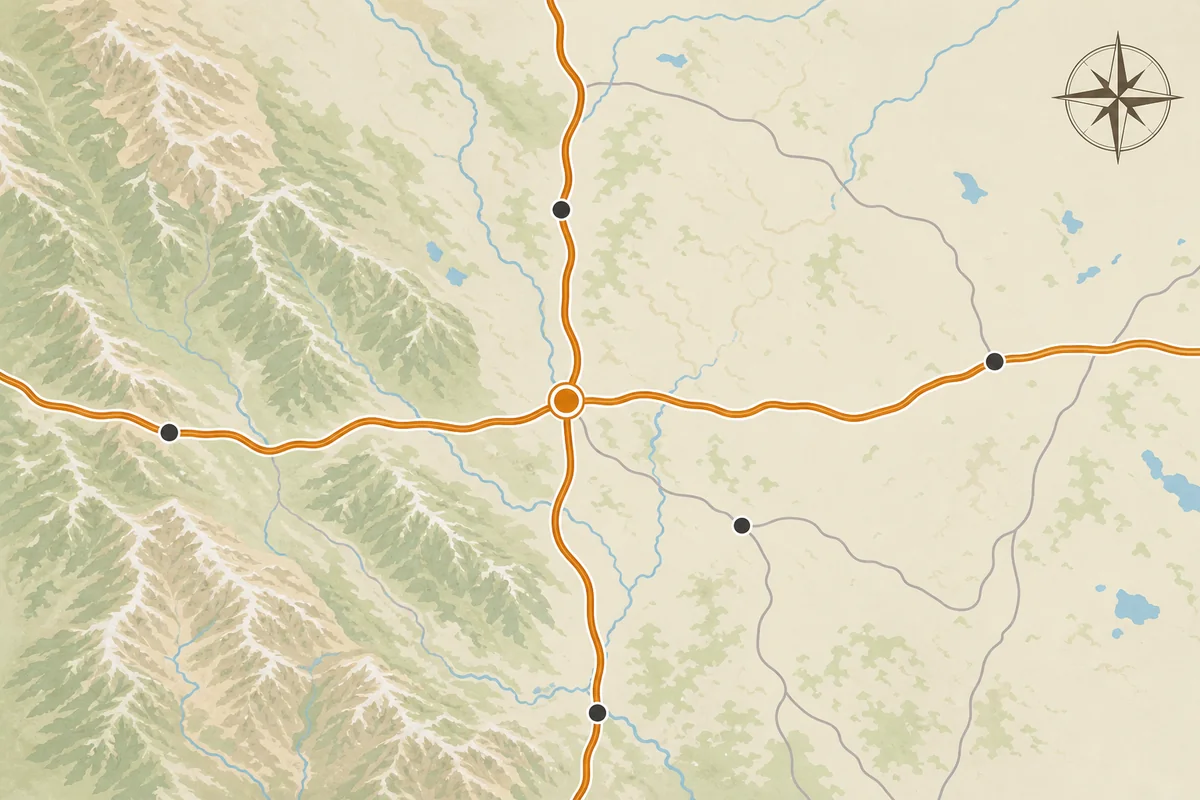
| Direction | Highway and distance | Notes |
|---|---|---|
| East to Harlowton | U.S. 12, 57 miles | See Harlowton |
| Southwest to Townsend | U.S. 12, 42 miles | Connects toward Helena |
| North to Neihart | U.S. 89, 40 miles | Over Kings Hill Pass; see Neihart |
| South to Livingston | U.S. 89, 71 miles | Through the Shields Valley |
| Great Falls | U.S. 89 north, then onward | See Great Falls |
| Helena | Via Townsend | See Helena |
| Showdown Ski Area | U.S. 89 north, roughly 30 miles | See Montana ski resorts |
Both highways run through town as Main Street and 3rd Avenue, which makes White Sulphur Springs a literal crossroads. The county around it, Meagher, had 1,927 residents in 2020, so roughly half the county lives in the seat.
A Short History in Layers
Brewer’s Claim and a New Name
The Smith River Valley marker (HMdb) records that James Scott Brewer discovered the White Sulphur Springs in 1866 and compares the water to that of Baden-Baden, Germany. The settlement was first known as Brewers Springs, and the name changed in 1876. A mineral-water resort business followed; the Spa and local reporting date the first commercial bath house, with a plunge, to about 1872.
Camp Baker, Fort Logan and a Boomtown Next Door
The same marker explains the setting. Gold placers in the Big Belt gulches drew miners in the 1860s and 1870s, and Montana Bar in Confederate Gulch was called the “richest acre of ground in the world.” The marker adds that the gulch’s population later grew past 10,000. Fort Logan, established as Camp Baker in 1869, stood near the north end of the valley to protect mining camps and ranches.
Meagher County was created on November 16, 1867, and named for Thomas Francis Meagher, the territorial governor. The first county seat was Diamond City, in the Confederate Gulch mining district, an area now in Broadwater County. White Sulphur Springs later became the seat.
Timeline
| Date | Event |
|---|---|
| 1866 | James Scott Brewer claims the springs |
| Nov. 16, 1867 | Meagher County created; Diamond City is the first seat |
| 1869 | Camp Baker (later Fort Logan) established |
| c. 1872 | First commercial bath house, called Brewer’s Springs |
| 1876 | Town name changes from Brewers Springs |
| 1890–1892 | Byron Sherman builds The Castle |
| 1905 | Sherman sells the house to Michael Donahoe of Seattle |
| 1911 | Wellman Block built |
| 1960 | Donahoe heirs donate The Castle to the county historical association |
Spa Hot Springs
What the Pools Are
Spa Hot Springs Motel at 202 W. Main Street holds two outdoor pools and one indoor pool. Hot springs locator listings give source water at 130°F and pool temperatures of 98°F, 103°F and 105°F. The pools are flow-through and are drained and cleaned nightly, with no chemicals added. Swimsuits are required.
The Water
Listed mineral content is led by bicarbonate (830 ppm), sodium (504 ppm) and sulfate (301 ppm). The water has no noticeable odor despite the town’s name. Day visitors pay a pool fee; motel guests soak free. A 2022 Missoula Current profile gave hours as 7 a.m. to 10 p.m. daily.
The People
The same profile says owners Gene and Annie Gudmundson bought the property in 1988. The article calls the springs one of Montana’s first commercial hot springs, dating to 1872, about 17 years before statehood. Murals inside depict the long human use of the water, which the Spa’s own history credits to Native visitors long before settlement.
The Castle
Who Built It
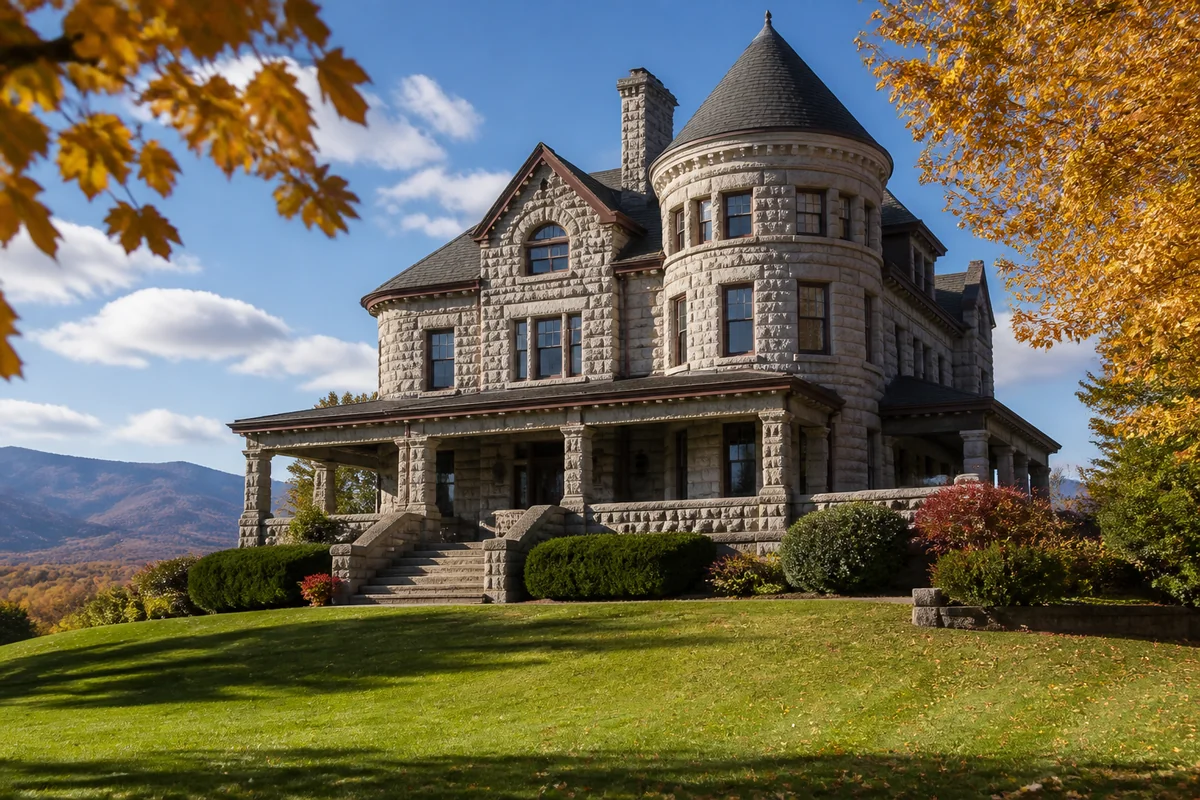
The Castle, also called the Sherman House, sits at 310 2nd Avenue Northeast. The 1976 National Register nomination credits Byron Roger Sherman with the design, a local contractor named Soos with the build and mason Ole Opshall with the stonework. Granite came from the Castle Mountains, about 12 miles away, on wagons pulled by 16-ox teams.
What Makes It Unusual
The two-story granite house has Romanesque features, a rectangular tower and a round tower. Inside, the nomination lists cherry and oak woodwork, Italian marble bath fixtures, crystal and brass lighting, a windmill-powered hot-water system with a coal furnace, and an acetylene gas plant. For a Montana ranching town in the 1890s, that was extraordinary.
Sherman’s Story
Sherman ran a grist mill at Fort Owen (1865), a ranch, a stage line and a livery, and sold real estate. He is also credited with the first local electric light plant. Montana’s Historic Landscape notes he wanted to show that livestock could pay well in central Montana. He moved to California in 1902 and sold the house in 1905.
Visiting
Into the Little Belts lists the Castle open May 15 to September 15, 10 a.m. to 5 p.m., with the last tour at 4:30 p.m.. The county historical society maintains it. Admission is not listed in the sources reviewed. See the best museums in Montana.
Downtown Main Street
Carroll Van West, writing for Montana’s Historic Landscape, singles out the Meagher County Courthouse as one of the state’s best New Deal-era courthouses. He also notes the Wellman Block, built in 1911 and listed on the National Register of Historic Places, now home to Red Ants Pants. The Strand Theatre sits next door. He mentions a roadside café known locally for a single sign reading “Eat,” a historic Bucka-Roo Bar, a Victorian commercial block and a 1960s modernist gas station. Some of these businesses may have changed hands.
Red Ants Pants Music Festival
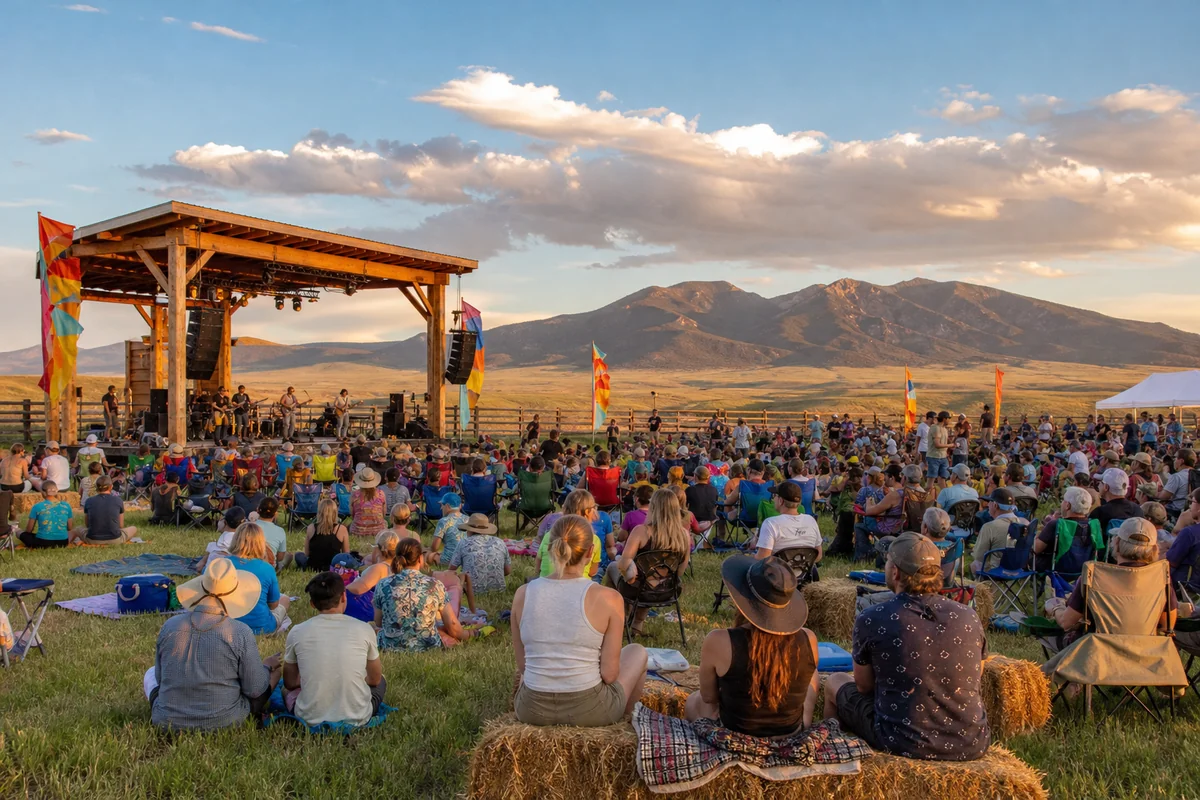
The festival’s 15th year ran July 23 to 26, 2026, according to NBC Montana. The 2026 lineup included Ricky Skaggs & Kentucky Thunder, Molly Tuttle, Sara Evans, Old 97’s and Brandy Clark, plus 16 side-stage performances. Proceeds support the Red Ants Pants Foundation, which works on women’s leadership, working family farms and ranches, and rural communities. Wikipedia lists founder Sarah Calhoun among the town’s notable people. Lodging fills early in festival week, so reservations should be made far ahead.
The Smith River Lottery
How It Works
The 59-mile float from Camp Baker to Eden Bridge is controlled by a Montana FWP lottery. According to January 2026 coverage, applications ran January 1 to February 15, with a tentative drawing on February 18. The nonrefundable application fee is $15. One permit covers a group of up to 15, and applicants must be at least 12.
Details Worth Knowing
Selected applicants receive an email with permit links, then a phone call two days before launch to finalize boat camps and float fees. A separate Super Permit lottery sells $5 chances, with the winner choosing any launch date. Floaters must use portable toilet systems, and bag systems such as RESTOP2 are not allowed. Total permit counts and fee amounts are not stated in the sources reviewed. Without a permit, the valley itself still offers hiking and fishing.
Honest Expectations
Winning is not guaranteed, and many applicants go unselected. The float is a multi-day, self-supported trip, not a casual tube ride. Outfitter options may exist.
Outdoor Options Without a Permit
Into the Little Belts lists 17 campgrounds in the county, including Kings Hill, Many Pines and Whitetail. Hikes include Memorial Falls and Elephant Rock; fishing includes Sheep Creek; motor trails include Deep Creek, Taylor Hills, South Pilgrim Creek and Balsinger. Historic points include the Carroll Trail, Ace in the Hole and Armington Junction. Golf is available at Jawbone Creek Country Club and Arrowhead Meadows Golf Course. See Montana national forests.
Kings Hill and Showdown
U.S. 89 north of town is part of the 71-mile Kings Hill Scenic Byway, which also passes Neihart and Belt. Showdown Ski Area, which opened in 1936 as King’s Hill Ski Area, lies north of town in Meagher County. Winter driving can be demanding; see the Montana winter driving guide.
People Tied to the Town
Wikipedia lists novelist Ivan Doig, born in White Sulphur Springs; Harlem Renaissance singer Emmanuel Taylor Gordon, born, raised and buried there; actor Dirk Benedict; and Red Ants Pants founder Sarah Calhoun. The local high school team is the Hornets.
The Bair Museum in Martinsdale
The Charles M. Bair Family Museum, at 2751 MT Highway 294 in Martinsdale, lists hours of 10 a.m. to 4 p.m., seven days a week June through August, and Wednesday through Sunday in September and October. Admission is posted separately.
Where to Eat, Stay and Resupply
Into the Little Belts lists lodging at Spa Hot Springs Motel, All Seasons Inn and Suites, Tenderfoot Hotel and Cabins and Heaven on Earth Ranch. Food and drink options include Bar 47, Stageline Pizza and Branding Iron Cafe, with a brewery listing for Basset Brewery. Groceries are Castle Mountain Grocery and Mathis Food Farm; gas is available at Town Pump and others. For campers, see best RV parks in Montana.
Reading the Valley: A Self-Guided Checklist
A short stop gains depth with a few things to look for:
- The creek in town. Hot Springs Creek rises in the middle of White Sulphur Springs, which explains why a bath house stood here before most of the buildings.
- The stone. The Castle’s granite came from the Castle Mountains about 12 miles away; the range on the eastern horizon is the quarry.
- The ranges. Four mountain ranges frame the basin: the Little Belts, Big Belts, Castles and Crazies. Memorial Falls and Elephant Rock offer closer looks.
- The crossroads. Two U.S. highways meet at Main Street and 3rd Avenue, a reason the town has served as county seat since the mining boom faded.
- The marker. The Smith River Valley marker on U.S. 89 south of town summarizes the placer-mining and Fort Logan story.
Visiting Responsibly
Hot springs, historic buildings and mountain roads all depend on visitors following the posted rules. Pool rules such as required swimsuits and nightly draining are part of how the water stays clean without chemicals. The Castle is maintained by a historical society, so donations and tour fees matter. On the river and in the forest, packing out waste is both a courtesy and, on the Smith, a requirement.
Climate and Seasons
Wikipedia’s 1991–2020 normals list an annual mean maximum of 55.3°F and mean minimum of 28.9°F, 13.04 inches of precipitation and 46.1 inches of snow. Records run from 103°F to −46°F.
| Season | What to expect | Notes |
|---|---|---|
| Winter (Dec-Mar) | Cold, snowy; hot-spring soaks, Showdown | Check passes before driving |
| Spring (Apr-May) | Mud, runoff; lottery results | Many seasonal sites not yet open |
| Summer (Jun-Aug) | Warmest weather; Castle open; festival in July | Busiest lodging |
| Fall (Sep-Oct) | Color, hunting traffic | Castle and Bair seasons end |
Sample Plans
A Half-Day Stop
Walk Main Street, tour the Castle in season and soak at the Spa.
A Weekend
Day one: Castle, downtown and a soak. Day two: drive Kings Hill to Neihart and back, or ski at Showdown in winter.
A Crossroads Loop
Link Helena, Townsend, White Sulphur Springs and Harlowton by US 12.
Getting There and Around
A car is required. The nearest commercial airports are Bozeman and Great Falls; see Montana airports. Cell coverage can drop in the mountains between towns.
What Visitors Rarely Hear
- The Castle’s season is short. Hours differ by source, so confirmation by phone is wise.
- The soak is hotter than the town’s name suggests. Pools run 98–105°F.
- Smith River permits come from a lottery. The window closes mid-February.
- The first county seat was Diamond City. Not White Sulphur Springs.
- Elevation is not 5,200 feet. Sources say about 5,060–5,100.
- The “sulphur” has no odor. The Spa lists none.
- Festival week strains lodging. July bookings fill early.
- Winter roads need respect. Kings Hill is a mountain pass.
Practical Information
| Item | Details |
|---|---|
| Location | Meagher County seat; U.S. 12 and U.S. 89 |
| Population | 955 (2020 census) |
| Elevation | About 5,060 feet |
| ZIP code | 59645 |
| Best season | June–September; winter for soaking and skiing |
| Spa Hot Springs | 202 W. Main St.; pools 98–105°F |
| The Castle | 310 2nd Ave NE; summer season |
| Smith River | FWP lottery; 59 miles |
| What to bring | Swimsuit, layers, chains in winter, cash |
Frequently Asked Questions
Is White Sulphur Springs worth visiting?
Yes, for the hot springs, the Castle, Kings Hill and the Smith River Valley.
How many people live there?
955 at the 2020 census.
Why is it called White Sulphur Springs?
The settlement began around James Scott Brewer’s 1866 claim on mineral springs; it was Brewers Springs until 1876.
What are the Spa pools like?
Two outdoor and one indoor pool at 98–105°F, drained nightly.
Who built the Castle?
Byron Roger Sherman, finished around 1892.
How does the Smith River lottery work?
Apply through FWP by February 15; the fee is $15 and the float is 59 miles.
When is Red Ants Pants?
July 23–26 in 2026.
How far is it from Great Falls and Helena?
Check current mileage; U.S. 12 and 89 lead to both.
Final Thoughts
White Sulphur Springs holds a lot in a small footprint: a creek that steams in winter, a granite house built by an ambitious stockman, a courthouse and theater from different eras and a river reserved by lottery. It is a town where the history is visible without a museum.
Pin this guide for a Montana crossroads trip, and leave questions in the comments. For the wider region, continue to Central Montana or browse all Montana cities and towns.