The history of Ashland, Montana cannot be told without St. Labre.
In 1883, a U.S. Army private named George Yoakam was stationed at Fort Keogh near Miles City. What he saw of the Northern Cheyenne people in the Tongue River Valley after the 1876 Battle of the Little Bighorn disturbed him deeply.
The Cheyenne had been victorious at Little Bighorn — but by 1883, eight years later, many were displaced, homeless, and hungry. The reservation boundaries had not yet been settled. The buffalo herds were essentially gone. Traditional nomadic life had been forcibly ended.
Yoakam contacted Bishop John Brondel of the Montana Catholic diocese.
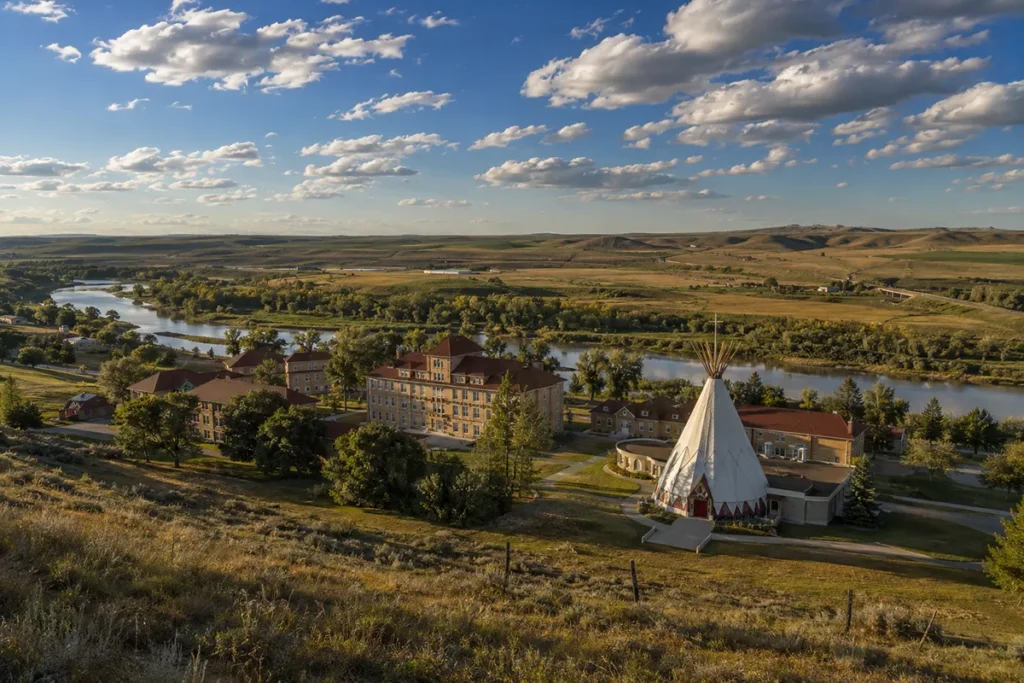
The bishop purchased land along the Tongue River. On March 29, 1884, four Ursuline Sisters from Ohio — led by Mother Amadeus Dunne, O.S.U. — arrived after a difficult horse-and-buggy journey from Miles City. They opened a school in a three-room log cabin that served simultaneously as residence, classroom, dormitory, and church.
They named the new mission St. Labre after Saint Benedict Joseph Labre — an 18th-century French saint known for his poverty and simplicity.
St. Labre Indian School has operated continuously since.
For 141 years, through religious order successions, devastating fires, world wars, the Great Depression, and the broader contemporary reckoning with federal Indian boarding school policy, St. Labre has served as the central institution of the small community that grew up around it.
Today the school serves approximately 700 students from the Crow and Northern Cheyenne tribes through preschool, elementary, middle, and high school programs.
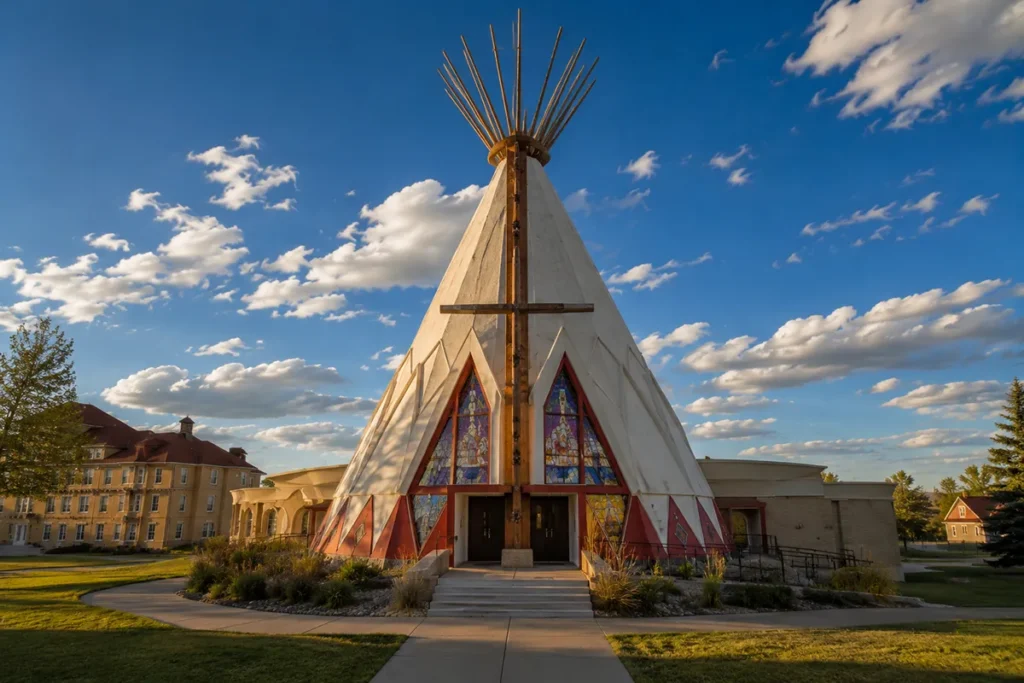
The St. Labre Indian Chapel — designed in a style inspired by the Plains Indian tepee, with a great wooden cross beam rising through what would be the smoke hole opening — is one of the more architecturally substantive religious structures in eastern Montana.
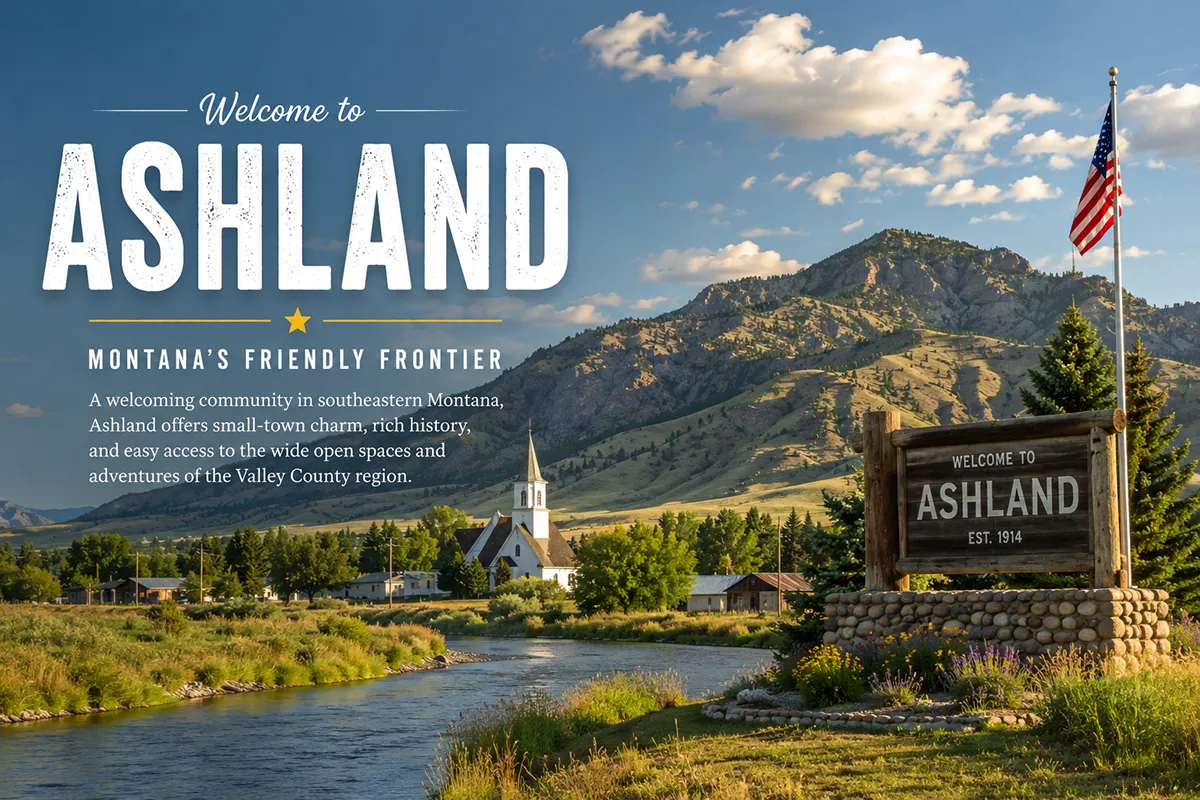
The town of Ashland — population approximately 763 at the 2020 census — sits along the Tongue River on US Highway 212, surrounded by the Northern Cheyenne Indian Reservation to the west and the Custer Gallatin National Forest’s Ashland Ranger District to the north and east.
TL;DR
- Ashland (~763) is an unincorporated CDP in Rosebud County on US Highway 212 in the Tongue River Valley, immediately adjacent to the Northern Cheyenne Indian Reservation.
- The community is anchored by St. Labre Indian School, founded March 29, 1884 by the Catholic Church.
- The school was established at the urging of Private George Yoakam of Fort Keogh, who recognized the hard times of the Northern Cheyenne people after the 1876 Battle of the Little Bighorn.
- Four Ursuline Sisters under Mother Amadeus Dunne arrived by horse-and-buggy from Miles City in March 1884.
- The school was named for Saint Benedict Joseph Labre, an 18th-century French saint known for poverty and simplicity.
- St. Labre currently serves approximately 700 students from the Crow and Northern Cheyenne tribes, with sister schools at Pretty Eagle Academy (St. Xavier) and St. Charles Mission (Pryor) on the Crow Reservation.
- The St. Labre Indian Chapel features architecture inspired by the Plains Indian tepee — a great wooden cross beam rising through a central skylight resembling the traditional smoke hole opening.
- The Cheyenne Indian Museum at St. Labre houses substantial Plains Indian artifacts and a documentary film on the school’s history.
- The contemporary relationship between St. Labre and the Northern Cheyenne Tribe has been complicated; a 2019 legal settlement provided $11 million in payments plus $60,000 annually, and the school launched a 2023 investigation into potential unmarked graves at the historic boarding school site.
- The surrounding Custer Gallatin National Forest’s Ashland Ranger District offers extensive hiking, hunting, camping, and dispersed recreation.
- Best for: religious heritage travelers, Northern Cheyenne cultural context, Tongue River corridor, Custer Gallatin National Forest gateway.
Liked this article?
Add Roaming Montana as a preferred source so you see more of our articles and guides on Google.
Ashland at a Glance
| Population (2020) | ~763 |
|---|---|
| County | Rosebud County |
| Status | Unincorporated CDP |
| Region | Southeast Montana (Tongue River Valley) |
| Elevation | 2,772 ft |
| Distance to Lame Deer (Northern Cheyenne agency) | ~22 miles west on US-212 |
| Distance to Forsyth (county seat) | ~50 miles north |
| Distance to Broadus | ~50 miles east on US-212 |
| Distance to Miles City | ~85 miles northeast |
| Distance to Colstrip | ~60 miles north |
| Distance to Billings | ~120 miles west |
| Distance to Wyoming border | ~35 miles south |
| St. Labre Indian School founded | March 29, 1884 |
| Best for | St. Labre Mission, Northern Cheyenne heritage, Tongue River recreation, Ashland Ranger District |
What Makes Ashland Different
Ashland exists because of the Tongue River and St. Labre.
The 1884 Founding
The story of St. Labre Indian School begins eight years after the Battle of the Little Bighorn.
In 1876, the combined forces of the Lakota, Cheyenne, and Arapaho had defeated Lieutenant Colonel George Armstrong Custer’s 7th Cavalry at the Little Bighorn. The Northern Cheyenne were among the victors.
But the victory was short-lived.
Within months, the U.S. Army was systematically pursuing the Plains tribes. The buffalo herds — which had sustained Plains Indian life for centuries — were being destroyed in a deliberate federal policy of extermination. The boundaries of reservations had not been fully settled.
Many Cheyenne, after the 1879 escape from forced relocation to Indian Territory (now Oklahoma) and the subsequent retreat to Montana, were essentially homeless in their own historic homeland.
Private George Yoakam — stationed at Fort Keogh near Miles City in 1883 — saw families struggling along the Tongue River with no resources to support themselves. He contacted Bishop John Brondel of the Montana Catholic diocese and asked for help.
The bishop purchased land. In March 1884, four Ursuline Sisters from Ohio — led by Mother Amadeus Dunne, O.S.U. — traveled to the new site by horse-and-buggy from Miles City. They brought supplies, ambition, and faith.
On March 29, 1884, St. Labre Indian School opened in a three-room log cabin.
The Saint Behind the Name
The school’s namesake — Saint Benedict Joseph Labre — was an unusual choice for an American Western mission.
Labre was an 18th-century French religious figure who had wandered Europe as a homeless religious pilgrim. He had no possessions. He slept in church doorways. He was canonized in 1881 — just three years before St. Labre Indian School was established.
The choice of patron made sense to the founders. The Northern Cheyenne in 1884 were also wandering without homes, without permanent shelter. Labre’s example of voluntary poverty and his focus on the marginalized matched the mission’s broader theology.
A small replica of the original log cabin still stands on the original mission site today.
Religious Order Succession
St. Labre has been administered by an unusual succession of Catholic religious orders since its founding:
- Ursulines (1884-1933) — founded and staffed the original school
- Jesuits (Turin Province, 1885-1897) — administered for 12 years
- Helena diocesan priests (1899-1914)
- Society of St. Edmund (1914-1925)
- Capuchins (St. Joseph’s Province, 1926-2004) — the longest tenure
- School Sisters of St. Francis (1933-c.1980) — provided teaching staff
- Lay administration (2004-present)
A destructive fire in 1917 damaged much of the school. It was rebuilt.
The Tepee-Inspired Chapel
The contemporary St. Labre Indian Chapel is architecturally distinctive.
The design draws explicitly from the Plains Indian tepee — the traditional dwelling that defined Cheyenne, Lakota, and other northern Plains nomadic life for centuries.
A great wooden cross beam rises through the center of the building to where the tepee’s traditional smoke hole opening would be. Beautiful stained glass windows flank the cross beam on either side.
The architectural choice represents a deliberate attempt to bridge Catholic religious symbolism and Northern Cheyenne cultural heritage.
The Cheyenne Indian Museum
The school’s museum features substantial collections of Plains Indian artifacts alongside a documentary film on St. Labre’s history. The museum is generally open daily 8:00 AM to 4:30 PM, with extended hours Memorial Day through Labor Day.
The museum is one of the more substantive Plains Indian heritage collections accessible in eastern Montana.
Contemporary Complexity
The contemporary relationship between St. Labre Indian School and the Northern Cheyenne Tribe has been substantively complicated.
The Northern Cheyenne Tribal Council pursued litigation against the school regarding the use of substantial donor funds in service to a limited number of actual tribal members.
The litigation was settled in 2019 for payments totaling $11 million plus $60,000 annually thereafter.
The settlement has itself become contentious — some Northern Cheyenne community members have argued the Tribal Council misappropriated the settlement funds. Demonstrations and protests have occurred.
In 2023, St. Labre launched an investigation into potential unmarked graves at historic Indian boarding school sites — including the Ashland campus. A commission has held listening sessions with Crow and Northern Cheyenne community members across multiple reservation locations.
Both stories are part of the broader contemporary reckoning with federal Indian boarding school policy across the United States and Canada.
For broader trip context, see my Montana cities and towns hub and Montana history overview.
The Top 6 Things to Do In & Around Ashland
1. St. Labre Indian School Campus Tour
The signature attraction.
The historic 1884 log cabin replica, the contemporary tepee-inspired chapel, the Cheyenne Indian Museum, and the broader campus are all open to respectful visitors. Tour hours typically 8:00 AM to 4:30 PM, with extended hours from Memorial Day through Labor Day.
The school is genuinely active — approximately 700 students attend daily during the academic year. Visit with appropriate sensitivity to ongoing operations.
2. Cheyenne Indian Museum
Located on the St. Labre campus.
The museum features Plains Indian artifacts, religious artifacts from the mission’s early decades, and a documentary film on the school’s history. Free admission; donations appreciated. One of the more substantive Plains Indian heritage collections in eastern Montana.
3. Tongue River Recreation
The Tongue River flows through Ashland on its way north to the Yellowstone River.
The river supports trout fishing, canoeing, kayaking, and shoreline camping. Multiple public access points along US-212. The Tongue River Reservoir State Park approximately 30 miles south near Decker offers additional water recreation.
4. Custer Gallatin National Forest — Ashland Ranger District
The forest’s Ashland Ranger District covers approximately 500,000 acres of the Custer National Forest portion of the combined Custer Gallatin.
Hiking, hunting, dispersed camping, and Forest Service road access throughout. The district headquarters is in Ashland. Stop in for current trail conditions, motor vehicle use maps, and recreation information.
5. Northern Cheyenne Reservation Day Trip
The reservation extends west from Ashland to Lame Deer (the agency seat, ~22 miles) and beyond.
The Northern Cheyenne Tribe Cultural Center in Lame Deer provides context for contemporary Northern Cheyenne community life. Guided tours and cultural programs are sometimes available — verify schedules with the tribal office.
6. US-212 Corridor Drive
US Highway 212 connects Broadus (east) to Crow Agency and Hardin (west), passing through Ashland.
The route is a substantial alternative to the I-90 corridor for travelers heading between the Yellowstone Valley and the Black Hills of South Dakota.
Multiple substantive stops along the way including the Lame Deer agency, the Rosebud Battlefield State Park (south of Decker, Wyoming border), and the Battle of the Little Bighorn National Monument near Crow Agency.
Where to Stay
Ashland has limited lodging.
Most travelers either stay at the modest local motel options or base in Forsyth (50 miles north) or Miles City (85 miles northeast).
| Lodging | Vibe | Price | Best For |
|---|---|---|---|
| Western 8 Motel (Ashland) | Basic local motel | $90–140 | Budget travelers |
| Vacation rentals (Ashland area) | Tongue River cabins | $130–250 | Anglers, longer visits |
| Forsyth lodging (50 min N) | Rosebud County seat | $100–180 | Most travelers |
| Miles City hotels (1.5 hrs NE) | Full small-city selection | $100–200 | I-94 corridor |
| Custer Gallatin USFS campgrounds | Backcountry sites | $20–30 | Self-sufficient |
Where to Eat
- Local Ashland options — small cafes and the Conoco station; verify current operations
- Forsyth dining (50 min N) — Rosebud County selection
- Miles City restaurants (1.5 hrs NE) — broader variety
Getting There & Around
From Miles City: 85 miles southwest on US-212, about 1.75 hours.
From Forsyth: 50 miles south on MT-39 and US-212, about 1 hour.
From Broadus: 50 miles west on US-212, about 1 hour.
From Billings: ~120 miles east via I-90 and US-212, about 2.25 hours.
From Colstrip: ~60 miles south via MT-39 and US-212, about 1.25 hours.
Cell service: Generally available in Ashland and along US-212. Reduced in the surrounding Custer Gallatin National Forest and on the Northern Cheyenne Reservation backroads.
When to Visit
Summer (June-August): Best weather; full school visiting hours; Tongue River recreation at peak.
Fall (September-October): Outstanding southeastern Montana light; cottonwood color along the Tongue River; hunting season.
Winter (December-March): Severe Montana weather possible; some campus tour hours reduced; verify school operating schedules.
Spring (April-May): Tongue River runoff; quieter shoulder season; school still in session.
Personal Tips
Visit St. Labre with respect. The school is a working educational institution serving approximately 700 active students. Self-guided tours of the public spaces (chapel, museum, log cabin replica) are welcome; respect that classrooms, dormitories, and administrative areas are off-limits to casual visitors.
Understand the contemporary complexity. The Northern Cheyenne Tribe’s 2019 settlement with St. Labre and the 2023 unmarked-graves investigation are substantive contemporary stories. Don’t pretend they don’t exist. The historical mission was complicated. The contemporary institutional reckoning is part of that history.
Read about the 1876 Battle of the Little Bighorn context. Understanding what happened to the Northern Cheyenne between 1876 and 1884 — the buffalo destruction, the 1879 escape from Indian Territory, the failure to settle reservation boundaries — adds substantial context to why St. Labre was founded in the first place.
Combine with Lame Deer. A morning at St. Labre followed by an afternoon at the Northern Cheyenne tribal office and cultural center in Lame Deer (22 miles west) makes a substantively meaningful Northern Cheyenne heritage day.
Plan for the Custer Gallatin Forest. The Ashland Ranger District covers approximately 500,000 acres and offers substantial uncrowded hiking, hunting, and camping. Stop at the ranger station in Ashland for current conditions.
Drive the full US-212 corridor. The route from Ashland east to Broadus and west to Crow Agency and the Battle of the Little Bighorn National Monument makes a substantive multi-day southeastern Montana experience.
Ashland Quick Facts
| Population (2020 CDP) | ~763 | | County | Rosebud County | | Region | Southeast Montana (Tongue River Valley) | | Elevation | 2,772 ft | | St. Labre Indian School founded | March 29, 1884 | | St. Labre founder advocate | Private George Yoakam (Fort Keogh) | | Original bishop sponsor | Bishop John Brondel | | Founding sisters | Four Ursulines under Mother Amadeus Dunne, O.S.U. | | Saint patron | Saint Benedict Joseph Labre (18th-century French) | | Original structure | Three-room log cabin | | 1917 fire | Major reconstruction event | | Capuchin tenure | 1926-2004 | | Lay administration | 2004-present | | Current student enrollment | ~700 (Crow + Northern Cheyenne) | | Northern Cheyenne Tribe 2019 settlement | $11 million + $60,000 annually | | 2023 unmarked graves investigation launched | Active | | Chapel architectural style | Plains Indian tepee-inspired | | Custer Gallatin Ashland Ranger District | ~500,000 acres | | Average summer high | 86°F | | Average winter low | 8°F |
Conclusion
Ashland is a 763-person Rosebud County community with substantively significant religious, educational, and cultural heritage.
The March 29, 1884 founding of St. Labre Indian School by Bishop Brondel and four Ursuline Sisters under Mother Amadeus Dunne — at the urging of an Army private named George Yoakam who could not ignore the Cheyenne hardship he witnessed at Fort Keogh — remains one of the more substantive religious heritage stories in Montana.
The contemporary complexity — the 2019 tribal settlement, the 2023 unmarked-graves investigation, the ongoing reckoning with federal Indian boarding school policy — is part of the same story.
The tepee-inspired chapel. The Cheyenne Indian Museum. The Tongue River corridor. The Custer Gallatin Ashland Ranger District. The proximity to the Northern Cheyenne Reservation. All of it adds up to one of the more substantively important small communities in southeastern Montana.
The next time you’re driving US-212 between Broadus and Crow Agency, stop for at least half a day.
Have an Ashland question? Drop it in the comments — I read every one.
Frequently Asked Questions
Is Ashland Montana worth visiting?
Yes — Ashland is worth visiting primarily for St. Labre Indian School (founded March 29, 1884, one of the most substantive religious heritage sites in southeastern Montana), the Cheyenne Indian Museum on the St. Labre campus, the architecturally distinctive tepee-inspired St. Labre Indian Chapel, access to the Custer Gallatin National Forest’s Ashland Ranger District (approximately 500,000 acres of public land), and as a gateway to the Northern Cheyenne Indian Reservation to the west.
What is St. Labre Indian School?
St. Labre Indian School is a Catholic-administered K-12 school in Ashland, Montana, founded on March 29, 1884 to serve Northern Cheyenne children. The school was established at the request of Private George Yoakam of Fort Keogh near Miles City, who recognized the hard times facing Northern Cheyenne families after the 1876 Battle of the Little Bighorn and the subsequent destruction of the buffalo herds. Bishop John Brondel of the Montana Catholic diocese purchased land along the Tongue River; four Ursuline Sisters from Ohio, led by Mother Amadeus Dunne, O.S.U., arrived by horse-and-buggy from Miles City in March 1884 to open the school. The school was named for Saint Benedict Joseph Labre, an 18th-century French saint known for poverty and simplicity. Today St. Labre serves approximately 700 students from the Crow and Northern Cheyenne tribes, with sister schools at Pretty Eagle Academy (St. Xavier) and St. Charles Mission (Pryor).
Where is the Northern Cheyenne Reservation?
The Northern Cheyenne Indian Reservation is a federal Indian reservation in southeastern Montana, immediately adjacent to Ashland on the west. The reservation agency headquarters is at Lame Deer, approximately 22 miles west of Ashland on US Highway 212. The reservation covers approximately 444,000 acres in Rosebud and Big Horn counties. The Northern Cheyenne people are descendants of the Cheyenne who fought at the 1876 Battle of the Little Bighorn and the 1879 escape from Indian Territory under Chiefs Dull Knife and Little Wolf. The reservation was formally established by executive order in 1884 — the same year St. Labre Indian School was founded just outside its boundaries.
Who was Saint Benedict Joseph Labre?
Saint Benedict Joseph Labre (1748-1783) was an 18th-century French Catholic religious figure who wandered Europe as a homeless religious pilgrim. He possessed essentially nothing, slept in church doorways, and dedicated his life to prayer and voluntary poverty. He was canonized in 1881 — just three years before the St. Labre Indian School at Ashland, Montana was founded in his name. The choice of patron reflected the founding mission’s focus on the displaced and homeless Northern Cheyenne, whose situation in 1884 paralleled Labre’s own life of wandering without permanent shelter.
What is the Cheyenne Indian Museum?
The Cheyenne Indian Museum is a museum on the St. Labre Indian School campus in Ashland, Montana, featuring substantial collections of Plains Indian artifacts and a documentary film on the history of St. Labre Indian School. The museum is one of the more substantive Plains Indian heritage collections accessible in southeastern Montana. Tours are typically conducted from 8:00 AM to 4:30 PM, with extended hours Memorial Day through Labor Day. Free admission; donations appreciated.
How far is Ashland from Miles City Montana?
Ashland is approximately 85 miles southwest of Miles City via US Highway 212 — about a 1.75-hour drive. From Forsyth (the Rosebud County seat to the north), Ashland is approximately 50 miles south via MT-39 and US-212, about 1 hour. Miles City and Forsyth are the practical urban anchors for any Ashland visit, with full hotels, restaurants, and services not available in the small Ashland community itself.
What was the 2019 St. Labre settlement?
In 2019, the Northern Cheyenne Tribe and St. Labre Indian School settled litigation that the Tribe had pursued regarding the school’s use of substantial donor funds in service to a limited number of actual tribal members. The settlement included $11 million in payments plus $60,000 annually thereafter. The settlement has itself been contentious; some Northern Cheyenne community members have argued the Tribal Council misappropriated the settlement funds, and demonstrations and protests have occurred. The settlement represents part of the broader contemporary reckoning with federal Indian boarding school policy and the relationship between religious mission institutions and the communities they were established to serve.