In 1891, the Great Northern Railway built a short spur line west from Kalispell and terminated it at a new community called Marion.
The community was named for Marion Shields — the daughter of Thomas Shields, a substantial figure in early Flathead County history who was himself the namesake of nearby Shields Creek.
For 11 years between 1892 and 1902, the substantial role of Marion in regional rail transportation was substantially elevated: the Great Northern Railway used the Marion spur as part of its main transcontinental line between Columbia Falls and Libby, routing trains through the rugged Haskell Pass of the broader Salish Mountains.
For those 11 years, Marion was a substantial through-traffic stop on one of America’s primary transcontinental rail corridors.
Then in 1904, the Great Northern moved its main line north to Whitefish — establishing the corridor that remains active today. The Kalispell-Marion spur reverted to its original local-service role. The railroad between Kalispell and Marion was eventually abandoned in 1940.
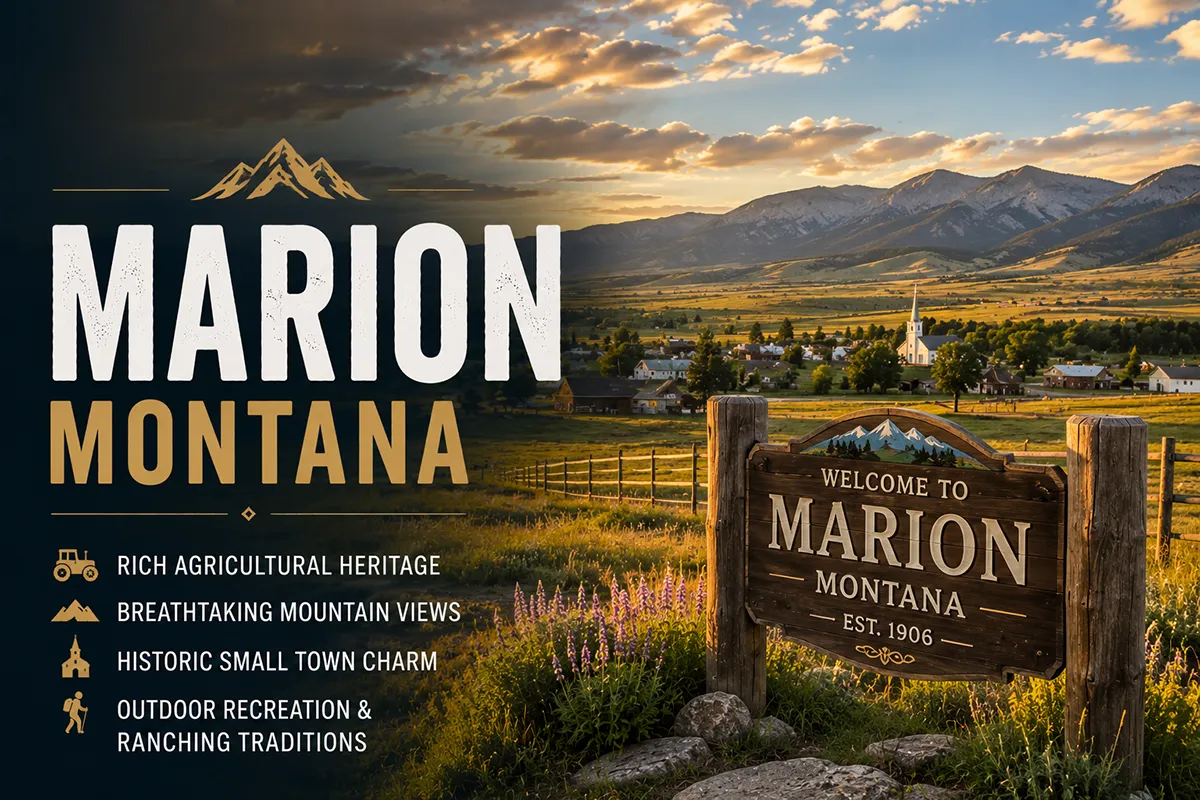
Today, Marion has approximately 1,119 residents (2020 census). The community sits 21 miles west of Kalispell along US Highway 2, in substantially beautiful country adjacent to Little Bitterroot Lake, near McGregor Lake, and within easy access of the Lost Trail National Wildlife Refuge (20 miles northwest).
The substantial timber-industry heritage — anchored by businessman Lewis Kelsey’s decision to relocate his sawmill to Marion from Somers at the turn of the 20th century — has substantially shaped the community’s economic and cultural character ever since.
TL;DR
- Marion (1,119) is an unincorporated CDP in Flathead County, 21 miles west of Kalispell on US Highway 2.
- The community was created in 1891 by the Great Northern Railway as the terminus of a short spur line west from Kalispell.
- From 1892 to 1902, Marion was part of the Great Northern’s substantial main transcontinental line through Haskell Pass to Columbia Falls and Libby.
- In 1904, the Great Northern moved its main line north to Whitefish, and the spur to Marion eventually closed in 1940.
- The community was named for Marion Shields, daughter of Thomas Shields (the namesake of Shields Creek).
- Little Bitterroot Lake (3,907 ft elevation) lies immediately adjacent to the community.
- McGregor Lake, McGregor Meadows (800-acre WPA waterfowl production area), and the Lost Trail National Wildlife Refuge (20 miles northwest) provide substantial outdoor recreation.
- Glacier National Park is approximately 90 minutes northeast.
- Best for: Little Bitterroot Lake recreation, Great Northern Railway heritage, Lost Trail wildlife refuge visits, western Flathead Valley exploration.
Liked this article?
Add Roaming Montana as a preferred source so you see more of our articles and guides on Google.
Marion at a Glance
| Population (2020) | 1,119 |
|---|---|
| County | Flathead County |
| Status | Unincorporated CDP |
| Region | Northwest Montana (western Flathead Valley) |
| Elevation | 4,042 ft |
| CDP area | 16.92 sq miles (16.87 land + 0.050 water) |
| ZIP code | 59925 |
| Distance to Kalispell (county seat) | ~21 miles east on US-2 |
| Distance to Whitefish | ~30 miles northeast |
| Distance to Columbia Falls | ~30 miles northeast |
| Distance to Libby | ~60 miles west |
| Distance to Bigfork | ~35 miles east |
| Distance to Lakeside | ~30 miles southeast |
| Distance to Somers | ~25 miles east |
| Distance to Glacier National Park (West Glacier entrance) | ~60 miles northeast (~90 min) |
| Distance to Lost Trail National Wildlife Refuge | ~20 miles northwest |
| Adjacent lake | Little Bitterroot Lake |
| Founded | 1891 (Great Northern Railway) |
| Best for | Little Bitterroot Lake, McGregor Lake area, railroad heritage, wildlife refuge |
What Makes Marion Different
Three distinct stories define Marion’s character: the railroad, the lakes, and the wildlife.
The 1891 Great Northern Founding
The Great Northern Railway — James J. Hill’s transcontinental rail empire — was substantially completing its mainline across northern Montana in 1891.
The substantial railroad construction effort required substantial supporting infrastructure. Spur lines extended in multiple directions to access timber, support construction crews, and provide commercial connections to developing communities.
In 1891, the Great Northern built a substantial spur line west from its Kalispell station and terminated it approximately 21 miles west at a location selected for its proximity to Little Bitterroot Lake and the surrounding timber resources of the western Flathead Valley.
The new community was named Marion — for Marion Shields, daughter of substantial early-Flathead-Valley figure Thomas Shields (whose own name lives on as the namesake of nearby Shields Creek).
The Marion post office was established in 1892.
The 1892-1902 Main Line Era
For 11 years between 1892 and 1902, the substantial regional role of Marion was substantially elevated.
The Great Northern Railway used the Marion spur — combined with extended trackage through the substantial Haskell Pass of the Salish Mountains — as part of its main transcontinental line between Columbia Falls (then a substantial GN railhead) and Libby (the substantial timber-and-mining center to the west).
For 11 years, substantial through traffic — transcontinental passenger trains, freight, mail, and substantial settlement-era commerce — passed through Marion.
The Haskell Pass route through the Salish Mountains was substantially challenging — narrow valleys, steep grades, harsh winter conditions. By the early 1900s, the railroad was substantially looking for a better alternative.
The 1904 Mainline Move
In 1904, the Great Northern Railway substantially relocated its main transcontinental line north to Whitefish — establishing the corridor that remains the BNSF (former Great Northern) main line today.
The substantial decision was driven by multiple factors:
- The northern route via Whitefish offered substantially better grades
- Less severe winter weather conditions
- Substantial new timber and mining traffic potential in the northern Flathead Valley
- The substantial growth of Whitefish itself as a developing railroad town
The Marion spur reverted to its original local-service role. Substantial through traffic disappeared. Marion contracted from its substantial 1892-1902 boom-era importance.
The Lewis Kelsey Sawmill
Substantial economic continuity for Marion came from the timber industry.
Around the turn of the 20th century, Lewis Kelsey — a substantial businessman who had been operating a sawmill at Somers on Flathead Lake — relocated his operations to Marion. The substantial Marion-area timber resources and the still-operating railroad spur made the move substantially advantageous.
The Kelsey sawmill became one of the substantial economic anchors of Marion through the early 20th century. Substantial timber operations continued in the broader area through subsequent decades.
The 1940 Spur Abandonment
The railroad between Kalispell and Marion was eventually abandoned in 1940.
The substantial 49-year railroad heritage of the community came to a close. By that time, automobile and truck transportation had substantially superseded the spur’s freight role. The post-abandonment Marion remained an unincorporated rural community along the substantial US-2 corridor.
Today, the Great Northern Historical Trail rails-to-trails system runs along portions of the abandoned grade between Kalispell and Kila, with substantial plans to continue the trail to Marion in coming years.
The Lakes
Marion’s substantial contemporary identity centers on its lakes.
Little Bitterroot Lake — at 3,907 feet elevation — sits immediately adjacent to the community. The substantial lake supports fishing (kokanee salmon, lake trout, yellow perch, rainbow trout), boating, swimming, scuba diving, and substantial shoreline recreation.
McGregor Lake — slightly further west — provides additional substantial lake recreation. McGregor Meadows — an 800-acre WPA (Waterfowl Production Area) — provides substantial waterfowl habitat.
The Lost Trail National Wildlife Refuge
Approximately 20 miles northwest of Marion is the substantial Lost Trail National Wildlife Refuge — a substantially diverse habitat that supports migratory and breeding waterfowl, deer, elk, moose, black bears, and lynx.
The refuge is one of the more substantively important wildlife refuges in northwest Montana. Substantial viewing opportunities along established refuge roads.
For broader trip context, see my Montana cities and towns hub and Montana history overview.
The Top 6 Things to Do In & Around Marion
1. Little Bitterroot Lake Recreation
The signature local lake.
Located immediately adjacent to Marion at 3,907 feet elevation, Little Bitterroot Lake supports fishing, boating, swimming, scuba diving, and substantial shoreline recreation. Multiple substantial public access points along county roads from Marion provide lake access.
2. McGregor Lake & McGregor Meadows
Located slightly west of Marion.
McGregor Lake provides additional substantial lake recreation including fishing, boating, and shoreline access. The 800-acre McGregor Meadows Waterfowl Production Area (WPA) supports substantial waterfowl habitat — particularly substantial during spring and fall migration seasons.
3. Lost Trail National Wildlife Refuge
Approximately 20 miles northwest of Marion via county roads.
The substantial refuge supports a substantial diversity of wildlife including migratory and breeding waterfowl, deer, elk, moose, black bears, and lynx. Substantial viewing opportunities; respect refuge regulations and seasonal closures.
4. Great Northern Railway Heritage
The abandoned 1891-1940 Great Northern Railway grade between Kalispell and Marion is substantially visible across the region.
Portions of the grade between Kalispell and Kila have been substantially converted to the Great Northern Historical Trail rails-to-trails system. Plans are in place to extend the trail substantially west to Marion in coming years.
5. Day Trip to Kalispell (21 miles east)
The Flathead County seat is the natural urban anchor for any Marion visit.
Attractions include the substantial Conrad Mansion (1895), the Northwest Montana History Museum, the Hockaday Museum of Art, and substantial restaurant and shopping options. See things to do in Kalispell for a comprehensive guide.
6. Glacier National Park Day Trip (90 minutes northeast)
One of the most substantially important national parks in the system.
The Going-to-the-Sun Road, substantial alpine hiking, and the broader 1-million-acre park infrastructure await. See best hikes in Glacier National Park and where to stay in Glacier National Park for detailed planning.
Where to Stay
Marion has limited dedicated lodging.
Most travelers base in Kalispell (21 miles east) or in Whitefish (30 miles northeast).
| Lodging | Vibe | Price | Best For |
|---|---|---|---|
| Kalispell hotels (25 min E) | Full Flathead County selection | $130–280 | Most travelers |
| Whitefish options (40 min NE) | Resort town — see where to stay in Whitefish | $180–450 | Resort experience |
| Bigfork lodging (45 min E) | Lake-area options | $150–350 | Flathead Lake-focused |
| Libby options (1 hr W) | Lincoln County seat | $100–200 | Extended western travel |
| Lakeside cabins (Little Bitterroot/McGregor) | Lake-focused | $130–300 | Lake recreation |
| Vacation rentals (Marion area) | Rural Flathead Valley | $130–280 | Quieter base |
| Glacier National Park lodging — see where to stay in Glacier National Park | In-park options | $200–500 | Park-focused |
Where to Eat
- Local Marion options — small selection; verify current operations
- Kalispell dining (25 min E) — extensive variety
- Whitefish restaurants (40 min NE) — substantial resort-town selection
- Libby options (1 hr W) — Lincoln County dining
Getting There & Around
From Kalispell: 21 miles west on US-2, about 25 minutes.
From Whitefish: 30 miles southwest via US-93 and US-2, about 40 minutes.
From Columbia Falls: 30 miles southwest via US-2, about 35 minutes.
From Libby: 60 miles east on US-2, about 1 hour.
From Bigfork: 35 miles northwest via MT-35 and US-2, about 45 minutes.
To Glacier National Park (West Glacier): ~60 miles northeast via US-2, about 90 minutes.
Cell service: Limited in Marion and along the western US-2 corridor. Bring offline maps.
When to Visit
Summer (June-August): Best Marion weather; substantial lake recreation at Little Bitterroot, McGregor, and surrounding lakes; warmest temperatures.
Fall (September-October): Outstanding northwest Montana fall color; cooler temperatures; substantial wildlife activity at Lost Trail NWR during migration.
Winter (December-March): Substantial Montana winter; lakes freeze; substantial winter recreation possible; access can be limited to remote refuge roads.
Spring (April-May): Lake ice-out; the country greens up; substantial waterfowl migration through Lost Trail NWR.
Personal Tips
Use Marion as a substantial lake-focused base. The community’s adjacent position to Little Bitterroot Lake and easy access to McGregor Lake make it substantively practical for travelers focused on northwest Montana lake recreation away from the more touristed Flathead Lake corridor.
Read about the 1892-1902 Great Northern main line era. Understanding that Marion was briefly part of one of America’s substantial transcontinental rail corridors — and that the railroad’s 1904 decision to relocate the main line north to Whitefish substantially changed Marion’s economic trajectory — adds substantial historical depth to a visit.
Visit the Lost Trail National Wildlife Refuge during migration. Spring and fall waterfowl migration through Lost Trail provides substantial wildlife viewing opportunities. The 20-mile drive northwest from Marion accesses one of northwest Montana’s more substantively important wildlife refuges.
Combine with Kalispell and Glacier National Park. A morning at Marion’s lakes, an afternoon at the Northwest Montana History Museum in Kalispell, and the following day at Glacier National Park (60 miles northeast) makes a substantively meaningful northwest Montana itinerary.
Don’t expect a town center. Marion is functionally a substantial rural community spread across substantial CDP area (16.92 sq mi) rather than a compact municipality. The community’s character is rural-residential with substantial lake access.
Plan for substantial road quality variations. The substantial county roads accessing Little Bitterroot Lake, McGregor Lake, McGregor Meadows, and the Lost Trail NWR vary substantially in surface quality and seasonal accessibility.
Marion Quick Facts
- Population (2020) | 1,119
- County | Flathead County
- CDP area | 16.92 sq mi (16.87 land + 0.050 water)
- Population density | 66.3 per sq mi
- Elevation | 4,042 ft
- ZIP code | 59925
- Founded | 1891 (Great Northern Railway terminus)
- Named for | Marion Shields (daughter of Thomas Shields)
- Post office established | 1892
- GN main line through Marion | 1892-1902
- GN main line moved to Whitefish | 1904
- Spur abandoned | 1940
- Adjacent lake | Little Bitterroot Lake (3,907 ft)
- Nearby lake | McGregor Lake
- McGregor Meadows WPA | 800 acres
- Distance to Lost Trail NWR | ~20 miles northwest
- Distance to Glacier National Park | ~60 miles northeast (~90 min)
- Average summer high | 78°F
- Average winter low | 14°F
Conclusion
Marion is a 1,119-person Flathead County community with substantively interesting Great Northern Railway heritage and substantial outdoor recreation infrastructure.
The 1891 Great Northern Railway founding as the spur-line terminus west of Kalispell. The substantial 1892-1902 main line era through Haskell Pass to Libby. The 1904 mainline relocation north to Whitefish that fundamentally changed Marion’s regional role.
The 1940 spur abandonment. The substantial Little Bitterroot Lake, McGregor Lake, and McGregor Meadows WPA that anchor contemporary recreation. The substantial Lost Trail National Wildlife Refuge 20 miles northwest. The substantial 1.5-hour position from Glacier National Park.
The next time you’re driving US-2 between Kalispell and Libby, or planning a substantial western Flathead Valley lake-focused itinerary, consider an overnight in Marion.
Have a Marion question? Drop it in the comments — I read every one.
Frequently Asked Questions
Is Marion Montana worth visiting?
Marion is worth visiting for substantial Little Bitterroot Lake and McGregor Lake recreation, the substantial Lost Trail National Wildlife Refuge (20 miles northwest) with its substantial waterfowl, deer, elk, moose, black bear, and lynx populations, and as a substantively practical base for exploring the broader western Flathead Valley and northwest Montana corridor. The community offers substantial substantively peaceful character compared to the more touristed Kalispell and Whitefish areas.
Who is Marion Montana named after?
Marion was named for Marion Shields, the daughter of Thomas Shields — a substantial early Flathead County figure who was himself the namesake of nearby Shields Creek. The Great Northern Railway established the community in 1891 as the terminus of a short spur line west from Kalispell, and the substantial naming choice honored a member of one of the area’s earliest substantial settler families.
When was Marion Montana founded?
Marion was founded in 1891 as the terminus of a short spur line that the Great Northern Railway built west from Kalispell. The community’s post office was established in 1892. From 1892 to 1902, Marion was briefly part of the Great Northern’s substantial main transcontinental line between Columbia Falls and Libby through the rugged Haskell Pass of the Salish Mountains. In 1904, the Great Northern moved its main line north to Whitefish, and the Marion spur reverted to local-service status. The railroad between Kalispell and Marion was eventually abandoned in 1940.
How big is Marion Montana?
Marion had a population of 1,119 at the 2020 U.S. Census. The CDP covers approximately 16.92 square miles in western Flathead County at an elevation of 4,042 feet. The substantial CDP area (one of the larger Montana unincorporated communities by geographic size) reflects Marion’s rural character — homes and ranches are substantially spread across the community rather than concentrated in a compact town center.
What is Little Bitterroot Lake?
Little Bitterroot Lake is a substantial lake in western Flathead County immediately adjacent to Marion, Montana. The substantial lake sits at 3,907 feet elevation and supports fishing (kokanee salmon, lake trout, yellow perch, rainbow trout), boating, swimming, scuba diving, and shoreline recreation. Multiple substantial public access points along county roads from Marion provide lake access. Little Bitterroot Lake is one of the more substantively important lakes in the western Flathead Valley away from the broader Flathead Lake corridor.
What is the Lost Trail National Wildlife Refuge?
The Lost Trail National Wildlife Refuge is a substantial federal wildlife refuge located approximately 20 miles northwest of Marion in Flathead County, Montana. The refuge provides substantial diverse habitat that supports migratory and breeding waterfowl, deer, elk, moose, black bears, and lynx. Spring and fall waterfowl migration produces substantial wildlife viewing opportunities. The refuge is one of the more substantively important wildlife refuges in northwest Montana. Access is via county roads from Marion or from US Highway 2.
How far is Marion from Kalispell Montana?
Marion is approximately 21 miles west of Kalispell via US Highway 2 — about a 25-minute drive. Kalispell serves as the practical urban anchor for any Marion visit, with full hotels, restaurants, the substantial Conrad Mansion, the Northwest Montana History Museum, the Hockaday Museum of Art, and the Glacier Park International Airport (~30 miles east of Marion). See things to do in Kalispell for a comprehensive guide to the broader Kalispell area.