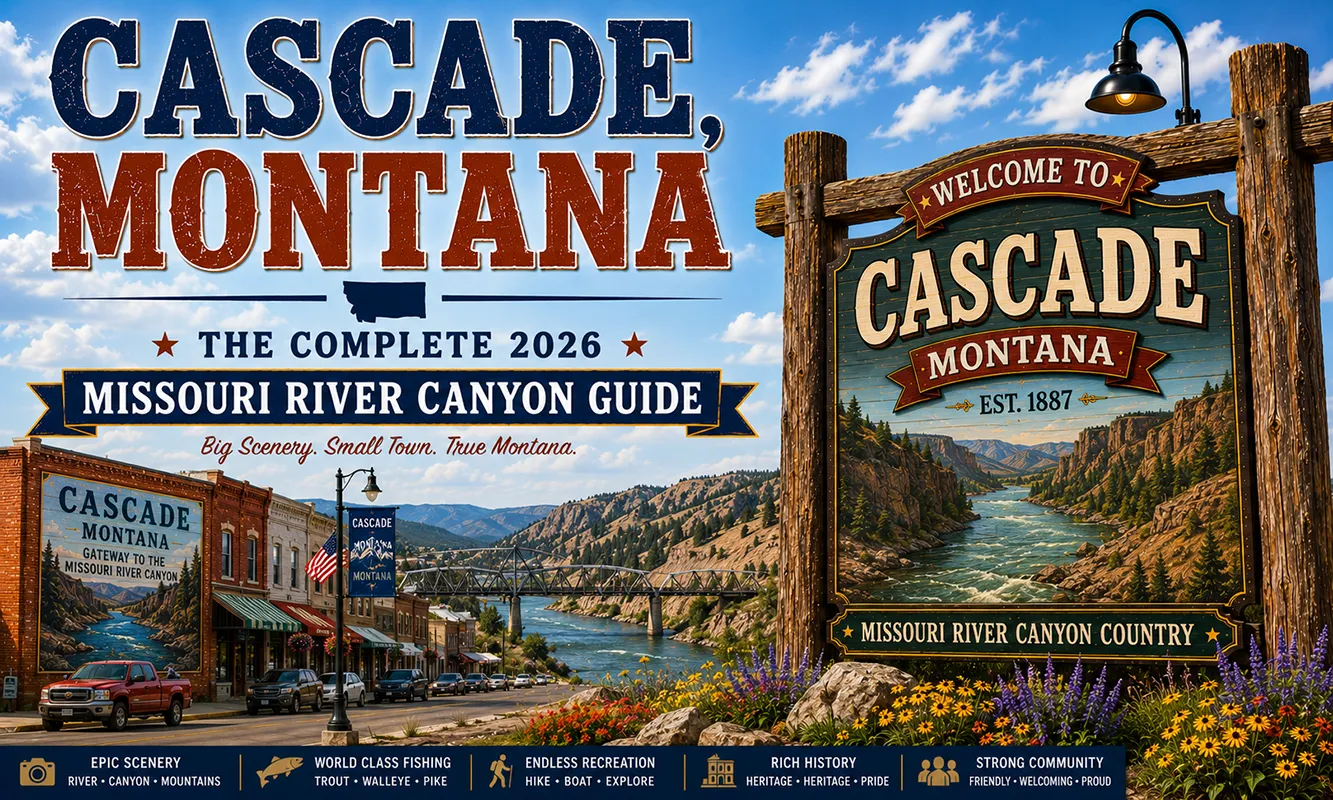
Between Great Falls and Helena, I-15 follows the Missouri River through a landscape that most travelers experience only as a blur at 80 miles per hour.
The river cuts through increasingly dramatic canyon country south of Great Falls — the same canyon that stopped the Lewis and Clark Expedition for a full month in 1805, when the explorers spent weeks portaging 18 miles around the Great Falls.
Cascade sits in this corridor at the point where the Missouri River has begun its transition from plains river to canyon river, and where the surrounding hills show the first hints of the rough country that defines central Montana.
TL;DR
- Cascade (~800) is a small Missouri River community on I-15, 25 miles south of Great Falls and 75 miles north of Helena.
- The Missouri River here provides excellent fishing access — brown trout, walleye, and catfish in a canyon setting.
- The Beartooth Game Range and surrounding public lands offer wildlife viewing and hunting access.
- The historic Cascade Caves (Cave Mountain area) were used by Indigenous peoples and later homesteaders.
- Best for: Missouri River fishing and scenery, I-15 canyon corridor travelers, and anyone wanting to experience the river Lewis and Clark portaged.
Liked this article?
Add Roaming Montana as a preferred source so you see more of our articles and guides on Google.
Cascade at a Glance
| Population (2020) | ~800 |
|---|---|
| County | Cascade County |
| Region | North-Central Montana |
| Elevation | 3,314 ft |
| I-15 exit | Exit 247 |
| Distance to Great Falls | ~25 miles north (~25 min) |
| Distance to Helena | ~75 miles south (~1.25 hours) |
| Distance to Wolf Creek | ~20 miles south (~20 min) |
| Best for | Missouri River fishing and canyon scenery, I-15 corridor stop, Lewis & Clark river context |
What Makes Cascade Different
The Missouri River corridor between Great Falls and Helena is one of Montana’s most historically significant stretches of water and one of its least-appreciated scenic drives. Lewis and Clark spent June 1805 in the Great Falls area — first exploring upstream to confirm they’d found the main river, then organizing the exhausting 18-mile portage around the five major falls.
By the time they reached the area near modern Cascade, they were heading into increasingly complex terrain as the river cut through the first ranges of the Rocky Mountains.
Today the I-15 corridor follows this route, and at Cascade the landscape is beginning its transition. The river here is emerging from the straight plains channel above Great Falls and entering a more dynamic, canyon-influenced environment.
The canyon walls aren’t as dramatic as the Missouri Breaks far downstream or the Gates of the Mountains 20 miles south, but they’re significant — limestone bluffs, cottonwood bottomlands, and the river itself narrowing into something with more character than a plains river.
Fishing is the primary recreational draw. The Missouri River below Holter Dam (just south of Wolf Creek) is famous for trophy trout — some of the largest wild brown and rainbow trout in Montana are caught in the tailwater below the dam.
The Cascade area is upstream of the most famous tailwater section, but still provides excellent walleye and catfish fishing, with some trout near canyon structure.
The Beartooth Game Range — a Montana Fish, Wildlife & Parks managed wildlife area west of Cascade — provides public land for hunting and wildlife viewing. Mule deer, whitetail, elk, and pheasants are all present.
For broader trip context, see my Montana cities and towns hub.
The Top 10 Things to Do In & Around Cascade
1. Missouri River Fishing
The Missouri near Cascade is productive year-round for walleye, sauger, channel catfish, and brown trout. Bandolier Landing is the primary public fishing access site near Cascade — a developed access with boat ramp on the Missouri. The river here is wide with deep runs and cutbanks that hold fish. Walleye are most active in spring and fall; catfish in summer.
2. Gates of the Mountains (20 miles south near Wolf Creek)
Lewis and Clark named this Missouri River canyon on July 19, 1805 — at the point where the river appears to enter a solid rock wall and the canyon closes dramatically overhead. Today the Gates of the Mountains Wilderness is accessible by boat tour from a landing near Wolf Creek, 20 miles south of Cascade. One of the most significant Lewis and Clark landmarks in Montana.
3. Beartooth Game Range Wildlife Viewing
Public land west of Cascade managed for wildlife habitat — good deer, elk, and upland bird habitat. Access via county roads west of I-15. Wildlife viewing particularly good in early morning and evening.
4. Cave Mountain / Historic Cascade Caves
The cave systems in the hills near Cascade were used by Indigenous peoples and later homesteaders. The caves are not a developed attraction — they’re accessed via hiking in rough terrain — but represent a significant piece of the area’s pre-European history. Local knowledge is helpful for finding the access route.
5. Holter Lake & Missouri River Tailwater (20 miles south near Wolf Creek)
The Holter Dam creates a reservoir just north of Wolf Creek, and the tailwater below the dam is legendary for trophy brown and rainbow trout. The Holter Lake Recreation Area (Bureau of Reclamation) provides camping, boating, and fishing access. This is the beginning of the most famous section of the Missouri River trout fishery.
6. Missouri River Float Trip
The Missouri River between Cascade and Wolf Creek can be floated by canoe or kayak — a multi-day journey through canyon scenery with the same river Lewis and Clark ascended. Multiple access points allow shorter day floats.
7. Hi-Line Road Trip Context
For travelers driving I-15 between Great Falls and Helena, Cascade is the midpoint community — a genuine town rather than just an exit. Getting off the interstate for 30 minutes to drive through the canyon bottomlands alongside the river gives a completely different perspective from the elevated highway.
8. Day Trip to Great Falls (25 minutes north)
C.M. Russell Museum, Lewis & Clark Interpretive Center, Giant Springs State Park. See Great Falls guide.
9. Day Trip to Helena (75 minutes south)
State Capitol, Last Chance Gulch, Montana Historical Society. See Helena guide.
10. Wolf Creek & Canyon Area (20 minutes south)
Wolf Creek is a tiny I-15 community with the Oasis Bar (a legendary local spot) and the access point for Gates of the Mountains boat tours and Holter Lake recreation.
Where to Stay
| Hotel | Vibe | Price | Best For |
|---|---|---|---|
| Cascade Motel | Local basic | $80–120 | Road trip stop |
| Missouri River campgrounds | Various BLM/state sites | $15–30 | Campers, anglers |
| Wolf Creek area cabins (20 min south) | River setting | $130–220 | Fishing focus |
| Great Falls hotels (25 min north) | Full selection | $130–250 | More variety |
| Helena hotels (1.25 hours south) | Full city | $140–260 | Capital city access |
Where to Eat
- Cascade Bar & Grill — the community gathering place; reliable bar food
- Korner Café — breakfast and lunch basics
- Wolf Creek area dining (20 min south) — the Oasis Bar is a regional legend
- Great Falls (25 min north) — full dining variety
Getting There & Around
From Great Falls: I-15 south, Exit 247 at Cascade, 25 miles (~25 minutes).
From Helena: I-15 north, Exit 247 at Cascade, 75 miles (~1.25 hours).
From Wolf Creek: I-15 north 20 miles, about 20 minutes.
By plane: Great Falls International Airport (GTF) is the nearest major airport, 25 minutes north.
What Cascade Unlocks
Gates of the Mountains (20 min south)
The dramatic Lewis and Clark canyon — the Missouri entering a near-vertical rock wall. Boat tours from the Gates of the Mountains landing (seasonal).
Holter Lake & Missouri Tailwater (20 min south)
Trophy brown and rainbow trout below Holter Dam — some of the largest wild trout in Montana.
Great Falls Lewis & Clark Interpretive Center (25 min north)
The definitive Lewis & Clark Expedition museum in Montana, covering the Great Falls portage.
Helena (75 min south)
Montana’s capital, with the Last Chance Gulch, Montana Historical Society, and the state’s best museums.
When to Visit
Spring (April–May): Missouri River rising; walleye and catfish fishing; Gates of the Mountains boat tours begin.
Summer (June–August): Full river access; boat tours running; floating season.
Fall (September–October): Best brown trout fishing; cottonwood leaves turning gold along the river; hunting season.
Winter: Cold; the river stays open below dams; ice fishing on Holter Lake.
Personal Tips
Gates of the Mountains is mandatory. It’s 20 minutes south of Cascade — the boat tour through the canyon is one of the best Lewis and Clark experiences in Montana and operates May through September. Book ahead for weekends.
Stop at the Missouri River, not just the interstate. Getting off I-15 at Cascade and driving to Bandolier Landing takes 10 minutes and gives you actual riverbank contact with the same water Lewis and Clark ascended. The interstate experience is just pavement.
Wolf Creek for evening fishing. The tailwater below Holter Dam south of Wolf Creek is worth an evening drive. The trout are real, the canyon is spectacular, and the river corridor between Cascade and Wolf Creek has some of the finest brown trout water in central Montana.
The Oasis Bar in Wolf Creek. A Montana I-15 legend — a roadhouse serving legitimate steaks and cold beer to interstate travelers for decades. Worth the 20-minute detour from Cascade.
Cascade Quick Facts
| Founded | 1880s (Missouri River ferry crossing) | | I-15 exit | 247 | | Missouri River | Lewis and Clark portaged around Great Falls, 25 miles north (1805) | | Gates of the Mountains | Named by Lewis and Clark, July 19, 1805; 20 miles south | | Average summer high | 83°F | | Average winter low | 9°F |
Conclusion
Cascade is the I-15 stop that most travelers don’t take, between a major city (Great Falls) and the state capital (Helena) — and that’s a mistake. The Missouri River here is beautiful and fishable, the Gates of the Mountains is 20 minutes south, the Holter Lake tailwater trout fishery is the same distance, and the canyon scenery through the corridor is what Montana looks like before the interstate engineers smooth it out.
Have a Cascade question? Drop it in the comments — I read every one.
Frequently Asked Questions
Is Cascade Montana worth visiting?
Yes — Cascade is worth a stop for Missouri River fishing access (walleye, catfish, and brown trout at Bandolier Landing), as a basecamp for the Gates of the Mountains boat tour and Holter Lake tailwater trout fishery 20 minutes south, and for the Lewis & Clark river corridor context. As an I-15 stop between Great Falls and Helena, it’s more substantive than it appears from the highway.
What is near Cascade Montana on the Missouri River?
The Gates of the Mountains Wilderness (20 miles south, accessible by boat tour from the landing near Wolf Creek) is the most significant Lewis and Clark landmark in the area. Holter Lake and the world-class Missouri River tailwater trout fishery below Holter Dam are 20 miles south near Wolf Creek. Bandolier Landing provides public fishing access right at Cascade.
How far is Cascade from Great Falls?
Cascade is approximately 25 miles south of Great Falls on I-15 — about a 25-minute drive. Great Falls has the C.M. Russell Museum, the Lewis & Clark Interpretive Center, and full hotel and dining options.
What fish can you catch near Cascade Montana?
The Missouri River near Cascade holds walleye, sauger, channel catfish, and brown trout. The most famous fishing is 20 miles south near Wolf Creek — the tailwater below Holter Dam produces trophy brown and rainbow trout up to 20+ inches.