The Gros Ventre people call themselves A’aninin — “White Clay People.” The Assiniboine call themselves Nakoda — “Those Who Cook With Stones.” These two distinct nations, with separate languages, cultural traditions, and histories, share the Fort Belknap Indian Reservation in north-central Montana.
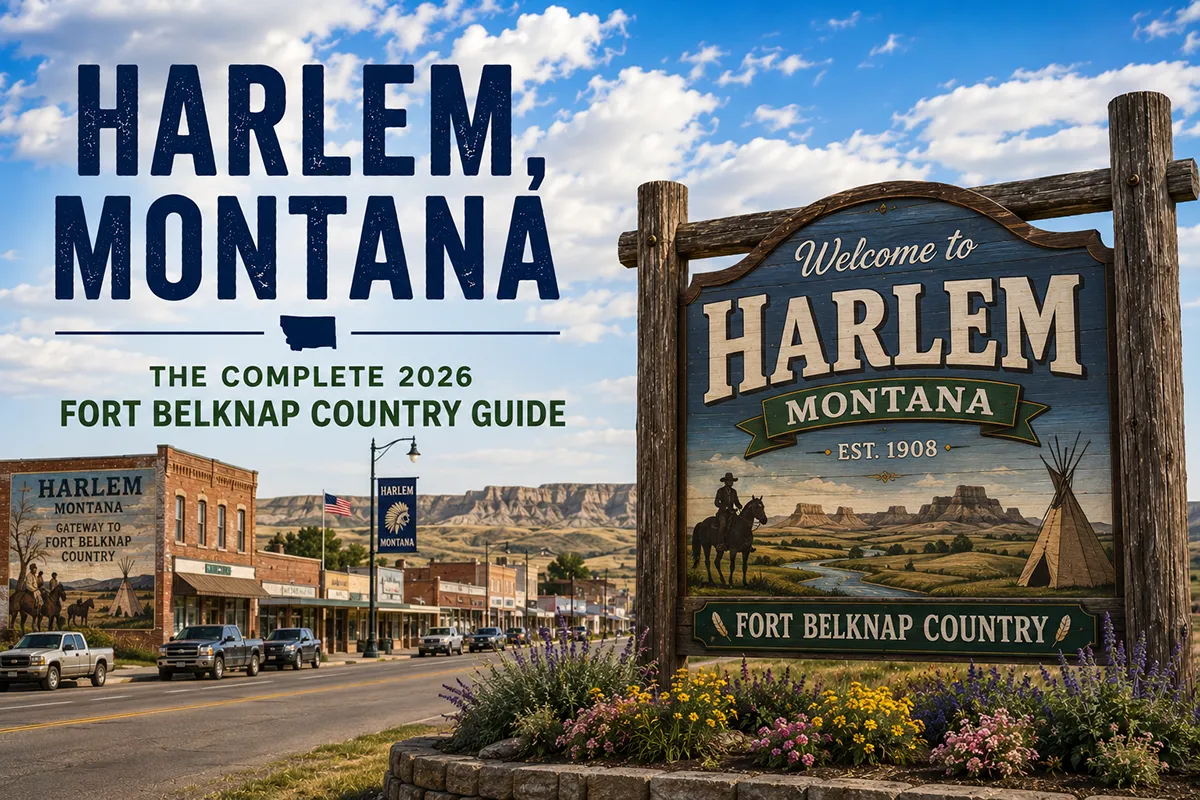
Harlem sits at the southern boundary of that reservation on US-2, where the Hi-Line highway meets the reservation’s agricultural edge. It’s a small community — about 800 people — but it serves as the functional gateway between the Hi-Line corridor and the tribal homelands to the north.
TL;DR
- Harlem (~800) is in Blaine County on US-2, at the southern edge of the Fort Belknap Indian Reservation — homeland of the Gros Ventre (A’aninin) and Assiniboine (Nakoda) peoples.
- Fort Belknap Agency (tribal governmental center) is 5 miles north of Harlem.
- Fort Belknap College is the tribal college preserving Gros Ventre and Assiniboine cultural heritage and languages.
- The Milk River flows through the Harlem area — walleye and pike fishing.
- Best for: travelers genuinely interested in Fort Belknap Tribes culture, Hi-Line Indigenous history, and the Milk River corridor.
Liked this article?
Add Roaming Montana as a preferred source so you see more of our articles and guides on Google.
Harlem at a Glance
| Population (2020) | ~800 |
|---|---|
| County | Blaine County |
| Reservation | Fort Belknap Indian Reservation (Gros Ventre/Assiniboine) |
| Region | North-Central Montana (Hi-Line) |
| Distance to Havre | ~50 miles west (~55 min) |
| Distance to Chinook | ~20 miles east (~25 min) |
| Distance to Malta | ~70 miles east (~1.25 hours) |
| Best for | Fort Belknap Reservation culture, Milk River access, Hi-Line Indigenous history |
What Makes Harlem Different
The Fort Belknap Reservation is one of Montana’s most culturally distinctive Indigenous communities — two separate nations (Gros Ventre and Assiniboine) sharing a single reservation, each maintaining their distinct languages and traditions. The reservation was established in 1888 and covers approximately 652,000 acres of north-central Montana.
The cultural distinction matters: the Gros Ventre (A’aninin) people are linguistically related to the Arapaho and are among the northernmost of the Algonquian-speaking peoples.
The Assiniboine (Nakoda) are a Siouan-speaking people closely related to the Yanktonai Sioux. Their cultural traditions, ceremonial practices, and languages are genuinely different, and Fort Belknap College maintains active programs in both.
Harlem’s position on US-2 makes it the practical service town for travelers moving along the Hi-Line through this section — the reservation’s agricultural economy and the highway commercial corridor meet here.
Things to Do In & Around Harlem
1. Fort Belknap Agency Cultural Center
Five miles north of Harlem on the reservation — the tribal governmental headquarters and cultural center of the Fort Belknap Tribes. Exhibits on Gros Ventre and Assiniboine history and culture.
2. Fort Belknap College
The tribal college maintains active programs in Nakoda (Assiniboine) and A’aninin (Gros Ventre) language preservation alongside vocational and academic programs. The college library has significant tribal historical archives.
3. Fort Belknap Powwows & Cultural Events
The Fort Belknap Tribes host cultural events and powwows seasonally. Contact the tribal office for current schedule. Open to respectful public visitors.
4. Milk River Fishing
The Milk River flows through the Harlem area — walleye, northern pike, and catfish. Tribal recreation permits required for fishing on reservation sections of the river.
5. Fort Belknap Community Celebration (July)
An annual summer powwow and community celebration on the Fort Belknap Reservation — traditional dance competitions and cultural events open to respectful visitors.
6. Little Rockies Mountains (South of Reservation)
The Little Rocky Mountains south of the reservation boundary rise from the Hi-Line plains — an isolated mountain range with some public access for hiking and wildlife viewing. The former Zortman and Landusky mining communities are in this area.
7. Hi-Line US-2 Drive
US-2 through the Harlem area passes through some of the Hi-Line’s most classic prairie scenery — grain elevators, the Milk River valley, and vast northern skies.
8. Day Trip to Chinook (25 min east)
Bear Paw Battlefield and Blaine County Museum. See Chinook guide.
9. Day Trip to Havre (55 min west)
Havre Beneath the Streets, Bear Paw Battlefield context. See Havre guide.
10. Day Trip to Malta (70 min east)
Phillips County Museum, Bowdoin NWR. See Malta guide.
Where to Stay
| Hotel | Vibe | Price | Best For |
|---|---|---|---|
| Harlem Inn | Local motel | $85–130 | Most travelers |
| Budget options | Basic | $75–110 | Budget |
| Havre (55 min west) | Full selection | $100–180 | More variety |
Where to Eat
- Local café and convenience options in Harlem — limited
- Havre (55 min west) or Chinook (25 min east) for more variety
Visitor Protocol
The Fort Belknap Reservation is sovereign Gros Ventre and Assiniboine territory:
- Approach cultural events as guests with genuine respect and curiosity
- Tribal recreation permits required for fishing on reservation waters
- Ask before photographing community members or ceremonial events
- Follow all posted guidelines on reservation lands
Getting There
US-2. 50 miles east of Havre (~55 min). 20 miles west of Chinook (~25 min).
When to Visit
Summer (June–August): Cultural events, Fort Belknap Community Celebration, Milk River fishing season.
Year-round: The reservation functions continuously; contact tribal office for current cultural event schedule.
Personal Tips
Contact the tribal office before planning a cultural visit. A phone call demonstrates respect and ensures you’re visiting at appropriate times.
Learn the distinction between Gros Ventre and Assiniboine. Two nations on one reservation — their distinct cultural traditions are what makes Fort Belknap culturally rich. The college’s cultural programs reflect both.
Chinook and Havre are the better bases. Harlem’s lodging options are limited; Chinook (25 min east) or Havre (55 min west) provide more comfortable staging for reservation visits.
Quick Facts
| Reservation established | 1888 | | Gros Ventre (A’aninin) | “White Clay People” — Algonquian language | | Assiniboine (Nakoda) | “Those Who Cook With Stones” — Siouan language | | Fort Belknap College | Tribal college preserving both languages | | Average summer high | 84°F | | Average winter low | 1°F |
Conclusion
Harlem is the Hi-Line’s window into the Fort Belknap Reservation — two distinct Indigenous nations maintaining their cultural identities in a shared homeland. Fort Belknap College’s language preservation work and the tribal cultural programs are the primary reasons a traveler with genuine interest would stop. Approach with respect and you’ll find a community with deep cultural heritage.
Have a Harlem question? Drop it in the comments — I read every one.
Frequently Asked Questions
Is Harlem Montana worth visiting?
Worth visiting for travelers genuinely interested in Fort Belknap Tribes history and culture — the Fort Belknap Agency cultural center, Fort Belknap College (with active Gros Ventre and Assiniboine language programs), and seasonal powwows make Harlem the gateway to one of Montana’s most culturally distinctive Indigenous communities.
What tribe lives in Harlem Montana?
Harlem is adjacent to the Fort Belknap Indian Reservation, home to two distinct peoples: the Gros Ventre (A’aninin) (“White Clay People,” Algonquian-speaking) and the Assiniboine (Nakoda) (“Those Who Cook With Stones,” Siouan-speaking). Both nations share the reservation established in 1888.
What is Fort Belknap College?
Fort Belknap College is the tribal college of the Fort Belknap Tribes near Harlem, offering academic and vocational programs alongside active Nakoda (Assiniboine) and A’aninin (Gros Ventre) language preservation programs. The college maintains significant historical archives on both tribal nations.
How far is Harlem from Havre Montana?
Harlem is approximately 50 miles east of Havre on US-2 — about a 55-minute drive along the Hi-Line.