For 122 years, Bonner was a lumber mill town.
The first logs were sawed at the new Bonner mill in June 1886. The mill operated continuously, through multiple ownership changes, two World Wars, the Great Depression, and the entire span of the American 20th century. It closed permanently in 2008.
That closure was not a small event. The Stimson Lumber operation employed hundreds of workers in a community of fewer than two thousand people. The mill was the economic heart of Bonner, Milltown, West Riverside, and Piltzville — the four small neighborhoods that grew up around it. When the last shift ended, the community had to figure out what came next.
What came next surprised almost everyone.
In the fall of 2016, two Missoula businessmen — Tim O’Leary, co-founder of KettleHouse Brewing Company, and Nick Checota, owner of the Top Hat Lounge, The Wilma, and the concert promotion company Logjam Presents — happened to be at the same business lunch in Missoula.
Checota mentioned he was looking for an outdoor concert venue. O’Leary, who was finishing up KettleHouse’s new brewery in Bonner, suggested Checota come look at the old Stimson mill site on the Blackfoot River.
A week later, bulldozers were on the property.
On July 13, 2017, the KettleHouse Amphitheater opened with Lyle Lovett and His Large Band. The 4,000-capacity natural amphitheater (now rated at 4,250) immediately became one of the most acclaimed outdoor music venues in the American West.
In its first year of operation, it was voted Best Concert Venue. Music writers compared it to Red Rocks in Colorado and The Gorge in Washington — not in scale, but in setting.
The deep amphitheater bowl, contemporary architecture, top-of-the-line sound system, and dramatic views of the Blackfoot River cliffs add up to something genuinely unusual.
Today Bonner is in transition.
The mill site has become a contemporary entertainment and brewing destination. The historic neighborhoods are slowly becoming a Missoula bedroom community.
The Milltown Dam — which W.A. Clark built at the confluence in 1907-08 to power Missoula’s streetcar — was removed in 2008 as part of one of the largest dam removal and Superfund cleanups in American history.
The community is becoming something different than it was, while the layered industrial heritage remains visibly present.
TL;DR
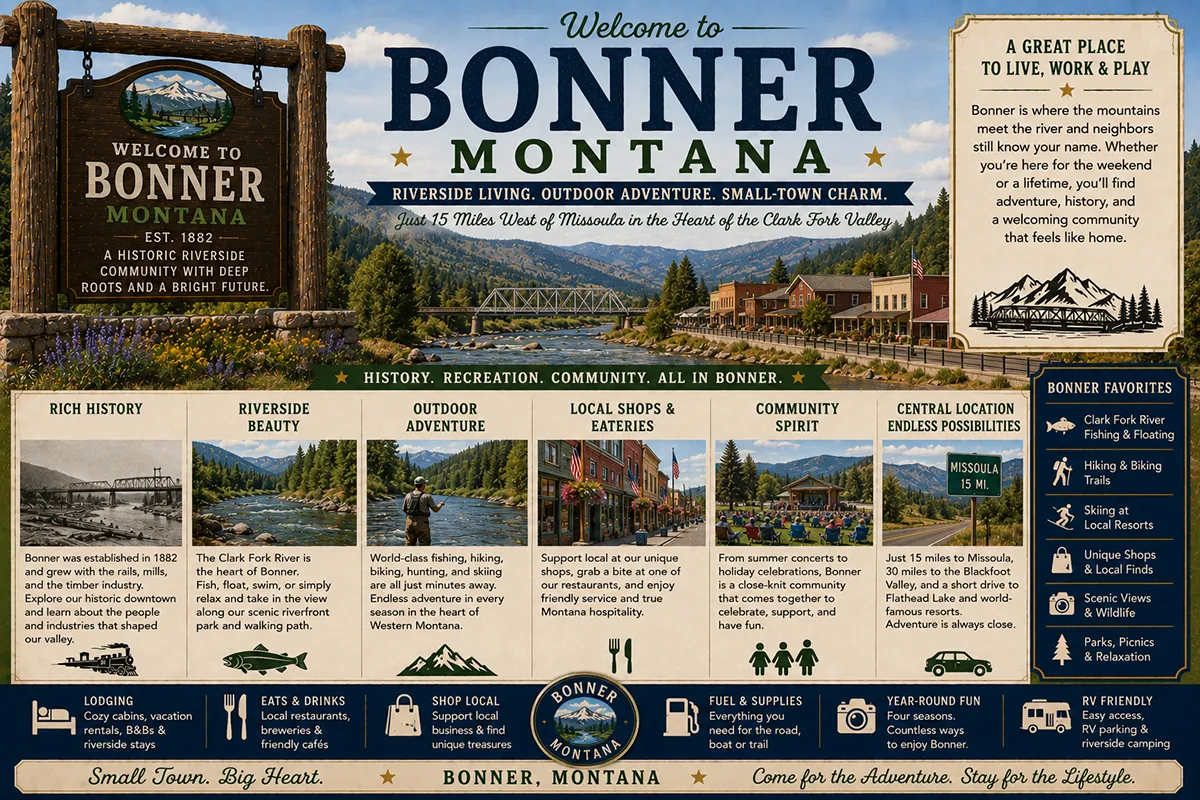
- Bonner is a small unincorporated community at the confluence of the Big Blackfoot and Clark Fork Rivers, about 8 miles east of Missoula in Missoula County.
- The town was founded around the Bonner mill, which operated from June 1886 until 2008 — 122 years of continuous operation.
- The mill was named for E.L. Bonner, partner with Andrew Hammond in the Montana Improvement Company.
- Marcus Daly’s Anaconda Copper Mining Company purchased the mill in 1898 for ~$1.5 million.
- The Milltown Dam (built 1907-08 by W.A. Clark) was removed in 2008 — one of America’s largest dam removal projects, addressing decades of upstream mining contamination.
- The KettleHouse Amphitheater (4,250 capacity) opened July 13, 2017 on the former Stimson mill site — one of the most acclaimed outdoor music venues in the West.
- Adjacent KettleHouse Brewing Company brews the venue’s signature “Bonner Logger” lager.
- Four neighborhood community: Bonner, Milltown, West Riverside, Piltzville.
- Best for: KettleHouse Amphitheater concert-goers, industrial heritage travelers, Blackfoot River anglers, Missoula day-trippers.
Liked this article?
Add Roaming Montana as a preferred source so you see more of our articles and guides on Google.
Bonner at a Glance
| Population (Bonner-West Riverside CDP, 2020) | ~1,650 |
|---|---|
| County | Missoula County |
| Status | Unincorporated community (combined Bonner-West Riverside CDP) |
| Region | Western Montana (Blackfoot-Clark Fork confluence) |
| Elevation | 3,257 ft |
| Distance to Missoula | ~8 miles west (~15 min on I-90) |
| Distance to Lolo | ~18 miles southwest (~25 min) |
| Distance to Seeley Lake | ~50 miles northeast on MT-200 |
| Distance to Three Forks | ~180 miles east on I-90 |
| Distance to Missoula International Airport (MSO) | ~14 miles west |
| KettleHouse Amphitheater address | 605 Cold Smoke Ln, Bonner-West Riverside, MT 59823 |
| Best for | KettleHouse concerts, mill heritage, Blackfoot River, Missoula day trips |
What Makes Bonner Different
The geography is the first thing to understand.
Bonner sits at one of the most consequential river confluences in western Montana — the point where the Big Blackfoot River (flowing west from the Bob Marshall Wilderness via Lincoln) joins the Clark Fork River (flowing west from Butte and the upper basin). Together they form the main stem of the Clark Fork, which continues west through Missoula and ultimately into Idaho and the Columbia.
The confluence sits in a narrow canyon, surrounded by Woody Mountain, Bonner Mountain, and University Mountain. The four small neighborhoods of Bonner, Milltown, West Riverside, and Piltzville are tucked into the limited valley land. Above and around them, the canyon walls rise dramatically.
This geography is exactly why both lumber mills and a contemporary outdoor amphitheater could be built here. The rivers provided power and log transportation in the 19th century. The natural amphitheater bowl provides acoustic and visual qualities for music in the 21st.
The 122-Year Mill Story
The mill story is genuinely one of the most consequential industrial histories in Montana.
In 1886, Andrew Hammond, E.L. Bonner, and others — partners in the Montana Improvement Company — established a permanent sawmill at the confluence
The mill served two enormous markets: the Northern Pacific Railroad building track across Montana, and the rapidly expanding mining and smelting operations in Butte and Anaconda.
In 1898, Andrew Hammond sold the Blackfoot Mill and surrounding timberlands to Marcus Daly’s Anaconda Copper Mining Company for approximately $1.5 million. Daly needed timber — Butte’s underground mines required vast quantities of mine timbers (“stulls”) to support shaft walls. The Anaconda Company would own and operate the Bonner mill for the next 74 years.
W.A. Clark — Daly’s bitter rival in the Butte copper wars — built his own competing mill operation a half mile away at what became known as Milltown. Clark’s Milltown Dam (completed late 1907) supplied power to his mill, the Missoula streetcar, Bonner, and parts of the Bitterroot Valley.
After Clark’s death in 1925, the Anaconda Company purchased his Western Lumber holdings in 1928, consolidating ownership of the entire confluence operation.
The original Bonner mill burned in January 1919 and was rebuilt by the summer of 1920. The rebuilt mill operated continuously through the Depression, World War II, and the postwar building boom.
Ownership transferred from Anaconda to Champion International in 1972, then to Stimson Lumber in 1993. Stimson closed the mill permanently in 2008 — ending 122 years of continuous lumber operation at the same site.
The Milltown Dam Removal
The 2008 dam removal deserves its own context.
In June 1908 — within months of Clark’s Milltown Dam being completed — a massive flood washed enormous quantities of heavy-metal-laden sediment down the Clark Fork from the upstream Butte/Anaconda mining operations. The sediments were trapped behind the new dam and accumulated there for the next century.
By the late 20th century, the contamination behind Milltown Dam had become one of the most serious Superfund issues in the American West.
The federal cleanup ultimately required removing the dam itself, excavating and properly storing the contaminated sediments, and restoring the river channel. The work began in 2007 and the dam was removed in 2008 — coincidentally the same year the Stimson mill closed.
The river today flows free at the confluence for the first time in 100+ years. The restored area is now Milltown State Park, with hiking trails, fishing access, and interpretive signage covering the mining heritage, the dam, and the restoration.
KettleHouse Amphitheater Era
The contemporary chapter began in October 2016.
Tim O’Leary (KettleHouse Brewing co-founder) and Nick Checota (the Missoula-based entertainment entrepreneur behind The Wilma, the Top Hat Lounge, and Logjam Presents) ended up at the same Missoula business lunch about Montana tourism.
Checota mentioned he’d been looking for an outdoor concert venue. O’Leary suggested the Bonner mill site, where KettleHouse was just finishing its new brewery.
By summer 2017, the amphitheater was built. The first concert on July 13, 2017 featured Lyle Lovett and His Large Band.
The venue’s combination of natural amphitheater geometry, sophisticated sound system (designed to share equipment with The Wilma in Missoula), and Blackfoot River setting immediately attracted artists and audiences who’d been seeking that kind of venue in the Pacific Northwest.
The adjacent KettleHouse Brewing Company is one of Montana’s most respected craft breweries. Cold Smoke Scotch Ale remains the flagship beer. The brewery created a specialty American light lager called “Bonner Logger” for the amphitheater.
For broader trip context, see my Montana cities and towns hub and Montana history overview.
The Top 10 Things to Do In & Around Bonner
1. KettleHouse Amphitheater Concert
The signature contemporary attraction. Major touring artists across rock, country, indie, folk, and jam-band genres play the 4,250-capacity venue throughout summer.
The 2026 season includes performers across the full musical spectrum. Tickets are sold through Logjam Presents and frequently sell out for popular shows. Address: 605 Cold Smoke Ln.
Seating options include tiered reserved stadium seats, general admission pit, general admission lawn, and the River Patio overlooking the Blackfoot. Bring layers — Montana summer evenings cool quickly after sunset.
2. KettleHouse Brewing Company
Adjacent to the amphitheater. The brewery is one of Montana’s most respected craft operations.
Cold Smoke Scotch Ale is the flagship. “Bonner Logger” is the amphitheater-specific specialty. The taproom offers full beer service and is open year-round. See my Missoula breweries guide for additional Missoula-area options.
3. Milltown State Park
The state park at the former Milltown Dam site interprets the layered history — the 1907-08 dam construction, the century of sediment accumulation, the Superfund cleanup, and the 2008 dam removal.
Hiking trails, fishing access, picnic areas, and interpretive signage. Free access. Open year-round.
4. Big Blackfoot River Fishing
The Blackfoot above Bonner is the legendary river of Norman Maclean’s A River Runs Through It. Brown trout, rainbow trout, westslope cutthroat, and federally threatened bull trout (mandatory catch-and-release).
Public access at multiple points along MT-200 east of Bonner. Local guides operate out of Missoula. Montana fishing license required.
5. Clark Fork River Fishing
The Clark Fork below the confluence offers wade and float fishing for browns and rainbows. Significantly improved water quality since the Milltown Dam removal and Superfund cleanup. Public access at multiple Missoula-area boat launches.
6. Bonner Mill Heritage Walk
The former Stimson mill site has been redeveloped, but interpretive signage at various points around Bonner, Milltown, and the KettleHouse Amphitheater grounds covers the 122-year mill history. The Bonner Milltown History Center & Museum (when open) offers more substantial heritage interpretation.
7. Day Trip to Missoula (15 minutes west)
The University of Montana town with full city services, the Smokejumper Visitor Center, the Missoula Art Museum, the Historical Museum at Fort Missoula, Caras Park along the Clark Fork, and an exceptional restaurant and brewery scene. See Missoula breweries and hotels in Missoula for planning.
8. MT-200 Blackfoot Corridor Drive
The scenic highway east from Bonner follows the Big Blackfoot River through the canyon and into the broader Blackfoot Valley toward Lincoln and beyond. One of western Montana’s most beautiful drives.
Particularly spectacular in fall when the cottonwoods turn gold. Cell service drops off significantly as you head east.
9. Marshall Mountain & Trail System
The former Marshall Mountain ski area east of Bonner has been redeveloped as a community-focused recreation area with hiking trails, mountain biking, and outdoor events. A growing collection of trails connects the area to the broader Missoula-area trail system.
10. Day Trip to Lolo (25 minutes south)
The community south of Missoula with Travelers’ Rest State Park — the only archaeologically verified Lewis and Clark Expedition campsite — and the Lewis & Clark Highway (US-12) corridor west toward Idaho. See Lolo guide for details.
Where to Stay
Bonner has limited dedicated lodging. Most visitors base in Missoula (15 minutes west).
| Hotel | Vibe | Price | Best For |
|---|---|---|---|
| Vacation rentals (Bonner-Milltown area) | River cabins, ranch homes | $150–350 | Concert-goers, families |
| Missoula hotels (15 min W) | Full city selection — see hotels in Missoula | $140–320 | Most travelers |
| Bonner-area RV parks | See RV parks in Missoula | $40–80 | RV travelers |
| Lolo Hot Springs Resort (45 min SW) | Historic hot springs | $150–280 | Hot springs lovers |
For broader RV planning, see best RV parks in Montana. For full Missoula-area planning, see hotels in Missoula.
Where to Eat
- KettleHouse Brewing Company taproom (Bonner) — flagship Cold Smoke Scotch Ale and Bonner Logger
- Concert food at KettleHouse Amphitheater — full beverage and food concessions
- Missoula dining (15 min west) — extensive variety; see best restaurants in Montana for broader Montana options
- Missoula breweries — multiple craft beer options 10-15 minutes away
- Local Bonner-area cafes along MT-200 and frontage roads
Getting There & Around
From Missoula: 8 miles east on I-90 (Exit 109), about 15 minutes.
From Missoula International Airport (MSO): 14 miles east, about 20 minutes.
From Lolo: 18 miles northeast via US-93 and I-90, about 25 minutes.
From Spokane: ~210 miles east on I-90, about 3.25 hours.
From Three Forks: 180 miles west on I-90, about 2.75 hours.
For KettleHouse Amphitheater concerts: The venue is at 605 Cold Smoke Ln, Bonner-West Riverside. Parking is available on-site for ticketed concert events. Ride-sharing from Missoula is popular for evening concerts. The amphitheater’s website lists current parking arrangements.
Cell service: Generally good in Bonner and along I-90. Reduced east on MT-200 in the Blackfoot Canyon.
What Bonner Unlocks
Missoula (15 min W)
University town with full city attractions and services.
KettleHouse Amphitheater (immediate)
One of the most acclaimed outdoor concert venues in the West.
Big Blackfoot River
Norman Maclean’s river; Blue Ribbon trout fishing east of Bonner.
Milltown State Park
Free state park with industrial heritage interpretation.
Blackfoot Corridor (MT-200 east)
Scenic drive through the river canyon toward Lincoln and Seeley Lake.
Lolo & US-12 Lewis & Clark Corridor (south)
Travelers’ Rest State Park and the Lochsa River drive into Idaho.
When to Visit
Summer (June–August): Peak KettleHouse Amphitheater concert season. Most major shows happen between Memorial Day and early September. Book lodging and tickets well in advance.
Fall (September–October): Outstanding fall colors in the Big Blackfoot canyon and at the river confluence. Quieter than peak summer. Some amphitheater shows continue into early fall.
Winter (November–March): The amphitheater is closed; KettleHouse Brewing Company operates year-round. Cross-country skiing in the surrounding national forest land. Quieter community character.
Spring (April–May): The valley greens up; Blackfoot River runs high with snowmelt; quieter shoulder season.
Personal Tips
Book KettleHouse concert tickets months in advance. Major touring artists sell out the 4,250-capacity venue quickly. Logjam Presents (the venue operator) releases tickets through standard channels; popular shows can sell out in minutes.
Plan for the post-concert traffic. Bonner’s narrow access points back up significantly after major concerts. Ride-sharing from Missoula is increasingly popular and avoids the parking and traffic issues.
Allow time to walk Milltown State Park. Most visitors don’t realize the state park exists. The interpretive trail through the former dam site and Superfund cleanup area is genuinely substantive — one of the most important environmental restoration stories in the American West.
Try the Bonner Logger. The KettleHouse light lager brewed specifically for the amphitheater is widely available at concerts and the brewery. A nice tribute to the mill heritage.
Use Bonner as a Missoula alternative. Missoula lodging gets booked solid for concert weekends. Bonner-area vacation rentals are often a viable alternative — closer to the venue, sometimes more available.
The Big Blackfoot River corridor rewards real attention. MT-200 east of Bonner is one of Montana’s most scenic drives. If you have a free day, drive it as far as Lincoln and back.
Stop by the History Center if open. The Bonner Milltown History Center & Museum hours are limited; verify before going. The collection covers the 122-year mill story in genuine depth — well worth time for industrial history travelers.
Bonner Quick Facts
| First logs sawed at Bonner mill | June 1886 | | Named for | E.L. Bonner (Montana Improvement Co. partner) | | Mill operating years | 1886–2008 (122 years) | | Anaconda Company purchase | 1898 (~$1.5M from Andrew Hammond) | | Original Bonner mill burned | January 1919 (rebuilt summer 1920) | | Anaconda → Champion International | 1972 | | Stimson Lumber acquisition | 1993 | | Mill closure | 2008 | | Milltown Dam built | 1907–08 (W.A. Clark) | | Milltown Dam removed | 2008 (one of largest US dam removal projects) | | KettleHouse Amphitheater opened | July 13, 2017 | | First concert | Lyle Lovett and His Large Band | | Amphitheater capacity | 4,250 | | KettleHouse founder (brewery) | Tim O’Leary | | Amphitheater venue partner | Nick Checota / Logjam Presents | | Surrounding mountains | Woody, Bonner, University | | Average summer high | 84°F | | Average winter low | 19°F |
Conclusion
Bonner is the kind of Montana community that rewards travelers who pay attention to layered history.
For 122 years it was a working lumber mill town — first under Andrew Hammond and E.L. Bonner, then Marcus Daly’s Anaconda Copper Mining Company for seven decades, then Champion International, then Stimson Lumber.
The 2008 closure ended an industrial chapter that had defined western Montana lumber production for over a century.
What’s emerging in the years since is genuinely interesting. The KettleHouse Amphitheater has become one of the most acclaimed outdoor music venues in the American West.
The KettleHouse Brewing Company anchors a contemporary craft beverage scene. Milltown State Park interprets one of America’s most significant environmental restorations. The Big Blackfoot River — Norman Maclean’s river — flows free for the first time in over a century.
The Bonner you visit today is in transition. The mill is gone. The new identity is still forming. That makes it a particularly interesting time to be paying attention.
Have a Bonner question? Drop it in the comments — I read every one.
Frequently Asked Questions
Is Bonner Montana worth visiting?
Yes — Bonner is worth visiting primarily for the KettleHouse Amphitheater (one of the most acclaimed outdoor concert venues in the American West), the adjacent KettleHouse Brewing Company, Milltown State Park (which interprets the historic 1907-08 dam and its 2008 removal), Big Blackfoot River fly fishing, and the layered industrial heritage of the 122-year Anaconda Company mill site. Position 8 miles east of Missoula makes it an easy day trip or concert destination.
What is the KettleHouse Amphitheater?
The KettleHouse Amphitheater is a 4,250-capacity outdoor concert venue in Bonner, Montana, located at 605 Cold Smoke Ln on the former Stimson Lumber mill site along the Big Blackfoot River. The venue opened on July 13, 2017 with a performance by Lyle Lovett and His Large Band, and has since become one of the most acclaimed outdoor music venues in the American West.
The amphitheater was founded through a collaboration between Tim O’Leary (co-founder of the adjacent KettleHouse Brewing Company) and Nick Checota (owner of the Top Hat Lounge, The Wilma, and the concert promotion company Logjam Presents). Music writers have compared the venue to Red Rocks in Colorado and The Gorge in Washington for its natural amphitheater setting, contemporary architecture, and top-tier sound system.
What is the history of the Bonner mill?
The Bonner mill operated continuously at the confluence of the Big Blackfoot and Clark Fork Rivers from June 1886 until 2008 — 122 years.
The original mill was established by Andrew Hammond, E.L. Bonner (for whom the town was named), and other partners in the Montana Improvement Company to supply timber for the Northern Pacific Railroad and the rapidly expanding Butte-Anaconda mining operations. In 1898, Hammond sold the mill and timberlands to Marcus Daly’s Anaconda Copper Mining Company for approximately $1.5 million. The Anaconda Company owned the operation until 1972, when it was acquired by Champion International. Stimson Lumber took over in 1993 and operated the mill until permanent closure in 2008.
Why was the Milltown Dam removed?
The Milltown Dam, built by William A. Clark between 1907-08 at the confluence of the Big Blackfoot and Clark Fork Rivers, was removed in 2008 as part of one of the largest dam removal and environmental restoration projects in American history.
The June 1908 flood — months after the dam’s completion — washed enormous quantities of heavy-metal-laden sediment down the Clark Fork from upstream Butte and Anaconda mining operations. These contaminated sediments accumulated behind Milltown Dam for the next century, ultimately becoming one of the most serious Superfund sites in the American West. The federal cleanup required removing the dam, excavating and properly storing the contaminated sediments, and restoring the river channel. The former dam site is now part of Milltown State Park.
How far is Bonner from Missoula?
Bonner is approximately 8 miles east of Missoula on Interstate 90 (Exit 109) — about a 15-minute drive. From Missoula International Airport (MSO), Bonner is approximately 14 miles east, about 20 minutes.
What is the KettleHouse Brewing Company?
The KettleHouse Brewing Company is one of Montana’s most respected craft breweries, with locations in Missoula and Bonner. The Bonner brewery, opened in the mid-2010s, sits adjacent to the KettleHouse Amphitheater on the former Stimson mill site. Cold Smoke Scotch Ale is the flagship beer. The brewery created a specialty American light lager called “Bonner Logger” specifically for amphitheater concerts. The taproom operates year-round; the amphitheater operates seasonally.
What communities are at the Bonner confluence?
Four small unincorporated neighborhoods grew up around the historic mill operations at the confluence of the Big Blackfoot and Clark Fork Rivers: Bonner (the original company town built by mill management), Milltown (the area around W.A. Clark’s competing mill and the historic Milltown Dam), West Riverside (north of the Clark Fork and west of the Blackfoot), and Piltzville (north of the Clark Fork and east of the Blackfoot). The combined “Bonner-West Riverside” CDP (census designated place) totaled approximately 1,650 residents in 2020.