Chief Two Moons was one of three Native American men whose faces became the model for the Buffalo Nickel.
The five-cent coin — designed by sculptor James Earle Fraser and produced by the U.S. Mint from 1913 to 1938 — featured a composite portrait drawn from three Native American leaders. Two Moons, a Northern Cheyenne war chief who had fought against the U.S. Army at the Battle of the Rosebud, the Battle of the Little Bighorn, and the Battle of Wolf Mountains, was one of those three.
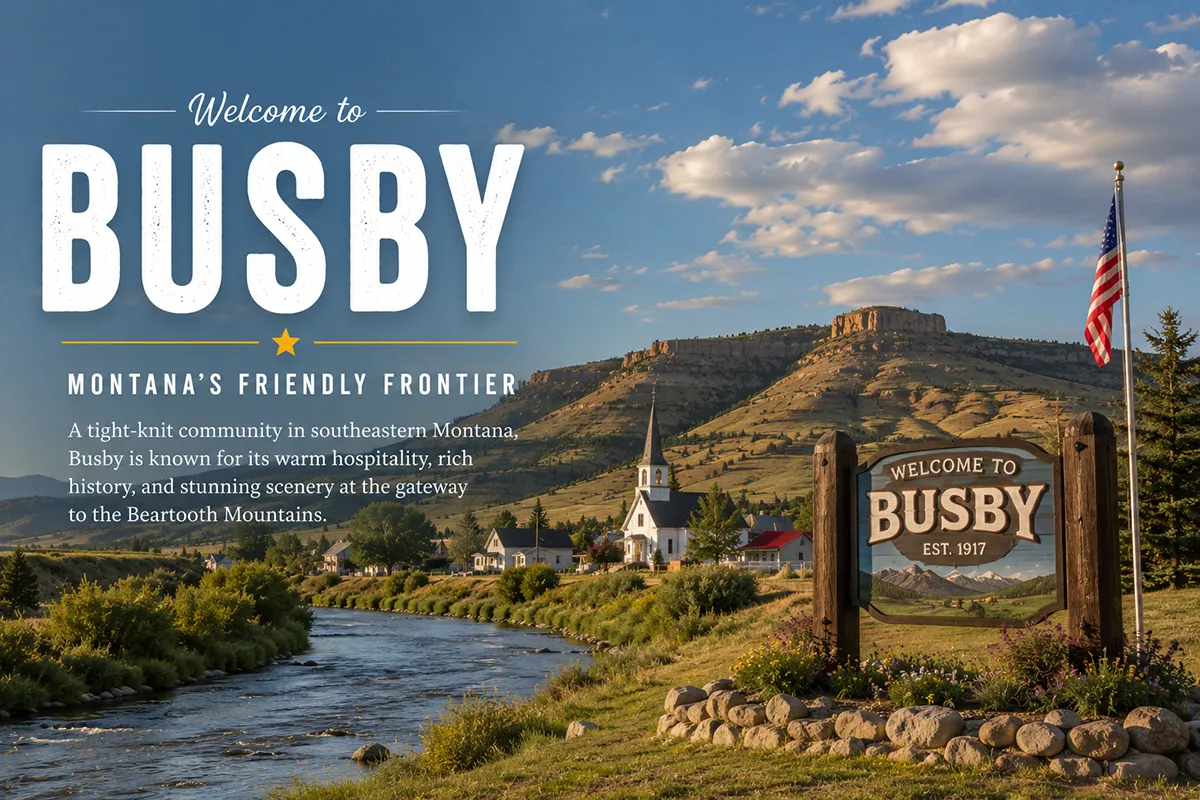
Two Moons (c. 1847-1917) made his home in his later years at Busby, Montana — the small Northern Cheyenne Reservation community on US Highway 212 that has approximately 700 residents today.
When Two Moons died in 1917, he was originally buried in a small cemetery near Busby.
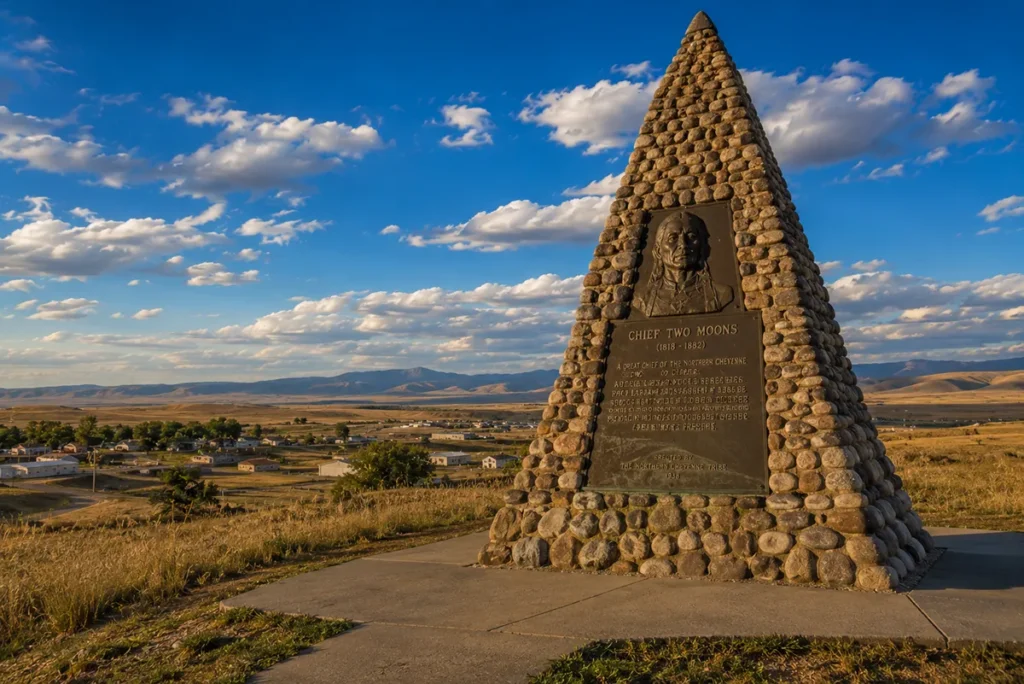
In 1936, an Indian trader named W.P. Moncure — with help from a store employee named Jules — exhumed and reburied Two Moons’ remains in a stone pyramid monument that Moncure built alongside US-212 just south of Busby. The monument vault contained Two Moons’ personal items, artifacts from the Battle of the Little Bighorn, and a sealed envelope of documents that Moncure inscribed for opening on June 25, 1986 — the 110th anniversary of the Little Bighorn battle.
The vault was broken open and the contents stolen sometime around October 1960. They’ve never been recovered.
But the Two Moons Monument still stands. In 1993, the remains of 10 men, five women, and two children — Cheyenne who died during the famous 1879 Fort Robinson Outbreak in Nebraska, whose remains had been scattered across museums across the country — were finally repatriated and reburied in a circle around the Two Moons Monument. The site has become substantively important as a Northern Cheyenne sacred place.
TL;DR
- Busby (~700) is an unincorporated CDP in Big Horn County on US Highway 212, on the Northern Cheyenne Indian Reservation.
- The community was named for Sheridan Busby, a homesteader who arrived in 1895 and established the first post office in 1904.
- The Chief Two Moons Monument — built 1936 by Indian trader W.P. Moncure — contains the grave of Northern Cheyenne war chief Two Moons (c. 1847-1917).
- Two Moons was one of three Native American models for the Buffalo Nickel (U.S. Mint, 1913-1938).
- Two Moons fought in all three major battles of the Great Sioux War of 1876-1877 in southeast Montana: Rosebud, Little Bighorn, and Wolf Mountains.
- After surrendering at Fort Keogh in April 1877, Two Moons served as a U.S. Army scout under General Miles and was appointed head Chief of the Northern Cheyenne Reservation.
- The 1936 monument vault was broken open in October 1960; the sealed items and documents were stolen.
- In 1993, the remains of 17 Cheyenne people from the 1879 Fort Robinson Outbreak were repatriated and reburied in a circle around the monument.
- US-212 through Busby is called the “Warriors Trail” — providing access to multiple Great Sioux War battlefields.
- Best for: Northern Cheyenne heritage travelers, Great Sioux War historians, US-212 corridor travelers, Buffalo Nickel collectors.
Liked this article?
Add Roaming Montana as a preferred source so you see more of our articles and guides on Google.
Busby at a Glance
| Population (estimated) | ~700 |
|---|---|
| County | Big Horn County |
| Status | Unincorporated CDP, on Northern Cheyenne Indian Reservation |
| Region | Southeast Montana (US-212 Warriors Trail) |
| Elevation | 3,424 ft |
| Distance to Lame Deer (tribal agency) | ~17 miles east on US-212 |
| Distance to Crow Agency | ~30 miles west |
| Distance to Hardin | ~50 miles west |
| Distance to Ashland | ~40 miles east |
| Distance to Miles City | ~100 miles northeast |
| Distance to Little Bighorn Battlefield | ~25 miles west |
| Distance to Rosebud Battlefield State Park | ~25 miles south |
| Distance to Sheridan, WY | ~80 miles south |
| Town named for | Sheridan Busby (1895 homesteader) |
| First post office | 1904 |
| Two Moons Monument built | 1936 |
| Best for | Two Moons Monument, Northern Cheyenne heritage, Great Sioux War battlefields |
What Makes Busby Different
The story of Busby is the story of Chief Two Moons.
Two Moons (c. 1847-1917)
Two Moons — known in Cheyenne as Ishaynishus (Éše’he Ôhnéšesêstse) — was one of the most prominent Northern Cheyenne warriors of the late 19th century.
He was the son of Carries the Otter, an Arikara captive who had married into the Cheyenne tribe. Two Moons grew up during the height of the Great Sioux War of 1876-1877 — the campaign in which combined Lakota, Cheyenne, and Arapaho forces fought to protect their treaty-protected hunting grounds against U.S. Army incursions.
Two Moons fought in all three major battles of the war in southeast Montana:
- The Battle of the Rosebud (June 17, 1876) — the prelude to Little Bighorn; the Cheyenne call this “Battle Where the Girl Saved Her Brother“
- The Battle of the Little Bighorn (June 25, 1876) — where the Lakota-Cheyenne-Arapaho force destroyed Lieutenant Colonel George Armstrong Custer’s 7th Cavalry
- The Battle of Wolf Mountains (January 8, 1877) — the last battle of the Great Sioux War in Montana, fought in the Tongue River Valley south of present-day Birney
After the campaign collapsed and the Cheyenne were forced into surrender, Two Moons surrendered at Fort Keogh near Miles City in April 1877.
From Warrior to Army Scout
After surrendering, Two Moons accepted service as a U.S. Army scout under General Nelson A. Miles.
The transition was uncomfortable but practical. Two Moons recognized that armed resistance had failed and that working within the U.S. military structure offered the best opportunity to advocate for the Northern Cheyenne people. General Miles came to value Two Moons highly. According to military sources, Two Moons’ “pleasant personality, the friendliness that he showed towards the whites, as well as his ability to get along with the military” led Miles to appoint him head Chief of the Northern Cheyenne Reservation.
Two Moons played a crucial role in the surrender of Chief Little Cow’s Cheyenne band at Fort Keogh. He served as a leadership bridge between the Northern Cheyenne people and the U.S. government for the next four decades.
Washington Trips and the Buffalo Nickel
Two Moons traveled multiple times to Washington, D.C. to advocate for the Northern Cheyenne. In 1914, he met with President Woodrow Wilson to discuss reservation conditions and the future of the Northern Cheyenne people.
Sometime in the early 1910s, Two Moons sat for sculptor James Earle Fraser — the artist who would design the Buffalo Nickel for the U.S. Mint.
Fraser combined the features of three different Native American leaders into the composite profile that appears on the obverse of the Buffalo Nickel. Two Moons was one of the three. The other two were Iron Tail (Lakota) and John Big Tree (Seneca).
The Buffalo Nickel was minted from 1913 to 1938. During those 25 years, hundreds of millions of coins bearing the partial likeness of Two Moons circulated through the American economy.
Two Moons died in 1917.
The 1936 Moncure Monument
Nineteen years after Two Moons’ death, W.P. Moncure — an Indian trader operating at Busby — decided to build a monument honoring the chief.
Moncure was an unusual character. Records describe him as both a respected community member and as someone whose motivations were occasionally suspect. The monument he built — with help from a store employee named Jules — was constructed as a stone pyramid along US Highway 212 immediately south of Busby.
The pyramid contained a vault. Inside the vault, Moncure placed:
- The reburied remains of Chief Two Moons
- Personal items belonging to Two Moons
- Artifacts and documents related to the Battle of the Little Bighorn
- A sealed envelope to be opened on June 25, 1986 (the 110th anniversary of Little Bighorn)
Moncure carved an inscription on the monument identifying six things sealed in the vault:
- History and location of “Starved to Death Rock”
- The 1874 Bozeman Expedition up Rosebud Creek
- Information that two soldiers got away from the Custer Battle alive
- History of the Indian fort up Busby Creek
- The hiding place and location of money and trinkets taken from dead soldiers on the Custer Battlefield
- Instructions: “To be opened June 25, 1986. Key removes screws with offset screwdriver.”
The monument was completed and dedicated June 25, 1936.
The 1960 Vault Break-in
Around October 1960, the Two Moons Monument vault was broken open.
The items — including the sealed envelope of documents — were stolen. None of the contents has ever been recovered or publicly identified.
The break-in remains one of the more genuinely unresolved mysteries of southeast Montana heritage. What did the sealed envelope actually contain? What did the thieves do with the Bighorn Battle artifacts? Did the “hiding place of money and trinkets” referenced in the inscription actually lead anywhere?
The answers may never be known.
The 1993 Fort Robinson Reburial
In 1993, the Northern Cheyenne Tribe undertook a substantial repatriation effort.
The remains of 10 men, five women, and two children — Cheyenne who had died during the famous Fort Robinson Outbreak of January 1879 — were retrieved from museums across the United States. The Outbreak was the desperate escape attempt by Northern Cheyenne held in captivity at Fort Robinson, Nebraska. Many escapees died in the freezing winter conditions. Their remains had been collected by U.S. Army and civilian researchers and distributed to natural history museums across the country.
In 1993, those remains were buried in a circle around the Two Moons Monument on US Highway 212.
The repatriation was one of the most substantial Northern Cheyenne sacred site restoration efforts of the late 20th century.
For broader trip context, see my Montana cities and towns hub and Montana history overview.
The Top 6 Things to Do In & Around Busby
1. Two Moons Monument
The signature attraction.
The 1936 stone pyramid monument stands immediately south of US-212 just outside Busby. The 1993 reburial circle for Fort Robinson Outbreak victims surrounds it. A security fence now protects the site after the 1960 vault break-in.
Approach respectfully. This is an active Northern Cheyenne sacred site. Photography is generally welcome from public viewpoints; respect any posted notices.
2. US-212 “Warriors Trail” Drive
US Highway 212 through Busby is part of what regional historians call the Warriors Trail — the corridor that provides access to multiple Great Sioux War battlefields and Northern Cheyenne heritage sites.
The drive from Lame Deer (east) through Busby to Crow Agency (west) crosses some of the most substantively important late-19th-century American military history landscape in the United States.
3. Little Bighorn Battlefield National Monument
Approximately 25 miles west of Busby in Crow Agency.
The site of the famous June 25, 1876 Battle of the Little Bighorn — where the combined Lakota-Cheyenne-Arapaho force destroyed Lieutenant Colonel George Armstrong Custer’s 7th Cavalry. National Park Service-administered; substantial interpretive infrastructure including the Custer National Cemetery and the Indian Memorial.
A natural pairing with the Two Moons Monument visit — Two Moons fought at Little Bighorn just 25 miles west.
4. Rosebud Battlefield State Park
Approximately 25 miles south of Busby.
The site of the June 17, 1876 Battle of the Rosebud — fought 8 days before Little Bighorn. The Lakota and Cheyenne (including Two Moons) effectively defeated General George Crook’s column and prevented Crook from supporting Custer at the Little Bighorn the following week.
The Cheyenne name for the battle — “Battle Where the Girl Saved Her Brother” — refers to Buffalo Calf Road Woman, a Cheyenne woman whose rescue of her brother became one of the defining heroic narratives of the engagement.
5. Day Trip to Lame Deer (17 miles east)
The Northern Cheyenne tribal agency headquarters and largest community on the reservation.
Attractions include the Chief Dull Knife College (named for the leader of the 1879 Fort Robinson Outbreak escape), the John Woodenlegs Memorial Library, and the Northern Cheyenne Tribe Cultural Center.
6. St. Labre Indian School Museum (Ashland)
Approximately 40 miles east in Ashland.
The Cheyenne Indian Museum on the St. Labre campus features substantial Plains Indian artifacts and a documentary film on the school’s 1884 founding. A natural pairing with Two Moons Monument for travelers interested in Northern Cheyenne heritage.
Where to Stay
Busby has no dedicated lodging.
Most travelers base in Hardin (50 miles west) or in the Crow Agency area near the Little Bighorn Battlefield.
| Lodging | Vibe | Price | Best For |
|---|---|---|---|
| Hardin hotels (1 hr W) | Big Horn County selection | $100–180 | Most travelers |
| Crow Agency lodging (30 min W) | Battlefield-adjacent | $100–180 | Little Bighorn-focused |
| Miles City hotels (1.75 hrs NE) | Full small-city selection | $100–200 | I-94 corridor |
| Vacation rentals (reservation area) | Limited; verify availability | $130–250 | Cultural travelers |
Where to Eat
- Local Busby options — small store and gas station; verify current operations
- Lame Deer dining (20 min E) — additional reservation options
- Hardin restaurants (1 hr W) — broader selection
Getting There & Around
From Hardin: ~50 miles east on US-212, about 1 hour.
From Crow Agency: ~30 miles east on US-212, about 35 minutes.
From Lame Deer: ~17 miles west on US-212, about 20 minutes.
From Ashland: ~40 miles west on US-212, about 50 minutes.
From Miles City: ~100 miles southwest, about 1.75 hours.
From Sheridan, WY: ~80 miles north, about 1.5 hours.
Cell service: Available in Busby and along US-212. Reduced on reservation backroads.
When to Visit
Summer (June-August): Best weather; full daylight for monument visits; warmest temperatures.
Late June: Battle of the Little Bighorn anniversary (June 25) — substantive commemorative events at the Little Bighorn Battlefield 25 miles west.
Fall (September-October): Outstanding southeastern Montana light; cooler temperatures; quieter.
Winter (December-March): Severe Montana weather; reservation roads can be treacherous; verify conditions.
Spring (April-May): Snowmelt; quieter shoulder season.
Personal Tips
Approach the Two Moons Monument as sacred ground. The 1993 reburial of Fort Robinson Outbreak victims has made the site substantively important as a contemporary Northern Cheyenne sacred place. Respect the security fence boundaries. Don’t climb on the monument. Photograph from established public viewpoints.
Read about the Great Sioux War. Understanding the June 1876-January 1877 campaign — the Rosebud, the Little Bighorn, and the Wolf Mountains — adds substantial context to a Two Moons Monument visit. The Cheyenne names for the battles (“Battle Where the Girl Saved Her Brother”) capture aspects of the events that Anglo-American military history typically misses.
Combine with the Little Bighorn Battlefield. A morning at the Little Bighorn Battlefield National Monument (25 miles west) followed by an afternoon at the Two Moons Monument makes a substantive Northern Cheyenne / Great Sioux War heritage day. The Battle of the Rosebud State Park (25 miles south) extends this into a multi-day itinerary.
Read about the Fort Robinson Outbreak. The January 1879 Cheyenne escape from captivity in Nebraska — and the deaths of many escapees — is one of the most genuinely tragic chapters in American Indian policy history. The 1993 repatriation and reburial at Busby was a substantive act of contemporary tribal healing.
Take the Buffalo Nickel connection seriously. Two Moons’ likeness — along with Iron Tail (Lakota) and John Big Tree (Seneca) — circulated on hundreds of millions of American coins for 25 years. Few Northern Cheyenne warriors are as historically present in American material culture as Two Moons.
Read about the 1960 vault break-in. The unsolved theft of the Two Moons Monument vault contents remains one of the more genuinely mysterious episodes in southeast Montana heritage. The sealed envelope’s contents — and the “hiding place of money and trinkets” referenced in Moncure’s inscription — remain undocumented.
Busby Quick Facts
| Population (estimated) | ~700 | | County | Big Horn County | | Reservation | Northern Cheyenne | | Elevation | 3,424 ft | | Named for | Sheridan Busby (1895 homesteader) | | First post office | 1904 | | Chief Two Moons | c. 1847-1917 | | Two Moons Cheyenne name | Ishaynishus (Éše’he Ôhnéšesêstse) | | Two Moons’ father | Carries the Otter (Arikara captive) | | Two Moons battles | Rosebud (June 17, 1876), Little Bighorn (June 25, 1876), Wolf Mountains (Jan 8, 1877) | | Two Moons surrender | April 1877 (Fort Keogh) | | Two Moons US Army scout | Under General Nelson A. Miles | | Two Moons head Chief appointment | By Gen. Miles | | Two Moons 1914 DC visit | Met with President Woodrow Wilson | | Buffalo Nickel minted | 1913-1938 | | Two Moons co-models | Iron Tail (Lakota), John Big Tree (Seneca) | | Monument built | 1936 (dedicated June 25) | | Monument builder | W.P. Moncure (Indian trader) | | Vault break-in | ~October 1960 | | 1993 repatriation | 10 men, 5 women, 2 children from Fort Robinson Outbreak | | Average summer high | 85°F | | Average winter low | 6°F |
Conclusion
Busby is a 700-person unincorporated community on the Northern Cheyenne Indian Reservation with substantively significant Indigenous heritage.
The story of Chief Two Moons — Northern Cheyenne war chief at Rosebud, Little Bighorn, and Wolf Mountains; later U.S. Army scout under General Miles; head Chief of the Northern Cheyenne Reservation; one of three models for the Buffalo Nickel; advocate who met with President Woodrow Wilson in 1914 — defines the contemporary community.
The 1936 monument that Indian trader W.P. Moncure built. The October 1960 vault break-in that scattered Two Moons’ personal items and the sealed envelope of mysterious documents.
The 1993 reburial of 17 Fort Robinson Outbreak victims in a circle around the monument. All of it adds up to one of the more substantively important small communities on the entire Northern Cheyenne Reservation.
The next time you’re driving the Warriors Trail (US-212) between Lame Deer and Crow Agency, stop at the Two Moons Monument. Pay respect.
Have a Busby question? Drop it in the comments — I read every one.
Frequently Asked Questions
Is Busby Montana worth visiting?
Yes — Busby is worth visiting for the Chief Two Moons Monument (built 1936 honoring the Northern Cheyenne war chief who fought at Rosebud, Little Bighorn, and Wolf Mountains, and who was one of three models for the Buffalo Nickel), the 1993 Fort Robinson Outbreak repatriation site surrounding the monument, the substantively important position along the “Warriors Trail” US-212 corridor between Lame Deer and the Little Bighorn Battlefield, and the broader Northern Cheyenne Reservation cultural context.
Who was Chief Two Moons?
Chief Two Moons (c. 1847-1917, known in Cheyenne as Ishaynishus or Éše’he Ôhnéšesêstse) was a Northern Cheyenne war chief who participated in all three major battles of the Great Sioux War of 1876-1877 in southeast Montana: the Battle of the Rosebud (June 17, 1876), the Battle of the Little Bighorn (June 25, 1876), and the Battle of Wolf Mountains (January 8, 1877). After surrendering at Fort Keogh in April 1877, Two Moons served as a U.S. Army scout under General Nelson A. Miles and was appointed head Chief of the Northern Cheyenne Reservation. He met with President Woodrow Wilson in 1914 to advocate for the Northern Cheyenne people. He was one of three Native American models for the Buffalo Nickel designed by James Earle Fraser (minted 1913-1938).
What is the Two Moons Monument?
The Two Moons Monument is a 1936 stone pyramid monument built by Indian trader W.P. Moncure along US Highway 212 just south of Busby, Montana. The monument contains the reburied remains of Chief Two Moons along with personal items, artifacts from the Battle of the Little Bighorn, and a sealed envelope of documents that Moncure inscribed for opening on June 25, 1986. The vault was broken open and the sealed items stolen around October 1960; the contents have never been recovered. In 1993, the remains of 17 Cheyenne people (10 men, five women, and two children) who died during the 1879 Fort Robinson Outbreak in Nebraska were retrieved from museums across the country and reburied in a circle around the Two Moons Monument.
Was Chief Two Moons on the Buffalo Nickel?
Yes — Chief Two Moons was one of three Native American models for the Buffalo Nickel designed by sculptor James Earle Fraser and produced by the U.S. Mint from 1913 to 1938. The Buffalo Nickel’s obverse profile is a composite portrait drawn from three different Native American leaders: Two Moons (Northern Cheyenne), Iron Tail (Lakota), and John Big Tree (Seneca). The coin circulated through the American economy for 25 years, with hundreds of millions of nickels bearing the partial likeness of Two Moons.
Where is Busby Montana located?
Busby is located in Big Horn County, southeast Montana, on US Highway 212 (the “Warriors Trail”) within the Northern Cheyenne Indian Reservation. The community is approximately 17 miles west of Lame Deer (the Northern Cheyenne tribal agency), 30 miles east of Crow Agency, and 25 miles east of the Little Bighorn Battlefield National Monument. The community has approximately 700 residents.
What was the Fort Robinson Outbreak?
The Fort Robinson Outbreak was a desperate escape attempt by approximately 130 Northern Cheyenne held in captivity at Fort Robinson, Nebraska in January 1879. The Cheyenne — under the leadership of Chiefs Dull Knife and Little Wolf — had been forcibly relocated from their Montana homeland to Indian Territory (now Oklahoma) in 1877, where many had died from disease and starvation. A group of approximately 300 had escaped and traveled north toward Montana before being recaptured in late 1878 and held at Fort Robinson. When refused permission to return to Montana, they attempted to escape in January 1879. Many died in the freezing winter conditions during the pursuit; their remains were collected by U.S. Army and civilian researchers and distributed to natural history museums across the country. In 1993, the remains of 10 men, five women, and two children were repatriated and buried in a circle around the Two Moons Monument at Busby.
How far is Busby from Little Bighorn Battlefield?
Busby is approximately 25 miles east of the Little Bighorn Battlefield National Monument at Crow Agency — about a 30-minute drive on US Highway 212. The Battle of the Little Bighorn occurred on June 25, 1876; Chief Two Moons (buried at Busby) was one of the Northern Cheyenne leaders who fought at the battle.