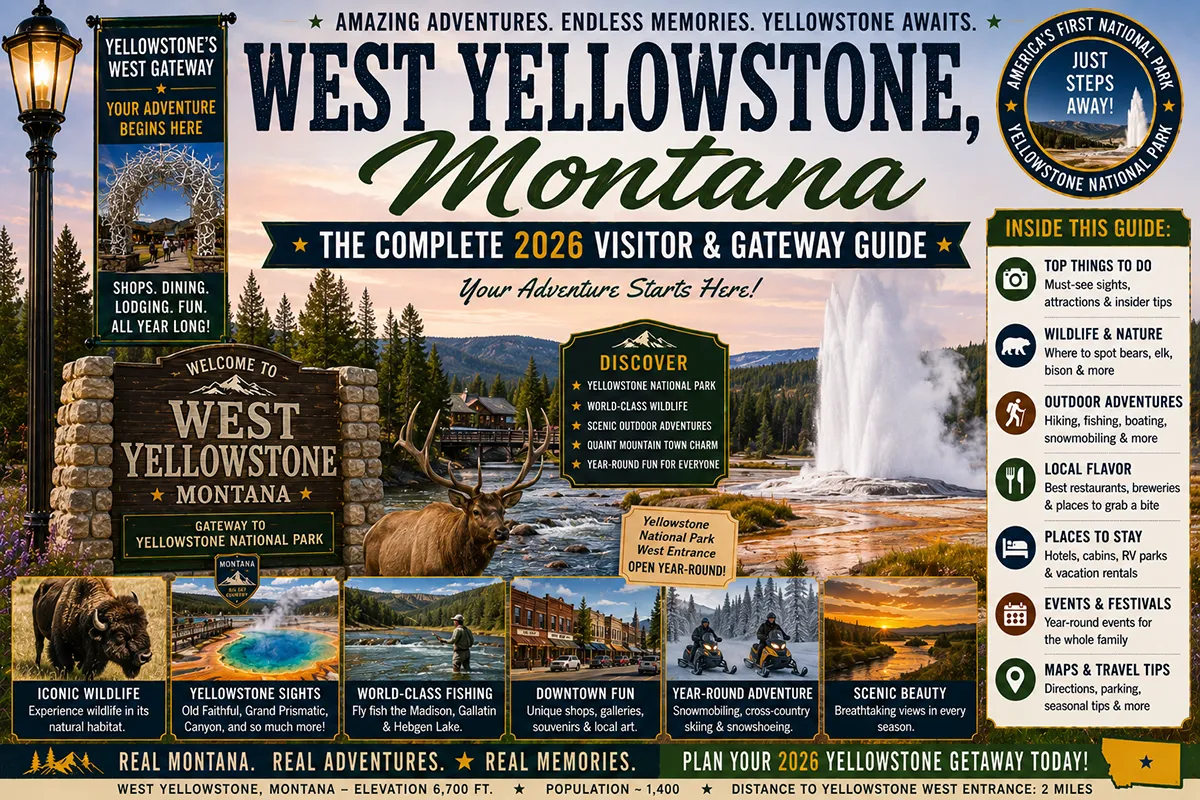
Here is the honest truth about West Yellowstone in July: it is absolutely packed. Canyon Street looks like a state fair midway. The road to the West Entrance backs up.
Every restaurant has a line. And the park itself is 3 miles away, so the moment you’re past the gate you’re into something genuinely wild and extraordinary.
That tension — between the tourist-town density outside and the immensity inside — is the defining experience of West Yellowstone, and knowing it in advance makes you a much better visitor.
TL;DR
- West Yellowstone (~1,200 residents, summer population swells to tens of thousands) is the most-used entrance town for Yellowstone National Park — the closest gateway to Old Faithful, Grand Prismatic Spring, and the major geyser basins.
- Also the snowmobile capital of the U.S. in winter, with 400+ inches of annual snowfall and direct snowmobile access into Yellowstone.
- Best for: first-time Yellowstone visitors targeting geyser basins, families, winter snowmobile trips.
- For wildlife-focused visits centered on Lamar Valley, Gardiner is the better base — 75 min closer to Lamar.
- The Grizzly & Wolf Discovery Center is excellent. The IMAX Theatre is a solid rainy-day option.
- Honest warning: summer crowds are intense. Plan entry times carefully.
Liked this article?
Add Roaming Montana as a preferred source so you see more of our articles and guides on Google.
West Yellowstone at a Glance
| Year-round population | ~1,200 |
|---|---|
| County | Gallatin County |
| Region | Southwest Montana (Yellowstone Country) |
| Elevation | 6,673 ft |
| Distance to Old Faithful | ~30 miles (45 min inside park) |
| Distance to Grand Prismatic Spring | ~25 miles (35 min) |
| Distance to Gardiner | ~90 miles (2 hours via park) |
| Distance to Bozeman | ~90 miles (1.5 hours) |
| Best for | Geyser-focused Yellowstone visits, families, winter snowmobile trips |
What Makes West Yellowstone Different
West Yellowstone was built for one purpose: to service visitors entering Yellowstone through the West Entrance. The Union Pacific Railroad reached here in 1907, the gateway town grew up around it, and today Canyon Street is one long gauntlet of outfitters, restaurants, souvenir shops, and lodges serving hundreds of thousands of annual visitors.
What it lacks in authentic small-town character it makes up in pure convenience. The West Entrance is 3 miles from the center of town, and Old Faithful is just 30 miles inside the park. For travelers who want to get up in the morning and be watching Old Faithful erupt within an hour, this is the base.
The strategic question is whether the West Entrance is right for your trip:
Choose West Yellowstone if: You’re focused on geysers (Old Faithful, Grand Prismatic, Norris), you have kids who need shorter drives, or you’re doing a winter snowmobile trip.
Choose Gardiner instead if: You’re focused on wildlife viewing (Lamar Valley), you want year-round access, or you want more authentic small-town Montana character.
For broader trip planning, see my Montana cities and towns hub, the Lamar Valley Montana guide, and the Gardiner Montana guide.
The Top 10 Things to Do In & Around West Yellowstone
1. Yellowstone National Park — Geyser Basins
The main event. Old Faithful, Grand Prismatic Spring (best viewed from the Fairy Falls overlook trail for full context), Norris Geyser Basin, Fountain Paint Pot, and Artists’ Paint Pots are all within 45 minutes of the West Entrance. Plan early morning entries — park traffic peaks between 10 a.m. and 3 p.m.
2. Grizzly & Wolf Discovery Center
An AZA-accredited wildlife center on the edge of town housing non-releasable grizzly bears, grey wolves, and river otters. Open 365 days a year. For visitors who want a guaranteed grizzly sighting at close range without the uncertainties of park viewing, this is excellent. Educational programs run seasonally.
3. Hebgen Lake & Earthquake Lake
12 miles northwest of town on US-287. Hebgen Lake is a large mountain reservoir excellent for boating, fishing, and paddleboarding. Adjacent Earthquake Lake (Quake Lake) was created by the 1959 earthquake that killed 28 people — the submerged ghost forest of dead trees standing in the water is hauntingly dramatic. Free interpretive center explains the geology.
4. Snowmobiling (Winter)
West Yellowstone is the undisputed snowmobile capital of the United States — 400+ inches of annual snowfall and direct snowmobile access into Yellowstone via the West Entrance make it a premier winter destination. Multiple rental and guide operations operate from town. The Rendezvous Ski Trails system (groomed Nordic) is excellent for cross-country skiing.
5. Yellowstone IMAX Theatre
A 60-foot IMAX screen showing large-format films about Yellowstone’s geology, wildlife, and history. Good rainy-day or first-evening activity for families. Films rotate seasonally.
6. Museum of the Yellowstone
Housed in the original 1909 Union Pacific Railroad Depot, this free museum covers Yellowstone’s history from the railroad tourism era through today. Worth an hour.
7. Fly Fish the Madison River
The Madison flows right past town — world-class trout water begins immediately outside the park boundary. Arrick’s Fly Shop is the local institution for local knowledge and guided trip bookings. See the Ennis Montana guide for the broader Madison context.
8. Free Heel & Wheel Bike Rentals
Road cycling and mountain biking options around West Yellowstone. The canyon road leading to the park entrance is popular. Fat-tire bikes available in winter.
9. Snowcoach Tours Into the Park (Winter)
When Yellowstone’s interior roads close to wheeled vehicles (November–April), heated snowcoaches carry visitors into the park for Old Faithful, Midway Geyser Basin, and even Lamar Valley on longer routes. A genuinely magical way to see the park in winter. Book ahead.
10. Bighorn Sheep Canyon Viewing (Drive North on US-191)
US-191 north from West Yellowstone through the Gallatin Canyon passes through prime bighorn sheep habitat. Early morning drives in winter frequently turn up sheep on the canyon walls. This road passes through the northwest corner of Yellowstone.
Where to Stay
| Hotel | Vibe | Price (Peak Summer) | Best For |
|---|---|---|---|
| Madison Hotel | Historic 1912, character | $180–280 | Authenticity seekers |
| Holiday Inn West Yellowstone | Full-service, pool | $250–400 | Families |
| West Yellowstone Conference Hotel | Largest in town, reliable | $200–350 | Groups |
| Gray Wolf Inn & Suites | Mid-range chain | $200–320 | Most travelers |
| Yellowstone Park Hotel | Newer, near park gate | $220–380 | Convenience |
| Budget motels (various) | Basic rooms | $150–230 | Budget |
Reality check: West Yellowstone summer rates are high — $200–400+ for most properties in July/August. Book 6–9 months in advance. Fall rates drop 30–40%.
Where to Eat
- Madison Crossing Lounge — best bar and dining in town
- Wild West Pizzeria — reliable pizza, popular with families
- Beartooth BBQ — smoked meats, hearty portions
- Running Bear Pancake House — classic breakfast; lines in summer
- Canyon Street Grill — burgers and sandwiches
- Slippery Otter Pub — good beer selection
- Firehole Bar & Grill — Western steakhouse ambiance
Getting There
From Bozeman: 90 miles south via US-191, about 1.5 hours through the Gallatin Canyon — one of the most scenic approach routes to Yellowstone.
From Salt Lake City: ~380 miles north via I-15 and US-20, about 5.5 hours.
From Jackson Hole, WY: ~90 miles north via US-89/191, about 1.5 hours through Grand Teton.
By plane: Bozeman Yellowstone International (BZN) is the nearest major airport, 1.5 hours north.
What West Yellowstone Unlocks
Yellowstone Geyser Basins (30–45 min inside park)
Old Faithful, Grand Prismatic, Norris Geyser Basin, Fountain Paint Pot.
Ennis & Madison River Fly Fishing (30 min north)
See Ennis guide.
Virginia City & Nevada City (75 min)
Gold rush ghost towns. See Virginia City guide.
Grand Teton National Park (90 min south)
Via US-89 through Yellowstone’s southern corridor.
Jackson Hole, WY (90 min south)
Via US-89/191 through Grand Teton.
When to Visit West Yellowstone
June–August (Peak): All facilities open, best weather, Old Faithful and geyser basins fully accessible. Crowds are intense — enter the park before 8 a.m. or after 4 p.m.
September–October (Best Value): Cooler, dramatically fewer crowds, fall colors, elk rut visible in Yellowstone meadows. Some businesses close after Labor Day.
November–April (Winter): Snowmobile season. Park roads closed to wheeled vehicles. Snowcoach access to Old Faithful. The Rendezvous Nordic trail system is world-class. Town is quiet but functional.
May (Shoulder): Park opens for the season (usually late April–May for most roads). Wildflowers, newborn wildlife, manageable crowds.
See best time to visit Montana for full seasonal context.
Personal Tips
Enter the park before 8 a.m. The Old Faithful parking lot fills by 10 a.m. on summer mornings. Early entry is dramatically better.
For wildlife, base in Gardiner instead. Lamar Valley is 90 minutes from West Yellowstone vs 75 minutes from Gardiner, and Gardiner has year-round access. If wolves and bears are your priority, read the Gardiner guide.
The Hebgen Lake / Earthquake Lake drive is mandatory. Even if you’ve been to Yellowstone before, the Quake Lake ghost forest is something you haven’t seen elsewhere.
Snowcoach tours in winter are the secret. Winter Yellowstone — bison in snow, steam columns rising from geysers — is extraordinary and far less crowded than summer.
Book snowmobile rentals/guides well ahead. The best winter operators fill up months in advance.
Fall is the best crowd-to-experience ratio. September in West Yellowstone has 70% fewer visitors than July with 90% of the experience.
West Yellowstone Quick Facts
| Founded | 1907 (Union Pacific Railroad) |
|---|---|
| Elevation | 6,673 ft (one of the highest towns in Montana) |
| Annual snowfall | 400+ inches |
| Distance to Old Faithful | ~30 miles inside the park |
| Average summer high | 75°F |
| Average winter low | 4°F |
Conclusion
West Yellowstone is the easiest way into the most popular national park in America — and that cuts both ways. The convenience is real; the crowds are real. Knowing how to work around peak traffic patterns transforms the experience. For first-time Yellowstone visitors especially, this is the smart starting point.
Have a West Yellowstone question? Drop it in the comments — I read every one.
Frequently Asked Questions
Is West Yellowstone worth visiting?
Yes — West Yellowstone is worth visiting as the most convenient gateway to Yellowstone’s geyser basins. Old Faithful is 30 miles inside the park, Grand Prismatic Spring is 25 miles, and Norris Geyser Basin is 35 miles. The Grizzly & Wolf Discovery Center provides excellent wildlife viewing in town. For wildlife-focused visits to Lamar Valley, Gardiner is the better base.
How far is West Yellowstone from Old Faithful?
Old Faithful is approximately 30 miles east of the West Entrance — about 45 minutes driving inside Yellowstone National Park. This is the closest gateway town to Old Faithful of any Yellowstone entrance.
Is West Yellowstone crowded?
Yes — West Yellowstone and the adjacent Yellowstone West Entrance are the busiest gateway in the park. July and August are intensely crowded. Enter the park before 8 a.m. or after 4 p.m. to avoid peak congestion. September through October see dramatically fewer visitors.
What is West Yellowstone like in winter?
West Yellowstone is the snowmobile capital of the United States in winter, with 400+ inches of annual snowfall and direct snowmobile access into Yellowstone’s interior. Snowcoach tours carry non-snowmobile visitors to Old Faithful. The Rendezvous Nordic Ski Trail system is world-class. Most lodging is open; some restaurants close between seasons.
Should I stay in West Yellowstone or Gardiner for Yellowstone?
It depends on your itinerary. West Yellowstone is better for geyser-focused trips (Old Faithful, Grand Prismatic, Norris), families, and summer visits. Gardiner is better for wildlife-focused trips (Lamar Valley wolves and bison), year-round access, and a more authentic Montana small-town experience. For a single park visit covering both geysers and wildlife, West Yellowstone is the more central base.
How far is West Yellowstone from Bozeman?
West Yellowstone is approximately 90 miles south of Bozeman via US-191 through the Gallatin Canyon — about a 1.5-hour drive. The canyon route is itself scenic, passing through Gallatin National Forest.
Is there an airport in West Yellowstone?
Yellowstone Airport (WYS) in West Yellowstone offers limited seasonal service (typically June through September) with direct flights from Salt Lake City. For year-round access, Bozeman Yellowstone International Airport (BZN) is the nearest major airport, 90 miles north.
What’s the best time of year to visit West Yellowstone?
September is often cited as the best balance of experience and crowds — manageable visitor numbers, fall colors, elk bugling in Yellowstone, and prices 30–40% below summer peak. June through August offers the best weather and full park access but peak crowds. Winter (December–March) is excellent for snowmobile and snowcoach experiences.