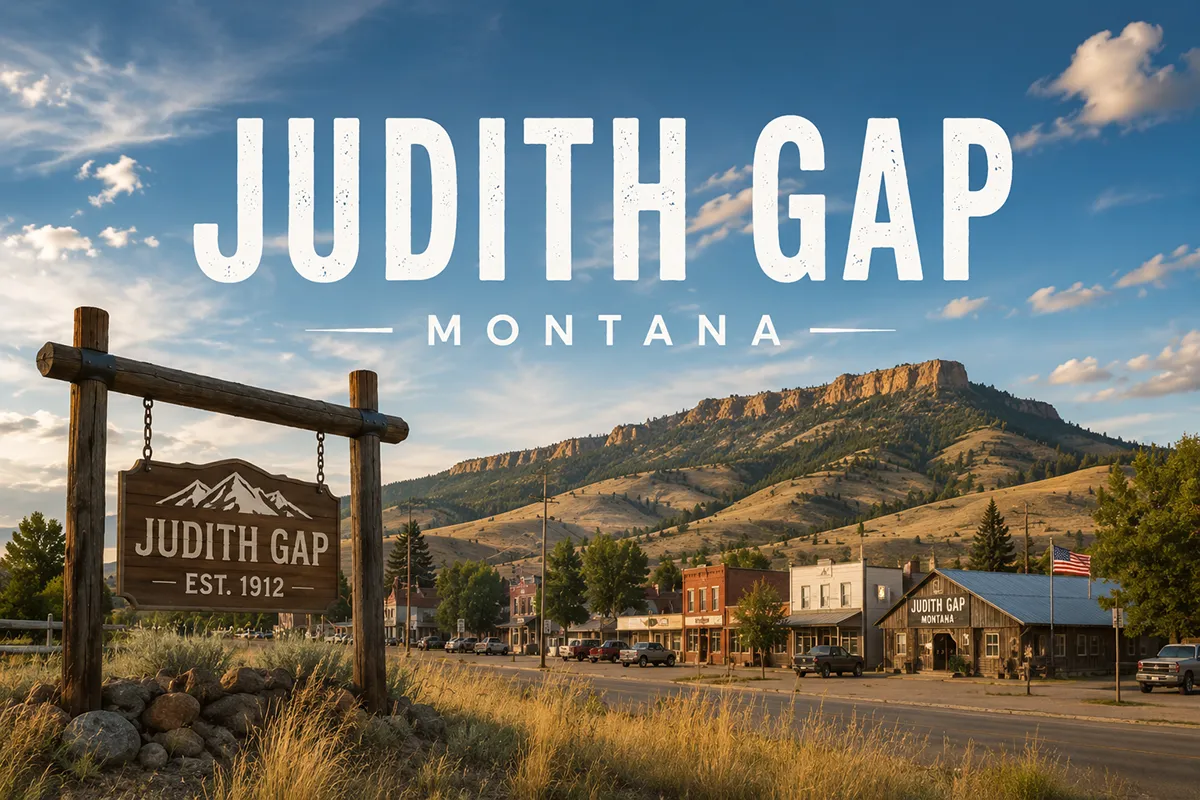
You see the wind turbines before you see the town.
From 25 miles away on US Highway 191, the slowly rotating blades of the Judith Gap Wind Farm dominate the horizon.
The towers are 262 feet tall. The blades are 126 feet long. At full extension, each structure reaches nearly 400 feet into the sky — about the height of a 40-story building.
There are 90 of them.
The wind farm sits six miles south of the town of Judith Gap on 8,300 acres of private and state land. When the first turbine came online in October 2005, it was Montana’s first utility-scale wind project. By early 2006, all 90 turbines were generating power.
Today the facility produces 135 megawatts of electricity — approximately 8% of all the power NorthWestern Energy delivers in Montana.
The town itself has 110 residents.
That’s the disproportion to understand about Judith Gap. A community small enough to share a single high school athletic co-op with neighboring Harlowton and Ryegate hosts one of the most significant pieces of energy infrastructure in central Montana.
It’s also the reason the town doubled its number of public parks from one to two.
When Invenergy was installing the wind farm in 2005, one of the giant turbine blades was damaged in transit. Rather than scrap it, the company donated the 126-foot blade to the town of Judith Gap.
Volunteers used a flatbed trailer, logging equipment, and a wrecker to haul it the six miles into town. Today it sits in Blade Park alongside US Highway 191 — one of the most unusual small-town landmarks in Montana.
TL;DR
- Judith Gap (110) is in Wheatland County on US Highway 191, 25 miles north of Harlowton and 40 miles south of Lewistown.
- The town sits in the actual Judith Gap — the geographic pass between the Big Snowy Mountains (to the northeast) and the Little Belt Mountains (to the northwest).
- The pass is one of the windiest places in central Montana — the reason the wind farm is here.
- The Judith Gap Wind Farm opened October 2005 — Montana’s first utility-scale wind project. 135 MW, 90 turbines, owned by Invenergy (Chicago).
- The facility supplies approximately 8% of NorthWestern Energy’s Montana demand.
- Blade Park in town features a real 126-foot turbine blade donated by Invenergy and moved into place by volunteers.
- The town has paid approximately $15 million in property taxes from the wind farm and received an $800,000 county impact fee.
- Judith Gap School is K-12; team name is the Tigers. In 2023, the school joined Harlowton and Ryegate for high school sports co-op.
- Best for: wind energy heritage, US-191 corridor stops, central Montana pass geography, Blade Park photo stops.
Liked this article?
Add Roaming Montana as a preferred source so you see more of our articles and guides on Google.
Judith Gap at a Glance
| Population (2020) | 110 |
|---|---|
| County | Wheatland County |
| Region | Central Montana (Judith Gap pass) |
| Elevation | 4,643 ft |
| Distance to Harlowton (county seat) | ~25 miles south on US-191 |
| Distance to Lewistown | ~40 miles north on US-191 |
| Distance to Stanford | ~50 miles northwest |
| Distance to Ryegate | ~50 miles southeast |
| Distance to Billings | ~100 miles southeast |
| Wind farm completion | October 2005 (first turbine) / early 2006 (all 90) |
| Best for | Wind farm tour, Blade Park, US-191 corridor stops |
What Makes Judith Gap Different
The geography is the foundation of everything.
Judith Gap is the geographic pass between the Big Snowy Mountains to the northeast and the Little Belt Mountains to the northwest. The gap channels prevailing winds at consistently high velocities — making this one of the windiest places in central Montana.
For most of the town’s history, that wind was simply a fact of life. Then it became infrastructure.
How the Wind Farm Came to Judith Gap
The project was first conceived in 2000.
Wind energy was still a relatively new commercial proposition in Montana at the time. Several developers had studied potential sites across the state. The Judith Gap pass area — with its consistent wind, available agricultural land, and proximity to existing transmission infrastructure — was identified as one of the most promising locations.
The contract was finally signed in January 2005.
Invenergy — a Chicago-based renewable energy company — committed to building a 135 MW facility. NorthWestern Energy agreed to purchase all the power produced under a long-term contract.
Construction proceeded quickly. The first turbine generated power in October 2005. By early 2006, all 90 turbines were online.
The Turbine Specifications
The General Electric turbines installed at Judith Gap are technically impressive even by contemporary standards:
- 262 feet to the nacelle (the housing at the top)
- 126-foot blades (three per turbine)
- ~400 feet total height at blade apex
- 1,500 kilowatts per turbine
- Maximum efficiency at 33.5 mph wind speed
- Automatic shutdown at wind speeds above 56 mph (to prevent damage)
- Highest recorded wind speed at the site: 65 mph
The facility covers 8,300 acres of private and state land, primarily working ranchland. Ranchers retain grazing rights around the turbine bases.
Economic Impact
The wind farm has been substantial for Wheatland County.
Before the project, Wheatland County was among Montana’s ten poorest counties by per-capita income. The wind farm has paid approximately $15 million in property taxes since 2005 and provided an $800,000 impact fee to the county.
Tax revenue has supported the Harlowton and Judith Gap school districts directly. The Judith Gap community has used Invenergy community fund contributions for fire hall improvements, a community center, and infrastructure upgrades.
Blade Park
The town’s most photographable landmark resulted from a construction-era accident.
In 2005, one of the 126-foot turbine blades was damaged during installation transit. Rather than scrap the blade, Invenergy donated it to the town of Judith Gap. Volunteers — using a flatbed trailer, logging equipment for one end, and a wrecker for the other — moved the blade six miles from the wind farm site to a location alongside US Highway 191 in town.
The result is Blade Park — a small public park anchored by a real, full-length wind turbine blade.
It’s an unusual small-town landmark in any context. In a 110-person Montana town that doubled its parks from one to two as a result, it’s genuinely substantive.
For broader trip context, see my Montana cities and towns hub.
The Top 6 Things to Do In & Around Judith Gap
1. Judith Gap Wind Farm Viewing
The signature attraction.
US Highway 191 runs directly through the wind farm. Multiple turnouts allow safe stops for photography and observation. The scale becomes apparent when you stand near a turbine base — the towers are genuinely enormous.
Best viewing in early morning and late afternoon light, particularly when the turbines are rotating against dramatic cloud cover.
2. Blade Park
A 126-foot wind turbine blade displayed alongside US-191 in town.
Free, brief stop. Photography opportunity. The contrast between the blade’s industrial scale and the small-town setting is genuinely striking.
3. Judith Gap Pass Photography
The actual geographic pass between the Big Snowy Mountains and the Little Belt Mountains is one of the more underrated landscapes in central Montana.
US-191 runs north-south through the pass. Multiple pullouts offer views of both mountain ranges and the surrounding wind farm. The grass color in late spring and early summer is particularly striking.
4. Day Trip to Harlowton (25 miles south)
The Wheatland County seat — Milwaukee Road electrified railway heritage, the Wheatland County Museum, and the Musselshell River corridor. The natural urban anchor for any Judith Gap visit.
5. Day Trip to Lewistown (40 miles north)
The Fergus County seat — Central Montana Museum, Big Spring Creek Blue Ribbon trout fishing, the Charlie Russell Chew Choo Dinner Train, and significantly broader services than the Judith Gap area can provide.
6. Big Snowy and Little Belt Mountains Recreation
The surrounding mountain ranges offer hiking, hunting, fishing, and dispersed camping in genuinely uncrowded country.
The Big Snowy Mountains to the northeast include Crystal Lake — a popular Forest Service recreation destination with hiking trails and a USFS campground.
The Little Belt Mountains to the northwest are the largest of central Montana’s “island ranges” and include the Showdown Montana ski area near Neihart.
Where to Stay
Judith Gap has no dedicated lodging.
Most travelers base in Lewistown (40 minutes north) or Harlowton (25 minutes south).
| Lodging | Vibe | Price | Best For |
|---|---|---|---|
| Lewistown hotels (40 min N) | Full small-city selection | $120–220 | Most travelers |
| Harlowton lodging (25 min S) | Small-town options | $100–180 | Wheatland County base |
| Vacation rentals (Wheatland County) | Ranch and farm stays | $130–250 | Hunters, photographers |
Where to Eat
- Local Judith Gap options — small cafes and bars; verify current operations
- Harlowton dining (25 min S) — small-town variety
- Lewistown restaurants (40 min N) — broader selection
Getting There & Around
From Harlowton: 25 miles north on US-191, about 30 minutes.
From Lewistown: 40 miles south on US-191, about 45 minutes.
From Ryegate: 50 miles via Harlowton, about 1.25 hours.
From Billings: ~100 miles northwest, about 1.75 hours.
From Stanford: ~50 miles southeast via MT-3 and MT-3, about 1 hour.
Cell service: Available in Judith Gap and along US-191. Reduced on the surrounding county roads.
When to Visit
Late spring through fall (May-October): Best weather; wind farm at peak visual character; longest daylight; access to surrounding mountain recreation.
Summer (June-August): Warmest weather; central Montana at peak visual character.
Fall (September-October): Outstanding light; harvest activity on surrounding ranches; cooler temperatures.
Winter (December-March): Severe wind and cold; the gap channels storms with particular force. Travel only with proper winter preparation. The turbines remain operational unless wind exceeds 56 mph.
Spring (April-May): Quieter shoulder season; the prairie greens up.
Personal Tips
Stop for the wind farm. US-191 runs directly through the facility. The scale becomes apparent only when you stand near a turbine base. Allow at least 30 minutes for photography and observation.
Don’t skip Blade Park. It’s only a five-minute stop, but the 126-foot blade is one of the more unusual small-town landmarks in Montana and provides a tangible sense of the wind farm’s scale.
The wind itself is part of the experience. Stand outside in the open and feel why this site was selected. On windy days — which is most days — the air at the pass is genuinely impressive.
Combine with Harlowton’s Milwaukee Road heritage. The Wheatland County Museum in Harlowton has substantial exhibits on the Milwaukee Road electrified mainline that once ran through this part of central Montana. The combination of historical railroad infrastructure and contemporary wind infrastructure makes a substantive county visit.
Pair with Lewistown and the Chew Choo. Travelers heading north from Judith Gap can connect to the Charlie Russell Chew Choo Dinner Train operating from Kingston Junction near Lewistown.
Bring layers. At 4,643 feet elevation in a wind-channeling pass, even summer evenings can be cool. Sweaters and windbreakers help.
Judith Gap Quick Facts
| Population (2020) | 110 | | Elevation | 4,643 ft | | Geographic feature | Pass between Big Snowy (NE) and Little Belt (NW) Mountains | | Wind farm capacity | 135 MW | | Number of turbines | 90 | | Turbine height (to nacelle) | 262 ft | | Blade length | 126 ft (each; 3 per turbine) | | Total height at blade apex | ~400 ft | | Wind farm owner | Invenergy (Chicago) | | Power purchaser | NorthWestern Energy | | NorthWestern’s Montana demand supplied | ~8% | | First turbine online | October 2005 | | All 90 turbines online | Early 2006 | | Facility footprint | 8,300 acres | | Project conceived | 2000 | | Contract signed | January 2005 | | Tax revenue since 2005 | ~$15 million | | County impact fee | $800,000 | | Maximum turbine efficiency wind speed | 33.5 mph | | Automatic shutdown wind speed | 56 mph | | Highest recorded site wind speed | 65 mph | | Average summer high | 78°F | | Average winter low | 11°F |
Conclusion
Judith Gap is a 110-person Wheatland County town with substantively important contemporary infrastructure.
The Judith Gap Wind Farm — Montana’s first utility-scale wind project — supplies approximately 8% of all the electricity NorthWestern Energy delivers in the state.
The geographic pass between the Big Snowy and Little Belt Mountains that gives the town its name is also the reason the wind farm is here. Blade Park in town features a real 126-foot turbine blade that volunteers moved six miles by flatbed trailer in 2005.
For travelers driving US-191 between Harlowton and Lewistown, Judith Gap is a substantive 30-minute stop worth the time.
Have a Judith Gap question? Drop it in the comments — I read every one.
Frequently Asked Questions
Is Judith Gap Montana worth visiting?
Judith Gap is worth a brief stop primarily for the Judith Gap Wind Farm (Montana’s first utility-scale wind project, with 90 turbines visible from US Highway 191 for 25 miles in each direction), the unusual Blade Park (featuring an actual 126-foot wind turbine blade), and the dramatic geographic pass between the Big Snowy Mountains and the Little Belt Mountains. It is not a traditional tourism destination but rewards travelers willing to slow down for the energy infrastructure context.
What is the Judith Gap Wind Farm?
The Judith Gap Wind Farm is a 135-megawatt utility-scale wind energy facility located six miles south of the town of Judith Gap in Wheatland County, Montana. The facility was Montana’s first utility-scale wind project, with the first turbine generating power in October 2005 and all 90 turbines online by early 2006. The wind farm is owned by Invenergy (a Chicago-based renewable energy company) and sells all of its power to NorthWestern Energy under a long-term contract. The facility supplies approximately 8% of NorthWestern Energy’s Montana demand and covers 8,300 acres of private and state ranchland.
How tall are the Judith Gap wind turbines?
The General Electric turbines at the Judith Gap Wind Farm are 262 feet tall to the nacelle (the central housing at the top of the tower). The three blades attached to each turbine are 126 feet long. At the apex of the blade rotation, each turbine reaches approximately 400 feet — equivalent to a 40-story building. Each turbine has a capacity of 1,500 kilowatts.
What is Blade Park in Judith Gap Montana?
Blade Park is a small public park in Judith Gap, Montana, that displays an actual 126-foot wind turbine blade alongside US Highway 191. The blade was originally intended for installation at the Judith Gap Wind Farm but was damaged during construction transit in 2005. Rather than scrap the blade, Invenergy donated it to the town. Local volunteers — using a flatbed trailer, logging equipment, and a wrecker — moved the blade six miles from the wind farm site to its current location in town. The park is one of the most unusual small-town landmarks in Montana and the reason Judith Gap doubled its number of public parks from one to two.
Where exactly is Judith Gap Montana?
Judith Gap is a city in Wheatland County, Montana, located on US Highway 191 at the geographic pass between the Big Snowy Mountains (to the northeast) and the Little Belt Mountains (to the northwest). The town is approximately 25 miles north of Harlowton (the Wheatland County seat) and 40 miles south of Lewistown (the Fergus County seat). Elevation is 4,643 feet.
How big is Judith Gap Montana?
Why is it called Judith Gap?
Judith Gap is the geographic pass between the Big Snowy Mountains to the northeast and the Little Belt Mountains to the northwest. The “Judith” portion of the name traces back to William Clark of the Lewis and Clark Expedition, who named the Judith River (which drains the area) in 1805 for Julia “Judith” Hancock — a young woman he later married. The “Gap” portion refers to the geographic pass itself. The pass channels prevailing winds at consistently high velocities, making this one of the windiest places in central Montana — and the reason the Judith Gap Wind Farm was sited here.