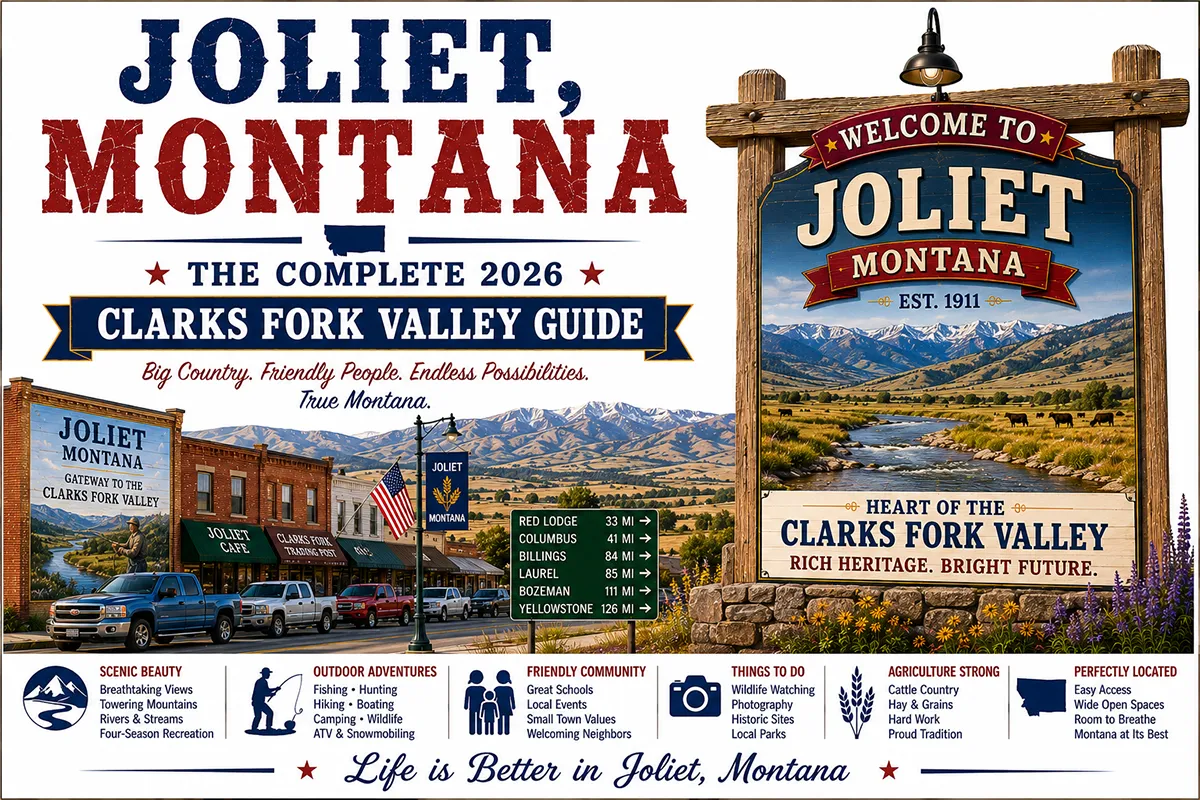
The Clarks Fork of the Yellowstone River drains one of south-central Montana’s most productive agricultural valleys — irrigated fields producing sugar beets, corn, beans, and hay alongside the dry-land wheat operations that spread across the benchlands above the valley floor.
Joliet sits in this corridor on US-310, midway between Billings and the mountains of Carbon County, and it exists precisely because of the agricultural productivity that surrounds it.
The town is named for Joliet, Illinois — brought by settlers from the Midwest who found in the Clarks Fork Valley the same combination of fertile soil, reliable water, and railroad access that had built the agricultural communities they’d left behind.
Joliet is not a destination in the way Red Lodge is a destination. It doesn’t have a famous saloon or a nationally recognized scenic drive or a world-class museum.
What it has is the authentic character of a Carbon County farming community — the grain elevators and sugar beet storage piles that define its skyline, the farmers market that runs on summer mornings, and the US-310 corridor character that connects Billings to the Beartooth through communities that most travelers drive past without stopping.
TL;DR
- Joliet (~565) is a Carbon County farming community on US-310, between Billings (50 miles north) and Belfry/Red Lodge (25–40 miles south).
- Part of the Carbon County Scenic Loop — Red Lodge east through Bearcreek, Joliet, Bridger, and Edgar to complete the full circuit.
- The Clarks Fork Valley around Joliet is some of the most productive irrigated agricultural land in south-central Montana — sugar beets, corn, and hay.
- The Joliet Farmers Market (summer Saturdays) is one of the Carbon County valley’s most authentic community food markets.
- Best for: Carbon County loop drive travelers, Clarks Fork Valley agricultural heritage, and US-310 corridor completers.
Liked this article?
Add Roaming Montana as a preferred source so you see more of our articles and guides on Google.
Joliet at a Glance
| Population (2020) | ~565 |
|---|---|
| County | Carbon County |
| Region | South-Central Montana |
| Elevation | 3,538 ft |
| Distance to Billings | ~50 miles north (~55 min on US-310) |
| Distance to Red Lodge | ~40 miles south (~45 min via Belfry) |
| Distance to Belfry | ~25 miles south (~28 min) |
| Distance to Bridger | ~12 miles south (~15 min) |
| Best for | Carbon County loop drive, Clarks Fork Valley agriculture, US-310 corridor travel |
What Makes Joliet Different
The Clarks Fork Valley between Billings and the Beartooth Mountains is one of Montana’s most productive agricultural areas — something that most Billings-to-Red Lodge travelers don’t absorb because the interstate and US-212 take them on a different route.
US-310 through Joliet and the Carbon County communities is the valley road, the agricultural road, the road that follows the actual river rather than cutting across benchlands.
The valley’s productivity comes from the same irrigation infrastructure that built Billings’s agricultural economy — water from the Clarks Fork and its tributaries, distributed by canals and ditches to fields that in the natural dry-land condition would support only ranching.
Sugar beets have been a signature crop here since the early 20th century; the Sidney Sugars plant 400 miles away processes beets from regions across eastern and south-central Montana, but the irrigated Clarks Fork corridor was among the first areas developed for sugar beet production.
Joliet’s farmers market is the community’s most visible summer gathering — local produce, honey, eggs, baked goods, and crafts from the surrounding valley farms.
It’s the kind of market that exists for the community rather than for tourism, which makes it more authentic and more interesting than larger food markets organized around visitor traffic.
The Carbon County Scenic Loop context matters. Travelers doing the full loop from Red Lodge east through Bearcreek, south through the valley to Joliet, Bridger, and Edgar, and then north back toward Billings are making a deliberate choice to understand Carbon County as a whole. Joliet is one of the valley’s anchor communities in that circuit.
For broader trip context, see my Montana cities and towns hub.
The Top 10 Things to Do In & Around Joliet
1. Clarks Fork Valley Agricultural Drive
Drive the US-310 corridor between Joliet and Bridger (12 miles south) through the valley’s irrigated heartland. The fields — sugar beets, corn, hay, beans — are at their most impressive in late summer, when the harvest equipment is working and the grain and beet storage infrastructure is active. Pull off at fishing access sites to see the river up close.
2. Joliet Farmers Market (Summer Saturdays)
Joliet’s summer farmers market brings together valley farms for fresh produce, honey, eggs, meats, baked goods, and local crafts. The genuine community market character — built for local families rather than tourists — gives it an authenticity that larger markets lose when they scale up.
3. Clarks Fork River Fishing
The Clarks Fork flows through the valley near Joliet with access at the Joliet Fishing Access Site. Brown trout and some rainbow trout in the lower accessible sections; warm-water species (catfish, sauger) in the slower stretches. The Clarks Fork is Blue Ribbon water in its prime sections further upstream.
4. Carbon County Scenic Loop Drive
The full loop from Red Lodge east through Bearcreek (pig races, Smith Mine Disaster) and south through Belfry, Joliet, Bridger (Pryor Mountain wild horses), Edgar (Edgar Bar steakhouse), and northeast back toward Billings covers 80+ miles of authentic Carbon County character. Joliet is the valley’s midpoint in this circuit.
5. Day Trip to Bearcreek (15 miles south via Belfry)
The Bear Creek Saloon’s famous pig races and Smith Mine Disaster Memorial. See Bearcreek guide.
6. Day Trip to Bridger (12 miles south)
Pryor Mountains Wild Horse Range access and Garage Steakhouse. See Bridger guide.
7. Day Trip to Red Lodge (40 miles south via Belfry)
Beartooth Highway, historic downtown Red Lodge, Carbon County museums. See Red Lodge guide.
8. Day Trip to Billings (50 miles north)
Montana’s largest city — Rimrocks, Yellowstone Art Museum, full services. See Billings guide.
9. Sugar Beet Harvest Observation (Fall)
The fall sugar beet harvest in the Clarks Fork Valley is one of south-central Montana’s most impressive agricultural events. Massive beet harvesters working through the fields, transport trucks running to storage piles, the valley smelling of cut beet — a genuine agricultural spectacle that most non-agricultural Montanans have never witnessed.
10. Local Bar & Community Character
Joliet’s local bars — the Valley Bar is the primary community gathering place — give access to the agricultural community’s rhythms. The conversations at a Carbon County bar during harvest are as authentic as anything in a formal museum.
Where to Stay
| Hotel | Vibe | Price | Best For |
|---|---|---|---|
| No lodging in Joliet | — | — | — |
| Bridger motels (12 min south) | Basic local | $85–130 | Most travelers |
| Red Lodge hotels (40 min south) | Mountain town | $120–280 | Beartooth focus |
| Billings hotels (55 min north) | Full city | $130–250 | More amenities |
Where to Eat
- Valley Bar — Joliet’s community gathering place; bar food
- Edgar Bar (north on US-310, ~20 min) — the Carbon County corridor’s best restaurant; famous jumbo prawns
- Red Lodge (40 min south) — full restaurant variety
- Billings (55 min north) — full city dining
Getting There & Around
From Billings: 50 miles south on US-310, about 55 minutes.
From Red Lodge: 40 miles north via Belfry on US-310, about 45 minutes.
From Bridger: 12 miles north on US-310, about 15 minutes.
When to Visit
Late August–September: Sugar beet harvest — the valley’s most dramatic agricultural activity.
Summer (June–August): Farmers market operating; Clarks Fork fishing; full Carbon County loop accessible.
Fall (September–October): Harvest season; fall colors in valley cottonwoods.
Personal Tips
The Carbon County Loop is the experience. Joliet makes the most sense as part of the Red Lodge → Bearcreek → Joliet → Bridger → Edgar → Billings loop rather than as a standalone stop.
Edgar Bar is 20 minutes north. The Carbon County corridor’s best meal — scratch-made food including jumbo prawns — is worth timing your Joliet stop around dinner.
Quick Facts
| Founded | 1900s | | Named for | Joliet, Illinois | | Primary crops | Sugar beets, corn, hay, wheat | | Average summer high | 87°F | | Average winter low | 11°F |
Conclusion
Joliet is the Clarks Fork Valley’s working agricultural heart — the kind of community that exists because the land around it is genuinely productive and the people who farm it need services.
The farmers market, the harvest culture, and the US-310 corridor position make it a meaningful stop on the Carbon County loop.
Drive slowly through the valley and you’ll understand why the Midwest settlers who named it after their Illinois hometown recognized something familiar in the landscape.
Have a Joliet question? Drop it in the comments — I read every one.
Frequently Asked Questions
Is Joliet Montana worth visiting?
Worth a stop as part of the Carbon County Scenic Loop from Red Lodge through Bearcreek, Joliet, Bridger, and Edgar — a full-day circuit covering the valley’s agricultural heritage and the Beartooth mountain approach. The Joliet Farmers Market (summer Saturdays) and Clarks Fork fishing add specific reasons to stop.
What is grown near Joliet Montana?
The Clarks Fork Valley around Joliet is primarily irrigated farmland producing sugar beets, corn, hay, and beans alongside dry-land wheat on the benchlands. Sugar beet production has been a signature crop since the early 20th century.