On March 14, 1922, a wildcat well drilled four miles north of a small railroad watering stop called Kevin struck oil.
The well was called Gordon Campbell #1. It hit pay in the Jurassic-age Ellis formation at depths less than 3,000 feet. The discovery wasn’t just a successful local strike — it was the birth of Montana’s entire crude oil industry.
It was also the first field in the United States to yield a significant amount of oil from Jurassic-age strata.
The Kevin-Sunburst Oil Field that developed from the Campbell discovery covers approximately 16 townships across the Sweetgrass Arch — a large geologic structural uplift somewhat similar in scale to the Cincinnati Arch.
Within five years of the 1922 discovery, more than 1,500 wells had been drilled on the field. By May 1925, the Kevin-Sunburst field stood second in production among all Rocky Mountain oil fields — exceeded only by Wyoming’s massive Salt Creek field.
Cumulative production from the Kevin-Sunburst field has now exceeded 85.7 million barrels of oil.
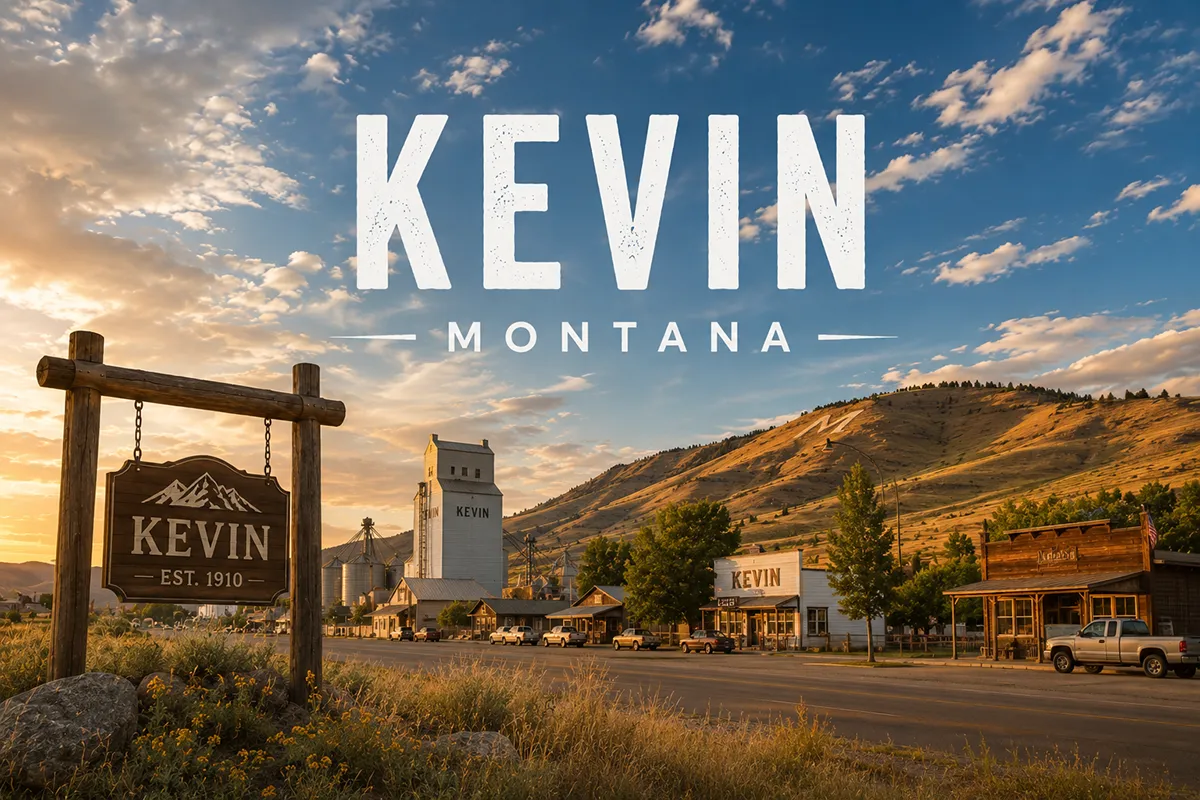
The town that gave the field its first name is now home to approximately 179 people.
Kevin sits 22 miles north of Shelby and 20 miles south of the Canadian border, in Toole County. Most of the oil infrastructure that defined the area in the 1920s and 1930s is gone.
The 1928 Texaco refinery is no longer operating. The 1,500 wells of the 1920s have consolidated into a much smaller number of contemporary producers. Students attend school in Sunburst ten miles north.
But the town remains genuinely substantive as the physical birthplace of Montana’s oil industry.
TL;DR
- Kevin (~179) is in Toole County on the Alberta border corridor, 22 miles north of Shelby and 20 miles south of the Canadian border.
- The town was established as a railroad watering stop on the Alberta Railway and Irrigation Company line (“the Turkey Track”) transporting coal from Alberta to Great Falls.
- Named for Colonel Kevin, a Turkey Track railroad official.
- March 14, 1922: oil was discovered at Gordon Campbell Well #1, four miles north of town — Montana’s first major commercial oil discovery.
- The discovery marked the birth of Montana’s crude oil industry and was the first field in the United States to produce a significant amount of oil from Jurassic strata.
- The Kevin-Sunburst Oil Field covered 16 townships across the Sweetgrass Arch geologic uplift.
- By May 1925, the field stood second in Rocky Mountain oil production (behind only Wyoming’s Salt Creek).
- Cumulative production has exceeded 85.7 million barrels of oil.
- The “Oily Boid gets the Woim” historical sign on US-2 at milemarker 381.8 marks the discovery.
- Best for: oil heritage travelers, US-2 Hi-Line corridor stops, Sweetgrass Hills photography, far-northern Montana exploration.
Liked this article?
Add Roaming Montana as a preferred source so you see more of our articles and guides on Google.
Kevin at a Glance
| Population (estimated) | ~179 |
|---|---|
| County | Toole County |
| Region | North Central Montana (near Canadian border) |
| Elevation | 3,316 ft |
| Distance to Shelby (county seat) | ~22 miles south |
| Distance to Sunburst | ~8 miles north |
| Distance to Sweetgrass / Canadian border | ~20 miles north |
| Distance to Cut Bank | ~50 miles west |
| Distance to Chester | ~55 miles east |
| Distance to Great Falls | ~110 miles south |
| Founded | Pre-1900 (as railroad watering stop) |
| Oil discovery date | March 14, 1922 |
| Best for | Oil heritage, far-northern Hi-Line, Sweetgrass corridor |
What Makes Kevin Different
The town predates the oil by at least two decades.
The community originated as a watering stop on the Alberta Railway and Irrigation Company Railroad — locally known as the “Turkey Track” — built to transport coal from Alberta, Canada south to Great Falls, Montana. The railroad needed water for its steam locomotives. The site that became Kevin had reliable water access.
It was named for Colonel Kevin, an Alberta Railway and Irrigation Company official.
The original Kevin consisted of a section house and a water tank. A depot was added later for passenger service and mail. Trains still pass through town today on the BNSF mainline, but they no longer stop.
The 1922 Oil Discovery
The pre-1922 history of the area as an oil prospect is worth understanding.
Oil had been noted in the Kevin area as early as 1909. The viability of commercial development was first explored in 1911-1912.
Standard Oil Company subsidiaries leased local landowners’ holdings only a few months after the drilling of the first test well in 1912. But no major commercial oil companies operated in the area until the 1920s.
The discovery well — Gordon Campbell #1 — was drilled in the rimrock country four miles north of Kevin. The well struck oil on March 14, 1922.
Within months, Kevin transformed from a quiet railroad watering stop into a booming oil town.
The Sweetgrass Arch and Jurassic Strata
The geologic significance of the Kevin-Sunburst discovery extended far beyond Montana.
The field sits on the Sweetgrass Arch — a large structural uplift comparable in scale to the Cincinnati Arch of the eastern United States. The arch creates a broad dome structure where oil and gas can accumulate in stratigraphic traps.
The Kevin-Sunburst field was the first major field in the United States to produce a significant volume of oil from Jurassic-age strata.
The primary producing horizon — the basal sand of the Ellis formation — became internationally significant for oil exploration geology. Decades later, exploration in Wyoming, the North Sea, and other regions referenced the Kevin-Sunburst as a Jurassic production model.
The Boom Years (1922-1929)
The boom was rapid and substantial.
Within five years of the Campbell discovery, more than 1,500 wells had been drilled on the Kevin-Sunburst dome.
Over 880 of them were rated as productive. By May 1925 — just three years after the initial strike — the field stood second in production among all Rocky Mountain oil fields, exceeded only by Wyoming’s much larger Salt Creek field.
A small refinery was built in Kevin in 1922 to process local crude. Texaco acquired the refinery in 1928 and operated it for decades — producing leaded gasoline that became important during and after World War II.
The Kevin Courier newspaper was founded by C.M. Brinton with its first issue on May 5, 1922 — directly responding to the boom. The first three issues were printed in Sweet Grass twenty miles north because Kevin didn’t yet have its own printing facility.
Contraction
By the 1970s, oil production in the area had largely ceased.
The Texaco refinery closed. Most of the small operators that had defined the 1920s and 1930s boom were gone. The Kevin-Sunburst field continued to produce, but at much lower volumes from a consolidated set of wells. Contemporary production is a small fraction of what flowed during the boom years.
Kevin’s population shrank substantially.
But the field remains historically significant. As recently as 2020, Calgary-based Thor Resources received approval to re-enter a Precambrian dry hole in the Greater Kevin-Sunburst Field to evaluate fractured basement rocks for possible helium production — part of ongoing helium exploration along the Sweetgrass Arch.
For broader trip context, see my Montana cities and towns hub.
The Top 6 Things to Do In & Around Kevin
1. Gordon Campbell #1 Well Site
The signature historical attraction.
The well site is located approximately four miles north of Kevin near the rimrock that defines the local landscape. Verify current access (it’s mostly on private land); photograph from public roads.
This is the spot where Montana’s commercial oil industry began on March 14, 1922.
2. “The Oily Boid Gets the Woim” Historical Sign
The clever Montana Historical Society marker on US Highway 2 at milemarker 381.8.
The sign covers the 1922 oil discovery, references the Turkey Track railroad, and acknowledges the area’s cow country and homesteader heritage. A brief stop with substantive historical content.
3. US-2 Hi-Line Drive
Kevin sits in the corridor just north of where US-2 runs east-west across Montana.
From Kevin, the surrounding country is the dramatic rolling rimrock terrain that defines far-northern Montana. The Sweetgrass Hills rise dramatically to the northwest — three isolated buttes (West Butte, Middle Butte, East Butte) that have been sacred to the Blackfeet people for centuries.
4. Sweetgrass Hills Photography
The three buttes of the Sweetgrass Hills are some of the most photographed landmarks in far-northern Montana.
The hills rise approximately 1,500 feet above the surrounding prairie. They’re accessible via gravel roads from Kevin and Sunburst. The eastern, middle, and western buttes each offer distinct character.
5. Day Trip to Shelby (25 minutes south)
The Toole County seat — the largest community in the region with full services, the Marias Museum of History and Art, restaurants, and the famous 1923 Jack Dempsey-Tommy Gibbons heavyweight championship boxing match site.
The natural urban anchor for any Kevin visit.
6. Day Trip to Sunburst (10 minutes north)
The slightly larger sister community (population 333). Sunburst has the Sunburst Refiners high school athletic teams — a direct reference to the area’s oil refinery heritage. The school serves Kevin students.
Where to Stay
Kevin has no dedicated lodging.
Most travelers base in Shelby (25 minutes south).
| Lodging | Vibe | Price | Best For |
|---|---|---|---|
| Shelby hotels (25 min S) | Toole County seat selection | $100–200 | Most travelers |
| Sunburst lodging (10 min N) | Smaller town options | $90–150 | Border-area travelers |
| Cut Bank hotels (1 hr W) | Glacier County options | $110–200 | Glacier Park-bound |
| Vacation rentals (Toole County) | Limited; ranch stays | $130–250 | Hunters |
Where to Eat
- Local Kevin tavern/cafe — one business; verify current operations
- Shelby restaurants (25 min S) — broader selection
- Sunburst dining (10 min N) — additional small-town options
Getting There & Around
From Shelby: 22 miles north on MT-215 / county roads, about 25 minutes.
From Sunburst: 8 miles south, about 10 minutes.
From Canadian border at Sweetgrass: ~20 miles south, about 25 minutes.
From Cut Bank: ~50 miles east, about 1 hour.
From Great Falls: ~110 miles south via I-15 to Shelby, then north, about 2 hours.
Cell service: Available in Kevin and along major roads. Reduced on the surrounding rural roads.
When to Visit
Summer (June-August): Best driving conditions; warmest weather; rolling wheat country at peak visual character.
Fall (September-October): Harvest season; outstanding northern prairie light.
Winter (November-March): Severe far-northern weather; temperatures regularly below -20°F. Travel only with proper preparation.
Spring (April-May): Quieter shoulder season; the prairie greens up.
Personal Tips
Take the Campbell well story seriously. The March 14, 1922 oil discovery here genuinely launched Montana’s commercial oil industry. The state that has produced billions of barrels of oil since started with this single well.
Stop for the Oily Boid sign. The Montana Historical Society marker at milemarker 381.8 on US-2 has substantive historical content and clever wordplay. A 5-minute stop with real value.
Photograph the Sweetgrass Hills. The three buttes north of Kevin are some of the most distinctive landforms in far-northern Montana. Best photography is early morning or late afternoon when shadows define the relief.
Use Shelby as your base. Kevin has minimal services. Shelby 25 minutes south has full restaurants, lodging, fuel, and supplies. Day-trip from there.
Combine with Sunburst for the full oil heritage story. Kevin was the site of the original 1922 discovery. Sunburst was where the refinery operated. The two communities together tell the broader Kevin-Sunburst Oil Field story.
Respect property boundaries. The historical well sites are largely on private agricultural land. Photograph from public roads. Don’t attempt to enter any active or abandoned well infrastructure.
Kevin Quick Facts
| Population (estimated) | ~179 | | Original purpose | Alberta Railway watering stop | | Named for | Colonel Kevin (Alberta Railway and Irrigation Co. official) | | Railroad nickname | “The Turkey Track” | | Oil discovery date | March 14, 1922 | | Discovery well | Gordon Campbell #1 (4 mi N of Kevin) | | Oil-bearing formation | Ellis formation (Jurassic age) | | Field name | Kevin-Sunburst Oil Field | | Dome size | ~16 townships | | Geologic feature | Sweetgrass Arch | | First-decade development | 1,500+ wells drilled by 1927 | | Productive wells | 880+ | | Peak ranking (May 1925) | Second in Rocky Mountain production | | Cumulative production | ~85.7 million barrels | | Refinery acquired by Texaco | 1928 | | Kevin Courier first issue | May 5, 1922 | | Historical sign location | US-2 milemarker 381.8 | | Average summer high | 80°F | | Average winter low | -4°F |
Conclusion
Kevin is a 179-person Toole County town that is genuinely significant in American oil history.
The March 14, 1922 discovery at Gordon Campbell Well #1 four miles north of town launched Montana’s entire commercial oil industry.
The Kevin-Sunburst Oil Field that followed was the first major American oil field producing from Jurassic-age strata — a discovery with global implications for petroleum geology. Within three years, the field was second in Rocky Mountain oil production.
Most of the boom-era infrastructure is gone. The contemporary town is a small ranching and agricultural community.
But the Sweetgrass Hills still rise to the north, the rimrock country still stretches in every direction, and the historical markers still tell one of the more substantive small-town stories on Montana’s US-2 Hi-Line corridor.
Have a Kevin question? Drop it in the comments — I read every one.
Frequently Asked Questions
Is Kevin Montana worth visiting?
Kevin is worth a brief stop primarily for its historical significance as the birthplace of Montana’s commercial oil industry — the March 14, 1922 discovery at Gordon Campbell Well #1 four miles north of town launched Montana’s entire crude oil sector. The “Oily Boid gets the Woim” historical sign at US-2 milemarker 381.8 commemorates the discovery. The town also sits in the Sweetgrass Hills corridor with substantial photography opportunities for the three sacred Blackfeet buttes north of town.
Who is Kevin Montana named after?
Kevin is named for Colonel Kevin, an official of the Alberta Railway and Irrigation Company Railroad — locally known as “the Turkey Track.” The railroad was built to transport coal from Alberta, Canada south to Great Falls, Montana. The town site originated as a watering stop for the railroad’s steam locomotives, with a section house and water tank as the original infrastructure.
When was oil discovered in Kevin Montana?
Oil was discovered at Gordon Campbell Well #1 approximately four miles north of Kevin on March 14, 1922. The discovery launched Montana’s commercial oil industry and gave birth to the Kevin-Sunburst Oil Field — the first major American oil field producing significant oil from Jurassic-age strata. Within five years of the discovery, more than 1,500 wells had been drilled on the Kevin-Sunburst dome.
What is the Kevin-Sunburst Oil Field?
The Kevin-Sunburst Oil Field is a historic oil field covering approximately 16 townships in Toole County, Montana, on the Sweetgrass Arch geologic uplift. Discovered with the March 14, 1922 Gordon Campbell well, the field was the first in the United States to produce a significant amount of oil from Jurassic-age strata. Cumulative production has exceeded 85.7 million barrels from depths less than 3,000 feet in the Ellis formation and other producing horizons. By May 1925, just three years after discovery, the field stood second in Rocky Mountain oil production behind only Wyoming’s Salt Creek field. Contemporary production is much reduced but the field remains historically significant.
What is the Sweetgrass Arch?
The Sweetgrass Arch is a large geologic structural uplift in north-central Montana extending into southern Alberta. The arch is comparable in scale and degree of folding to the Cincinnati Arch of the eastern United States. It creates a broad dome structure where oil and gas can accumulate in stratigraphic traps. The Kevin-Sunburst Oil Field sits on the crest of this dome. The arch has been the subject of ongoing oil and gas exploration since the 1922 discovery, with more recent exploration focused on helium production from fractured Precambrian basement rocks.
How far is Kevin from Shelby Montana?
How big is Kevin Montana?
Kevin has approximately 179 residents per the town’s official records (some recent sources estimate slightly lower). The town has a mayor-council form of government, a K-12 student population that attends school in Sunburst ten miles north, and a small business district consisting of one bar with café, a post office, a barber shop, an accountant, and a meat cutting business.