Of Montana’s hundreds of incorporated communities, exactly one has a Bulgarian name.
It’s Plevna.
In 1909, the Chicago, Milwaukee, St. Paul and Pacific Railroad — the Milwaukee Road — pushed its Pacific Coast Extension west through what is now Fallon County, Montana. Like virtually all American railroads of that era, the Milwaukee relied on enormous numbers of immigrant laborers to build the line.
Bulgarian-born workers were a substantial component of the crews working through the southeastern Montana stretch of the new line.
When the Milwaukee established a station along Sandstone Creek 12 miles northeast of present-day Baker, the railroad asked the workers what to call it.
The Bulgarian crew members suggested Plevna — the name of the city in their Bulgarian homeland that had been the site of the famous 1877 Siege of Plevna during the Russo-Turkish War.
Today the city is officially known as Pleven — Bulgaria’s seventh-largest city — but the older Russian-influenced spelling “Plevna” was the form that was widely used in early-20th-century English-language writing.
The railroad officials accepted the suggestion.
The post office opened that same year. Homesteaders began arriving. Many were of Bulgarian and Volga German descent — descendants of the German farmers who had been invited by Catherine the Great to settle the Russian steppes in the 18th century and who, by the early 20th century, were emigrating in significant numbers to the American Great Plains.
The town grew as a cluster of churches, bars, and mercantile operations serving the surrounding dryland farming community.
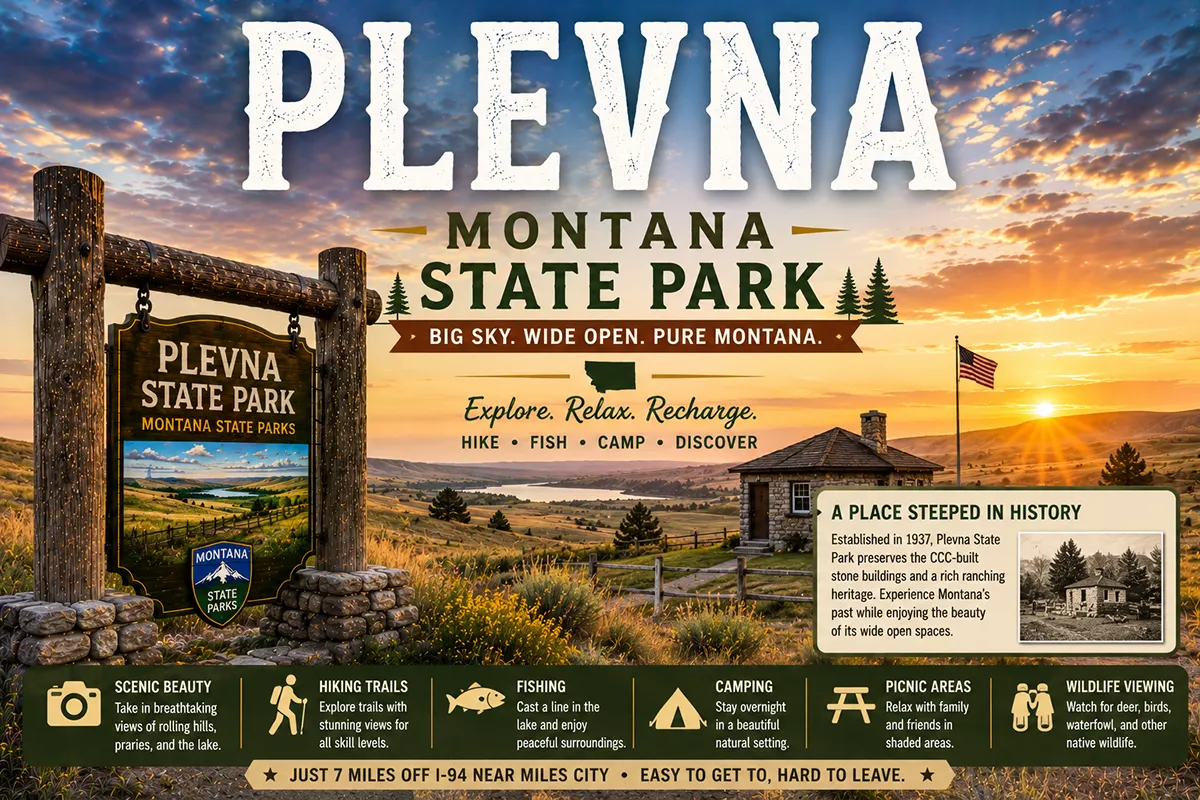
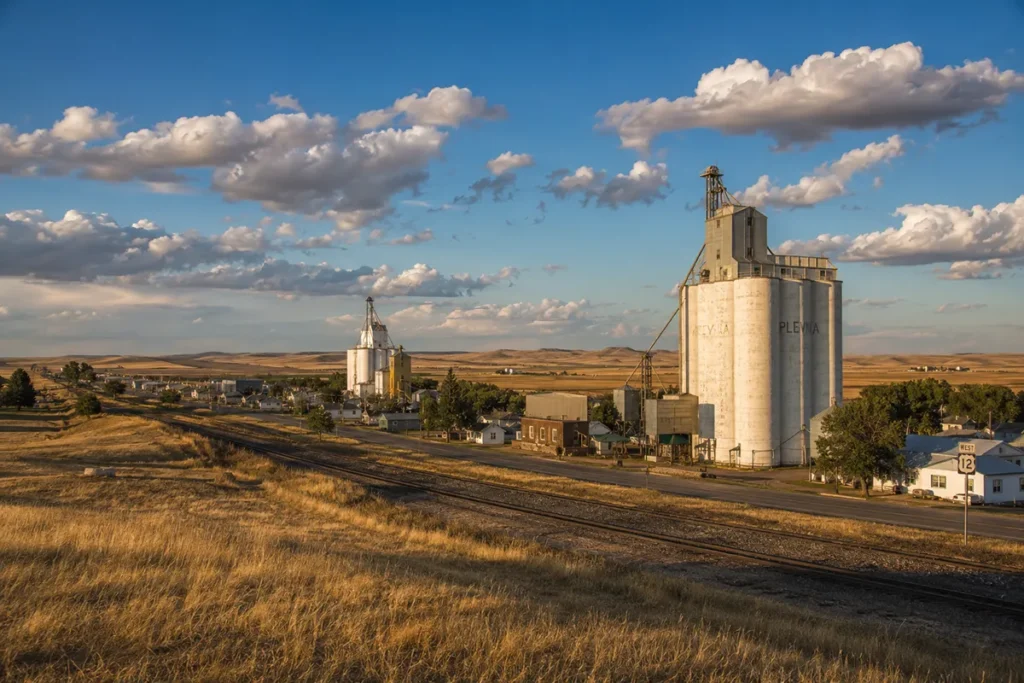
Today Plevna has 179 residents (2020 census). The town covers 0.59 square miles. US Highway 12 passes directly through the center. The Milwaukee Road tracks that founded the town were abandoned in 1980; BNSF now operates whatever railroad freight remains in the area.
The Bulgarian name has stuck for 116 years.
TL;DR
- Plevna (179) is in Fallon County on US Highway 12, 12 miles northeast of Baker (the county seat).
- The town was founded in 1909 along the Milwaukee Road’s Pacific Coast Extension.
- Bulgarian railroad workers named the town after the city of Pleven (older spelling: Plevna) in their Bulgarian homeland.
- This makes Plevna the only Bulgarian-named community in Montana.
- The Bulgarian city was the site of the famous 1877 Siege of Plevna during the Russo-Turkish War.
- Many of the town’s later homesteading settlers were of Volga German descent — descendants of German farmers invited by Catherine the Great to settle the Russian steppes.
- The town’s settlement pattern was characteristic of dryland farming communities: churches, bars, and a mercantile operation around the Milwaukee Road depot.
- The town is 14 miles east of Ismay, where the famously rural “Joe, Montana” community has identified Plevna as the nearest bar for decades.
- Best for: Bulgarian heritage travelers, Milwaukee Road railroad enthusiasts, US-12 corridor stops, far-southeast Montana exploration.
Liked this article?
Add Roaming Montana as a preferred source so you see more of our articles and guides on Google.
Plevna at a Glance
| Population (2020) | 179 |
|---|---|
| County | Fallon County |
| Region | Southeast Montana (US-12 corridor) |
| Elevation | 2,772 ft |
| Distance to Baker (county seat) | ~12 miles southwest on US-12 (~15 min) |
| Distance to Ismay | ~14 miles west |
| Distance to Wibaux | ~50 miles north |
| Distance to Glendive | ~80 miles north |
| Distance to Miles City | ~85 miles west |
| Distance to North Dakota border | ~17 miles east |
| Founded | 1909 (Milwaukee Road) |
| Original county | Custer County (until 1913) |
| Current county | Fallon County (formed 1913) |
| Town area | 0.59 square miles |
| Best for | Bulgarian heritage, Milwaukee Road history, US-12 stops |
What Makes Plevna Different
The Bulgarian name is genuinely singular in Montana history.
The 1877 Siege of Plevna
The Bulgarian city that Plevna, Montana is named for has a substantively significant historical claim.
Pleven — also commonly transliterated as “Plevna” in English during the 19th and early 20th centuries — was the site of one of the most decisive battles of the Russo-Turkish War of 1877-78.
For approximately five months between July and December 1877, Russian and Romanian forces besieged a fortified Ottoman garrison at Plevna.
The siege ended with the Ottoman surrender on December 10, 1877. The battle proved decisive in establishing Bulgarian autonomy from the Ottoman Empire — and made Plevna a powerful symbol in Bulgarian national identity ever after.
By 1909, when Bulgarian railroad workers were laying track for the Milwaukee Road across Montana, the name Plevna would have carried immediate patriotic weight. Suggesting it as the name for a new American town was a way of honoring their homeland’s defining military victory of the 19th century.
Multiple Etymologies
The town’s name has two distinct etymological explanations that appear in different sources:
The Slavic etymology traces “Plevna” to the Slavic word “plev” meaning “weed” — appropriate for a town established on prairie grassland.
The Russian etymology translates “Plevna” as “city of churches” — equally appropriate given that the town’s settlement pattern (per the Montana Historical Society Library and Archives) included multiple churches alongside the bars and mercantile operations that served the dryland farming community.
Both etymologies have circulated since the town’s founding.
The Volga German Connection
The early Plevna settler population wasn’t only Bulgarian.
Many of the homesteaders arriving after 1909 were of Volga German descent — also called Black Sea Germans or German Russians. These were descendants of German farmers who had been invited by Catherine the Great, Empress of Russia, to settle the Russian steppes in the mid-18th century.
By the late 19th and early 20th centuries, Volga German communities were emigrating in substantial numbers from Russia to the American Great Plains — particularly to North Dakota, South Dakota, Kansas, Nebraska, and eastern Montana.
The Bulgarian-named Montana town happened to fit perfectly into the broader Volga German settlement pattern that defined much of homestead-era southeastern Montana.
This is part of why the surrounding country has a distinct cultural character compared to other parts of Montana.
The Fallon County Politics
When Plevna was founded in 1909, it was part of the much larger Custer County.
In 1913, area residents — including those in Plevna — voted to split from Custer County and form the new Fallon County. The county is named for Benjamin O’Fallon, an Indian Agent and nephew of William Clark of the Lewis and Clark Expedition. (The “O'” disappeared from the county name; historians have been unable to determine exactly why.)
Fallon County itself was further reduced in subsequent years. Wibaux County split off in 1914. Prairie County split off in 1915. Plevna remained in the final reduced Fallon County boundaries that exist today.
The Nearest Bar to Ismay
One contemporary cultural detail deserves mention.
Approximately 14 miles west of Plevna is the much smaller community of Ismay — population 17 at the 2020 census, the smallest incorporated town in Montana. Ismay famously has no bar, restaurant, gas station, or grocery store of its own.
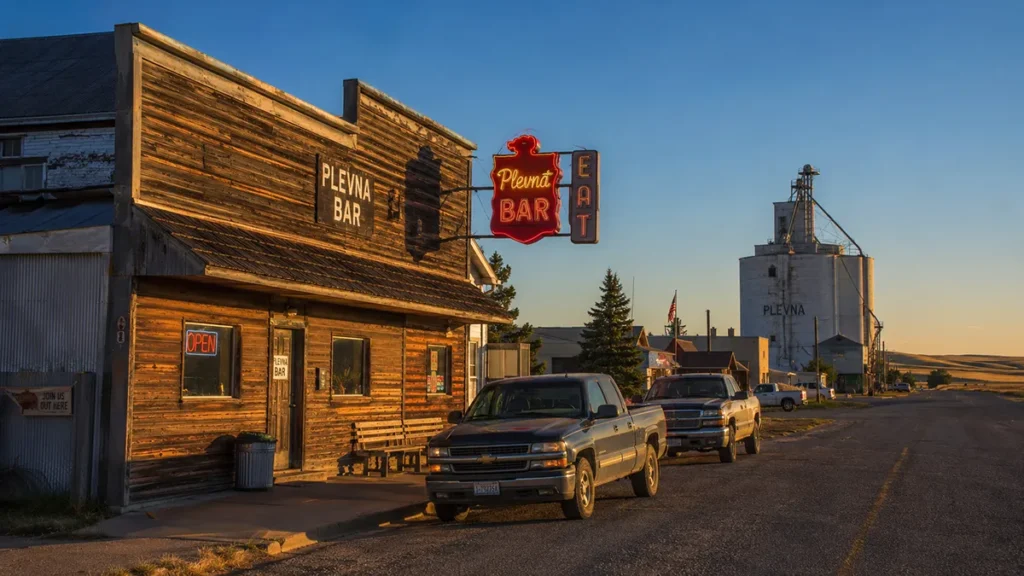
The Plevna Bar has been the nearest bar to Ismay for decades.
It’s not the kind of cultural detail that shows up in tourism marketing, but it’s a substantively important one for understanding contemporary far-southeastern Montana social life.
For broader trip context, see my Montana cities and towns hub.
The Top 6 Things to Do In & Around Plevna
1. Bulgarian Heritage Photography
The signature contemporary attraction.
The town’s main entrance signs, the post office, and the Plevna Bar all acknowledge the Bulgarian heritage that defines the community’s identity. Photograph these markers for what they represent — the only Bulgarian-named community in the state of Montana.
2. Plevna Bar
The local social anchor.
Operating in some form since the early 20th century, the Plevna Bar has served not only the town’s small population but also residents of Ismay 14 miles west and travelers along US-12. A substantively authentic small-town Montana bar experience.
3. Annual Plevna Jamboree
A summer community festival typically held in mid-July.
The second annual Plevna Jamboree (2025) featured craft vendors, live music, food, and family games. Verify current scheduling for any planned visit.
4. Milwaukee Road Corridor Heritage
The abandoned Milwaukee Road grade runs through Plevna parallel to US-12.
Brief walking tour reveals the original railroad alignment, the depot site, surviving railroad-era commercial buildings, and the broader Pacific Coast Extension story.
See Montana railroads for broader rail-corridor context.
5. Day Trip to Baker (15 minutes southwest)
The Fallon County seat — the natural urban anchor for any Plevna visit.
Attractions include the O’Fallon Historical Museum (housed in the 1916 original Fallon County jail and Sheriff’s quarters, NRHP-listed), Baker Lake for fishing and swimming, the surrounding Badlands for hiking, and the annual Fallon County Fair.
6. Day Trip to Ismay (14 miles west)
The “smallest incorporated town in Montana” experience.
Population 17. Joe Montana Community Center (the legacy of the famous 1993 publicity rename to “Joe, Montana”). The historic jail. No services at all in town. A substantive 30-minute companion stop for any Plevna visit.
Where to Stay
Plevna has no dedicated lodging.
Most travelers base in Baker (15 minutes southwest).
| Lodging | Vibe | Price | Best For |
|---|---|---|---|
| Baker hotels (15 min SW) | Full Fallon County selection | $100–180 | Most travelers |
| Glendive lodging (1.5 hrs N) | I-94 options | $100–200 | I-94 travelers |
| Wibaux hotels (1 hr N) | Small-town options | $90–150 | Yellowstone-bound |
| Vacation rentals (Plevna area) | Limited; ranch and farm stays | $120–250 | Hunters, longer visits |
Where to Eat
- Plevna Bar — local community anchor and area’s nearest bar to Ismay
- Local Plevna cafes — verify current operations
- Baker dining (15 min SW) — broader Fallon County selection
Getting There & Around
From Baker: 12 miles northeast on US-12, about 15 minutes.
From Ismay: ~14 miles east via US-12 and county roads, about 25 minutes.
From Wibaux: ~50 miles south, about 1 hour.
From Glendive: ~80 miles south, about 1.5 hours via I-94 and US-12.
From Miles City: ~85 miles east on US-12, about 1.5 hours.
Cell service: Available in Plevna and along US-12. Reduced on surrounding county roads.
When to Visit
Summer (June-August): Best driving conditions; warmest weather; the annual Plevna Jamboree typically in mid-July.
Fall (September-October): Harvest season; outstanding southeastern Montana light; cooler temperatures.
Winter (December-March): Severe Montana weather possible; town quieter.
Spring (April-May): Quieter shoulder season; the prairie greens up.
Personal Tips
Stop at the Plevna Bar. The town’s social anchor is genuinely substantive. Spending 30 minutes here over a drink provides more authentic small-town Montana context than any historic marker tour can.
Read about the 1877 Siege of Plevna. Understanding why Bulgarian railroad workers in 1909 chose to honor their homeland with this specific city name — and what the Russo-Turkish War meant for Bulgarian national identity — adds substantive depth to a Plevna visit.
Combine with Baker and Ismay. A morning at the Fallon County O’Fallon Historical Museum in Baker, an afternoon at the Plevna Bar and Joe Montana Community Center in Ismay, and an evening back in Baker makes a substantive far-southeast Montana day trip.
Plan around the Jamboree. The annual mid-July Plevna Jamboree (second annual was 2025) is the town’s signature community event. A visit timed for the festival provides the maximum cultural context.
Don’t expect tourism amenities. Plevna is a working agricultural community of 179 people. The interesting things are the unique Bulgarian heritage story, the Milwaukee Road railroad context, and the social authenticity — not curated visitor services.
Bring full supplies. Fuel up in Baker before extended exploration of the surrounding country. Plevna has minimal services.
Plevna Quick Facts
| Population (2020) | 179 | | Founded | 1909 | | Railroad | Chicago, Milwaukee, St. Paul & Pacific (Pacific Coast Extension) | | Town named by | Bulgarian Milwaukee Road railroad workers | | Town named for | Pleven (older spelling: Plevna), Bulgaria | | Bulgarian city historical significance | Site of 1877 Siege of Plevna (Russo-Turkish War) | | Pleven, Bulgaria current population rank | 7th largest Bulgarian city | | Volga German settlement context | Significant secondary immigrant population | | Originally in | Custer County (until 1913) | | Currently in | Fallon County (formed 1913) | | County name origin | Benjamin O’Fallon (William Clark’s nephew) | | Distance to Ismay (Montana’s smallest town) | ~14 miles west | | Annual community festival | Plevna Jamboree (mid-July) | | Town area | 0.59 sq miles | | Elevation | 2,772 ft | | Milwaukee Road abandonment | 1980 | | Average summer high | 84°F | | Average winter low | 0°F |
Conclusion
Plevna is a 179-person Fallon County town with substantively unique heritage among Montana’s hundreds of incorporated communities.
The 1909 founding by Bulgarian railroad workers building the Milwaukee Road’s Pacific Coast Extension. The name choice honoring the 1877 Siege of Plevna that helped establish Bulgarian autonomy from the Ottoman Empire.
The status as Montana’s only Bulgarian-named community. The Volga German settler heritage that defined later homesteading. The contemporary role as the nearest bar to Ismay — Montana’s smallest incorporated town.
Most travelers driving US-12 between Baker and Miles City pass through Plevna without slowing down. The next time you’re on this corridor, take 30 minutes. The Bulgarian heritage story alone is worth it.
Have a Plevna question? Drop it in the comments — I read every one.
Frequently Asked Questions
Is Plevna Montana worth visiting?
Plevna is worth a visit primarily for its unique distinction as the only Bulgarian-named community in the state of Montana, the Milwaukee Road railroad heritage (the town was founded in 1909 along the Pacific Coast Extension), the social authenticity of the Plevna Bar (the nearest bar to Ismay, Montana’s smallest incorporated town), and as a stop on the broader US-12 corridor between Baker and Miles City.
Why is Plevna Montana named after Bulgaria?
Plevna was founded in 1909 along the Milwaukee Road railroad’s Pacific Coast Extension through southeastern Montana. The railroad relied on enormous numbers of immigrant laborers to build the line, and a substantial component of the workers on the southeastern Montana stretch were Bulgarian-born. When the Milwaukee established a new station along Sandstone Creek, the Bulgarian workers suggested naming it after their homeland’s historically significant city of Pleven (older English spelling: Plevna) — which had been the site of the famous 1877 Siege of Plevna during the Russo-Turkish War. The siege had been a decisive moment in Bulgarian national independence from the Ottoman Empire, making the name a meaningful patriotic gesture. The railroad accepted the suggestion. This makes Plevna the only Bulgarian-named community in the state of Montana.
What was the 1877 Siege of Plevna?
The 1877 Siege of Plevna was one of the most decisive battles of the Russo-Turkish War of 1877-78. For approximately five months between July and December 1877, Russian and Romanian forces besieged a fortified Ottoman garrison at the Bulgarian city of Pleven (then commonly spelled Plevna in English). The siege ended with the Ottoman surrender on December 10, 1877. The battle was decisive in establishing Bulgarian autonomy from the Ottoman Empire and made Plevna a powerful symbol in Bulgarian national identity ever after. By 1909, when Bulgarian railroad workers in Montana suggested naming a new Milwaukee Road station town after Plevna, the name carried immediate patriotic weight in their immigrant community.
How big is Plevna Montana?
Plevna had a population of 179 at the 2020 U.S. Census. The town covers approximately 0.59 square miles in Fallon County, southeastern Montana. The population has been relatively stable over the past several decades, having been 162 at the 2010 census.
What is the connection between Plevna and Ismay Montana?
Plevna sits approximately 14 miles east of Ismay, Montana’s smallest incorporated town (population 17 at the 2020 census, famously renamed “Joe, Montana” in 1993 as a publicity stunt for NFL quarterback Joe Montana). Ismay has no bar, restaurant, gas station, or grocery store of its own — making the Plevna Bar the nearest substantive bar for Ismay residents and visitors. The relationship between the two communities is one of the more substantive small-town cultural connections in far-southeastern Montana.
How far is Plevna from Baker Montana?
Plevna is approximately 12 miles northeast of Baker (the Fallon County seat) on US Highway 12 — about a 15-minute drive. Baker serves as the practical urban anchor for any Plevna visit, with hotels, restaurants, the O’Fallon Historical Museum (NRHP-listed in the 1916 original Fallon County jail), Baker Lake, and the surrounding Badlands.
Who were the Volga Germans?
The Volga Germans (also called Black Sea Germans or German Russians) were ethnic Germans whose ancestors had been invited by Catherine the Great, Empress of Russia, to settle the Russian steppes (particularly along the Volga River) beginning in the mid-18th century. By the late 19th and early 20th centuries, Volga German communities were emigrating in significant numbers from Russia to the American Great Plains — particularly to North Dakota, South Dakota, Kansas, Nebraska, and eastern Montana. Many of Plevna’s homesteading settlers after the town’s 1909 founding were of Volga German descent, giving the town’s broader population a distinct cultural character beyond just the Bulgarian railroad worker founders.