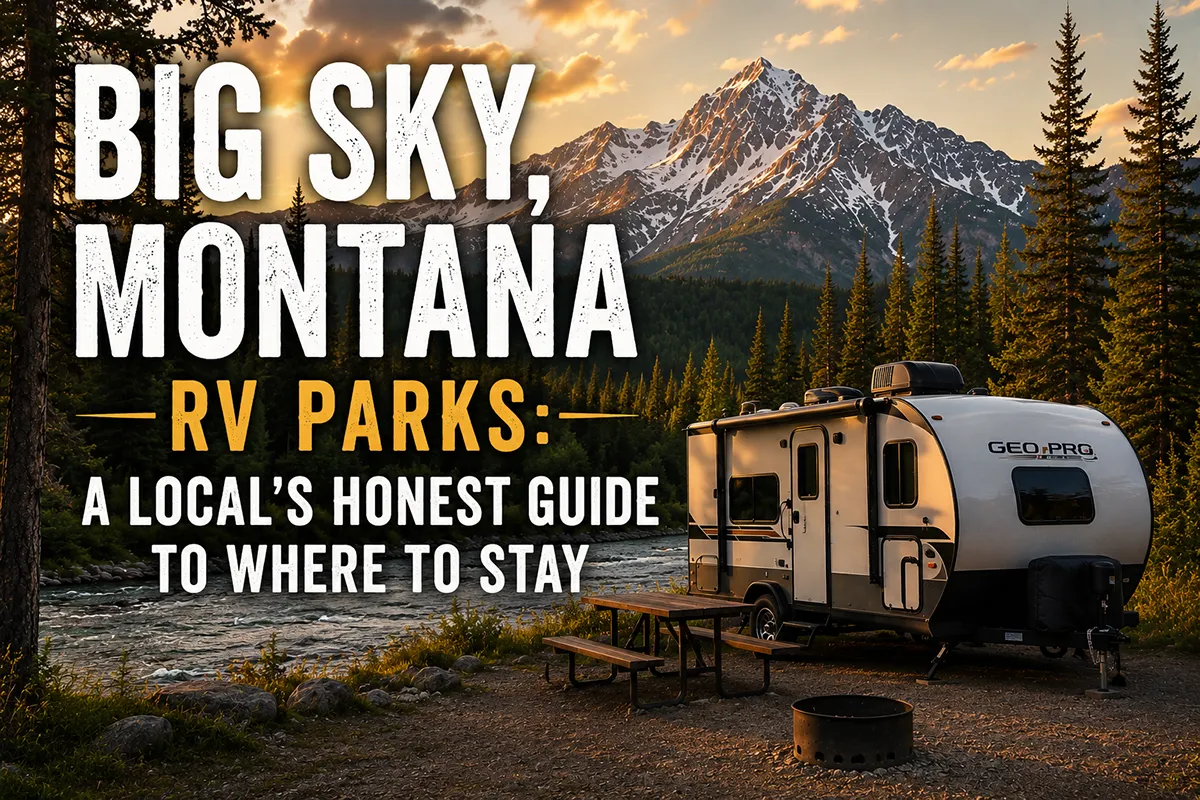
The first time someone asked me to recommend “the best RV park in Big Sky,” I had to gently break the news: Big Sky, Montana doesn’t really have RV parks the way most travelers picture them.
What it has is something better — a string of forest service campgrounds along the Gallatin River that locals quietly book a year in advance, plus a few private options just outside town.
If you know the corridor, you can have a more beautiful Big Sky base camp than any paved RV resort can offer.
TL;DR:
Big Sky itself is a high-altitude ski town with limited dedicated RV park infrastructure. The real RV experience is along the Gallatin Canyon corridor on US-191 — places like Red Cliff, Greek Creek, Swan Creek, and Moose Creek Flat campgrounds, all within 10–15 minutes of town. Closest full-hookup options are about 30 miles north (Bozeman) or 50 miles south (West Yellowstone). One name to know: “Big Sky Camp & RV Park” is actually in Miles City, on the other side of the state — a common booking mistake.
This is the regional deep-dive for Big Sky and the Gallatin Canyon. It’s part of my broader directory of the best RV parks in Montana, which covers every major region of the state. If you’re routing a Glacier-to-Yellowstone road trip, the Gallatin Canyon is one of the most scenic stretches you’ll drive — but it takes a little planning to do right.
Liked this article?
Add Roaming Montana as a preferred source so you see more of our articles and guides on Google.
Why “Big Sky RV Park” Searches Are Confusing
Before I get into the actual recommendations, I want to clear something up because it trips travelers up constantly. When you search “big sky camp and rv park” or “big sky rv park montana,” the results mix two completely different places:
- Big Sky, Montana — the ski resort town in Madison and Gallatin counties, in the southwest part of the state, about 50 miles south of Bozeman.
- Big Sky Camp & RV Park — an actual RV park, but it’s located in Miles City, on the eastern edge of Montana, near the North Dakota border. It’s a perfectly fine I-94 transit park, but it’s about 500 miles from the Big Sky ski town.
If you’re heading to the mountains, ski resort, or Yellowstone-area Big Sky, you don’t want to book the Miles City park. I’ve had readers email me after they realized the mistake too late. Always confirm the address before you click “reserve.”
For the rest of this post, I’m talking about the real Big Sky — the mountain town. And there, your options are different from what you’d find in Bozeman or West Yellowstone.
The Real Big Sky RV Camping Picture
Big Sky sits at roughly 7,500 feet of elevation, tucked into the Madison Range. The town itself is spread across a mix of resort base areas (Big Sky Resort, Moonlight Basin, Spanish Peaks) and the Meadow Village commercial district along Lone Mountain Trail. Most of the lodging here is hotel rooms, condos, and short-term rentals — not RV parks.
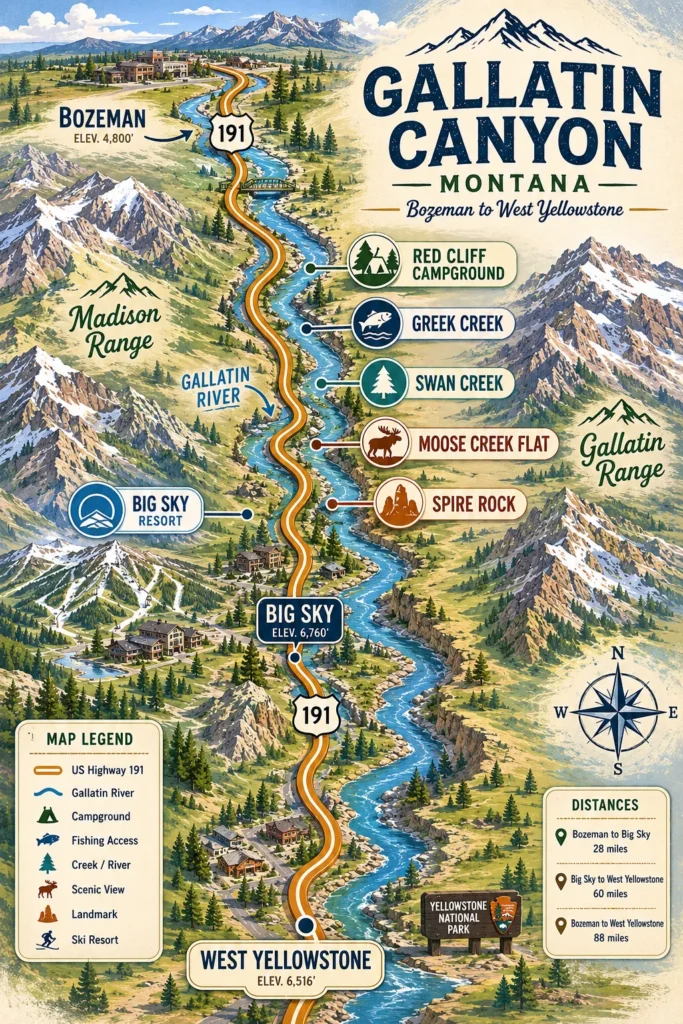
What surrounds Big Sky, though, is the Gallatin Canyon: a 35-mile stretch of US-191 between Bozeman and West Yellowstone that runs alongside the Gallatin River. This is where the RV camping actually lives. The Custer Gallatin National Forest operates a string of small, well-maintained campgrounds along the river, all within a 5–15 minute drive of Big Sky town. They book through Recreation.gov.
A few of these campgrounds have electric hookups; most don’t. None offer full hookups. The closest full-hookup commercial parks are in Bozeman to the north or West Yellowstone to the south.
The Best Campgrounds in Gallatin Canyon (Near Big Sky)
These are the forest service campgrounds I’d actually book — listed roughly in the order you’d encounter them driving south from Bozeman toward Big Sky.
Greek Creek Campground
Greek Creek sits at 5,600 feet elevation, about 30 miles south of Bozeman and roughly 10 miles north of Big Sky. It has 14 single-family campsites along the Gallatin River, each with a picnic table and fire ring.
Vault toilets, drinking water, and trash collection are provided. The roads inside are paved; parking spurs are gravel. Sites run around [verify current rate — recently $26/night].
What I like: Cottonwoods give some of the sites genuine afternoon shade, which matters in July when the river canyon hits the high 80s. The Gallatin frontage means you can be fishing within 30 seconds of waking up.
Heads-up: Bears use this canyon. Greek Creek requires all food and scented items to be stored in approved containers when sites are unattended — and rangers do enforce it.
Open season: Roughly May 16 through September 30 with full services; limited service October 1 through December 1.
Swan Creek Campground
Slightly further south at 5,800 feet, 31 miles from Bozeman, Swan Creek is the more intimate option. Just 13 sites split across two loops, set in dense spruce and fir forest along Swan Creek (a Gallatin tributary). The upper loop has better spacing and privacy than the lower loop.
What I like: Of all the canyon campgrounds, this one feels most like genuine wilderness camping. The trees absorb sound. The Swan Creek Trail starts right inside the campground and climbs into the Spanish Peaks Wilderness — one of the best dayhike trailheads in the area.
Heads-up: Hand-pump drinking water only (no spigots), no electric, and the first two vehicles per site are included but extra vehicles run [verify — recently $9/night each]. Open through late September. Firewood available at Greek Creek for [verify — recently $8/bundle].
Moose Creek Flat Campground
About 32 miles south of Bozeman at 5,700 feet, Moose Creek Flat is the most accessible canyon option. Single-family sites plus one large group site (up to 90 people, around $115/night) work for family reunions and scout troops.
The campground sits in an open meadow alongside the Gallatin River, with an accessible fishing dock at the river’s edge — one of the few in the area genuinely suited for travelers with mobility needs.
What I like: The open meadow setting means killer star views at night and easier maneuvering for larger RVs than the tree-tight loops elsewhere.
Heads-up: No electric, no drinking water at the group site (bring your own), and the meadow means less shade — pick early morning or late afternoon arrival to set up if it’s hot.
Red Cliff Campground
Red Cliff is the largest in the canyon — about 63 campsites — and the only one offering electric hookups at some sites. It’s roughly 10 miles south of Big Sky, right on the Gallatin River. This is where I send people who want a forest service experience but need a little more rig support than the others provide.
What I like: Electric at select sites is huge if you’re running a CPAP, refrigerator, or want to skip generator hours. River views from the right loop sites are some of the best in the canyon.
Heads-up: Because it has more amenities and more sites, it books faster than the others. Late May to late September. Reserve online via Recreation.gov.
Spire Rock Campground
Spire Rock is the smaller, less-developed option — 19 sites, no drinking water, vault toilets only. It sits a bit further from the river up Squaw Creek Road. If you’re self-sufficient and want quiet, this is the pick. If you need basic services, skip it.
Private RV Park Options Near Big Sky
If you need full hookups (water, sewer, 30/50-amp electric) or a longer stay, the forest service options won’t work and you’ll need to look just outside the immediate Big Sky area.
Bozeman direction (north): About 30 miles north of Big Sky in Four Corners, you’ll find a cluster of full-hookup parks plus Bozeman Hot Springs Campground & RV Park, which combines hookups with on-site hot springs — a genuinely nice combination after a long day of canyon hiking. I cover these in detail in my guide to RV parks in Bozeman.
West Yellowstone direction (south): Roughly 50 miles south of Big Sky on US-191, West Yellowstone has the largest concentration of full-hookup RV parks in the region, including Grizzly RV Park and Yellowstone Park / West Gate KOA Holiday. These are park-gateway parks; book months ahead in summer.
Hipcamp-style private listings: A handful of private property hosts near Big Sky list 30-amp sites through Hipcamp and similar platforms. Quality varies. Most are 1 or 2 sites with limited amenities — fine for a solo traveler in a small rig, less useful for a family in a 35-foot fifth-wheel.
What to Do When You’re Parked Near Big Sky
Most people come to Big Sky for one of four reasons: skiing in winter, fly fishing in summer, hiking the Spanish Peaks Wilderness, or routing between Bozeman and Yellowstone. The Gallatin Canyon basecamp works for all four.
Fly Fishing the Gallatin
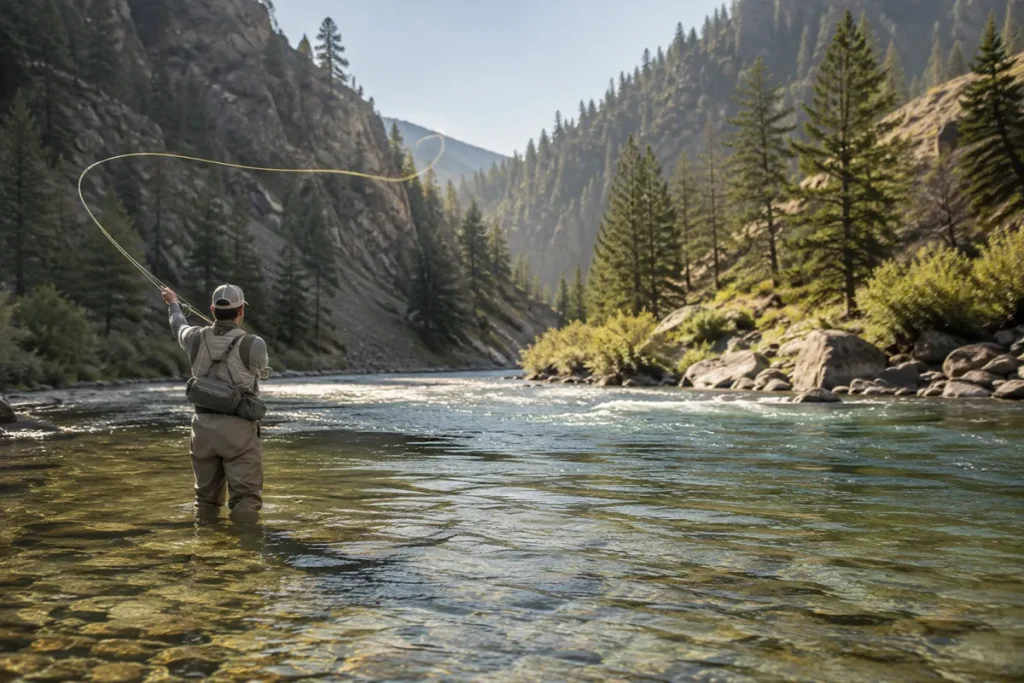
The Gallatin is the river that the movie A River Runs Through It was filmed on. It runs cold and fast, holds rainbow, brown, brook, and cutthroat trout, plus whitefish and the occasional Arctic grayling. The stretch through the canyon is technical pocket water — challenging, but rewarding.
If you’re new to fly fishing, the local outfitters in Big Sky and West Yellowstone offer guided half-days that are genuinely worth the money.
The Madison River, a short drive west, is also legendary — and the Madison Valley around Ennis is where some of Montana’s friendliest fly-fishing-focused RV parks live. I cover those in my Ennis and Madison Valley RV parks guide.
Hiking and Wildlife
The Beehive Basin trail is the famous one — a roughly 6-mile out-and-back to an alpine lake with Lone Peak views that are the cover-photo kind. The Lava Lake trail is another go-to.
Both are bear country. Carry bear spray, know how to use it, make noise, and travel in groups. Bald eagles, bighorn sheep, moose, elk, mountain goats, deer, coyotes, and both black and grizzly bears all live in the Gallatin Canyon.
I’ve seen all of them except the grizzly from my campsite over the years — though I’ve certainly seen tracks.
Big Sky Resort and Lone Peak
Big Sky Resort itself is one of the largest ski resorts in North America — 5,850 acres of terrain, 4,350 feet of vertical, top elevation 11,166 feet on Lone Peak.
In summer, the resort runs a tram and chairlifts for sightseeing and lift-served mountain biking. Worth a half-day even if you’re not a skier.
Yellowstone Day Trips
West Yellowstone’s gate is about 50 miles south down US-191 — a beautiful drive that follows the river the entire way. Easy day trip from a Gallatin Canyon basecamp.
Gardiner and the north entrance are further but doable; see my full Yellowstone gateway RV parks in Gardiner guide if you’d rather basecamp at the north entrance instead.
If you’re early in your planning, my overview of things to do across Montana will help you figure out how Big Sky fits into the broader picture.
What I Wish I’d Known Before My First Big Sky RV Trip
Five things that would have saved me real grief on my first canyon trip, ranked roughly by how much grief they would have saved:
1. The dump station gap is real. There are no public RV dump stations in Big Sky town or anywhere in the immediate canyon. The closest options are in Bozeman (about 50 miles north) and West Yellowstone (about 50 miles south). If you’re doing a multi-day canyon stay, plan your black/gray tank capacity carefully — or budget a half-day detour each direction.
2. Cell service drops out fast in the canyon. Verizon holds best, but even Verizon goes patchy between about Greek Creek and the Big Sky turnoff. T-Mobile is hit-or-miss. AT&T is mostly miss. Download maps offline, tell someone your trailhead plans, and don’t rely on phone GPS.
3. Elevation is real. Big Sky town is at 7,500 feet. The canyon campgrounds are 5,600–5,800 feet. If you’re coming from sea level, give yourself 24–48 hours to acclimate before any hard hiking. Hydrate aggressively. Even your camp stove will boil water differently up here.
4. Weather changes in 20 minutes. I’ve been at Swan Creek in July when an afternoon thunderstorm dropped the temperature from 85°F to 52°F in half an hour, with hail. Always have a layer accessible. Don’t leave awnings out when you go hiking.
5. The forest service campgrounds book 6 months out for July weekends. Recreation.gov releases sites on a rolling 6-month window. For peak summer dates (4th of July through Labor Day), if you’re not setting a calendar reminder for the 6-month-out date at 10 a.m. Eastern, you’re going to be looking at first-come first-served and the leftovers. Tuesday-Thursday stays are dramatically easier than weekends.
6. The Beartooth Pass is closer than you think. From Big Sky, you can route a multi-day loop that includes Yellowstone’s north entrance and Beartooth Pass — one of the most spectacular drives in the country. Park your RV in Bozeman or Gardiner and take a tow vehicle for the pass; the Beartooth is not recommended for motorhomes due to grades and switchbacks.
7. Hot springs are an easy bonus. Both Bozeman Hot Springs and Norris Hot Springs are within 60–90 minutes of Big Sky. After a hard day of canyon hiking, the soak is worth the drive. I’ve written a full guide to Montana hot springs RV resorts if you want to make a hot springs stay part of the trip.
Practical Info Box: Big Sky RV Camping at a Glance
| Detail | What to Know |
|---|---|
| Best season for canyon camping | Mid-June through mid-September |
| Canyon campground open dates | Typically May 16 – September 30 (full service) |
| Average forest service site rate | ~$26/night (no hookups), slightly more for electric at Red Cliff |
| Closest dump stations | Bozeman (50 mi north) or West Yellowstone (50 mi south) |
| Closest full-hookup parks | Four Corners / Bozeman area (north); West Yellowstone (south) |
| Reservation system | Recreation.gov, 6-month rolling window at 10 a.m. Eastern |
| Elevation (town) | ~7,500 ft |
| Elevation (canyon campgrounds) | 5,600–5,800 ft |
| Cell service | Patchy throughout canyon; Verizon strongest |
| Bear safety | Mandatory food storage; carry bear spray on all trails |
| Nearest airport | Bozeman Yellowstone International (BZN), ~50 mi north |
| Don’t confuse with | “Big Sky Camp & RV Park” in Miles City, ~500 mi east |
The Bottom Line on Big Sky RV Camping
If you came to this post hoping I’d send you to a flat, paved, full-hookup resort five minutes from the chairlifts at Big Sky Resort — that park doesn’t really exist.
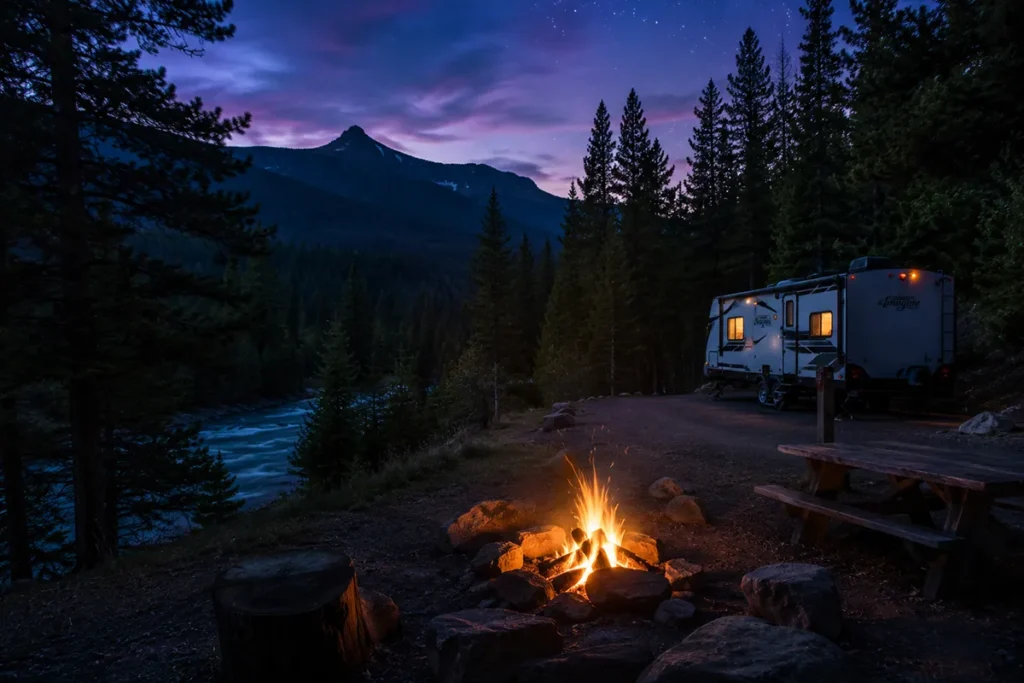
The reality of Big Sky RV camping is mountain camping: forest service sites along one of the most beautiful river canyons in the lower 48, with a 50-mile drive each direction to a full-hookup park.
For most travelers, that tradeoff is the point. Waking up to the sound of the Gallatin running past your rig, with Lone Peak catching first light through the trees, is the Big Sky experience you actually came for.
If you need full hookups or a paved-resort feel, book in Four Corners or West Yellowstone and day-trip in. If you want the real canyon experience and you’ve got a self-contained rig (or a small enough trailer for a forest service spur), book Greek Creek, Swan Creek, Moose Creek Flat, or Red Cliff six months ahead and call it a trip.
Pin this post for your trip planning, and check out the full best RV parks in Montana directory for the rest of the state. Drop your Big Sky questions in the comments — I update this guide every spring after the canyon campgrounds reopen.
— Sarah Bennett