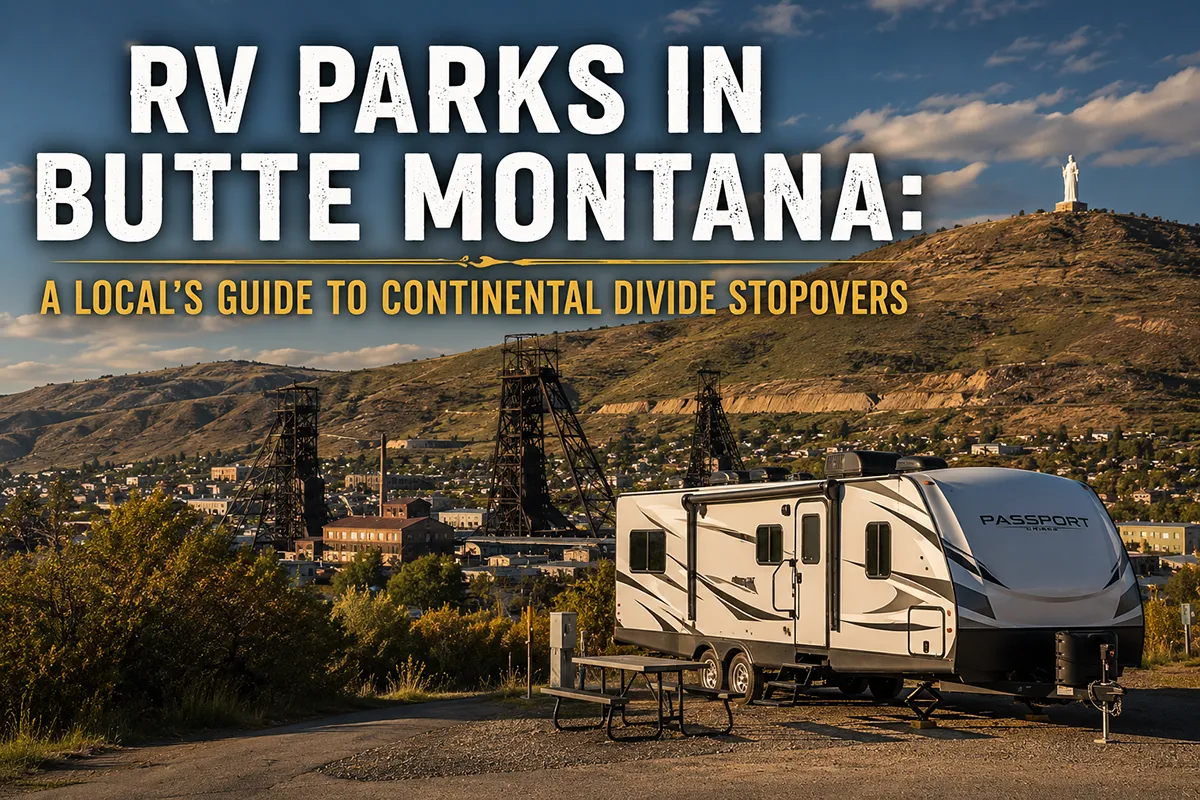
Most RV travelers blow right through Butte on their way to Glacier or Yellowstone, which is a mistake. This is the only town in Montana built directly on the Continental Divide — every drop of rain that hits your awning here decides whether it ends up in the Pacific or the Gulf of Mexico. It’s also at the junction of I-15 and I-90, which makes it one of the most strategic overnight stops you can pick for any Montana road trip.
TL;DR:
Butte is a low-competition, high-value RV stopover in southwest Montana, sitting at the I-90/I-15 junction at the top of the Continental Divide. The Butte KOA Journey is the headline park with 75+ sites and full hookups, 2 Bar Lazy H sits on the west edge of town (open year-round), and a short drive west puts you at Fairmont Hot Springs with mineral pools. The mining-history old town is the genuine draw — most people don’t realize Butte was once allegedly the largest city between Minneapolis and Seattle.
This is the southwest Montana deep-dive for RVers. For the bigger picture, see my full directory of the best RV parks in Montana, which covers every region of the state.
Liked this article?
Add Roaming Montana as a preferred source so you see more of our articles and guides on Google.
Why Butte Punches Above Its Weight as an RV Stop
Geography first. Butte sits at 5,538 feet on the spine of the Continental Divide. Interstate 15 runs north-south through here (Helena 65 miles north, Idaho Falls 220 miles south).
Interstate 90 runs east-west (Bozeman 85 miles east, Missoula 120 miles west). For RVers building a Glacier-to-Yellowstone loop, Butte sits at almost the exact midpoint of nearly every routing I’ve ever planned.
The town’s other geographic advantage is climate. Butte’s summer overnight lows often dip into the 40s and 50s even when Bozeman and Missoula are still in the 70s — a real comfort win for anyone who’s tired of running the rooftop AC at midnight.
The flip side: spring and fall come hard and early here. I’ve had snow flurries on the 4th of July at the higher trailheads, and the first real snow can hit by mid-October.
Then there’s the history. Butte was the Copper King city — at its peak around 1917, allegedly the largest city between Minneapolis and Seattle, swelled with immigrants from Ireland, Cornwall, Italy, Finland, and a dozen other countries who came for the mines.
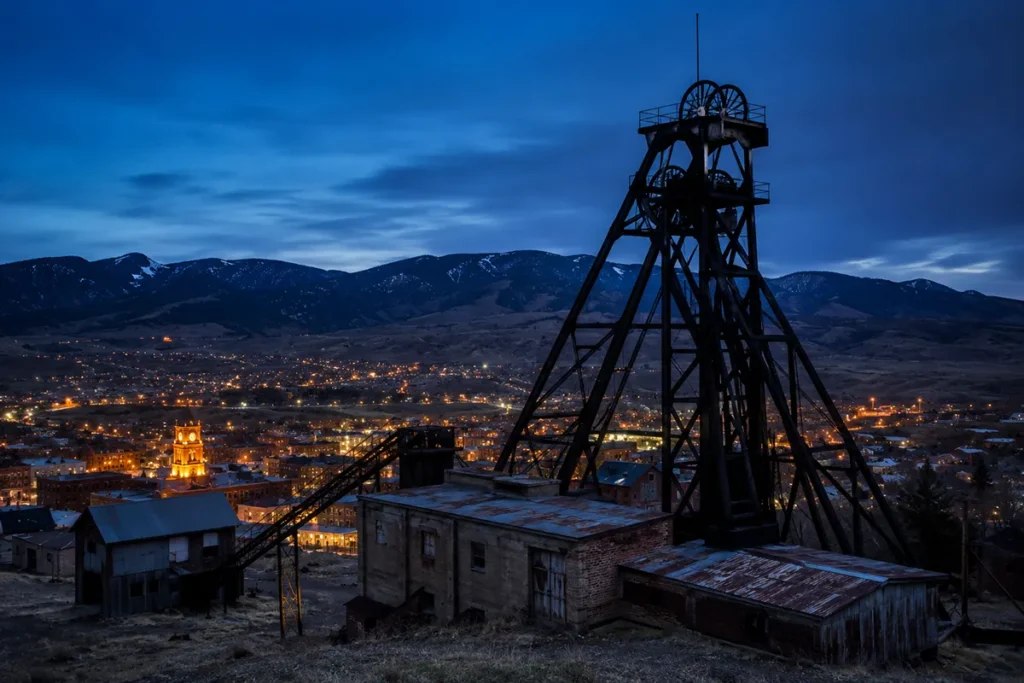
The old Uptown is one of the largest National Historic Landmark Districts in the country, and the headframes (the black steel “gallows” that mark old mine shafts) still punctuate the skyline.
Even if you’re not a history person, an afternoon walking Uptown Butte is one of the most unusual experiences in Montana.
The Best RV Parks in Butte
Butte KOA Journey
This is the headline park, and for most travelers it’ll be the right pick. The KOA sits just off the I-90/I-15 junction at Exit 126 on Montana Street — about as central as you can get.
The campground has 75+ RV sites with pull-throughs up to 95 feet, full hookups with 50-amp service, 25+ tent sites with water/electric options, and six cabins.
Standard KOA amenities: heated pool (open June through September), dog park, bike rentals, snack bar, gem-mining for kids, propane and firewood on-site.
What sets it apart: The location is the real value. You’re next door to the Butte Silver Bow Chamber of Commerce, which is where the “Old Number One” trolley tour boards — the best way to get a guided introduction to Uptown Butte without driving your rig through narrow historic streets. There’s also a paved riverwalk path for dog walks right next to the park.
Heads-up: As a KOA Journey on a major junction, it fills up in July and August. Reserve early. Highway noise from I-90 is real on some sites — request a back loop if you’re a light sleeper.
2 Bar Lazy H RV Campground
Located on the west edge of Butte just off I-90, 2 Bar Lazy H is the year-round option. While most of southwest Montana’s private parks close down water service by mid-October, 2 Bar Lazy H stays open through winter on 23 acres of treed property. Full hookups with 50-amp service. Diesel is available at the highway entrance.
What I like: The 23-acre footprint means more space between sites than you’ll get at the KOA, and it’s a real winter base for hunters, snowbirds heading south, or anyone catching a late-season shoulder trip. The discount for traveling with kids is a nice family touch.
Heads-up: Less polished than the KOA on amenities — no pool, smaller store. If you need pool / dog park / activities, the KOA is the better pick.
Fairmont RV Park
About 20 minutes west of Butte off I-90 (Exit 211), Fairmont RV Park sits adjacent to the Fairmont Hot Springs Resort — meaning you can park your rig and walk to massive Olympic-sized mineral pools.
Full hookups, laundry, BBQs, small store. Their dump station is open to non-guests, which is a useful thing to know if you’re transiting and need to dump in southwest Montana.
What I like: This is the destination pick rather than the stopover pick. The mineral pools are large, family-friendly, and operate year-round. I cover Fairmont in detail in my guide to Montana hot springs RV resorts — if soaking is part of your trip, the dedicated guide has the full breakdown.
Heads-up: Rates are higher than the in-town Butte options. The resort itself can get busy with non-camping day visitors on summer weekends.
Mountain View RV & Trailer Park
A smaller in-town Butte option at 5103 S Warren Ave. Long-term and monthly rates are the play here — this is where some seasonal Butte workers and retirees overwinter. Less suitable as a single-night transit park; better if you’re staying a week or longer.
Pipestone RV Park (Whitehall)
About 25 miles east of Butte off I-90 in Whitehall, Pipestone RV Park is the option for travelers who’d rather be on the quieter east side of Homestake Pass. Worth knowing about if Butte itself is full or if you want a more rural feel.
Beyond Butte: The Southwest Montana Stopover Network
Butte is the hub, but several smaller towns in southwest Montana have RV parks worth knowing about, especially if you’re building a multi-day route through the region.
Dillon: Southside RV Park
About 60 miles south of Butte down I-15, Dillon is one of those Montana towns that’s been hiding in plain sight — Forbes Magazine actually named it one of America’s prettiest towns back in 2010.
Southside RV Park sits just 9 blocks from downtown Dillon at Exit 62, with 40 full-hookup sites averaging 35′ x 70′, free cable, free WiFi, and Blacktail Creek running right through the property.
It’s a Good Sam–rated park with a 9.5 environmental rating. No tents allowed — it’s an RV-only setup. From here you can walk into Dillon for dinner, hit the legendary Sparky’s Garage two blocks away, or use it as a basecamp for Bannack State Park (about 25 miles west), Montana’s first territorial capital and one of the best-preserved ghost towns in the country.
I cover Southside RV Park in detail in my hidden-gem Montana RV parks guide along with the rest of the small-town gems.
Deer Lodge KOA
About 35 miles west of Butte on I-90, Deer Lodge is the right call if you’re routing through to Missoula and want to stop somewhere with more breathing room than the Butte KOA.
The town itself is home to the Grant-Kohrs Ranch National Historic Site — a working frontier cattle ranch the National Park Service operates as a living-history museum. Worth at least a half-day stop.
Cardwell Store and RV Park
About 40 miles east of Butte, Cardwell sits along the Jefferson River and is closest to Lewis & Clark Caverns State Park. Limestone cave tours here are some of the most decorated in North America. The park is small, but as a one-night base for cavern exploring it works.
What to Do When You’re Parked in Butte
I’ve spent more time in Butte than most travelers ever will — partly because of how often it’s been a logical overnight on whatever Montana loop I was running, and partly because the town genuinely rewards lingering. Here’s what’s actually worth your time.
Uptown Butte and the Mining Heritage
The single highest-return activity is the trolley tour. “Old Number One” departs from the Chamber of Commerce next to the KOA and runs you through the National Historic Landmark District — Copper King mansions, the gallows headframes, churches built by immigrant communities, and the World Museum of Mining.
The narration is honest about both the wealth and the human costs of the mining boom, including the 1917 Granite Mountain–Speculator Mine disaster that killed 168 miners — the deadliest hard-rock mining disaster in U.S. history.
The World Museum of Mining itself is on the site of the old Orphan Girl Mine. You can take an underground tour into actual mine workings, which is one of the more visceral history experiences I know of.
The Berkeley Pit
Butte’s most photographed feature is also one of the most sobering. The Berkeley Pit is a former open-pit copper mine, 1,800 feet deep and a mile long, now filled with toxic heavy-metal water.
It’s one of the largest Superfund sites in America. There’s a viewing platform with educational displays. It’s not pretty, but it’s real Montana — and it puts the rest of the state’s untouched landscape in perspective.
Our Lady of the Rockies
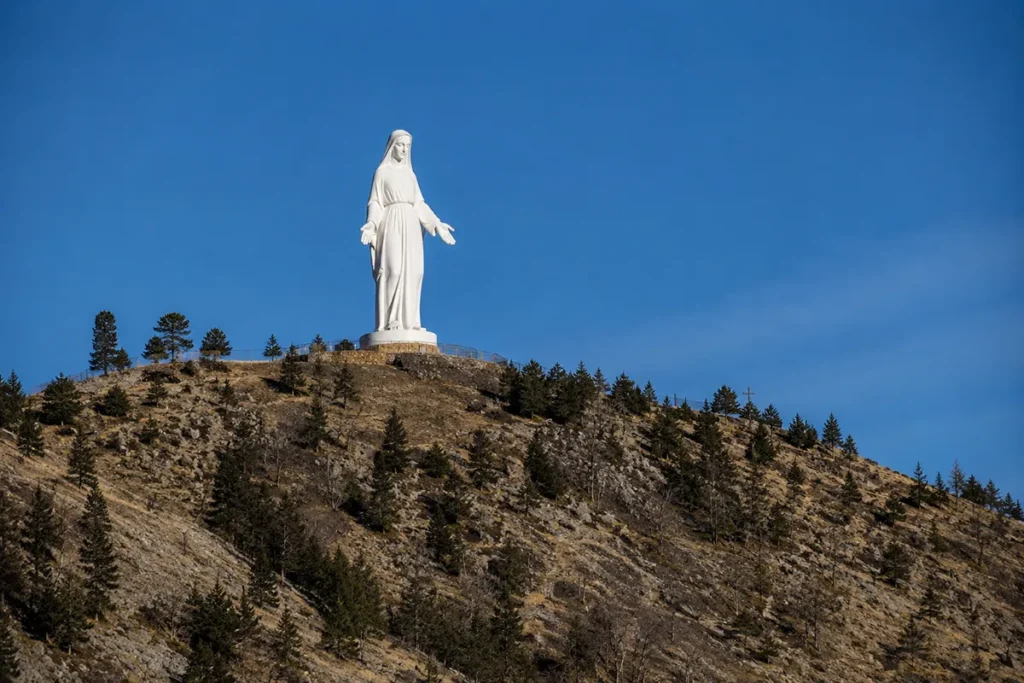
The 90-foot statue of Mary on the Continental Divide above Butte is the fourth-tallest statue in the United States. You can take a guided bus tour up to the statue itself (the road isn’t suitable for RVs and isn’t open to private vehicles). The view from up there covers the entire Summit Valley and the surrounding mountain ranges.
Pintler Wilderness and Georgetown Lake
For outdoors travelers, the Anaconda-Pintler Wilderness sits about 30 minutes west of Butte, and the trails here are remarkably uncrowded — I’ve done full-day hikes in July and seen fewer than five other people.
Georgetown Lake, just west of Anaconda at over 6,000 feet, is excellent for kayaking, fishing for rainbow trout and kokanee salmon, and afternoon picnicking. From Butte KOA it’s about 35 miles.
Continental Divide National Scenic Trail
Butte is one of the few major towns the CDT actually passes through. Thirteen trailheads in the immediate area connect to the trail. Even if you’re not a thru-hiker, day hiking on a CDT section gives you genuine Continental Divide bragging rights without committing to weeks of backcountry travel.
Lewis & Clark Caverns State Park
About 45 miles east of Butte (between Butte and Bozeman on I-90), Lewis & Clark Caverns is one of the most decorated limestone caverns in North America. Guided tours run May through September. It’s a half-day stop and pairs well with a Butte basecamp.
Big Hole National Battlefield
About 70 miles southwest of Butte, the Big Hole National Battlefield commemorates the August 1877 battle between U.S. Army troops and the Nez Perce people during their long flight toward Canada.
The visitor center and walking trails around the battlefield make for one of the most thoughtful and important historical stops in Montana. Allow a half-day.
If you’re building out a broader Montana itinerary, my guide to things to do across Montana has the regional context.
What I Wish I’d Known Before My First Butte RV Trip
A few hard-won lessons from years of routing through this town:
1. Plan your fuel stop carefully. Butte sits at 5,538 feet at the top of long climbs from both directions. If you’re towing east on I-90 or pulling north up I-15, you’ll burn noticeably more fuel getting here than the mileage suggests. Top off in Bozeman, Missoula, Helena, or Dillon before the climb depending on direction.
2. The hot springs detour is worth half a day. Fairmont Hot Springs is only 20 minutes west, and after a long driving day there’s nothing like soaking. If you want a longer hot springs experience, look at the full Montana hot springs RV resorts guide for options across the state.
3. Uptown Butte streets are not RV-friendly. Park your rig at the KOA or 2 Bar Lazy H and take the trolley, your tow vehicle, or a rideshare. The Uptown grid is steep, narrow, and dotted with historic streetlights that motorhome mirrors do not love.
4. Cell service is strong in Butte itself. All three major carriers (Verizon, AT&T, T-Mobile) cover Butte reasonably well. The signal drops fast once you head into the Pintler Wilderness or up to Georgetown Lake, so download maps before heading west.
5. Weather changes fast at 5,500 feet. I’ve seen Butte get a clear sunny morning, an afternoon thunderstorm with hail, and a clearing evening with rainbow visibility — all on the same July day. Don’t leave awnings out when you head into town.
6. Evel Knievel was from Butte, and the locals are proud of it. There’s an annual Evel Knievel Days festival in July (typically last weekend) that draws a serious crowd. If you’re hoping for a quiet Butte stopover, check the festival dates first — and if you want to attend the festival, book your RV park at least three months out.
7. Adjacent regions worth pairing with a Butte stay. If you’re coming from the east, see my Bozeman RV parks and RV camping near Big Sky guides for the lead-in stops. From the north, my RV parks in Helena guide covers the capital region just up I-15. From the west on I-90, RV parks in Missoula covers the next major hub before Butte.
Practical Info Box: Butte RV Camping at a Glance
| Detail | What to Know |
|---|---|
| Best season | Mid-May through early October |
| Elevation | 5,538 ft (Continental Divide) |
| Highway access | I-90 / I-15 junction, Exit 126 |
| Year-round options | 2 Bar Lazy H (open year-round); KOA seasonal |
| Closest hot springs | Fairmont Hot Springs Resort (~20 mi west, Exit 211) |
| Closest national historic site | Grant-Kohrs Ranch (Deer Lodge, 35 mi west) |
| Closest cavern | Lewis & Clark Caverns State Park (45 mi east) |
| Distance to Glacier (West Entrance) | ~300 mi (5–6 hrs driving) |
| Distance to Yellowstone (West Entrance) | ~175 mi (3 hrs driving) |
| Cell service | Strong in town; spotty in Pintler/Georgetown Lake areas |
| Nearest commercial airport | Bozeman Yellowstone International (BZN), ~85 mi east |
| Local festival to know about | Evel Knievel Days, late July |
The Bottom Line on Butte RV Camping
Butte rewards travelers who slow down. The Glacier and Yellowstone-chasers who blow through here on I-90 are missing one of the most distinctive towns in the American West — a place where industrial heritage, immigrant culture, and rugged mountain landscape sit on top of each other in a way you genuinely don’t see anywhere else.
The RV park options are solid (the KOA for amenities, 2 Bar Lazy H for year-round, Fairmont for soaking), and the strategic I-90/I-15 location makes Butte one of the easiest cities in Montana to fold into any Western road trip.
If your route runs through southwest Montana at all, give it at least two nights. One day for the trolley tour and Uptown, one day for either Lewis & Clark Caverns to the east or Pintler/Georgetown Lake to the west. You’ll leave with a better sense of where Montana actually came from than most tourists ever get.
Pin this post for your trip planning, check the full best RV parks in Montana directory for the rest of the state, and drop your Butte questions in the comments — I’m through here at least twice a year and the regional guide gets updated each spring.
— Robert Hayes