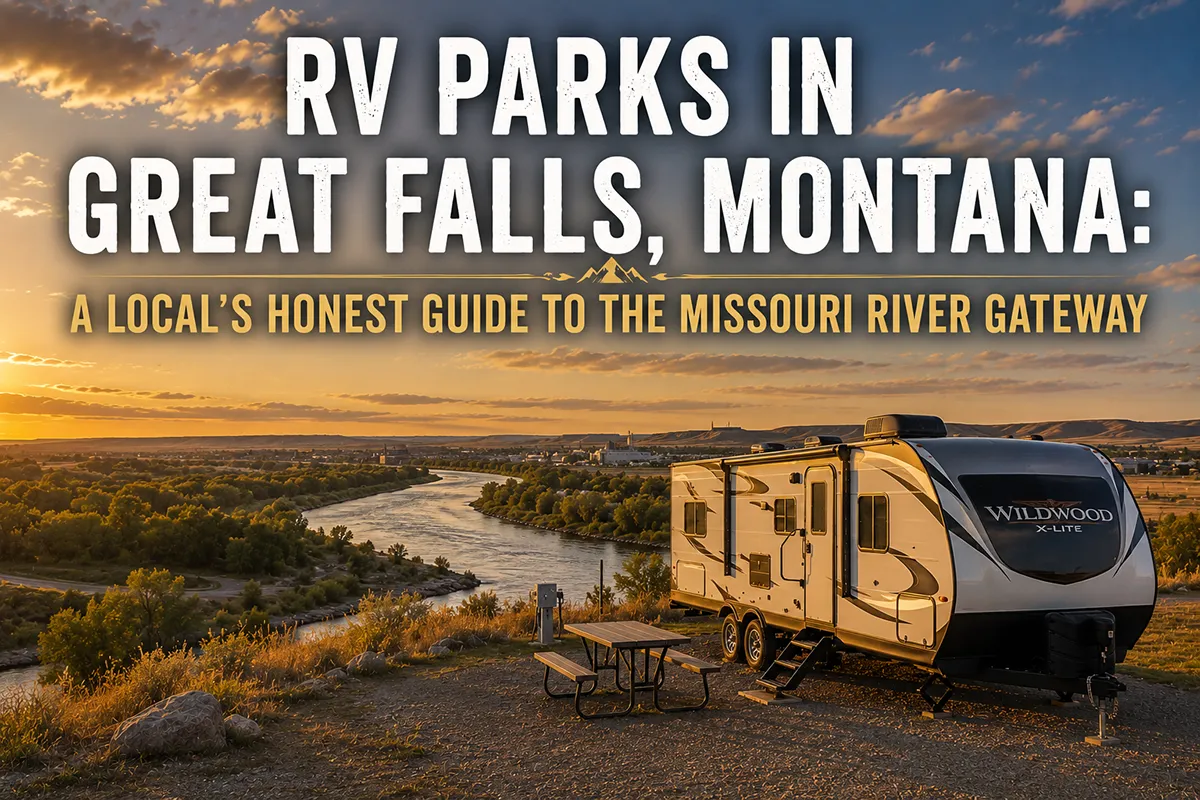
Great Falls is the Montana city most RVers don’t realize they want to stop in. I’ve been guilty of it myself — blowing through on I-15 on the way to Glacier, telling myself I’d “do it next time.” Then one summer I actually stayed two nights.
The Lewis and Clark Interpretive Center alone is worth the stop. The Missouri River trail system runs more than 60 miles through the city.
The RV parks here are cleaner, friendlier, and significantly cheaper than anything near Glacier or Yellowstone. If you’re routing north toward the parks, Great Falls is the smartest overnight on the entire approach.
TL;DR: Great Falls is Montana’s third-largest city and one of the most underrated RV stops in the state. Dick’s RV Park is the headline option — clean, well-run, walking distance to the Missouri River trail system. KOA and Missouri Meadows round out the central options. Day trips include the Lewis and Clark National Historic Trail Interpretive Center, the C.M. Russell Museum, Giant Springs State Park (one of the largest freshwater springs in the world), and the Ryan Dam waterfall. Best season: May through October. Significantly more affordable and available than mountain-corridor parks.
This is the central Montana RV deep-dive. It’s part of my broader best RV parks in Montana directory. Great Falls is the natural overnight stop on the I-15 corridor between Helena and Glacier National Park’s east side — and the cleanest, easiest urban resupply between Bozeman and Kalispell.
Liked this article?
Add Roaming Montana as a preferred source so you see more of our articles and guides on Google.
Why Great Falls Punches Above Its Weight
Geography first. Great Falls sits at 3,330 feet on the Missouri River, in the wide-open plains of central Montana. The city earned its name from the series of five waterfalls along the upper Missouri that Lewis and Clark had to portage around in the summer of 1805 — a 10-mile portage that took them 31 grueling days. Today, each of those five falls has a hydroelectric dam on it, which earned Great Falls another nickname: the Electric City.
What that means for you as a traveler: Great Falls is a real working city with serious infrastructure (Malmstrom Air Force Base anchors a steady population, plus regional medical, retail, and government services).
It’s a major Lewis and Clark heritage city. And it has more legitimate cultural depth than its size would suggest — the Charles M. Russell Museum here is one of the most important Western art museums in the country.
Strategic value for RVers: Great Falls is at the literal center of Montana, on the most logical I-15 route from Idaho or southwest Montana up toward Glacier. From here you can reach Glacier’s east entrance (St. Mary) in about 3 hours, or the west entrance (West Glacier) in about 3.5 hours via US-2.
The northern Great Plains start opening up east of town if you’re routing toward North Dakota. As an overnight stop, Great Falls turns what would otherwise be a brutal 8-hour Bozeman-to-Glacier push into two manageable days.
The Best RV Parks in Great Falls
1. Dick’s RV Park — The Headline Option
Location: 1403 11th Street SW, Great Falls — convenient I-15 access on the southwest edge of town.
Dick’s is the locally-owned park most RVers in the region recommend first, and after staying there twice I understand why.
Spacious pull-through sites that fit any rig size, full hookups including 30 and 50-amp service, clean modern laundry facilities, on-site propane, free WiFi that actually works, and a small store. The sites are noticeably better-spaced than at most KOAs — you’re not parked five feet from your neighbor.
What I like: Cleanliness and quiet. Dick’s runs like a tight ship. The owners or long-time staff are usually around, helpful with local recommendations, and willing to point you to specific dining or fishing spots most travelers wouldn’t find. Easy walk to the King Avenue commercial corridor for groceries and dinner.
Heads-up: Books up earlier than people expect for a non-mountain park — 2–4 weeks ahead for summer weekends, especially during Memorial Day, July 4, and Labor Day. No pool, so families with kids looking for amenities should compare with the KOA below.
2. KOA Great Falls Montana
Location: 1500 51st Street South, Great Falls — also easy I-15 access, eastern side of town.
The KOA Holiday-tier option with the standard amenity stack: heated pool (open Memorial Day through Labor Day), playground, dog park, mini golf, propane, firewood, KOA Patio sites with built-in fire pits, and a large camp store. Pull-through sites accommodate any rig size with full hookups.
What I like: If you’re traveling with kids, the KOA wins on activities. The pool alone justifies the modest premium over Dick’s. Their cabin options are a useful “out of the rig for a night” choice for families with multiple kids.
Heads-up: Standard KOA Holiday pricing — runs higher than Dick’s. The pool closes after Labor Day, so shoulder-season travelers don’t get the full amenity value.
3. Missouri Meadows Campground
Location: 3012 Lower River Road, Great Falls — closer to the river itself.
The independent, lower-key alternative. Smaller park, more local feel, walking distance to several Missouri River access points. Full hookups but fewer amenities than the KOA or Dick’s.
What I like: River access. If you’re a fly fisher routing through the area, this puts you walking distance from the river itself rather than having to drive every morning. The walking trail along the Missouri continues for miles in either direction.
Heads-up: Smaller park = limited availability. Confirm by phone.
4. Other Central Montana Options
A few additional area parks worth knowing about:
- Spring Creek Camping in Lincoln (about 75 miles south on Highway 200) — quiet mountain-town basecamp if you’d rather be in the hills than the city
- Chouteau County Fair Campground in Fort Benton (an hour northeast) — historic small-town option right next to the Missouri at the start of the Wild and Scenic River segment
- Choteau RV Park in Choteau (about an hour northwest) — gateway to the Rocky Mountain Front and Egg Mountain (dinosaur dig sites)
Day Trips From Great Falls: What’s Actually Worth Your Time
Great Falls rewards travelers who use it as a basecamp for 1–2 days rather than just a one-night sleep stop. Here’s where to go.
1. Lewis and Clark National Historic Trail Interpretive Center
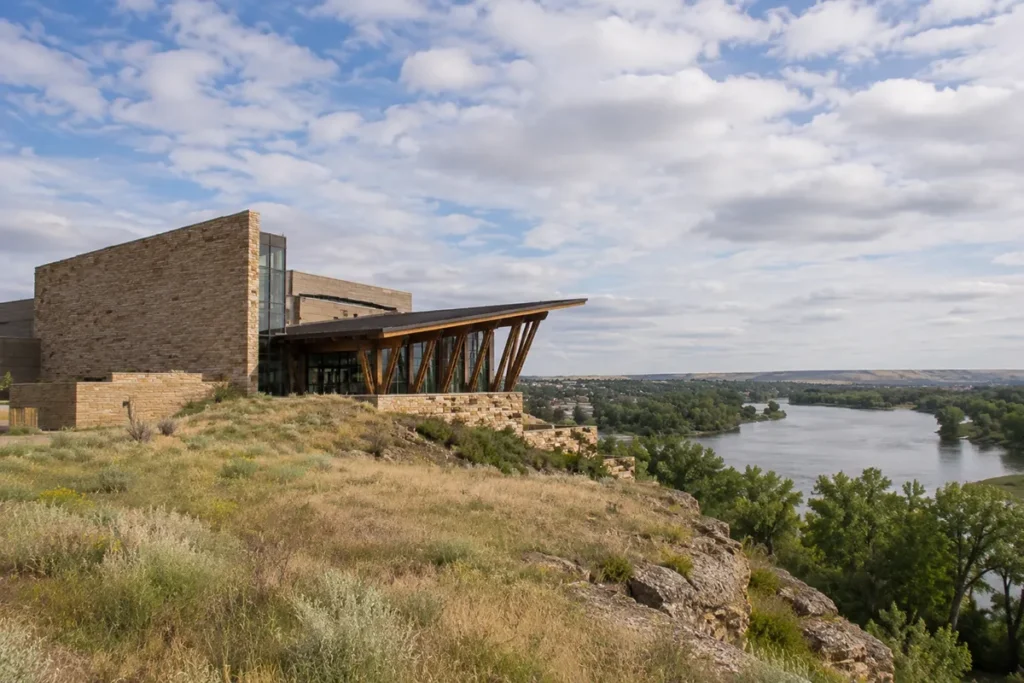
This is the headline cultural attraction. Located along the Missouri at 4201 Giant Springs Road, the center is operated by the U.S. Forest Service and is the definitive interpretive site for the Lewis and Clark Expedition.
The 25,000-square-foot museum walks you through the entire 1804–06 journey with full-scale dioramas, films, and interactive exhibits.
The portage around the Great Falls — the 31-day, 18-mile slog that nearly broke the expedition — is told here with depth you won’t get anywhere else along the trail.
Plan 2–3 hours. The center connects directly to the River’s Edge Trail, so you can walk from your visit straight along the Missouri.
2. Giant Springs State Park
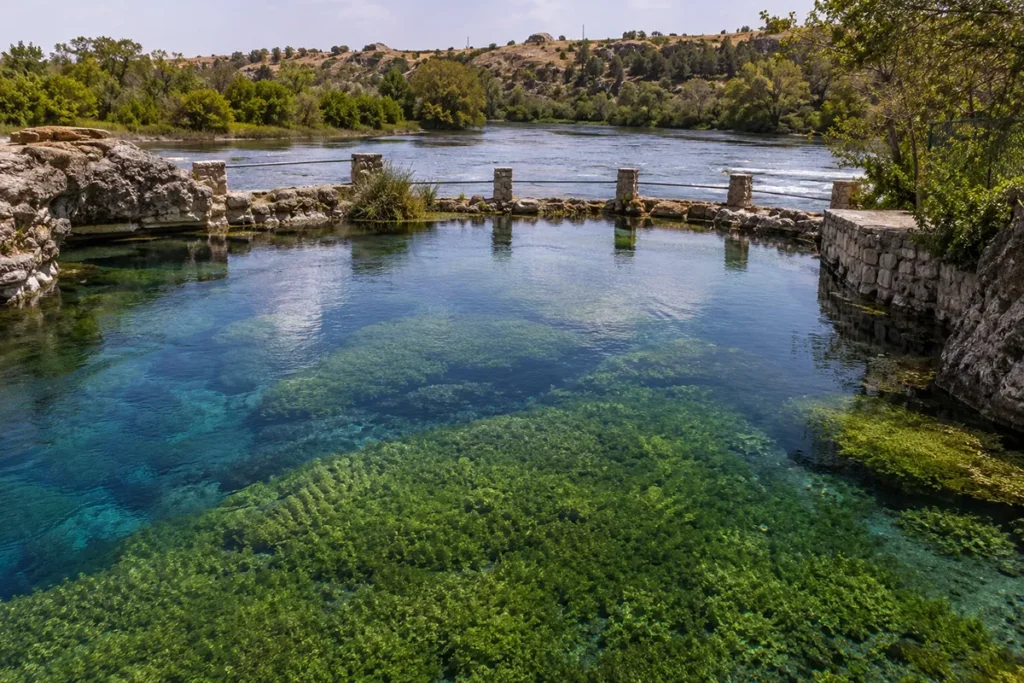
About 2 miles from downtown Great Falls is one of the largest freshwater springs on Earth — Giant Springs flows about 156 million gallons per day at a constant 54°F.
Lewis and Clark documented the springs in 1805 (one of the more impressive things they catalogued). The spring water surfaces in a wide pool, then flows into the Missouri via what the state calls the “Roe River” — sometimes claimed as the world’s shortest river at 201 feet.
The state park includes the spring itself, picnic areas, an interpretive center, a state-run fish hatchery (open to visitors), and direct access to the River’s Edge Trail. Half-day stop. No camping at the state park; you’ll come from your RV park base.
3. The C.M. Russell Museum Complex
400 13th Street North, downtown. Charles M. Russell was Montana’s defining Western artist — about 4,000 works of art across his career, much of it depicting the late-frontier West, Indigenous peoples of the Northern Plains, and cowboy life.
He set up his Great Falls studio in 1892, and the museum complex is built around his original log studio and home.
This is one of the most important regional art collections in America. If you’ve ever seen a classic Western painting of horsemen against an open sky, Russell almost certainly painted it (or influenced the artist who did). Plan 2 hours minimum.
4. The River’s Edge Trail
Great Falls has built more than 60 miles of paved and unpaved trails along both sides of the Missouri, connecting the Lewis and Clark Center, Giant Springs, downtown, multiple parks, and the various dams.
For RVers who want to stretch their legs after a long driving day, there’s nothing better. Bring bikes if you have them; otherwise, walking from your park into Giant Springs (about 4 miles one way from Dick’s) is a satisfying morning.
5. Ryan Dam and the Original Falls
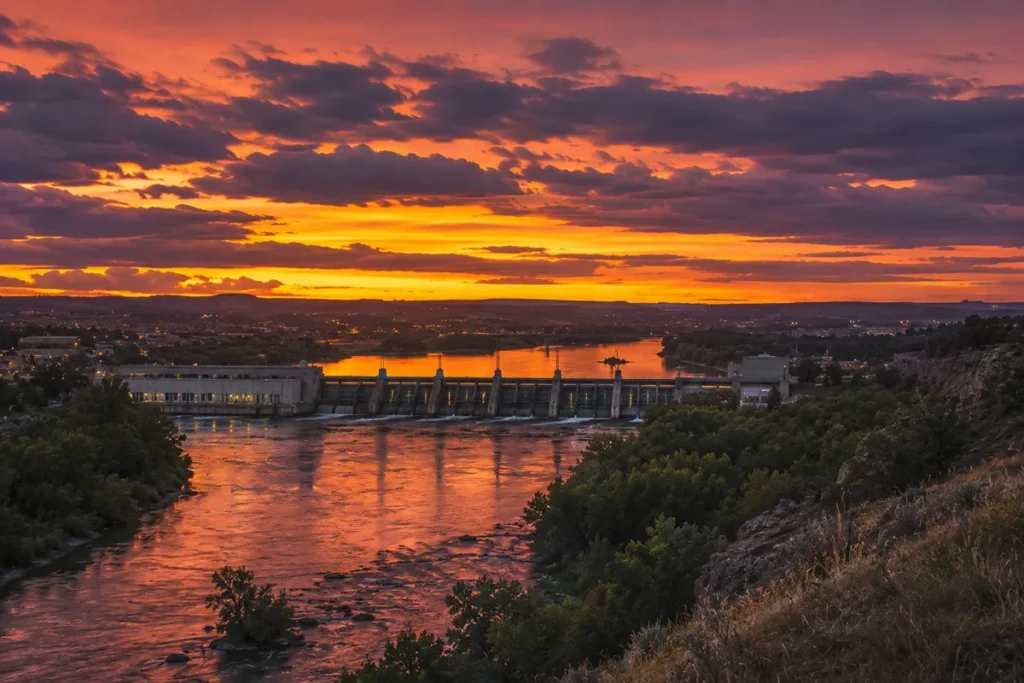
About 10 miles east of downtown. Ryan Dam is built on top of one of the original five “great falls” of the Missouri. The dam has a small park with a footbridge to the spillway side, where you can see the river spilling over what would have been the natural waterfall.
It’s a small, lightly-visited stop — but seeing the water come off the spillway gives you a real sense of why the portage took Lewis and Clark a month.
6. Malmstrom Air Force Base and the Cold War Museum
Malmstrom is one of three Air Force bases still operating Minuteman III intercontinental ballistic missiles. The base itself isn’t open to the public, but the Malmstrom Museum and Air Park has retired aircraft, missile components, and Cold War-era exhibits that are unusual and well-presented. Free admission.
7. The Rocky Mountain Front
About an hour west of Great Falls on US-89 toward Choteau is the Rocky Mountain Front — the dramatic line where the Rocky Mountains rise abruptly from the plains.
Egg Mountain (a major dinosaur dig site where the first dinosaur nests with eggs were discovered in North America), the Pine Butte Swamp Preserve, and the eastern boundary of the Bob Marshall Wilderness are all here.
This is a great day trip if you’ve got an extra day, especially for anyone interested in paleontology or birds.
If you’re using Great Falls as a Glacier basecamp, see my Glacier West Entrance RV parks guide for the gateway options on the other side. For a broader Montana picture, my guide to things to do across Montana covers the whole state.
What I Wish I’d Known About RVing Through Great Falls
Seven lessons from years of working this corridor:
1. Great Falls is windy. Like Billings, central Montana sits in a wind-prone area. Sustained 30+ mph winds happen multiple times a month in spring and fall. Awning damage and rooftop satellite issues are the most common RVer complaints. Retract awnings before leaving the site, even briefly.
2. The portage is more impressive on the ground. Reading about Lewis and Clark’s 31-day, 18-mile portage around the falls is one thing. Walking even a mile along the actual route, with a full pack, gives you visceral respect for what they pulled off. The Interpretive Center provides a portage route map; even an hour walking part of it adds depth.
3. Restaurant prices are 30% lower than Bozeman or Glacier. If you’ve been getting hammered by mountain-town pricing, Great Falls is a relief. Roadhouse Diner (featured on Diners, Drive-Ins and Dives) makes their hamburger fresh daily. The pasty shops downtown are a Cornish-mining-heritage holdover that’s stuck around.
4. Cottonwood fluff is real in early summer. Late May through mid-June, the cottonwoods along the river drop fluffy seed material that clogs RV AC condensers. I’ve watched a friend’s roof AC stop working until we cleaned a thick mat of cottonwood fluff off the coils. Park away from large cottonwoods if possible during fluff season.
5. Cell service is solid. Great Falls is well-covered by Verizon, AT&T, and T-Mobile. Even the rural day-trip routes (Choteau, Fort Benton) hold service better than the mountain corridors.
6. The Missouri River has serious bug seasons. Mosquitoes can be aggressive June through July, especially near the river edges and irrigation canals. Bring DEET or use a Thermacell on porch evenings.
7. Adjacent routing. Heading south, see my RV parks in Helena guide for the next major stop on I-15. Heading northwest toward Glacier, US-2 takes you past Lake Five and toward West Glacier and Columbia Falls — see my Glacier West Entrance RV parks guide. Smaller stops along the route are covered in Montana’s small-town RV parks.
Practical Info Box: Great Falls RV Camping at a Glance
| Detail | What to Know |
|---|---|
| Best season | May through October (long season due to lower elevation) |
| Elevation | 3,330 ft |
| Highway access | I-15 (Exits 277, 278, 280 for various park access); US-87, US-89 |
| Closest airport | Great Falls International (GTF) |
| Headline park | Dick’s RV Park |
| Family / amenity pick | KOA Great Falls |
| River-access pick | Missouri Meadows |
| Distance to Glacier East (St. Mary) | 175 mi, ~3 hrs |
| Distance to Glacier West (West Glacier) | 220 mi, ~3.5 hrs via US-2 |
| Distance to Helena | 90 mi, ~1.5 hrs on I-15 |
| Distance to Bozeman | 180 mi, ~2.75 hrs |
| Wind exposure | High in spring/fall — secure awnings |
| Cottonwood fluff season | Late May to mid-June; clean AC coils |
| Cell service | Strong all carriers |
| Average peak season nightly rate | [verify — typically $40–$70 full hookups, lower than mountain MT] |
The Bottom Line on Great Falls RV Camping
Great Falls is the Montana city that quietly rewards travelers who slow down. The Lewis and Clark Interpretive Center is genuinely one of the best history museums in the American West.
The 60-mile River’s Edge Trail system is one of the best urban-river trails in the country. The C.M. Russell Museum is a serious art destination. And the RV parks are cleaner, friendlier, and more affordable than anything in the mountain corridor.
If you’re routing toward Glacier from anywhere south, Great Falls is the smartest overnight on the approach. Two nights is the right amount — one for the Lewis and Clark / Charlie Russell pairing, one for Giant Springs and either Ryan Dam or the Rocky Mountain Front day trip.
From there, you’ll roll into Glacier rested, with a deeper understanding of the country you’ve just driven through.
Pin this post for your trip planning, check the full best RV parks in Montana directory for the rest of the state, and drop your Great Falls questions in the comments — the guide gets updated each spring.
— Sarah Bennett