Ekalaka, Montana has 331 residents, no stoplights, and a museum with a formal sister-institution relationship to a dinosaur museum on an island in Kumamoto Prefecture, Japan. If that combination doesn’t convince you this corner of southeastern Montana deserves more attention than it gets, I’m not sure what will.
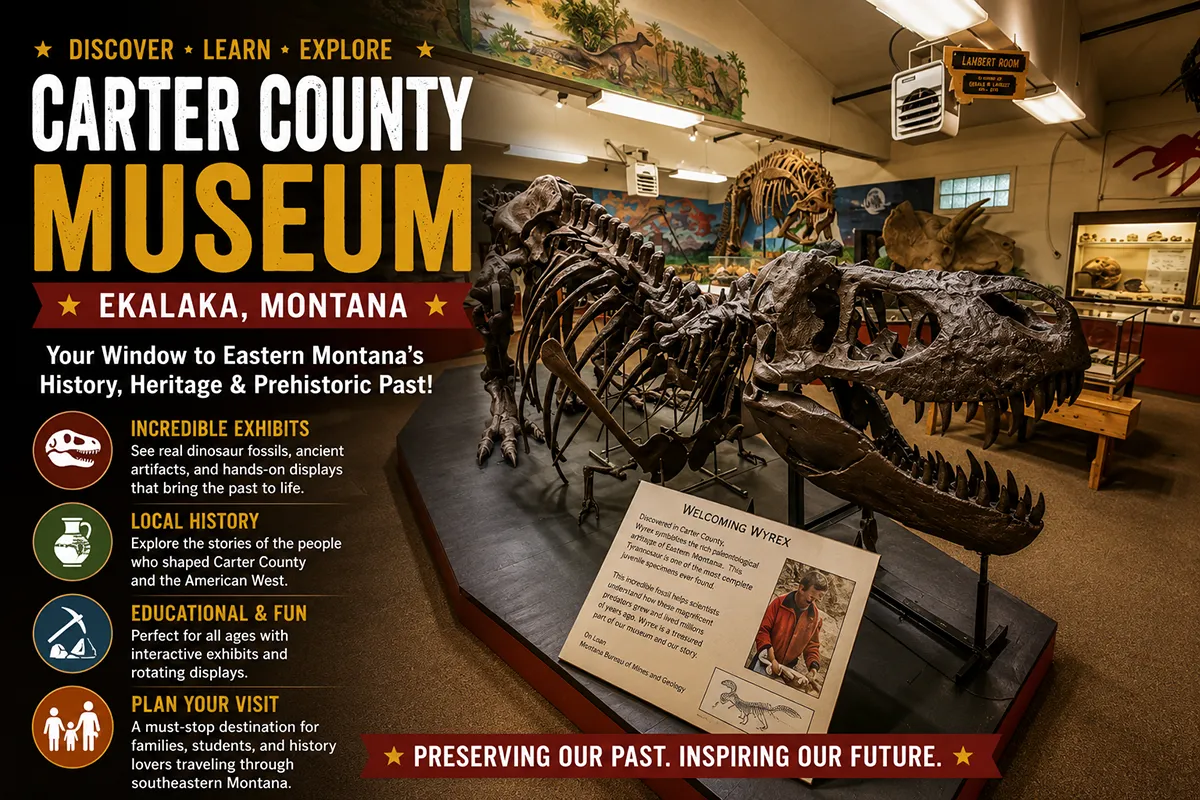
Carter County Museum, founded in 1936, holds the distinction of being Montana’s first county museum and the state’s first dinosaur museum, housed in a former automotive garage on Ekalaka’s Main Street. It’s the eastern anchor of the Montana Dinosaur Trail, the official fossil repository for nearby Medicine Rocks State Park, and home to the Dino Shindig, a Montana Office of Tourism “Event of the Year” award winner. This guide covers what’s inside, the museum’s genuinely unusual international connections, and a major expansion project currently in progress.
Liked this article?
Add Roaming Montana as a preferred source so you see more of our articles and guides on Google.
A Museum Built By Amateurs Who Turned Out to Be Right
Carter County Museum was founded in 1936 by members of the Carter County Geological Society — a group of local amateur archaeologists and paleontologists who recognized that the fossils turning up on area ranches deserved formal collection and study rather than scattered private ownership or loss.
That founding mission gave the museum an unusually specific original focus for a county historical institution: dinosaur fossils first, broader county history second.
It’s Montana’s first county museum, full stop, and also the state’s first dedicated dinosaur museum, a distinction that predates every other stop on the modern Montana Dinosaur Trail by decades.
One founder in particular deserves specific credit: Walter Peck, the museum’s first director, was also a Montana state senator, and during his tenure he helped pass the legislation that established the legal and tax structure allowing county museums to exist in Montana at all.
Without that specific piece of institutional groundwork, a huge share of the small-town museums scattered across this state — many of them covered elsewhere in our Montana museums guide — might never have had a functioning legal framework to operate under.
The museum spent its early years housed inside Carter County High School before moving to its current, permanent home in a former automotive garage on Main Street in the late 1970s, where it remains today.
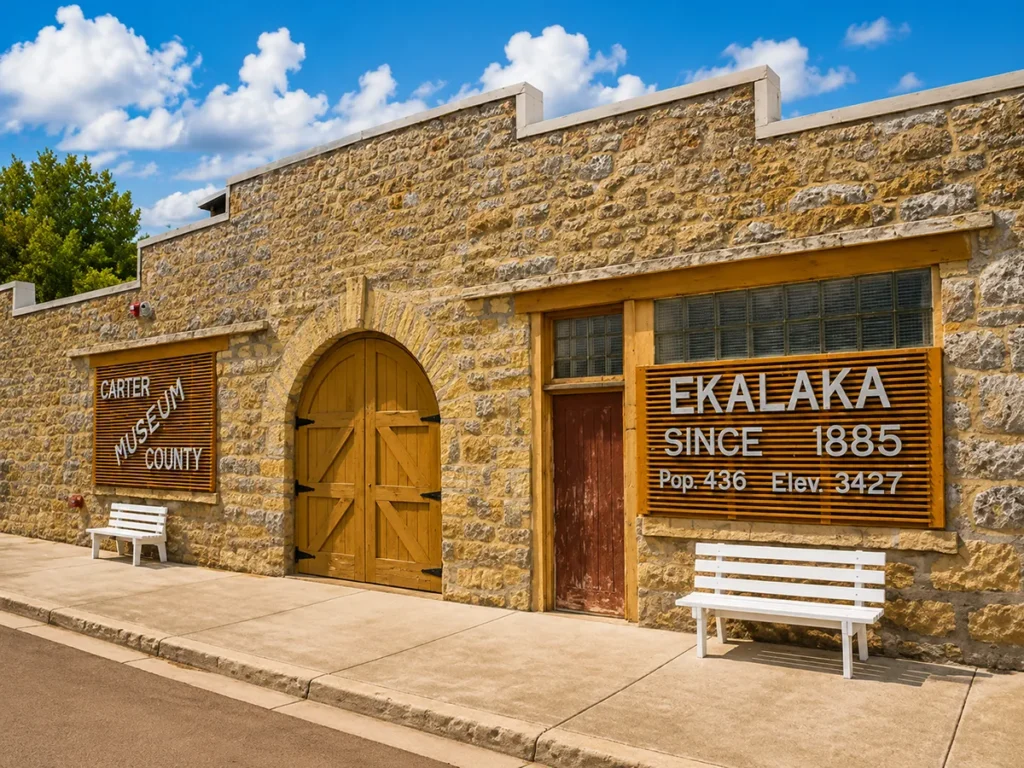
What’s Inside: 100 Million Years in One Small-Town Building
The museum’s exhibits cover roughly 100 million years of regional history, spanning fossil dinosaurs from the ancient Western Interior Seaway through the K-Pg extinction boundary preserved in the Hell Creek Formation, Ice Age hunting techniques used by Paleoindian tribes, and the homesteading history that shaped Carter County after its 1917 founding.
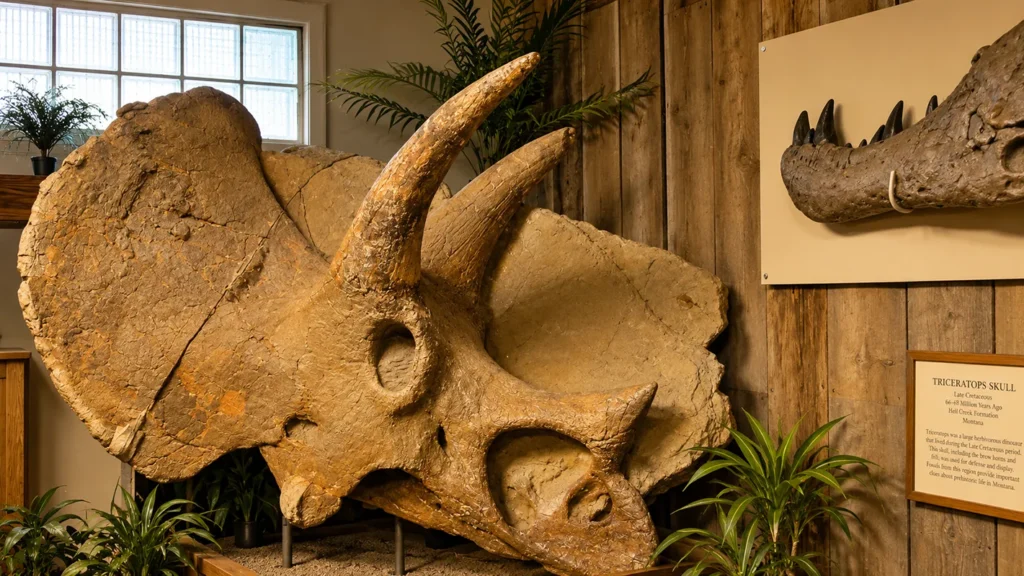
The headline paleontology specimens include a fully mounted Anatotitan copei (a duck-billed hadrosaur historically known as Anatosaurus), a Tyrannosaurus rex mount, a complete Triceratops skull largely collected from private ranchland in the 1930s and 1940s, and mounts or casts of Pachycephalosaurus, a mosasaur, a pterosaur, and Nanotyrannus.
Beyond the dinosaurs, the collection includes vertebrate and invertebrate remains gathered from the Pierre Shale, Hell Creek, Fort Union, Arikaree, and Pleistocene geological layers, collected continuously since the early 1930s — nearly a century of accumulated local paleontology in one modest building.
Cultural collections cover arrowheads, pottery, garments, historic photographs, newspapers, and documents tied to the people who’ve lived in this part of Montana, including honest representation of the Lakota, Northern Cheyenne, Crow, Hidatsa, Arikara, and Mandan nations whose ancestral land the museum sits on — the museum’s own materials explicitly acknowledge this history rather than treating it as a footnote.
A dedicated veteran’s room covers the military service of local Carter County residents from the Indian Wars period through Desert Storm, tracing the county’s relationship to nearly every major American conflict since its 1917 founding.
An Unusually Well-Connected Small Museum
For a museum in a town of 331 people, Carter County Museum has a genuinely remarkable list of institutional affiliations.
It’s a designated “sister museum” to both Museum of the Rockies in Bozeman and the Amakusa Museum of Goshoura Dinosaur Island in Kumamoto Prefecture, Japan, and it’s a member of the resulting Kumamoto Montana Natural Science Museums Association — an international partnership connecting Montana’s fossil-rich landscape with a similarly significant paleontology site on the other side of the Pacific.
Beyond that, the museum serves as a non-federal repository for fossils collected on Bureau of Land Management and USDA Forest Service land, and it’s the official repository for all archaeological and paleontological material recovered from nearby Medicine Rocks State Park — meaning significant discoveries made at one of southeastern Montana’s most striking natural landmarks ultimately end up here rather than at a larger, more distant institution.
The museum also holds memberships in the American Alliance of Museums, the Museums Association of Montana, the Mountain Plains Museum Association, the Montana Nonprofit Association, and the Society of Vertebrate Paleontology — a level of professional institutional credibility that’s genuinely uncommon for a museum this size and this remote.
The Dino Shindig
Since 2013, Carter County Museum has hosted the Annual Dino Shindig during the last weekend in July, an event recognized as Montana’s Event of the Year by the state’s Office of Tourism and Business Development and now the single biggest driver of tourism to the Ekalaka area.
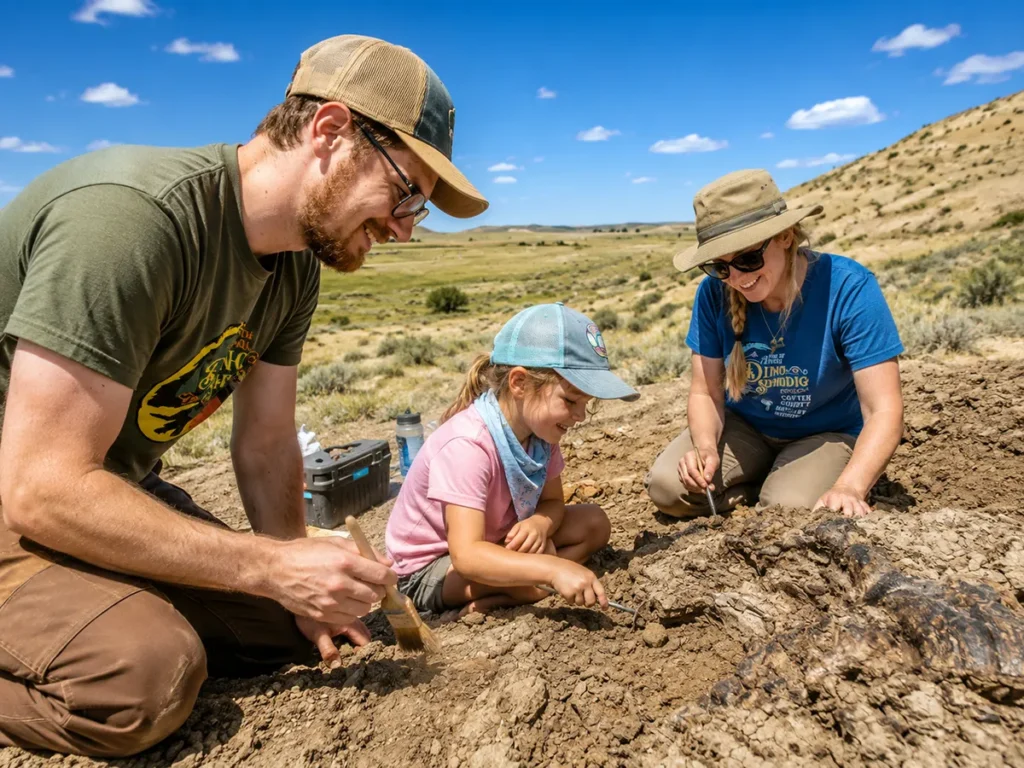
Visiting paleontologists give talks to the local community about their current research, and the weekend culminates in a street dance followed by an actual expedition into the Hell Creek Formation, where families and amateur fossil enthusiasts get genuine, hands-on field paleontology experience alongside working scientists.
If your Montana trip timing has any flexibility at all, I’d actively build a late-July visit around this event rather than treating it as a nice-to-have — it’s a genuinely rare chance to do real fieldwork in one of the most productive dinosaur fossil regions in North America. [verify current Dino Shindig dates and registration requirements at cartercountymuseum.org]
A Major Expansion Is Underway
Worth knowing before you plan your visit: Carter County Museum has been in the middle of a significant capital project, working through a formal contractor selection process for a roughly 5,800-square-foot renovation and expansion of the existing facility.
The project reflects genuinely exponential growth in the museum’s artifact and fossil collection, visitation, and program participation in recent years — success that’s outgrown the museum’s original automotive-garage footprint.
Depending on exactly when you’re reading this, construction may be actively underway, which could mean temporary exhibit changes or partial access limitations. [verify current construction status and any visitor impacts before your trip]
Visiting With Kids
Given the museum’s original mission around dinosaur fossils, this tends to be a genuinely engaging stop for kids, and the small scale actually works in families’ favor — there’s less ground to cover than at a sprawling institution, which means less risk of attention spans giving out halfway through.
The mounted T. rex and Triceratops skull are the obvious highlights for most young visitors, but I’d also make a point of walking through the veteran’s room with older kids, since it gives a concrete, personal-scale entry point into American military history that’s easier to connect with than an abstract national narrative.
If your visit happens to fall during Dino Shindig weekend, that’s genuinely one of the best kid-oriented Montana experiences on this entire list — actual fieldwork, not just a museum tour.
Quick Questions I Get Asked
Is the museum’s sister-museum relationship with Japan a real, active partnership?
Yes — it’s a formal institutional connection through the Kumamoto Montana Natural Science Museums Association, not just a symbolic gesture, and it reflects genuine shared interest in Late Cretaceous paleontology between the two regions.
Is Ekalaka worth visiting if we’re not completing the full Dinosaur Trail?
I’d still say yes if you’re already in southeastern Montana or planning a dedicated trip to that part of the state — the museum’s history and collection stand on their own, independent of trail-completion motivations.
How does this compare to Great Plains Dinosaur Museum in Malta?
Both are excellent, remote, small-town Dinosaur Trail anchors, but Carter County Museum leans more heavily into county and cultural history alongside its paleontology, while Malta’s museum is more purely fossil-focused. If you can only visit one of the trail’s remote eastern or northeastern stops, I’d let your broader road trip route decide rather than picking based on content alone — they’re both worth the detour.
Can we just show up, or do we need to plan ahead?
Walk-ins are welcome for individual visitors; only larger group visits require reservations. That said, given the current expansion project, I’d still call ahead if your visit is time-sensitive.
- The Japan sister-museum connection almost never gets mentioned, despite being one of the more genuinely surprising facts about any small-town Montana institution.
- Walter Peck’s role in creating the legal framework for Montana county museums generally gets left out entirely, even though it’s directly relevant to understanding why so many of the state’s small museums exist at all.
- The Dino Shindig is rarely flagged as a specific, plannable travel event, despite being recognized by the state’s own tourism office as an event of statewide significance.
- The museum’s role as official repository for Medicine Rocks State Park fossils goes unmentioned, disconnecting two closely related southeastern Montana attractions that would benefit from being paired in trip planning.
- The ongoing expansion project is recent enough that most existing travel content hasn’t caught up to it, risking outdated expectations about the facility’s current size and layout.
Personal Tips: What I Wish I Knew
- Time a summer trip around the Dino Shindig if you possibly can. Late July is when this remote museum comes most alive, and the Hell Creek expedition is a genuinely unique add-on you won’t find replicated at bigger institutions.
- Check current hours carefully — they shift by season. Summer (April–October) runs Monday–Saturday 9 a.m.–5 p.m. and Sunday 1–5 p.m.; winter hours are more limited and shift days around, so don’t assume summer hours apply year-round.
- Consider museum membership if you’re a repeat Montana visitor. At roughly $10 a year, it’s an inexpensive way to directly support one of the state’s most historically significant small museums.
- Pair this with Medicine Rocks State Park, given the museum’s direct repository relationship with that site — seeing where some of the collection’s material actually came from adds real context to the exhibits.
- Ekalaka is genuinely remote. Fuel up and plan accordingly; this isn’t a spontaneous detour from a well-traveled route, it’s a deliberate destination worth building real time into your southeastern Montana itinerary.
How This Fits a Southeastern Montana Road Trip
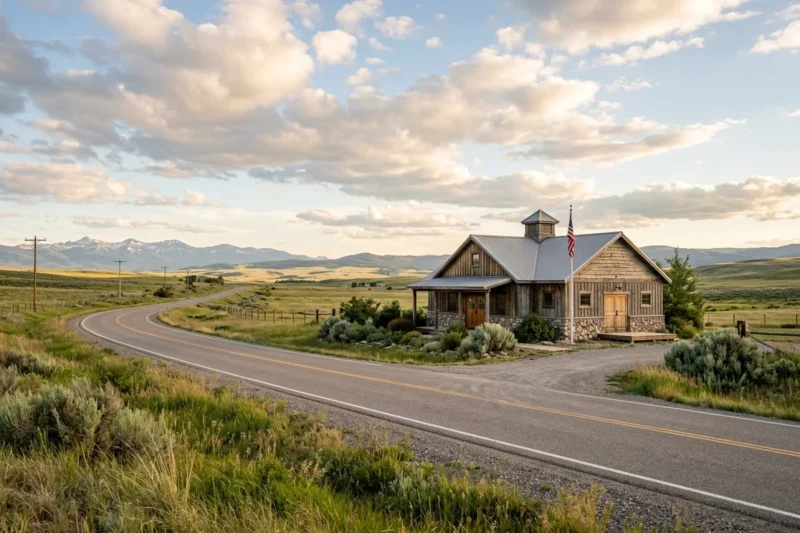
Ekalaka sits at the junction of Montana Highway 7 and Carter County Road 323, about 35 miles south of Baker and 70 miles north of Alzada — genuinely out of the way for most Montana itineraries, which is exactly why so few travelers make it out here.
If you’re completing the full Montana Dinosaur Trail, this is the trail’s eastern anchor, pairing naturally with the western stops covered in our guides to Two Medicine Dinosaur Center, Old Trail Museum, and Great Plains Dinosaur Museum, plus the flagship Museum of the Rockies in Bozeman, this museum’s official sister institution.
Our Baker guide covers the nearest larger town if you need lodging or supplies before or after your visit, and our Montana museums guide maps how this remote stop fits into the state’s broader museum landscape.
Practical Info
| Address | 306 N Main St, Ekalaka, MT 59324 |
| Phone | (406) 775-6886 |
| Summer hours (Apr 1–Oct 31) | Mon–Sat 9 a.m.–5 p.m., Sun 1–5 p.m. |
| Winter hours (Nov 1–Mar 31) | Mon–Fri 9 a.m.–5 p.m., Sat–Sun 1–5 p.m. Closed all U.S. federal holidays. |
| Membership | Approximately $10/person/year, 10% gift shop discount [verify current pricing] |
| Photography | Allowed; flash photography prohibited |
| Time needed | 1–2 hours (longer during Dino Shindig weekend) |
| Good for | Dinosaur Trail completionists, paleontology enthusiasts, Southeast Montana road trippers |
| Nearby pairing | Medicine Rocks State Park, our Baker guide |
Final Thoughts
Carter County Museum is one of those places that quietly rewrites your assumptions about what a town of 331 people can accomplish.
A group of local amateurs in 1936 built the legal and institutional groundwork for Montana’s entire county museum system, and nearly ninety years later their museum has a sister institution in Japan and an official role protecting fossils from a state park down the road.
Few stops on the Dinosaur Trail carry this much genuine institutional weight in this small a building, and fewer still can claim a direct hand in making the rest of the trail’s small-town museums legally possible to begin with.
Pin this for your Southeast Montana trip planning, and if you’ve made the trip out for the Dino Shindig, I’d love to hear what the Hell Creek expedition turned up in the comments.