I’ve watched more than one out-of-town visitor do a double-take at the front desk here, the same way people do when they learn Montana has no sales tax. Free admission to a genuinely serious contemporary art museum still catches people off guard, and MAM has never charged a cent since it opened.
- Missoula Art Museum (MAM) is a fully free contemporary art museum in downtown Missoula’s former Carnegie Library building
- It holds the largest collection of contemporary Native American art in Montana, including the biggest holdings anywhere of Jaune Quick-to-See Smith’s work
- An outdoor Art Park with large-scale sculpture sits right alongside the galleries, also free to walk through
- Don’t confuse this with the separate Montana Museum of Art & Culture on the University of Montana campus — they’re two different institutions
- This is one of the best museums in Montana that genuinely rewards a spontaneous lunch-break visit, not just a planned trip
Liked this article?
Add Roaming Montana as a preferred source so you see more of our articles and guides on Google.
Free By Design, Not By Accident
Missoula Art Museum has never charged admission. That’s not a temporary promotion or a pandemic-era policy — it’s been the operating philosophy since the museum opened its doors in 1975 as the Art Museum of Missoula.
Staff have been direct about why. The idea is that people should be able to walk in on a lunch break, spend fifteen minutes with a single piece, and come back another day to look again without feeling like they need to “get their money’s worth” out of a ticket.
That’s a genuinely different relationship with art than most paid museums encourage, and it shows in how casually locals treat the place — as a regular stop, not a special occasion.
The museum earned accreditation from the American Association of Museums in 1987, just over a decade after opening. An endowment followed in 1989, and MAM became a registered 501(c)3 nonprofit in 1995. The City of Missoula and Missoula County have provided sustaining annual support since day one, alongside funding from Montana’s coal severance tax.
<!– wp:image –> <!– IMAGE PLACEHOLDER Position: Hero image, top of post before TL;DR Alt text: “Exterior of Missoula Art Museum in a converted Carnegie Library building in downtown Missoula, Montana” Caption: “Missoula Art Museum occupies a converted Carnegie Library building fused with a contemporary addition in downtown Missoula.” “Realistic travel photography, historic brick library building with a modern glass architectural addition, downtown Missoula Montana street setting, warm afternoon light, wide-angle architectural composition, no visible people, editorial travel photography style” –> <!– /wp:image –>
A Century-Old Building, Reimagined
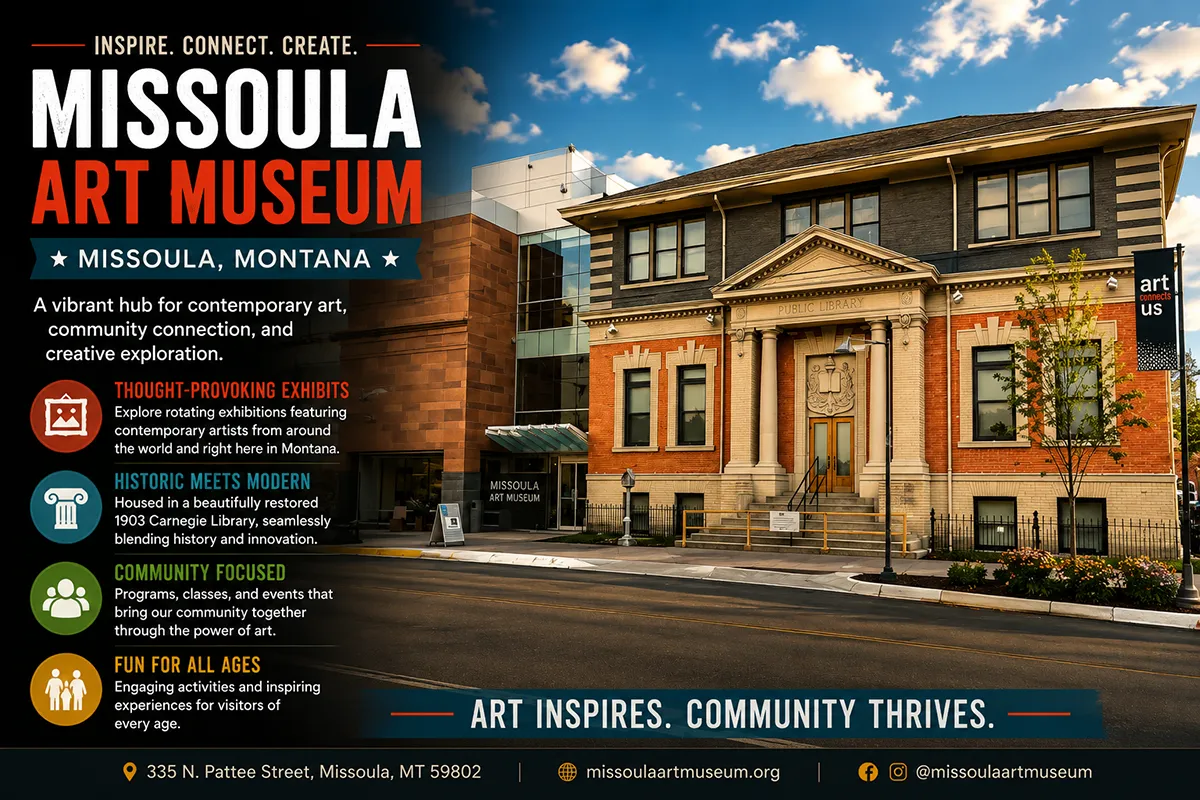
The museum’s home has real architectural history behind it. It started as a Carnegie library, part of the same nationwide wave of library philanthropy that built similar buildings across small American cities in the early 1900s.
A $5.3 million capital campaign changed everything in 2006. The renovation fused the century-old library structure with a contemporary addition, creating what today functions as seven to eight distinct exhibition spaces, a library, an education center with a working classroom and printing press, and an inviting lounge area.
Walking between the original library architecture and the newer addition, you genuinely feel the building’s two eras in conversation with each other — old brick and tall library windows giving way to cleaner, more contemporary gallery space built specifically for large modern work.
The Contemporary American Indian Art Collection
This is the collection that sets MAM apart from most regional art museums, and it deserves more attention than it typically gets.
MAM holds the largest collection of contemporary Native American art anywhere in Montana. Within that collection sits something even more specific: the largest holdings of work by Jaune Quick-to-See Smith, a Salish Kootenai artist, held by any museum anywhere.
Quick-to-See Smith built a genuinely significant national reputation over her career, working across painting, printmaking, and mixed media to address Indigenous identity, land, and history through a distinctly contemporary lens rather than the historic or ceremonial framing museums often default to for Native art.
Her work has been exhibited at major institutions across the country, which makes it all the more notable that the single deepest collection of it sits in a free, walk-in Missoula museum rather than behind a paid admission gate somewhere with a bigger marketing budget.
If contemporary Native art interests you at all, budgeting extra time specifically for this part of the permanent collection is worth it.
I’d also encourage pairing a visit here with the Museum of the Plains Indian in Browning if your Montana trip allows for it — the two institutions approach Indigenous art and material culture from genuinely different angles, one historic and ceremonial, the other contemporary and artist-driven, and seeing both gives you a much fuller picture than either alone.
<!– wp:image –> <!– IMAGE PLACEHOLDER Position: After the Contemporary American Indian Art Collection section Alt text: “Contemporary Native American art gallery display at Missoula Art Museum” Caption: “MAM holds the largest collection of contemporary Native American art in Montana, including the deepest holdings anywhere of Jaune Quick-to-See Smith’s work.” “Realistic photography, contemporary art gallery with mixed-media Native American artwork on display, warm gallery lighting, minimalist white walls, editorial museum photography style, no visible people” –> <!– /wp:image –>
The Art Park: Sculpture You Can See From the Street
One of the smarter design decisions to come out of the 2006 renovation was the Missoula Art Park, an outdoor sculpture space built directly alongside the museum’s galleries.
Before the renovation, this was just an unremarkable strip of lawn next to a brick building. The redesign pushed the park space out on both sides of the street, reinforced the ground with rebar and anchoring specifically so it could support sculptures weighing several thousand pounds, and added a public restroom, seating, and bike parking.
That last detail matters more than it sounds. Missoula sits along the Adventure Cycling Association’s TransAmerica route, and cyclists passing through from around the world often encounter this Art Park as one of their first real impressions of the city.
According to museum staff, that’s intentional — sculpture visible from Higgins Avenue immediately signals what kind of museum this is, rather than just presenting a plain brick facade.
The Art Park is free to walk through any time, even outside museum hours, and installations rotate seasonally.
<!– wp:image –> <!– IMAGE PLACEHOLDER Position: After the Art Park section Alt text: “Outdoor sculpture installation at the Missoula Art Park adjacent to Missoula Art Museum” Caption: “The Missoula Art Park sits alongside the museum’s galleries and is free to walk through anytime, even outside museum hours.” “Realistic travel photography, outdoor urban sculpture park with large-scale contemporary metal sculptures on a landscaped plaza, downtown street setting, golden hour lighting, wide-angle composition, no visible people, editorial travel photography style” –> <!– /wp:image –>
Don’t Confuse This With the Other Missoula Art Museum
Here’s a genuine point of confusion worth clearing up before your visit. Missoula has two separate, unrelated art museums, and a lot of visitors don’t realize it until they show up at the wrong one.
Missoula Art Museum (MAM), covered in this guide, sits downtown at 335 North Pattee Street and focuses on contemporary regional and Native American art.
The Montana Museum of Art & Culture (MMAC) is an entirely different institution, located in a newer building on the University of Montana campus at 795 South 5th Street East.
MMAC holds a much larger and more historically varied collection — nearly 12,000 objects spanning thousands of years, and it’s officially designated one of Montana’s three state museums.
It’s also free, though it suggests a $10 donation. Recent MMAC exhibitions have covered everything from a centennial retrospective of modernist artist Morton Levin to a horse-themed show pulled from its permanent collection.
If you’re planning a serious Missoula art day, I’d genuinely recommend visiting both. Just don’t assume they’re the same place, and check current hours for each separately since they operate independently.
Visiting With Kids
MAM runs genuinely robust family programming, which sets it apart from a lot of contemporary art museums that skew heavily adult. Saturday Family Art Workshops run regularly, and the museum offers Teen Artist Studios and Open Studio Nights specifically aimed at older kids and teenagers.
The education center’s classroom, complete with an actual printing press, gives the museum hands-on capacity beyond just looking at finished work on gallery walls. Summer Art Camps and after-school programs extend that same hands-on philosophy throughout the year, not just during a single visit.
Because admission is free, MAM works well as a genuinely low-stakes stop with kids — if they lose interest after ten minutes, you haven’t wasted a ticket price, and you can simply head out to the Art Park instead.
<!– wp:image –> <!– IMAGE PLACEHOLDER Position: After the Visiting With Kids section Alt text: “Family art workshop activity space inside Missoula Art Museum’s education center” Caption: “MAM’s education center includes a working classroom with a printing press, supporting regular family and teen art programs.” “Realistic photography, bright museum education classroom with art-making tables and supplies, natural light through large windows, editorial museum photography style, no visible people” –> <!– /wp:image –>
Quick Questions I Get Asked
Is MAM really free every single day it’s open, no exceptions?
Yes — general admission has never had a fee since the museum opened in 1975, and that’s confirmed as an ongoing institutional commitment, not a limited-time offer.
Are guided tours available?
Yes, and they’re also free, though reservations are required in advance rather than available as a walk-up option.
How is this different from the Montana Museum of Art & Culture?
They’re entirely separate institutions with different collections, different buildings, and different operating organizations — one is a standalone downtown nonprofit, the other is part of the University of Montana. Confirm which one you’re headed to before you go.
Is the Art Park always accessible, even when the museum is closed?
Yes, it’s an outdoor public space and doesn’t operate on the museum’s indoor hours.
Does MAM sell original art, or is it purely a display space?
Exhibitions are primarily for display and education rather than direct sales, though the museum does hold periodic fundraising art auctions featuring dozens of regional artists, open to public bidding.
Most Missoula travel content mentions MAM in a single sentence, if at all, and misses several genuinely distinctive details:
- The Jaune Quick-to-See Smith connection rarely gets mentioned, despite MAM holding the largest collection of her work anywhere.
- The Art Park’s design story gets skipped entirely, losing a genuinely thoughtful piece of urban design reasoning behind a space most visitors just walk past.
- The MAM/MMAC confusion almost never gets addressed, sending some visitors to the wrong museum entirely.
- The “always free, by philosophy not just policy” angle rarely gets explained, reducing a genuinely deliberate institutional choice to a generic “free admission” bullet point.
Personal Tips: What I Wish I Knew
- Treat this as a genuine lunch-break stop, the way locals do. You don’t need to block out half a day; fifteen or twenty minutes with one gallery is a completely legitimate way to visit.
- Check the exhibition rotation schedule before a repeat visit. Shows change every three to four months across five or six spaces at a time, so a visit a season later will look genuinely different.
- First Fridays are worth timing your trip around, if your schedule allows — the monthly Art Walk brings extra energy and often expanded hours.
- Walk the Art Park even if the museum happens to be closed. It’s outdoor, free, and accessible any time.
- Confirm which museum you’re headed to if a local mentions “the art museum.” Given how easily MAM and MMAC get conflated, a quick clarifying question saves a wrong turn.
How This Fits a Missoula Visit
Missoula’s downtown core makes stringing together several cultural stops in one day genuinely easy, and MAM sits right in the middle of that walkable area.
Pair it with the Historical Museum at Fort Missoula for the city’s pioneer and westward-expansion history, or with Museum of Mountain Flying out near the airport if aviation history interests you.
Our Missoula guide covers the rest of what’s worth doing in town, and our Missoula hotels guide rounds out your trip planning if you need a place to stay.
If you’re building a broader Montana museum itinerary, our Montana museums guide maps how this stop connects to the state’s other art and history museums, including the Holter Museum of Art in Helena, which recently moved away from its own long-standing free-admission policy — a useful contrast to MAM’s continued commitment to staying free.
Practical Info
| Address | 335 North Pattee St, Missoula, MT 59802 |
| Phone | (406) 728-0447 |
| Hours | Tuesday–Saturday, 10 a.m.–5 p.m.; closed Sunday and Monday [verify current hours] |
| Admission | Free, always |
| Time needed | 45 minutes–1.5 hours |
| Good for | Contemporary art enthusiasts, budget-conscious travelers, downtown Missoula day trips |
| Nearby pairing | Missoula Art Park (adjacent, free), rest of our Missoula guide |
Final Thoughts
Missoula Art Museum has stayed free for fifty years on purpose, not by accident, and that philosophy shapes everything about how the place feels to visit.
It’s low-pressure in a way paid museums rarely manage, and the Jaune Quick-to-See Smith collection alone makes it worth more than the quick pass-through most visitors give it.
What I keep coming back to is how genuinely Missoula this whole arrangement feels — a college town proud enough of its no-sales-tax, walk-in-anytime culture to build an entire museum’s operating philosophy around the same spirit.
It’s the kind of institutional choice that would be a hard sell in a bigger city, and it works precisely because Missoula has the community buy-in to sustain it.
Pin this for your Missoula trip planning, and don’t mix it up with MMAC across town. If you’ve spent a lunch break here yourself, I’d love to hear what pulled you in for longer than planned in the comments.