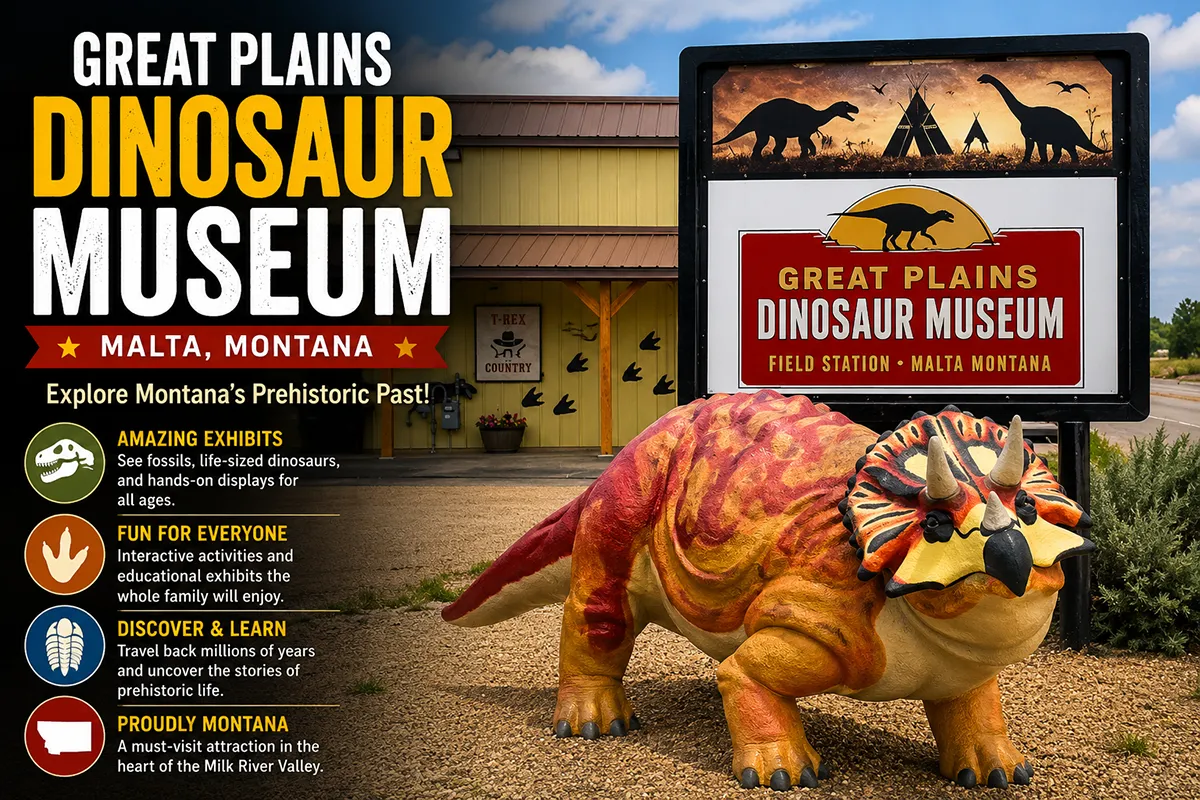
There are only four mummified dinosaurs known to exist anywhere on the planet, and one of them lives in a small museum on Highway 2 in Malta, Montana, a town most people driving between Glacier and North Dakota never think to stop in. It’s one of the more surprising entries on my running list of the best museums in Montana, precisely because so few travelers know it’s there.
Great Plains Dinosaur Museum and Field Station in Malta houses Leonardo, a Guinness World Record-holding mummified Brachylophosaurus with preserved skin, soft tissue, and even stomach contents. The museum also displays Herb the Triceratops, one of the world’s first mounted triceratops skeletons, alongside fossils from both the Judith River and Hell Creek geological formations. This guide covers what makes Leonardo scientifically remarkable, the museum’s entirely self-funded, volunteer-run operating model, and how to build a stop here into a Missouri River Country road trip.
Liked this article?
Add Roaming Montana as a preferred source so you see more of our articles and guides on Google.
Meet Leonardo
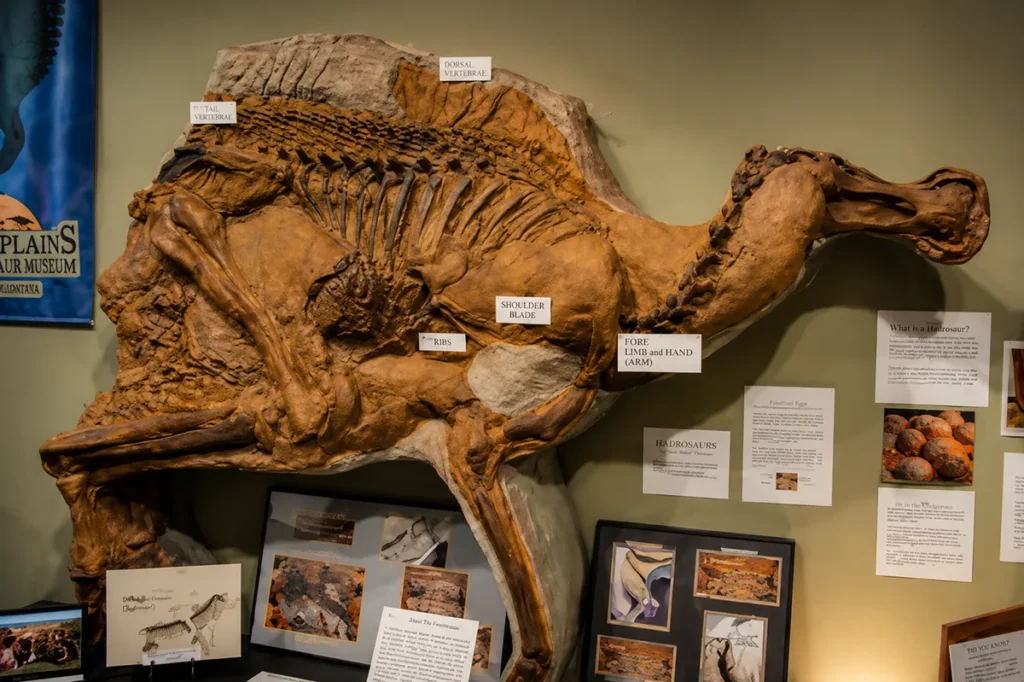
Discovered in 2000 in the Judith River Formation near Malta, Leonardo is a Brachylophosaurus canadensis — a duck-billed dinosaur — and one of only four mummified dinosaur specimens known anywhere in the world.
“Mummified” here means something specific and genuinely remarkable in paleontology: rather than just bones, Leonardo’s soft tissue was preserved too. Skin impressions cover most of the body, and scientists examining the specimen found preserved muscle tissue and even stomach contents, revealing physical evidence of Leonardo’s actual last meal in the form of preserved plant material.
Guinness World Records recognizes Leonardo as the most complete mummified dinosaur specimen ever found.
I want to be clear about why this matters beyond the “wow” factor: dinosaur fossils are overwhelmingly just bone, and bone alone can only tell paleontologists so much about how an animal actually looked, moved, and lived.
Leonardo has taught researchers more about Brachylophosaurus biology than any other single find, precisely because the soft tissue evidence answers questions fossilized bone simply can’t.
Multiple peer-reviewed papers have been published specifically on Leonardo’s preserved gut contents and possible parasite trace fossils found within them — genuinely active, ongoing scientific research tied directly to the specimen on display in this small-town Montana museum.
Researchers have used Leonardo to study everything from skin texture and coloration patterns to muscle mass distribution, details that are essentially unrecoverable from a typical bone-only fossil no matter how complete the skeleton is.
That’s part of why paleontologists from well beyond Montana continue to cite this specific specimen in published research years after its 2000 discovery — it isn’t just a impressive museum centerpiece, it’s an active reference point for the field.
Herb, Roberta, Ralph, and the Rest of the Cast
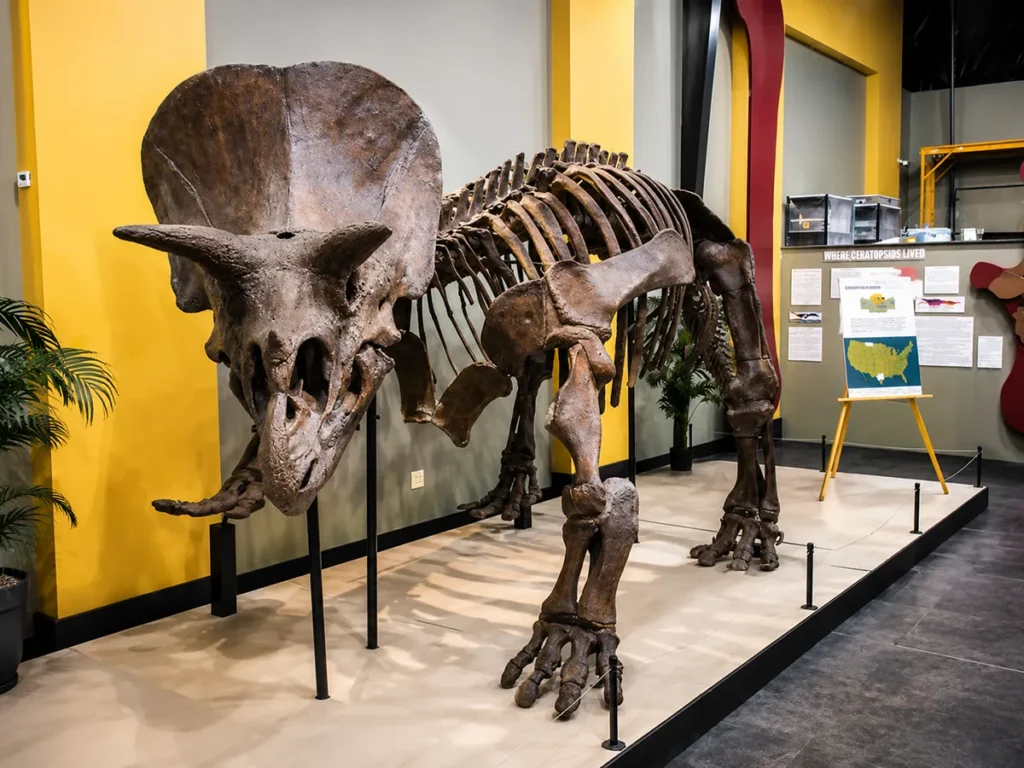
Leonardo isn’t the only named specimen worth knowing before you visit. Herb the Triceratops has a genuinely notable history of his own: discovered in the 1930s, with the skull from Wyoming and body elements from Montana, Herb was mounted as the very first triceratops skeleton ever put on public display anywhere in the world, originally shown at a natural history museum before eventually finding a home here.
Roberta, another Brachylophosaurus specimen like Leonardo, and Ralph, a Camarasaurus, round out the museum’s headline specimens, alongside Giffen the Stegosaurus.
The collection spans two distinct and geologically significant formations. The Judith River Formation, an ancient coastal deltaic environment roughly comparable to today’s Gulf Coast, produced the area’s famous herds of Brachylophosaurus, including both Leonardo and a separate, exceptionally complete specimen nicknamed “Elvis” — found about 30 minutes north of Malta and now displayed at the neighboring Phillips County Museum and at Museum of the Rockies in Bozeman rather than here, worth knowing if you go looking for Elvis specifically at this location and come up empty.
The Hell Creek Formation, the last geological layer from the Age of Dinosaurs in western North America, produced the museum’s Triceratops and other late-Cretaceous specimens.
A Camarasaurus collected in 2003 near the Little Snowy Mountains ranks among the oldest dinosaur fossils found anywhere in Montana.
Beyond the headline dinosaurs, the museum’s broader fossil collection includes plants, invertebrates, fish, turtles, and crocodiles — giving you a fuller sense of the ancient ecosystem these animals actually lived in, not just the dinosaurs that get the marquee billing.
A Museum That Runs on Volunteers and Grit
This is genuinely worth knowing before you visit, because it changes how I think about the admission price and the gift shop purchase: Great Plains Dinosaur Museum is governed and operated entirely by volunteer board members of the Judith River Foundation, a nonprofit established in 2002.
The museum isn’t a municipal entity, isn’t affiliated with any university, and receives no general tax support — it runs entirely on membership fees, admissions, dig and tour revenue, and fundraising.
Every dollar spent here goes directly back into keeping a genuinely significant scientific collection accessible to the public in one of the most remote corners of the state.
The museum opened in 2008 and includes a working fossil preparation lab visible to visitors, similar in spirit to the research-lab element at Museum of the Rockies, just on a dramatically smaller, more intimate scale.
More than one visitor has told me the small footprint actually works in the museum’s favor — with fewer specimens to move through, you end up spending real time with each one rather than rushing past dozens of glass cases.
Field Digs and Educational Programs
Throughout the summer season, the museum offers hands-on dig and educational programs for both kids and adults, run in partnership with museum staff and paleontologist partners.
This puts Great Plains Dinosaur Museum in the same small category as Two Medicine Dinosaur Center as one of the few Montana Dinosaur Trail stops offering genuine public participation in active fieldwork rather than gallery viewing alone.
Program details and scheduling vary by season, so I’d reach out directly before building your trip around a specific dig date. [verify current dig program schedule and registration requirements at greatplainsdinosaurs.org]
Visiting With Kids
This is one of the more genuinely hands-on Dinosaur Trail stops for families, and reviewers consistently mention that the smaller scale actually works better for kids than a sprawling museum where attention spans give out halfway through.
The fossil prep lab gives kids a real sense that paleontology is ongoing, active work rather than a finished, static display, and staff are generally very willing to explain what they’re currently working on if you ask.
If your kids are especially fossil-obsessed, the summer dig and education programs are worth booking in advance — this is exactly the kind of small, personal-scale operation where a family can get real one-on-one time with actual paleontologists in a way that’s much harder to arrange at a larger institution.
Quick Questions I Get Asked
Is Leonardo actually on display, or is it a replica?
Leonardo is the genuine specimen — this isn’t a cast or reproduction, which is part of what makes seeing it in person genuinely remarkable rather than just another dinosaur skeleton.
How far is Malta from other major Montana attractions?
It’s remote. Glacier National Park, Yellowstone, and Bozeman are all several hours away by car, which means this works best as a deliberate stop on a Highway 2 or Missouri River Country road trip rather than a side trip from a Glacier-based vacation.
Is the museum worth visiting if we’re not particularly interested in dinosaurs?
I’d still say yes if you have any general curiosity about science or natural history — the story of how a self-funded, volunteer-run museum in a town this size ended up housing one of the most scientifically significant fossil specimens in the world is compelling on its own, independent of any prior dinosaur interest.
Can we see both this museum and Phillips County Museum in one visit?
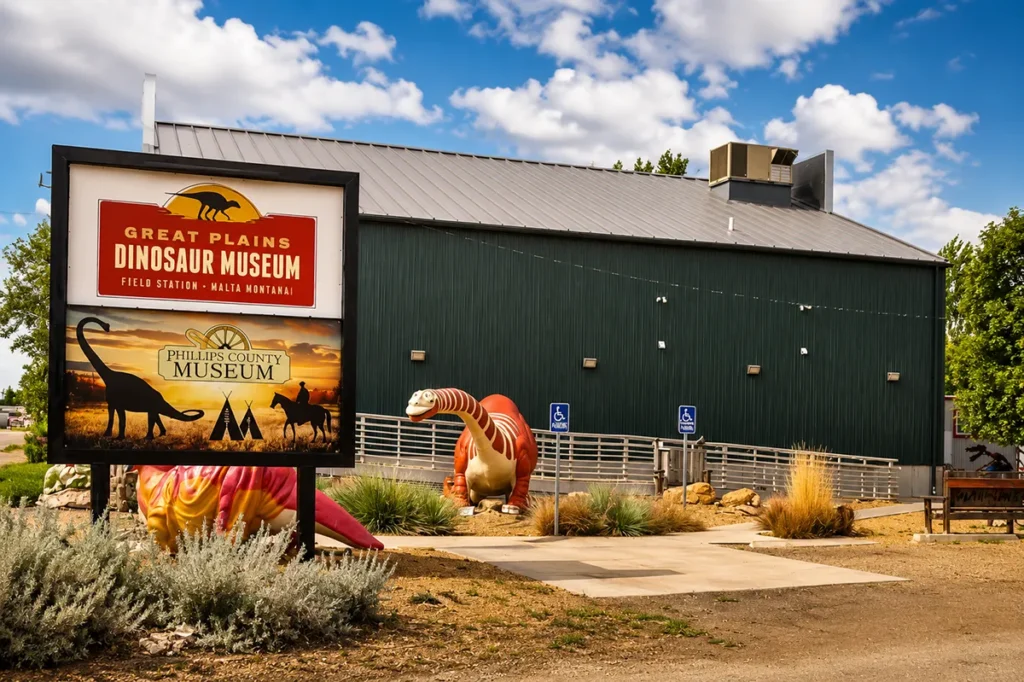
Yes, easily — they sit across the same parking lot, and most visitors treat the two as a single combined stop rather than separate trips.
- Leonardo’s scientific significance rarely gets explained beyond “well-preserved.” The specific detail that this is one of only four mummified dinosaurs worldwide, with documented stomach contents, is the kind of fact that actually justifies a detour to a remote town most travel content skips entirely.
- The museum’s volunteer-run, self-funded status almost never gets mentioned, even though it’s directly relevant to understanding what your admission fee actually supports.
- “Elvis” being displayed elsewhere, not at this museum, causes real visitor confusion that better trip planning content would head off in advance.
- Malta’s broader appeal as a Missouri River Country stop gets ignored entirely in favor of treating this as an isolated, single-purpose detour rather than part of a fuller regional visit.
- The direct pairing with Phillips County Museum right across the parking lot rarely gets flagged, despite being one of the easiest two-for-one museum stops on the entire Dinosaur Trail.
Personal Tips: What I Wish I Knew
- Pair this immediately with Phillips County Museum, literally across the parking lot — there’s no reason to treat these as separate trips given the proximity.
- Call ahead if you’re visiting outside the core summer season. Hours shift to call-for-appointment status the rest of the year, and Malta is remote enough that showing up to a locked door is a genuinely wasted afternoon rather than a minor inconvenience.
- Budget real time for the fossil prep lab, not just the main gallery — watching active preparation work in progress is one of the more memorable parts of a visit here.
- If you’re chasing “Elvis” the Brachylophosaurus specifically, redirect your expectations — you’ll find that specimen at Phillips County Museum next door or at Museum of the Rockies, not here.
- Malta is genuinely remote, and I mean that as useful trip-planning information rather than a warning: fuel up, plan meals around limited options, and treat this as a deliberate stop on a Missouri River Country loop rather than a quick highway pull-off.
How This Fits a Missouri River Country Road Trip
Malta sits in Missouri River Country, Montana’s least-visited tourism region and, in my experience, one of the quietest and most rewarding for travelers willing to make the drive.
Beyond the two dinosaur museums, the Trafton walking trail system and HG Robinson House Gardens are both worth a stop in town, and Bowdoin National Wildlife Refuge just outside Malta is a genuinely excellent birding and wildlife-watching stop if you have extra time.
The communities of Zortman and Landusky, roughly 45 miles south in an “island mountain” range, offer additional outdoor recreation and lodging if you’re extending your stay in the area.
This part of the state rewards a slower travel pace than the Glacier-to-Yellowstone corridor most first-time visitors default to — if you’ve already checked off the state’s bigger-name attractions on a previous trip, Missouri River Country is where a repeat Montana visit starts to feel genuinely different from the first one.
For the rest of your Dinosaur Trail itinerary, our guides to Two Medicine Dinosaur Center and Old Trail Museum cover the trail’s western stops, and our Montana museums guide maps the complete picture across the state.
If you’re building a broader Montana bucket list around lesser-known stops like this one, our Montana bucket list post has more ideas in the same spirit.
Practical Info
| Address | 405 North 1st Street East, Malta, MT (on Highway 2) |
| Phone | (406) 654-5300 |
| Summer hours | Monday–Saturday 10 a.m.–5 p.m., Sunday 12:30–5 p.m. [verify current summer hours] |
| Rest of year | Call ahead for hours or appointment |
| Admission | Child and group discounts available [verify current pricing at greatplainsdinosaurs.org] |
| Time needed | 1–2 hours (longer with Phillips County Museum next door) |
| Good for | Dinosaur Trail completionists, paleontology enthusiasts, families, anyone exploring Missouri River Country |
| Nearby pairing | Phillips County Museum (same parking lot), Bowdoin National Wildlife Refuge |
Final Thoughts
Great Plains Dinosaur Museum punches enormously above its weight for a volunteer-run institution in a town of a few thousand people. Leonardo alone is worth the drive if you have any interest in paleontology — genuine soft-tissue evidence from a 75-million-year-old animal is not something you’ll find casually on display in many other places on Earth, let alone off a two-lane highway in northeastern Montana.
Museums like this one are exactly why I’d encourage any serious Montana traveler to look past the state’s headline attractions at least once — the density of genuinely world-class discoveries scattered across small, easy-to-overlook towns is one of the more surprising things about spending real time here.
Pin this for your Missouri River Country trip planning, and if you’ve made the trip out to Malta specifically for Leonardo, I’d love to hear whether it lived up to the hype in the comments.