Before cars, before pavement, before the idea of a “road trip” even existed, getting to Yellowstone meant a stagecoach ride from a train depot in a town that existed for exactly one reason: to move tourists into the park. That depot is still standing, and it’s now a museum.
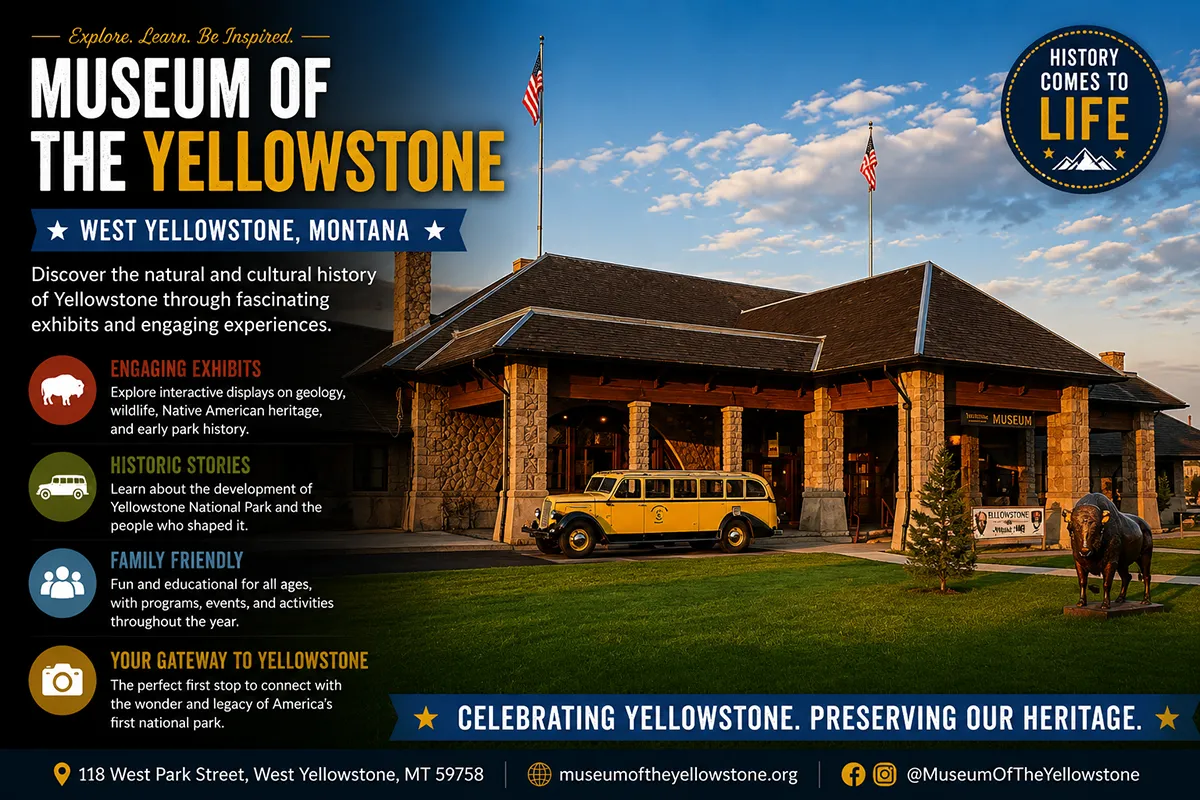
- Museum of the Yellowstone occupies the historic Union Pacific Depot in West Yellowstone, two blocks from the park’s west entrance
- The museum traces how tourists actually reached Yellowstone — stagecoach, railroad, then automobile — alongside the town’s own founding purpose
- A detailed exhibit on the 1988 Yellowstone fires is consistently the standout for visitors, alongside programs on the 1959 Hebgen Lake earthquake
- The museum is open daily, mid-May through mid-October, and admission covers two consecutive days
- This is one of the best museums in Montana worth visiting before you enter the park, not after, since it changes how you understand the drive in
Liked this article?
Add Roaming Montana as a preferred source so you see more of our articles and guides on Google.
A Town Built Entirely to Move Tourists
West Yellowstone doesn’t have the layered, centuries-deep history a lot of Montana towns can claim. It exists for one specific, deliberate reason: to funnel visitors into Yellowstone National Park.
The Union Pacific Railroad built this depot to do exactly that. Trains brought tourists as far as the rails could go, and from here, stagecoaches carried them the rest of the way into a park that was, at the time, a genuinely difficult place to reach.
The museum housed inside this same building tells that entire evolution — stagecoach, then railroad, then the automobile age that eventually made the whole operation obsolete.
Walking through the depot today, you’re standing in the actual building where that transition happened. This isn’t a replica built to evoke the era; it’s the real structure that shaped how an entire generation of Americans first experienced Yellowstone.
<!– wp:image –> <!– IMAGE PLACEHOLDER Position: Hero image, top of post before TL;DR Alt text: “Historic Union Pacific Depot building housing Museum of the Yellowstone in West Yellowstone, Montana” Caption: “Museum of the Yellowstone occupies the historic Union Pacific Depot, the building that once funneled tourists into the park.” “Realistic travel photography, historic railroad depot building with distinctive architecture, West Yellowstone Montana street setting, mountains visible in the background, warm afternoon light, wide-angle architectural composition, no visible people, editorial travel photography style” –> <!– /wp:image –>
Stagecoaches, Trains, and a Restored World’s Fair Railcar
The transportation exhibits form the museum’s real backbone, and they go deeper than a typical “here’s an old train” display.
You’ll see genuine stagecoach and railroad artifacts documenting the companies that hauled tens of thousands of early visitors toward the park entrance.
Historic promotional paintings from the railroad era show exactly how Montana and the park marketed themselves to a national audience that had never seen anything like Yellowstone.
The standout piece sits outside the main building: a fully restored railcar from the Montana Centennial Train of 1964-65.
This isn’t a generic vintage railcar — it’s the actual car that appeared at the 1964 New York World’s Fair, restored to its original showcase appearance. Seeing it parked outside a small-town Montana museum is a genuinely unexpected connection to a much bigger moment in American history.
<!– wp:image –> <!– IMAGE PLACEHOLDER Position: After the Stagecoaches, Trains, and Restored Railcar section Alt text: “Restored 1964 Montana Centennial Train railcar on display outside Museum of the Yellowstone” Caption: “This restored railcar from the 1964 Montana Centennial Train previously appeared at the 1964 New York World’s Fair.” “Realistic photography, vintage restored railroad passenger car parked on display tracks, polished exterior reflecting mountain scenery, warm afternoon light, wide-angle composition, editorial documentary photography style, no visible people” –> <!– /wp:image –>
The 1988 Fires: The Museum’s Most Powerful Exhibit
If you only have time for one part of this museum, make it the fire exhibit. Visitors consistently name it the most compelling thing here, and for good reason.
The 1988 Yellowstone fires burned across a huge portion of the park and genuinely threatened the town of West Yellowstone itself.
The museum’s detailed film, produced shortly after the fires, uses real footage from that summer and explains exactly how local residents and firefighters brought in from across the country managed to save the park’s most treasured areas.
Watching that footage inside a town that was directly in the fire’s path adds a weight you don’t get from reading about it after the fact. This is lived, local history, not an abstract natural-disaster documentary.
The Hebgen Lake Earthquake: A Disaster Most Visitors Never Hear About
Beyond the fires, the museum has recently expanded its programming to cover another genuinely dramatic chapter in the region’s history: the 1959 Hebgen Lake earthquake.
A magnitude 7.5 quake struck the area in August 1959, triggering a massive landslide that killed campers and dramatically reshaped the landscape, eventually forming what’s now known as Quake Lake just outside West Yellowstone.
It’s one of the most significant natural disasters in Montana’s modern history, and it’s genuinely surprising how few visitors know about it before arriving.
A dedicated film, “Yellowstone Earthquake: The Story of the 1959 Hebgen Lake Disaster,” now runs as part of the museum’s programming.
If you’re researching Montana’s major earthquakes more broadly, this exhibit connects that history directly to a place you can actually stand and see the landscape it reshaped.
<!– wp:image –> <!– IMAGE PLACEHOLDER Position: After the Hebgen Lake Earthquake section Alt text: “Historic photograph exhibit about the 1959 Hebgen Lake earthquake at Museum of the Yellowstone” Caption: “The museum’s programming now includes a dedicated film on the 1959 Hebgen Lake earthquake and landslide.” AI Generation Prompt: “Realistic photography, museum exhibit display with archival black and white photographs of earthquake damage and landslide terrain, warm gallery lighting, editorial documentary museum photography style, no visible people” –> <!– /wp:image –>
Snaggletooth and What Kids Actually Remember
Not everything here is heavy history. Snaggletooth, a taxidermy bear on permanent display, has become something of an informal museum mascot, and reviewers consistently mention it as the thing their kids remember most clearly afterward.
It’s worth being honest about the museum’s limitations for younger visitors, too. More than one reviewer has described parts of the museum as slow-paced for kids, and the coverage of Native American history in the region has been fairly described as thin relative to the depth given to transportation and settler-era history.
That’s a real gap, and it’s worth knowing before you set expectations for a family visit built entirely around this one stop.
Guided walking tours of the historic district, run by museum staff, and ranger-led programs through Yellowstone National Park add real value beyond the static exhibits, especially if your visit happens to line up with one.
Why West Yellowstone Exists At All
It’s worth understanding the town’s origin story a bit more, because it explains why this museum focuses so heavily on transportation rather than, say, mining or ranching like most other Montana museums.
West Yellowstone wasn’t a town that grew organically around agriculture, industry, or a natural resource discovery the way Butte or Bozeman did.
It was built specifically, deliberately, as infrastructure — a place for railroads and later automobiles to stage tourists before sending them into the park. Everything about the town’s early development, down to its street layout and its earliest businesses, revolved around that single function.
That’s a genuinely unusual origin story even by Montana standards, and it’s why a museum housed in a former train depot makes so much sense here in a way it wouldn’t in most other Montana towns. The building isn’t just where the museum happens to be located — it’s the literal machine that built the town around it.
<!– wp:image –> <!– IMAGE PLACEHOLDER Position: After the Why West Yellowstone Exists section Alt text: “Historic black and white photograph style exhibit showing early tourists arriving in West Yellowstone by stagecoach” Caption: “West Yellowstone was built specifically to funnel tourists toward the park entrance, first by stagecoach, then by rail.” “Realistic archival-style photography, sepia-toned image of vintage stagecoaches and early automobiles near a wooden depot building, early 1900s aesthetic, warm nostalgic lighting, editorial documentary photography style” –> <!– /wp:image –>
Visiting With Kids
Snaggletooth the bear aside, this museum requires a bit more parental narration than a typical hands-on children’s museum. The exhibits lean toward reading panels, historic photographs, and films rather than interactive, push-button displays kids can operate themselves.
That said, the films genuinely hold attention well, especially the 1988 fire documentary, which has enough dramatic real footage to engage older kids and teenagers even without prior interest in Yellowstone history.
Younger children will likely get the most out of Snaggletooth and the outdoor railcar, treating the rest of the visit as a shorter, guided walk-through with an adult filling in context along the way.
If you’re building a full West Yellowstone day with kids, I’d pair this museum with something more physically active nearby — a short walk, a wildlife-watching stop, or time at the park entrance itself — rather than expecting the museum alone to fill an entire afternoon for younger visitors.
Quick Questions I Get Asked
Is Museum of the Yellowstone the same as Yellowstone Historic Center?
Yes — the Yellowstone Historic Center is the nonprofit organization that manages and operates the museum, which is physically housed in the historic depot building. You’ll see both names used somewhat interchangeably in older references and signage.
Is the museum open year-round?
No, it operates seasonally, daily from mid-May through mid-October, matching the town’s broader tourist season. Off-season access is generally not available to the public.
Is this a good stop if we’re only in West Yellowstone for one day before entering the park?
Yes, especially in the morning before you head into Yellowstone itself. It’s a short, informative stop that adds real context to the drive you’re about to take, and the two-day admission window means you can return the next day if your schedule allows.
How does this compare to the Grizzly & Wolf Discovery Center, also in West Yellowstone?
They’re very different experiences — this museum covers human history and transportation, while the Discovery Center focuses on live wildlife education. Many visitors combine both in the same trip, treating one as history and the other as nature and conservation.
- The building’s own history as a working depot rarely gets explained, treating it as just a backdrop rather than the actual artifact it is.
- The 1959 Hebgen Lake earthquake programming is recent enough that a lot of existing travel content doesn’t mention it at all.
- Two-day admission validity almost never gets flagged, even though it’s genuinely useful for visitors splitting their time between the museum and the park entrance.
- The thin Native American history coverage rarely gets acknowledged honestly, leaving visitors with an incomplete sense of what the museum actually covers well versus what it doesn’t.
- Confusion between “Museum of the Yellowstone” and “Yellowstone Historic Center” trips up some visitors — they’re the same institution, with the Historic Center as the nonprofit organization managing the museum housed in the depot.
Personal Tips: What I Wish I Knew
- Visit before you enter the park, not after. Understanding how tourists historically struggled to reach Yellowstone genuinely changes how you experience driving in on a paved highway today.
- Budget at least two hours if you want to see both films. Between the fire documentary, the earthquake program, and the standard exhibits, this adds up to more time than the building’s modest size suggests.
- Check current status before you go. Some directories have listed the museum as temporarily closed at various points, while the official site shows active current-year programming — confirm directly before building your day around it.
- Take advantage of the two-day admission window. If you’re staying in West Yellowstone for a few days, split your museum visit around park days rather than rushing through in one sitting.
- Set expectations for kids honestly. Snaggletooth is a hit, but the denser historical panels may need an adult narrating along the way to hold younger attention.
How This Fits a Yellowstone Trip
West Yellowstone functions as one of the busiest gateway towns into the park, and this museum is one of the few things worth doing in town itself before you head through the entrance.
If wildfire history interests you specifically, pairing this with our Museum of Mountain Flying guide in Missoula rounds out the aviation side of Montana’s wildland firefighting story — smokejumpers who trained and flew out of Missoula supported fire operations across the entire region, including the 1988 Yellowstone fires this museum documents.
Our Montana wildfires guide provides broader statewide context, and if you need a place to stay before heading into the park, our where to stay in Yellowstone guide covers lodging options on both sides of the boundary.
Our Montana museums guide maps how this stop fits into the state’s wider museum landscape.
Practical Info
| Address | 104 Yellowstone Ave, West Yellowstone, MT 59758 |
| Phone | (406) 646-1100 |
| Season | Daily, mid-May through mid-October [verify current season and status before visiting] |
| Admission | Valid for two consecutive days; participates in Museums for All [verify current pricing] |
| Time needed | 1.5–3 hours, including both films |
| Good for | History enthusiasts, wildfire and geology buffs, pre-park orientation |
| Nearby pairing | Yellowstone National Park’s west entrance (2 blocks away) |
Final Thoughts
Museum of the Yellowstone does something most visitor-center-style museums don’t: it makes you appreciate how genuinely difficult reaching this park used to be.
A restored World’s Fair railcar, a sobering fire documentary, and a landslide that reshaped the local landscape all live inside one small-town railroad depot.
Most visitors treat West Yellowstone as a pass-through town, a place to fuel up and grab a coffee before the real trip starts at the park gate.
This museum is the best argument I know for slowing down before you cross that boundary — understanding what it took to get earlier generations of travelers here makes your own drive in feel less like a formality and more like the latest chapter in a genuinely long story.
Pin this for your Yellowstone trip planning, and build it into your first day in West Yellowstone rather than an afterthought on your way out. If you’ve caught the earthquake program, I’d love to hear how it compares to the fire exhibit in the comments.