For years, this was one of the few genuinely free art museums in Montana. That’s no longer entirely true, and a lot of existing travel content hasn’t caught up.
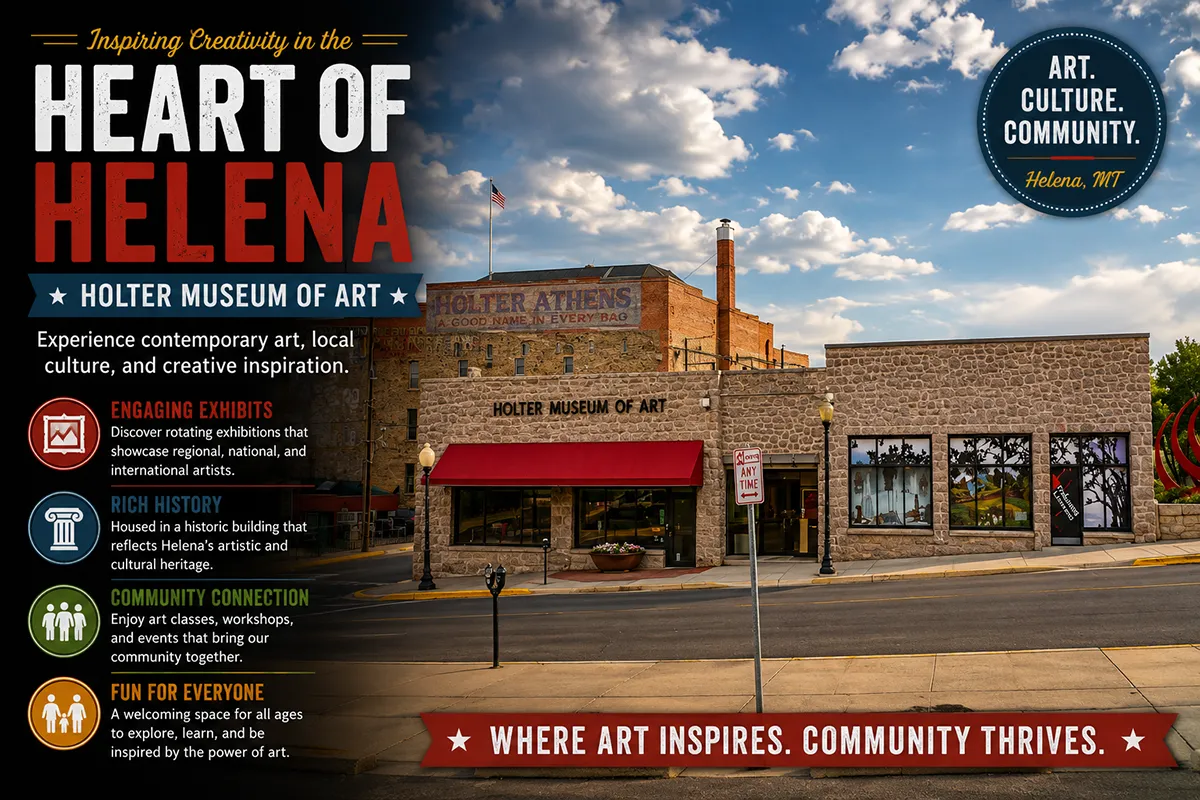
- Holter Museum of Art sits in downtown Helena, off Last Chance Gulch, in a converted former tool supply store
- Adults now pay $10 admission, though members, veterans, kids 17 and under, and seniors 70+ still get in free
- Fridays are free for everyone, regardless of age or membership status
- The museum was founded in 1987 specifically to showcase contemporary art, deliberately different from Montana’s more common Western-art tradition
- This is one of the best museums in Montana worth double-checking admission info for before you go, since several existing listings still say it’s free
Liked this article?
Add Roaming Montana as a preferred source so you see more of our articles and guides on Google.
Founded to Fill a Gap in Montana’s Art Scene
The Holter Museum of Art opened in 1987 inside a former tool supply store in downtown Helena. Its founders had a specific, deliberate goal in mind.
Montana already had strong representation of traditional landscape and Western art through institutions built around artists like Charlie Russell. The Holter’s founders saw a gap: nowhere in the state offered consistent public exposure to contemporary, more cosmopolitan art. They built the Holter specifically to fill it.
That decision was genuinely countercultural for Montana at the time. Western and frontier-era art wasn’t just popular here — it was, and largely still is, the default expectation visitors and locals alike bring to a Montana art museum.
Choosing to build an institution around contemporary work instead took a specific kind of confidence in a state where cowboy art sold reliably and abstract or conceptual work didn’t have an obvious built-in audience.
That founding philosophy still shapes the museum today. If you’ve spent time at the C.M. Russell Museum in Great Falls and want a genuinely different kind of Montana art experience, this is exactly the counterpoint.
Where Russell’s work captures a specific, romanticized frontier moment frozen in time, the Holter’s rotating shows are deliberately about right now — whatever regional or national contemporary artists happen to be doing this year, not a century ago.
<!– wp:image –> <!– IMAGE PLACEHOLDER Position: Hero image, top of post before TL;DR Alt text: “Exterior of Holter Museum of Art in downtown Helena, Montana” Caption: “Holter Museum of Art occupies a converted former tool supply store in downtown Helena, near Last Chance Gulch.” “Realistic travel photography, converted industrial-style museum building exterior in downtown Helena Montana, modern architectural addition blending with historic brick, warm afternoon light, wide-angle composition, no visible people, editorial travel photography style” –> <!– /wp:image –>
Admission Isn’t Free Anymore, But It’s Not Expensive Either
Here’s the update most existing guides haven’t caught: as of the museum’s current policy, adults ages 18 to 69 who aren’t members or veterans pay $10 for general admission.
That’s a genuine change from the museum’s long-standing reputation as a free, walk-in-anytime cultural space. Several travel sites and directories still describe the Holter as completely free, which will surprise visitors who show up expecting no-cost entry.
The good news is the fee comes with real exceptions. Members, veterans, children 17 and under, and seniors 70 and over don’t pay anything. And every Friday, admission is free for everyone, regardless of age, membership, or veteran status.
If you’re planning a Helena museum day and want to keep costs down, a Friday visit is the easy move.
Five Galleries Built to Talk to Each Other
A $2 million capital campaign, completed in 2002, added 6,500 square feet to the museum and pushed its total exhibition space to roughly 17,000 square feet across five distinct galleries.
The Millikan Gallery functions as the museum’s spatial and symbolic center. You pass through it moving between any of the other galleries, and it typically displays pieces from the permanent collection. The High Gallery, part of the newer addition, is an expansive space built specifically to give large-scale pieces the room they need.
The Bair Gallery is the first room visitors encounter, effectively setting the tone for the rest of a visit. Two smaller galleries round out the five-space layout, typically used for more intimate or experimental work that wouldn’t suit the larger rooms.
Museum curators have described the design intent as deliberately relational — galleries built to reflect on and communicate with each other rather than functioning as isolated, unrelated rooms.
That’s a genuinely thoughtful curatorial approach, and it means the sequence you walk through actually matters to how the exhibitions read, not just what’s hanging on each individual wall.
The 2002 expansion also improved sightlines between the education spaces and the galleries themselves, letting students see directly from classroom areas into active exhibition space and back again.
<!– wp:image –> <!– IMAGE PLACEHOLDER Position: After the Five Galleries section Alt text: “Contemporary art gallery interior at Holter Museum of Art in Helena, Montana” Caption: “The museum’s five galleries were designed to relate to and reflect on each other rather than function as isolated rooms.” “Realistic photography, modern contemporary art gallery interior with white walls and large-scale paintings, natural light from high windows, minimalist gallery design, editorial museum photography style, no visible people” –> <!– /wp:image –>
A Small Permanent Collection, A Lot of Rotating Work
Don’t come expecting a massive standing collection. The Holter holds roughly 25 permanent pieces, a genuinely modest number compared to Montana’s larger history museums.
What makes up for that is turnover. The museum rotates 15 to 20 solo and group exhibitions through its galleries every year, meaning the experience changes meaningfully from one visit to the next.
Past exhibitions have included a major retrospective of legendary Montana artist Robert DeWeese, alongside work from three of his former students, and a show from internationally recognized outsider artist James Castle.
Checking the current exhibition calendar before you go is genuinely worth doing here, more so than at a museum built around a large static permanent collection.
<!– wp:image –> <!– IMAGE PLACEHOLDER Position: After the Small Permanent Collection section Alt text: “Rotating contemporary art exhibition on display at Holter Museum of Art in Helena, Montana” Caption: “The Holter rotates 15 to 20 exhibitions through its galleries every year, keeping repeat visits genuinely different.” “Realistic photography, contemporary mixed-media art installation in a museum gallery setting, dramatic gallery lighting, editorial museum photography style, no visible people” –> <!– /wp:image –>
Practical Details Worth Knowing Before You Visit
A few policy details are worth knowing before you show up. Firearms and other weapons aren’t permitted anywhere on museum premises, though the policy specifically allows kirpans — ceremonial knives worn as a religious article of faith by Sikhs — as long as the blade is 4 inches or shorter, consistent with Montana and federal law.
Food and beverages aren’t allowed anywhere inside the museum, though bottled water is generally fine. Groups of 10 or more can request a scheduled group visit by contacting the museum’s education team directly, and Montana schoolchildren have access to docent-led tours as part of the museum’s education programming.
Funding partly comes through Montana’s coal severance tax, channeled into the state’s Cultural and Aesthetic Projects Trust Fund. That’s the same funding mechanism supporting several other Montana art institutions, including Western Heritage Center and Yellowstone Art Museum in Billings.
<!– wp:image –> <!– IMAGE PLACEHOLDER Position: After the Practical Details section Alt text: “Downtown Helena street scene near Last Chance Gulch close to Holter Museum of Art” Caption: “Holter Museum of Art sits within an easy walk of Helena’s Last Chance Gulch and the state capitol.” “Realistic travel photography, historic downtown Helena Montana street with brick storefronts, warm afternoon light, mountains visible in the distance, wide-angle composition, no visible people, editorial travel photography style” –> <!– /wp:image –>
Visiting With Kids
Contemporary art museums can be a harder sell for younger children than a hands-on history or science museum, and the Holter is no exception. That said, kids 17 and under get in free regardless of the day, which removes at least one barrier to a family visit.
The museum’s education programming is built around all ages and abilities, and school groups regularly visit through docent-led tours. If your kids respond well to open-ended, interpretive art rather than needing interactive buttons and displays, the Holter’s rotating exhibitions can genuinely surprise them.
I’d still recommend keeping a visit relatively short with younger children, and treating it as one stop in a fuller downtown Helena day rather than the entire day’s activity.
Quick Questions I Get Asked
Is the Holter the same as the Montana Historical Society Museum?
No — they’re separate institutions a short walk apart. The Holter focuses on contemporary art; the Historical Society’s new Heritage Center covers state history broadly, including a large C.M. Russell art collection of its own.
Do we need to book tickets in advance?
Generally no for individual visitors, though groups of 10 or more should contact the museum directly to schedule a visit.
Is photography allowed in the galleries?
Policies can vary depending on the specific exhibition, particularly for loaned contemporary work, so it’s worth asking at the front desk when you arrive.
Why did the museum start charging admission after being free for so long?
The museum hasn’t publicly detailed every factor behind the change, but it fits a broader pattern among nonprofit cultural institutions balancing free community access against the real costs of maintaining rotating, high-quality contemporary exhibitions. The generous free exceptions — members, veterans, kids, seniors, and every Friday — suggest an effort to keep the museum genuinely accessible despite the new fee.
What Other Guides Get Wrong
- The admission fee change is the biggest gap. Multiple existing travel listings still describe the Holter as completely free, which will genuinely surprise visitors expecting no-cost entry.
- Friday’s free admission rarely gets mentioned, even though it’s the easiest way to visit at no cost if your schedule allows it.
- The museum’s deliberate contemporary-art mission gets flattened into generic “local art gallery” language, losing the specific reasoning behind why it exists and how it differs from Montana’s more common Western-art institutions.
- The rotating exhibition schedule rarely gets flagged as a reason for repeat visits, since most guides describe the collection as if it’s static.
Personal Tips: What I Wish I Knew
- Check current admission policy before you go, not an old blog post. Given how recently the fee structure changed, it’s worth confirming directly with the museum rather than trusting older online listings.
- Plan a Friday visit if cost matters to your itinerary. It’s the one guaranteed free day for every visitor.
- Check the current exhibition schedule ahead of time. Unlike a museum built around a big permanent collection, what’s on view here changes substantially throughout the year.
- Wednesday evenings offer extended hours, running until 8 p.m., which is a good option if your days are packed with outdoor activities and you want an evening culture stop instead.
- Pair this with the Montana Historical Society Museum a short walk away for a full Helena museum day covering both contemporary art and state history.
How This Fits a Helena Visit
Helena’s downtown core, centered on Last Chance Gulch, makes it easy to combine several stops into one walkable day. The Holter sits right in that mix, a short walk from the Montana State Capitol and the Montana Historical Society Museum‘s new Heritage Center.
Our Helena things-to-do guide covers the rest of what’s worth building into your visit. Between the Capitol, the Historical Society’s Heritage Center, and the Holter, downtown Helena offers a genuinely dense cluster of free or low-cost cultural stops within easy walking distance of each other — a rarity for a state capital this size.
If you’re mapping out museums across the whole state, our Montana museums guide shows how this stop fits into the bigger picture.
Practical Info
| Address | 12 E Lawrence St, Helena, MT 59601 |
| Phone | (406) 442-6400 |
| Hours | Tue 10 a.m.–5:30 p.m., Wed 10 a.m.–8 p.m., Thu–Sat 10 a.m.–5:30 p.m., Sun 12–4 p.m.; closed Monday [verify current hours] |
| Closures | First few weeks of January, Nov 23, Dec 25 |
| Admission | $10 adults (18-69, non-member/veteran); free for members, veterans, children 17 and under, seniors 70+; free for all on Fridays [verify current pricing] |
| Time needed | 1–1.5 hours |
| Good for | Contemporary art enthusiasts, downtown Helena day trips, anyone wanting a break from Western-genre art |
| Nearby pairing | Montana Historical Society Museum, Montana State Capitol |
Final Thoughts
Holter Museum of Art still fills the same role it was built for in 1987: a genuine, deliberately contemporary counterpoint to Montana’s Western-art tradition. The admission policy has changed, but the mission and the rotating, always-different exhibition schedule haven’t.
What I appreciate most about this museum is how unapologetic it’s stayed about that original mission. It would have been easy, over nearly four decades, to drift back toward the safer, more commercially reliable Western-art tradition most Montana visitors expect.
Instead, the Holter has kept pushing rotating, sometimes challenging contemporary work in front of a state audience that didn’t necessarily ask for it — and that stubbornness is exactly why it’s worth a stop.
Pin this for your Helena trip planning, and double-check current admission details before you go. If you’ve caught a particularly memorable rotating exhibition, I’d love to hear about it in the comments.