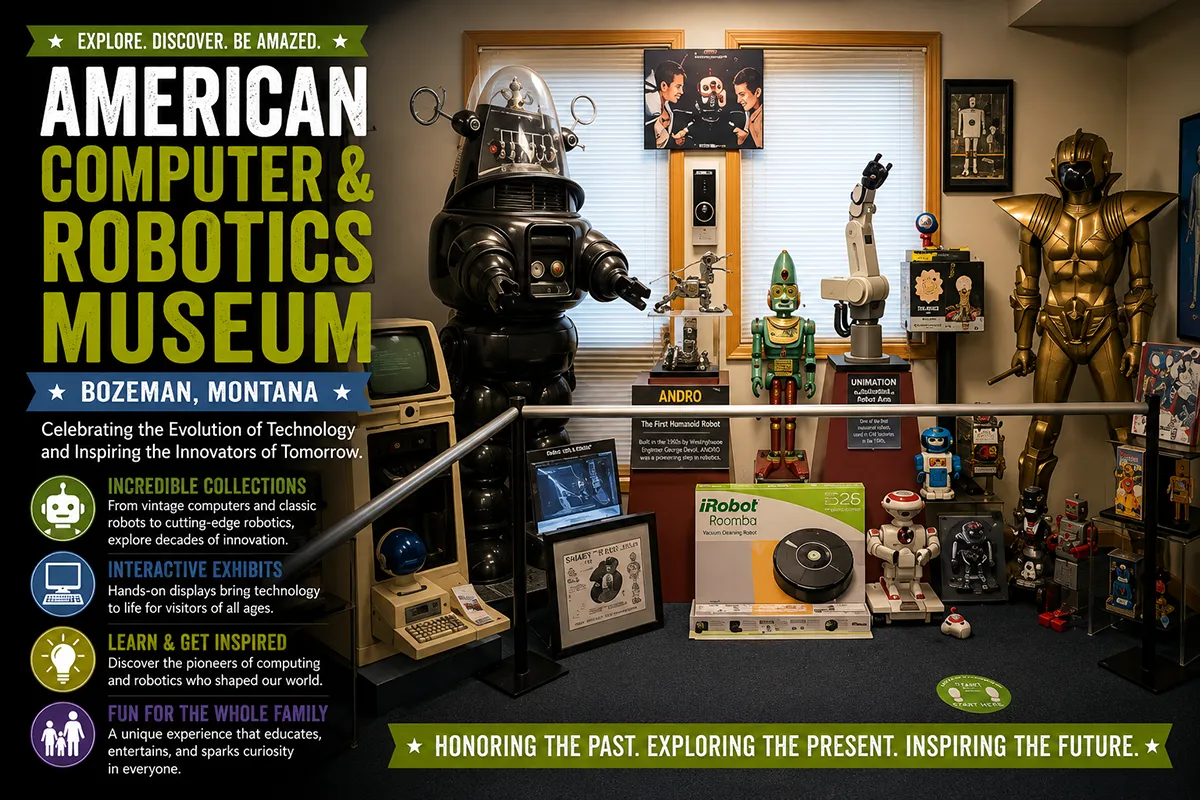
A Harvard scientist once called this “inch for inch, the best museum in the world.” It’s tucked into a small building near Montana State University, and most visitors driving to see dinosaurs half a mile away have no idea it exists.
- American Computer & Robotics Museum (ACRM) in Bozeman traces 4,000 years of information history, from ancient cuneiform tablets to modern AI
- It’s likely the oldest continuously operating computer history museum in the world, founded in 1990
- Real NASA hardware is on display, including the last surviving Apollo-mission mainframe computer
- Admission is $10 for adults, and most visits run 2 to 3 hours
- This is one of the best museums in Montana that even Bozeman locals routinely forget exists
Liked this article?
Add Roaming Montana as a preferred source so you see more of our articles and guides on Google.
An Antique Shop Find That Became a Museum
Every good museum has an origin story. This one starts with a misidentified cash register.
In the early 1980s, George Keremedjiev was walking through an antique shop in Florida when he spotted an unusual mechanical device. The shop owner had it labeled as an old cash register. It wasn’t.
That misidentified object turned out to be an early calculating device, and it sparked a genuine obsession. George and his wife, Barbara, spent the following years building a serious collection, and in May 1990, they opened it to the public in Bozeman as a nonprofit museum.
George passed away in November 2018. Barbara, the museum’s board, and its small staff have kept his mission going ever since: collect, preserve, interpret, and display the artifacts and history of the Information Age.

Real NASA Hardware, Not Replicas
This is the detail that surprises most first-time visitors. Several of the space artifacts here aren’t reproductions.
The museum holds a UNIVAC 418-II, the last surviving mainframe computer NASA used for the Apollo missions, including telemetry support for Apollo 11 in 1969.
NASA later reused the same machine in 1977 for the first Space Shuttle Approach and Landing Tests on the Enterprise orbiter, before retiring it and donating it to ACRM.
Think about what that single machine actually witnessed over its working life. It processed data during humanity’s first crewed Moon landing, then went on to support the earliest tests of the vehicle that would define American spaceflight for the next three decades. Very few artifacts anywhere connect those two specific chapters of space history in one physical object.
You’ll also find an Apollo Guidance Computer on loan from the National Air and Space Museum, alongside a watch worn on the Moon by Apollo 15 Commander David Scott. That’s genuinely rare material to find outside the Smithsonian.
Signed artifacts add another layer of authenticity. An original Altair 8800 carries Ed Roberts’ signature. An original Apple I is signed and was personally donated by Steve Wozniak himself.
Four Thousand Years, One Small Building
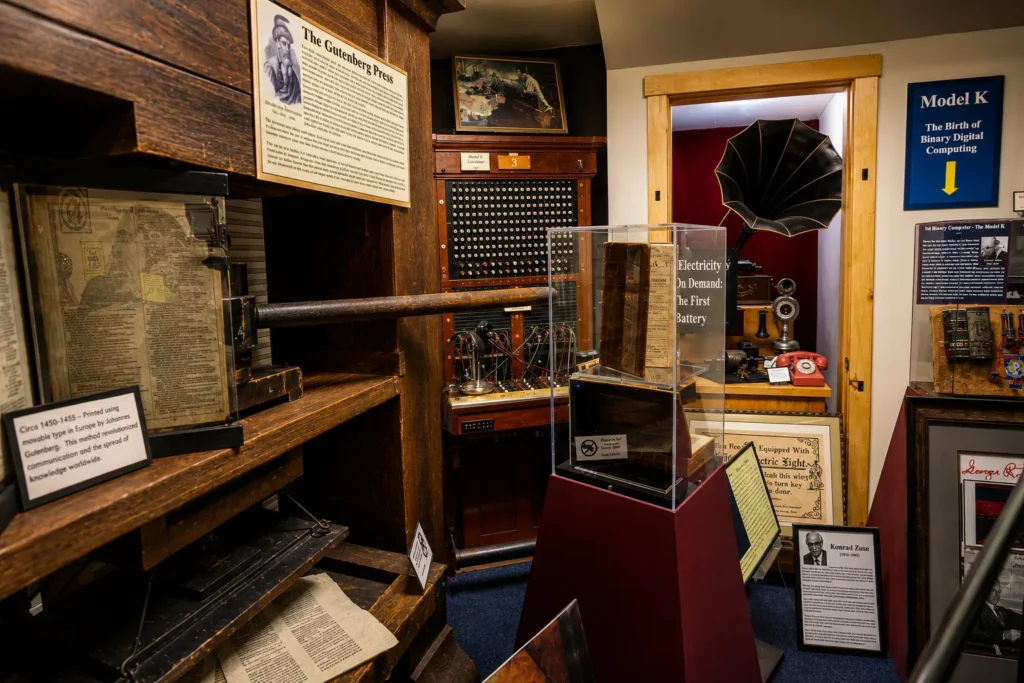
The museum’s core exhibit, “Benchmarks of the Information Age,” covers an almost absurd span of time. It starts around 1860 B.C.E. with the earliest writing systems and runs through 1976 C.E. and the Apple I personal computer.
Along the way, you’ll pass genuinely rare original documents: writings from John Locke, an original printing of Isaac Newton’s Principia, and signed materials from Thomas Jefferson, James Madison, Alexander Graham Bell, Samuel Morse, and Ada Lovelace. First editions from Charles Babbage and John von Neumann sit nearby.
A dedicated Enigma exhibit covers WWII codebreaking, consistently mentioned by visitors as one of the strongest sections in the building.
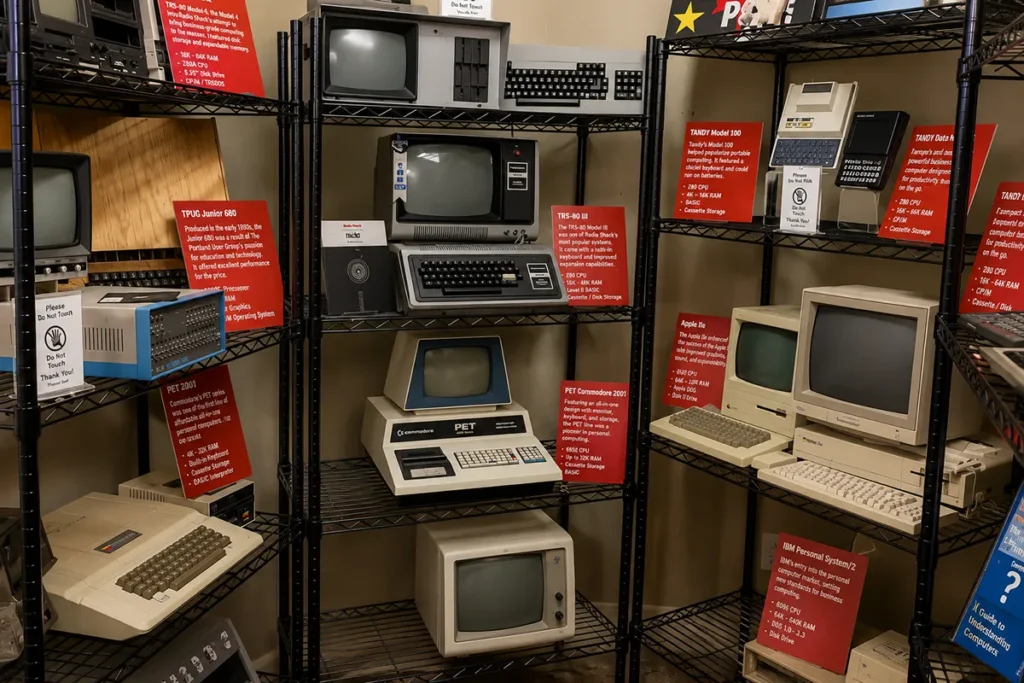
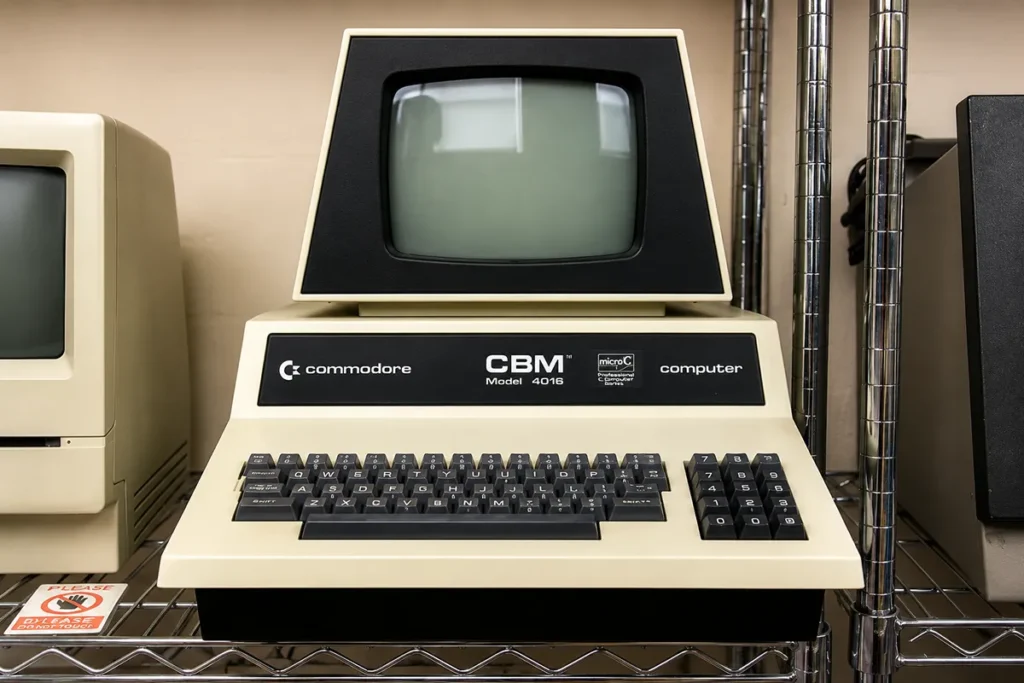
Early personal computers fill out another gallery: the Altair 8800, IMSAI 8080, Commodore PET, Sol-20, Apple II, Apple III, Apple Lisa, Apple Macintosh, KIM-1, and SYM-1, tracing the entire early home computing boom in one room.
The IdeaLab rounds things out with year-round hands-on learning programs built around core computing principles. It’s the one part of the museum that changes most often, so a repeat visit a year or two later won’t feel identical to your first.
Awards That Prove the Scientific Community Takes This Seriously
This isn’t just a nostalgia stop for tech enthusiasts. The museum carries genuine institutional weight in the history-of-science world.
In 1994, it won the Dibner Award for Excellence in Museum Exhibits from the Society for the History of Technology. Since 1997, it’s hosted the Stibitz-Wilson awards with support from Montana State University, honoring major contributors to computing and biodiversity technology.
Past honorees read like a who’s-who of computing history: Jack Kilby, Ted Hoff, and Federico Faggin among the 1997 group; Eric Horvitz, Douglas Hofstadter, and Hans Moravec among more recent honorees. That’s the kind of company this small Bozeman museum keeps.
Harvard biologist Edward O. Wilson, after visiting, described it as “Inch for inch, the best museum in the world.” The museum has also earned a TripAdvisor Certificate of Excellence six years running, and it’s rated the #1 Thing to Do in Bozeman on that platform.
The Antikythera Mechanism and the Ancient World
It’s easy to assume a computer museum starts with electricity. This one doesn’t, and that’s part of what makes it genuinely different from a typical tech museum.
A replica of the Antikythera mechanism, an ancient Greek analog device used to predict astronomical positions, sits alongside cuneiform tablets nearly 4,000 years old. The point being made is subtle but effective: humans have been building increasingly sophisticated information and calculation tools for almost the entirety of recorded history, not just the last 80 years.
That framing changes how the rest of the museum lands. By the time you reach the Apollo Guidance Computer or the signed Apple I, you’ve already walked through millennia of the same basic human impulse — building better tools to store, process, and share information.
Visiting With Kids
This museum tends to surprise parents. It’s not a hands-on children’s science center in the traditional sense, but it holds attention better than you’d expect from a collection this dense with historic documents and vintage hardware.
The IdeaLab is where kids get genuinely hands-on, working through activities built around core computing principles rather than just observing. Older kids and teenagers with any interest in technology tend to do especially well here, often recognizing early computer and video game hardware from what they’ve read about online.
I’d pair a visit here with something more physically active if your kids are younger than 8 or 9. The density of information in each gallery rewards a slower, more attentive pace than very young children typically have patience for.
Quick Questions I Get Asked
Is this really the oldest computer museum in the world?
It’s widely credited as likely the oldest continuously operating museum dedicated specifically to computing history anywhere in the world, based on its 1990 founding date and unbroken operation since.
Do we need a technical background to enjoy this?
Not at all. Staff give a roughly 10-minute introduction designed for visitors at any knowledge level, and the exhibits are built to work for casual visitors and serious tech enthusiasts alike.
Is parking available on-site?
The museum sits in a small commercial area near MSU’s campus with nearby parking options, though exact availability can shift depending on university events. Building in a few extra minutes on game days or move-in weekends is a reasonable precaution.
How does this compare to Museum of the Rockies?
They’re genuinely complementary rather than redundant. Museum of the Rockies covers dinosaurs and natural history; ACRM covers the history of human invention and information technology. Visiting both in the same day gives you a remarkably complete picture of “the history of everything” within half a mile of walking.
Most Bozeman travel content lists this museum in a single sentence sandwiched between Museum of the Rockies and downtown shopping. A few specific gaps show up repeatedly:
- The real NASA hardware rarely gets highlighted. Most guides don’t mention that the Apollo-era mainframe on display is the actual, last-surviving unit, not a replica.
- The founding story gets skipped entirely, losing one of the more charming small-museum origin stories in the state.
- The awards and academic recognition go unmentioned, even though they place this museum in genuinely serious company within the history-of-technology field.
- Visit-length expectations run short. Reviewers consistently note this “small” museum takes far longer to properly see than its footprint suggests.
Personal Tips: What I Wish I Knew
- Take the staff introduction seriously. It’s roughly 10 minutes, and it gives you the context needed to actually appreciate what you’re about to see rather than wandering in cold.
- Budget more time than the building’s size suggests. Two to three hours is typical; enthusiasts and history buffs should plan for four to five.
- Pair this with Museum of the Rockies on the same day. They’re half a mile apart, and together they give you both deep prehistory and the history of human invention in a single Bozeman afternoon.
- Don’t expect museum-branded souvenirs in the gift shop. It’s stocked with books and educational toys instead, which is honestly more useful than another magnet.
- This is a genuinely great rainy or cold-day option, especially if you’ve already done the dinosaur halls and want something different that still holds a family’s attention.
How This Fits a Bozeman Visit
Bozeman’s museum scene tends to get reduced to a single line: “go see the dinosaurs.” That undersells what’s actually available within walking distance of MSU’s campus.
ACRM sits one block west of the university, close to Bobcat Stadium and the Brick Breeden Fieldhouse. Our Bozeman things-to-do guide covers the rest of what’s worth building into your visit, and our Museum of the Rockies guide is the natural pairing if you want a full day of Bozeman museums.
If you’re already building out a broader list of unusual, worth-the-detour Montana stops, our Montana bucket list post covers other under-the-radar attractions in the same spirit as this one. And if you’re mapping out museums across the whole state, our Montana museums guide shows how this stop fits into the bigger picture.
Bozeman as a whole rewards visitors who budget time for its quieter, less-marketed attractions rather than rushing straight from the airport to Yellowstone. This museum is exactly the kind of stop that separates a good Bozeman visit from a genuinely memorable one.
Practical Info
| Address | 2023 Stadium Dr, Ste A, Bozeman, MT 59715 |
| Phone | (406) 582-1288 |
| Hours | Tuesday–Sunday, 10 a.m.–4 p.m.; closed Mondays and holidays [verify current hours] |
| Admission | $10 adults, $7.50 seniors (65+) and military, $5 youth (10-17) and students, free for kids 9 and under [verify current pricing] |
| Time needed | 2–3 hours; 4–5 hours for enthusiasts |
| Good for | Tech and history enthusiasts, families, rainy or cold-day Bozeman itineraries |
| Nearby pairing | Museum of the Rockies, rest of our Bozeman guide |
Final Thoughts
American Computer & Robotics Museum is proof that Bozeman’s museum scene goes well beyond dinosaurs. A misidentified antique shop find in Florida turned into one of the most scientifically respected small museums in the country, and it’s sitting quietly half a mile from one of Montana’s most-visited attractions.
What stays with me longest isn’t any single artifact, impressive as the Apollo hardware is. It’s the sense of continuity the museum builds across four millennia in one small room — watching the exact same human impulse to record, calculate, and share information run from clay tablets through punch cards to the device most visitors are carrying in their pocket on the way out the door.
Pin this for your Bozeman trip planning. If you’ve spotted the signed Apple I or gotten lost in the Enigma exhibit, I’d love to hear what stuck with you in the comments.