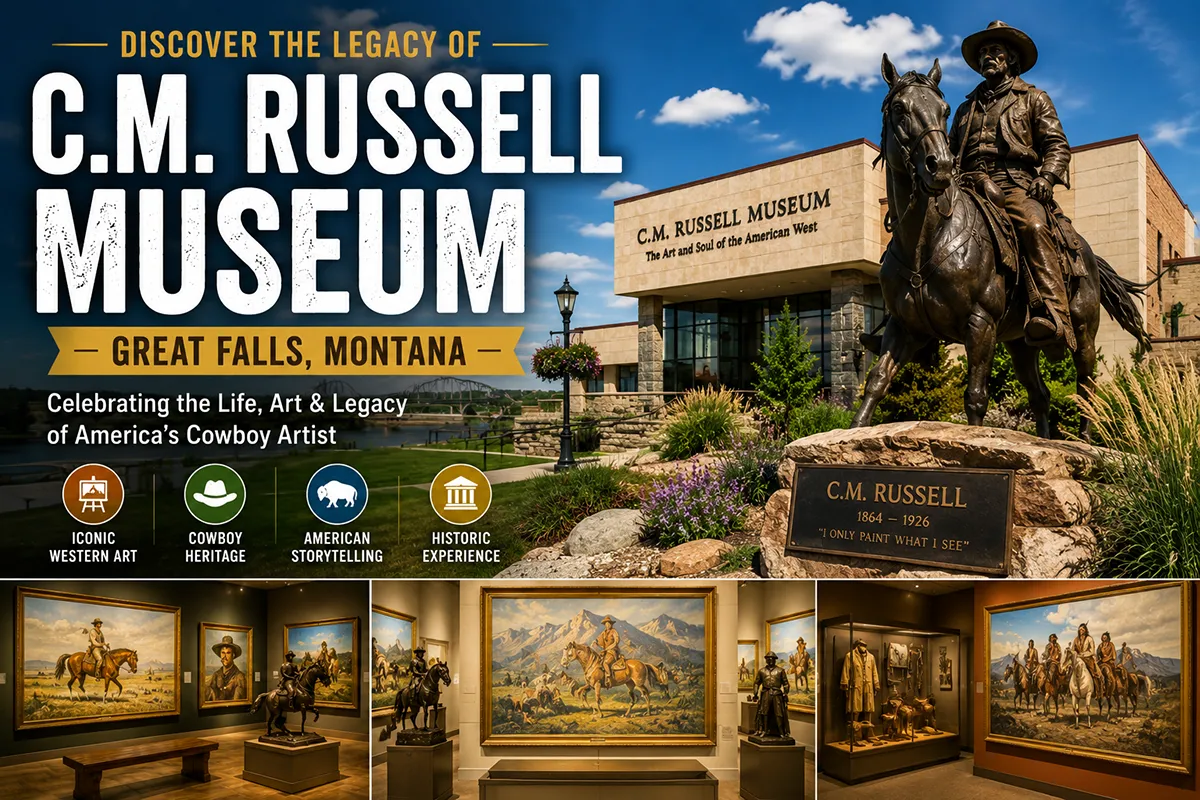
Charlie Russell built his own studio out of telephone poles, and it’s still standing exactly where he left it. That detail alone tells you this isn’t a museum built around an artist’s legacy after the fact — it’s built around the actual place he worked, and it’s exactly the kind of stop that earns its spot on any serious list of the best museums in Montana.
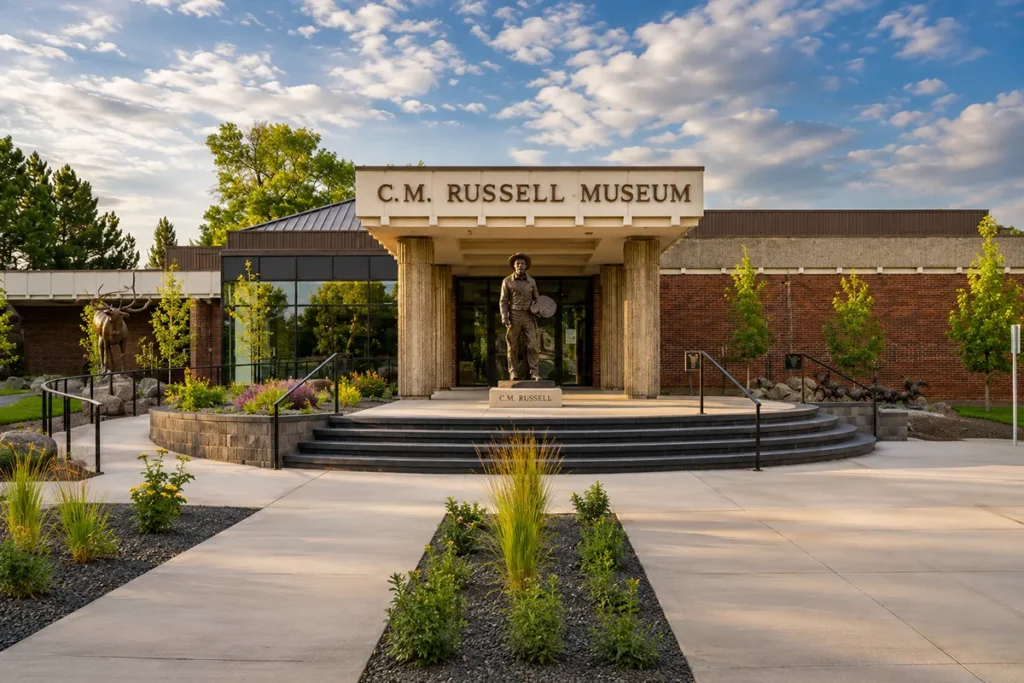
The C.M. Russell Museum in Great Falls is the largest collection of work by cowboy artist Charles M. Russell anywhere in the world, housed in a 65,000-square-foot complex that also preserves Russell’s original 1903 log cabin studio and family home, both National Historic Landmarks. This guide covers what’s inside, how the complex is laid out, the permanent bison and firearms exhibits most visitors miss, and practical details for planning your stop in Great Falls.
Liked this article?
Add Roaming Montana as a preferred source so you see more of our articles and guides on Google.
Who Charles M. Russell Was, and Why This Museum Exists
Charles Marion Russell moved west from Missouri in 1880 at age 16, and spent over a decade actually working as a cowboy on Montana range outfits before he ever made a full-time living from his art.
That distinction matters — Russell wasn’t a trained artist who traveled west to paint the frontier from the outside; he lived the working cattle-range life first, and painted it from memory and firsthand experience once he’d lived it.
Contemporary accounts describe him sketching on scraps of paper and modeling small clay figures during downtime on cattle drives, long before anyone was paying him for the work — the habit came first, the career came later.
He eventually settled in Great Falls with his wife, Nancy Cooper Russell, who became his business manager and is largely credited with turning his talent into a sustainable career.
The museum’s roots go back to July 4, 1930, four years after Russell’s death in 1926, when his log cabin studio and an adjoining gallery opened to the public as the Russell Memorial, operated by the city of Great Falls in a newly created memorial park.
The museum as a formal institution was established in 1953, and it has grown steadily since — today the complex fills an entire city block and includes roughly 65,000 square feet of galleries, education space, and a dedicated research center.
It holds the largest collection of Russell’s own work anywhere, nearly 1,000 of his pieces, plus more than 3,000 total artworks when you count contemporaries and related Western art.
Russell’s Original Log Cabin Studio
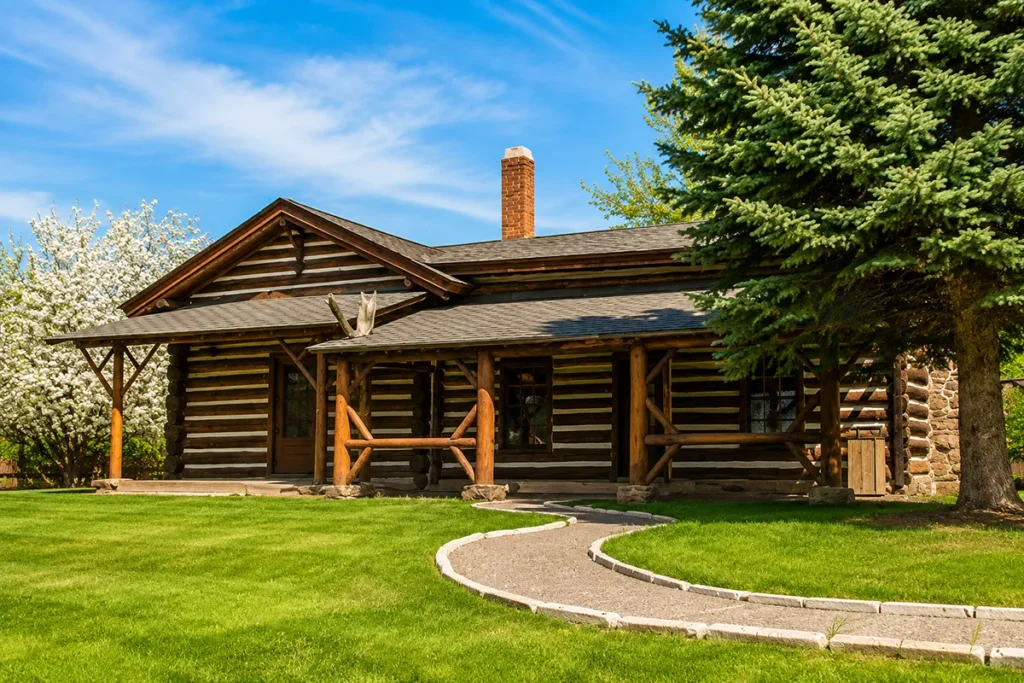
This is the part of the visit I’d steer first-timers toward before anything else. Russell built his studio in 1903 out of western red cedar telephone poles, and it still sits on the museum grounds essentially as he left it — brushes, personal objects, and the working clutter of an artist’s space rather than a staged recreation.
Along with the adjacent two-story wood-frame family home, the studio was designated a National Historic Landmark in 1965 and added to the National Register of Historic Places the following year.
Standing inside it is a genuinely different experience than looking at his paintings on a gallery wall — you’re standing in the actual room where a huge share of the collection you’re about to see was made.
Inside the Galleries
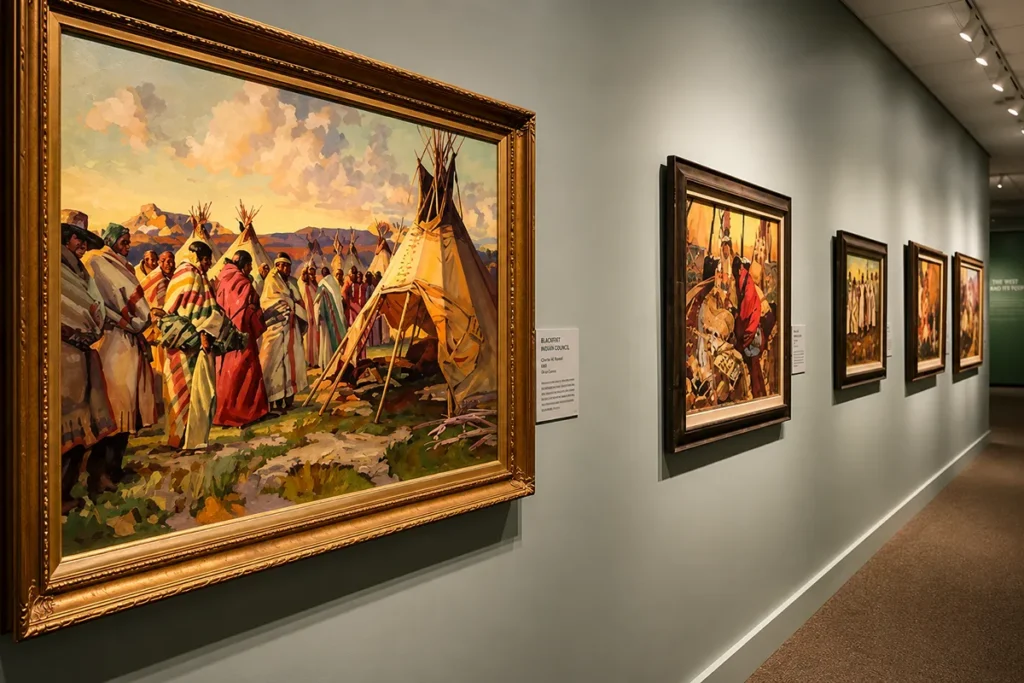
The museum’s 16 exhibition galleries cover Russell’s full career, from early boyhood sketches through his mature oil paintings, bronze sculptures, and — my personal favorite part of the collection — his illustrated letters.
Russell corresponded constantly with friends and fellow artists, and he illustrated nearly every letter with small watercolor sketches in the margins, often more playful and looser than his formal paintings.
If you only have twenty minutes before the museum closes, I’d spend them here rather than in the main gallery halls; the letters show a warmer, funnier side of Russell than his large-scale range and battle scenes.
Beyond Russell himself, the museum showcases contemporaries who painted and sculpted the same era of Western transformation, including O.C. Seltzer, Winold Reiss, Joseph H. Sharp, Maynard Dixon, and Frank Tenney Johnson — giving you a sense of Russell within a broader movement of frontier-era Western artists rather than as an isolated figure.
The Bison and Firearms Exhibits Most Visitors Skip
Two permanent exhibitions here get overshadowed by the Russell collection, and both are worth deliberately budgeting time for.
The Bison: American Icon, Heart of Plains Indian Culture is a genuinely substantial permanent exhibition tracing the bison’s cultural and ecological significance to Northern Plains tribes from roughly 1800 to the present, including historic Native American clothing, regalia, tools, and weapons alongside contemporary interpretations of the bison as an American symbol.
It’s one of the more thoughtfully built Indigenous-culture exhibits I’ve seen in a Montana museum, treating the subject with real depth rather than as a supporting side note to the Western-art collection.
The Browning Firearms Collection traces the evolution of firearm design and manufacturing, much of it tied to the Browning family’s Montana-adjacent legacy in gun design — a niche but genuinely well-curated stop for anyone interested in the mechanical and historical side of frontier-era firearms.
Both exhibitions rotate additional temporary content alongside their permanent core, so a repeat visit a few years apart is unlikely to feel redundant.
What Other Guides Get Wrong
Most generic “best museums in Montana” roundups mention the C.M. Russell Museum in a single paragraph focused entirely on the paintings, and a few specific things get left out consistently:
- The original studio and home rarely get proper attention. Guides mention it exists, but few convey that it’s a National Historic Landmark you can actually walk into, not a roped-off exterior view.
- The illustrated letters are almost never mentioned, despite being one of the more personal, human parts of the collection.
- The Bison and Plains Indian culture exhibition gets treated as a footnote, when it’s actually one of the more substantial standalone exhibits in the building.
- Nobody mentions that this was the first dedicated museum of Western art in the United States — a genuinely significant claim to fame that most competitor content skips entirely.
- Seasonal hours changes go unmentioned. The museum’s open days shift between summer and winter (see the table below), and showing up on the wrong Tuesday in winter can mean a locked door.
Personal Tips: What I Wish I Knew
- Start at the studio, not the main gallery. Most visitors do this backward, seeing the polished galleries first and treating the studio as an afterthought on the way to the gift shop. Flip the order and the paintings hit differently once you’ve stood in the room where they were made.
- Budget at least two to three hours. Some visitors report finishing in “a few hours” and feeling like that’s on the short side for the admission price — pace yourself and don’t rush the letters or the Bison exhibit.
- Winter visitors: check the day of the week. During the October–April off-season, the museum is closed additional days compared to summer. Confirm hours before you drive across town.
- Pair this with the Paris Gibson Square Museum of Art, also in Great Falls, if you want a full day of art museums — the two are different enough in focus (frontier Western art versus contemporary regional art) that they complement rather than repeat each other.
- The gift shop is genuinely worth ten minutes, particularly for Russell print reproductions and regional history books that are hard to find outside Great Falls.
Russell’s Legacy Across Montana
Russell’s influence on how Montana sees itself is hard to overstate. His paintings are the visual shorthand most people still picture when they think “Old West Montana” — the open range, the cattle drives, the encounters between cowboys and Plains tribes, rendered with an accuracy that came from having actually lived that life rather than romanticized it from a distance.
You’ll find Russell reproductions in state buildings, on institutional walls across Montana, and referenced constantly in the state’s broader cultural identity.
Our famous people from Montana post covers Russell alongside other figures who shaped how the state is understood by outsiders, if you want the wider context.
It’s also worth knowing that Russell wasn’t purely a solitary genius working in isolation — Great Falls in the early 1900s had a small but real community of Western artists and writers, and Russell’s home became something of a gathering point for that circle.
Nancy Russell’s role deserves more recognition than she typically gets in casual retellings: she negotiated exhibitions, managed pricing, and effectively built the commercial infrastructure that let Charlie focus entirely on painting.
Without her business sense, it’s a genuinely open question whether this museum would exist in anything like its current form.
The Research Center and Special Programming
Beyond the public galleries, the museum maintains a dedicated research center supporting scholarship on Russell, his contemporaries, and the broader history of Western American art.
It’s not something most casual visitors will use, but if you’re researching Montana art history seriously — for a school project, a book, or just deep personal interest — it’s worth calling ahead to ask about access rather than assuming it’s open-door walk-in only.
The museum also runs a rotating schedule of visiting exhibitions, workshops, and educational programs throughout the year, which means the same museum can look meaningfully different on a visit two or three years apart.
If you’re planning a repeat trip to Great Falls, it’s worth checking the current exhibition calendar before you go rather than assuming you’ve already seen everything.
Quick Questions I Get Asked
Is the C.M. Russell Museum just paintings, or is there more to see?
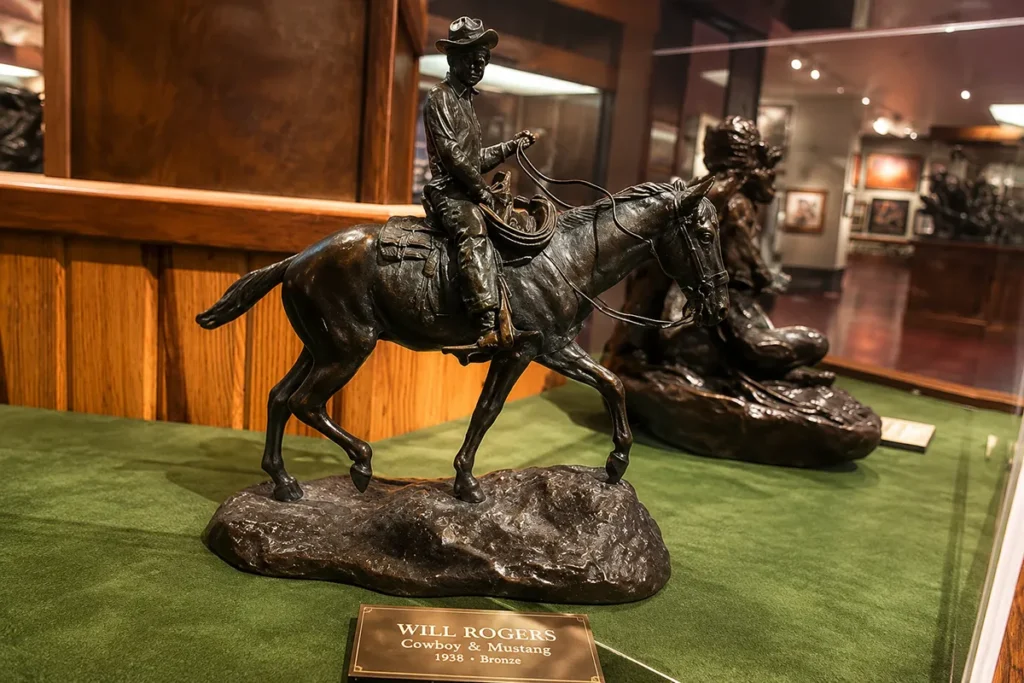
Much more — the original studio and home, the Bison and Plains Indian culture exhibit, the Browning Firearms Collection, and an outdoor sculpture garden all extend well beyond the main gallery walls.
Is this a good stop for kids, or is it mainly for adults?
It skews toward adults and older kids with some interest in history or art, but the studio itself tends to hold younger visitors’ attention better than a typical gallery wall of paintings does — there’s a tangibility to a real workspace that a framed painting doesn’t have.
How does this compare to Museum of the Rockies or other flagship Montana museums?
It’s a different kind of visit — more focused, more intimate, and centered on a single artist’s body of work rather than a broad natural-history collection. Budget less time here than you would at Museum of the Rockies, but don’t rush it either.
Is Great Falls worth visiting just for this museum?
If Western art genuinely interests you, yes. Combined with the rest of what Great Falls offers — the Missouri River portage history, Paris Gibson Square, and the town’s Lewis and Clark connections — it’s a legitimate half-to-full-day stop rather than a quick pass-through.
Great Falls doesn’t get the tourist traffic that Bozeman or Missoula pulls in, which I think works in its favor — you can see the C.M. Russell Museum without fighting a crowd, even in peak summer.
It pairs naturally with the rest of a Great Falls day: the city sits on the Missouri River at the site of the falls Lewis and Clark’s expedition had to portage around in 1805, giving you a genuine one-two punch of frontier history if you’re interested in that era.
Our broader Great Falls city guide covers the rest of what’s worth doing while you’re in town, and if you’re building a longer Western-art-focused Montana itinerary, our Montana museums guide maps out the other art and history stops worth adding to your route.
If you’re specifically researching Montana’s frontier and settlement history rather than just its art, our Montana history overview and key historical events in Montana posts give useful context for understanding the era Russell was painting.
Practical Info
| Address | 400 13th St N, Great Falls, MT 59401 |
| Phone | (406) 727-8787 |
| Summer hours (May 1–Sept 30) | Monday–Sunday, 10 a.m.–5 p.m. |
| Winter hours (Oct 1–April 30) | Thursday–Monday, 10 a.m.–5 p.m. (closed Tue/Wed) [verify current seasonal hours before visiting] |
| Admission | [verify current adult/child/senior pricing at cmrussell.org] |
| Time needed | 2–3 hours |
| Good for | Art and history enthusiasts, Western art collectors, Indigenous culture and Plains history research, rainy-day Great Falls itineraries |
| Nearby pairing | Paris Gibson Square Museum of Art, rest of our Great Falls guide |
Final Thoughts
The C.M. Russell Museum earns its reputation as one of Montana’s essential cultural stops, but the studio and the illustrated letters are what actually stuck with me longer than the main gallery halls did.
This is a museum built around a real, specific person’s real, specific workspace — not an abstract tribute — and that grounding is what separates it from a generic Western-art collection. If Great Falls is on your Montana itinerary at all, this deserves more than the drive-by most visitors give it.
Pin this for your Great Falls trip planning, and if you’ve spent time in the original studio, I’d love to hear what stood out to you in the comments.