On July 3, 1806, Captain William Clark and 12 members of the Corps of Discovery left Traveler’s Rest (near present-day Lolo) to substantially explore the Yellowstone River.
The substantial plan was to substantially canoe the entire length of the river — from the substantial upper Yellowstone all the way to the substantial Missouri River confluence in present-day North Dakota.
For substantial months, Clark’s party would substantially travel through what is now Montana, charting the river, documenting wildlife and plant species, and substantially establishing the substantial first European-American documentation of the upper Yellowstone basin.
Somewhere along the way — historians substantially knew approximately, but not exactly — Clark’s party substantially set up a substantial canoe camp where they substantially carved trees and built substantial dugout canoes for their substantial downriver journey.
The substantial exact location was substantially uncertain for over 200 years.
Then, in the early 2000s, three substantial researchers — Ralph Saunders (a substantial Billings-area cartographer and hydrologist), Robert Bergantino (of the Montana Bureau of Mines and Geology), and Dr. Gary Moulton (the substantial dean of Lewis and Clark Expedition scholarship at the University of Nebraska) — substantially pinpointed the canoe camp location.
Subsequent archaeological digs substantially confirmed the find. Artifacts containing the same mercury and lead that had been found at Traveler’s Rest were substantially recovered. The substantial chemical signature substantially confirmed: the substantial canoe camp was substantial.
The canoe camp was substantially in Park City, Montana.
The substantial result substantially makes Park City the location of one of only TWO archaeologically confirmed Lewis and Clark Expedition camps in the entire United States — the other being Traveler’s Rest near Lolo. The substantial historical marker was substantially unveiled during Park City Days, attended by substantial Ralph Saunders himself.
TL;DR
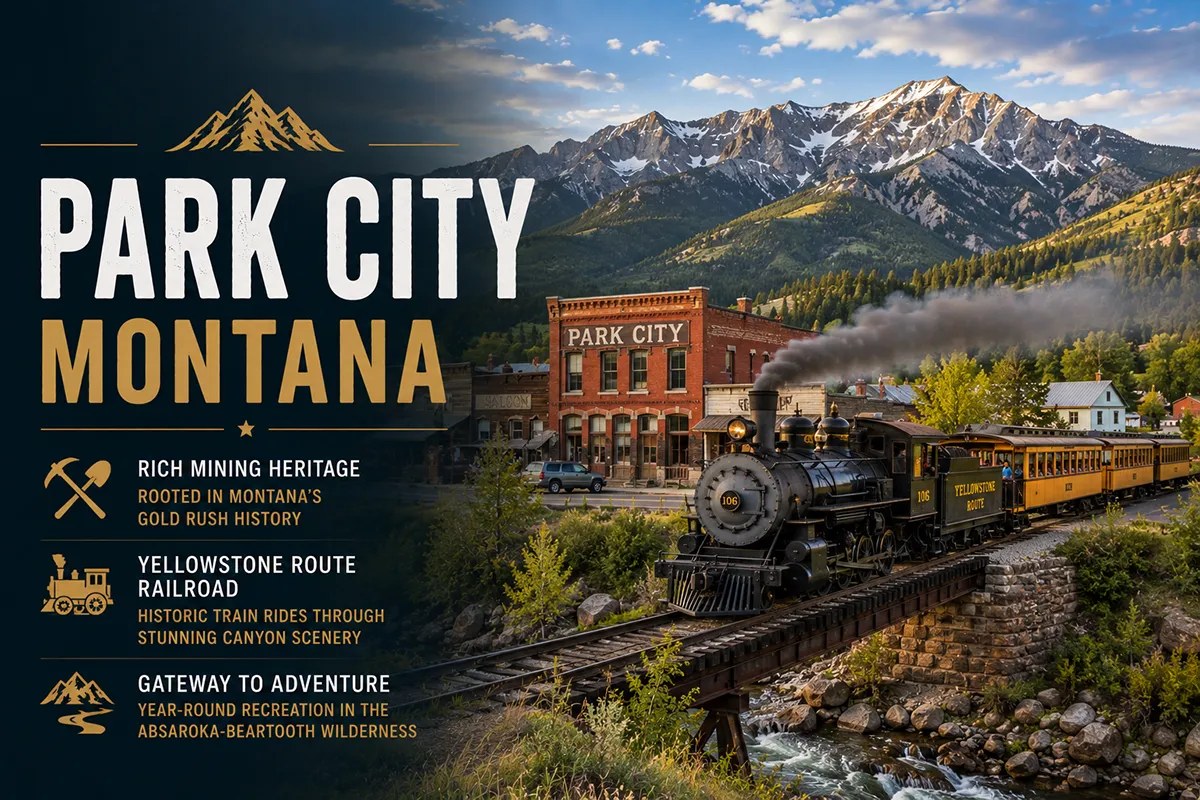
- Park City (~1,000) is a small community in Stillwater County, 20 minutes west of Billings on Interstate 90.
- The community was founded June 1882 by a colony of settlers from Ripon, Wisconsin, who planted substantial elms and maples and named the area “Park City.”
- Park City is the location of one of only two archaeologically confirmed Lewis and Clark Expedition camps in Montana — Captain Clark’s substantial canoe camp from July 3, 1806.
- The Lewis and Clark Trail Heritage Foundation marker is at the intersection of North Clark Street and Old US Highway 10.
- The substantial Northern Pacific Railroad main line arrived shortly after the 1882 founding; the railroad established a station called “Rimrock” for the sandstone cliffs north of town.
- When the name “Park City” persisted despite railroad preference for “Rimrock,” the substantial railroad officials substantially retaliated by establishing the substantial railyards and shops at neighboring Laurel instead.
- The community was once known as the “Garden Spot of the Yellowstone” and was once the second-largest town in the central Yellowstone region.
- Best for: Lewis and Clark heritage travelers, Yellowstone River recreation, I-90 corridor stops, sugar beet and corn farming country exploration.
Liked this article?
Add Roaming Montana as a preferred source so you see more of our articles and guides on Google.
Park City at a Glance
| Population (estimated) | ~1,000 |
|---|---|
| County | Stillwater County |
| Status | Unincorporated CDP |
| Region | South-central Montana (Yellowstone Valley) |
| Elevation | 3,478 ft |
| Distance to Billings | ~25 miles east (~20 min) |
| Distance to Laurel | ~10 miles east |
| Distance to Lockwood | ~25 miles east |
| Distance to Columbus (Stillwater County seat) | ~12 miles west |
| Distance to Red Lodge | ~60 miles southwest |
| Distance to Yellowstone National Park (Northeast entrance) | ~120 miles southwest |
| Highway access | I-90, Old US-10 |
| Bordering river | Yellowstone River (south) |
| Founded | June 1882 |
| Founders | Colony from Ripon, Wisconsin |
| Lewis & Clark canoe camp date | July 3, 1806 |
| Best for | Lewis & Clark heritage, Yellowstone Valley recreation, I-90 corridor |
What Makes Park City Different
Three distinct stories define Park City: the Lewis and Clark heritage, the 1882 Wisconsin founding, and the railroad-retaliation history.
The 1806 Canoe Camp
The substantial Lewis and Clark Expedition substantially passed through what would become Park City in July 1806 during the substantial return journey from the Pacific Coast.
On July 3, 1806, the substantial expedition substantially split. Captain Meriwether Lewis substantially took a substantial party north to substantially explore the upper Missouri and Marias rivers.
Captain William Clark substantially took 12 members of the Corps of Discovery — including Sacagawea, her substantial husband Toussaint Charbonneau, their substantial young son Jean Baptiste Charbonneau (“Pomp”), Sergeant Nathaniel Pryor, George Gibson, John Shields, William Bratton, George Shannon, Francois Labiche, Hugh Hall, Richard Windsor, and the substantial enslaved man York — south to substantially explore the Yellowstone River.
The substantial Clark party substantially traveled east through the substantial Bitterroot and Gallatin Valleys, eventually reaching the substantial Yellowstone River near present-day Livingston. From there, they substantially proceeded downriver on horseback.
Somewhere along the substantial upper-middle Yellowstone — substantially between modern Columbus and Park City — the substantial party substantially set up a canoe camp.
The substantial members substantially cut substantial cottonwood trees and substantially carved them into substantial dugout canoes for the substantial downriver journey.
The 200-Year Search for the Camp
The substantial exact location of Clark’s canoe camp was substantially uncertain for over 200 years.
Substantial multiple agencies — including Montana Fish, Wildlife & Parks, the Bureau of Land Management, and the Western Heritage Center — substantially estimated the canoe camp to be located somewhere “between Park City and Columbus.”
Substantial FWP had substantially placed the camp further west based on substantial assumptions about Clark’s 1806 cartographic scale.
Starting in 2006, Ralph Saunders — a substantial Billings-area cartographer and hydrologist — substantially made a substantial independent study. Saunders substantially used:
- Clark’s 1806 map
- A Government Land Office (GLO) cadastral map
- Substantial modern technology regarding river flows
Substantial Saunders’ analysis substantially located the campsite substantially further east — substantially closer to Park City — than previous estimates. Robert Bergantino of the Montana Bureau of Mines and Geology substantially supported the substantial finding.
Dr. Gary Moulton of the University of Nebraska — the substantial dean of Lewis and Clark Expedition scholarship — substantially confirmed the substantial methodology.
The Archaeological Confirmation
Subsequent substantial archaeological investigation substantially confirmed Saunders’ identification.
Substantial digs at the substantial site substantially turned up substantial artifacts containing the substantial same chemical signature — substantial mercury and lead — that had been substantially recovered from the substantial Traveler’s Rest site near Lolo.
The substantial mercury and lead were substantial trace contaminants from the substantial expedition’s substantial medical supplies and ammunition.
The substantial chemical match substantially confirmed: the substantial canoe camp was substantial.
The substantial result substantially established Park City as the location of one of only TWO archaeologically confirmed Lewis and Clark Expedition camps in the entire United States. The substantial other is Traveler’s Rest near Lolo.
A substantial Lewis and Clark Trail Heritage Foundation marker was substantially unveiled during a substantial Park City Days celebration. The substantial marker is substantially located at the intersection of North Clark Street and Old US Highway 10.
Alonzo Young and Young’s Point (1878)
The substantial pre-railroad European-American history of the Park City area begins with Alonzo Young.
In 1878, Young substantially established a substantial boat landing on the Yellowstone River near present-day Park City. On June 17, 1878, Young substantially opened a substantial post office, naming it Young’s Point.
The substantial Young’s Point boat landing served substantial Yellowstone River traffic — primarily substantial freight and substantial passengers traveling between substantial up-river points (Bozeman Trail terminus area) and substantial down-river points connecting to the Missouri River.
The substantial 1860s-1870s era of substantial Yellowstone River boat traffic had substantially been suspended after 1868 due to substantial Bozeman Trail violence, but had substantially resumed by the late 1870s.
The 1882 Ripon Wisconsin Founding
The substantial more permanent European-American settlement of Park City began in June 1882.
A substantial colony of settlers from Ripon, Wisconsin substantially arrived in the Yellowstone Valley intending to substantially establish a new community. The substantial settlers substantially:
- Substantially planted a grove of elms and maples (substantial trees not native to the Yellowstone region)
- Substantially built substantial first buildings
- Substantially established their own post office named “Park City” in recognition of the substantial park-like character that the substantial new tree grove created
The substantial name “Park City” substantially persisted.
The Northern Pacific Railroad Conflict
The substantial Northern Pacific Railway substantially reached the area shortly after the 1882 founding.
The substantial railroad substantially constructed a substantial station at Park City. The substantial railroad officials substantially decided to substantially name the station “Rimrock” — for the substantial sandstone cliffs visible north of town.
But the substantial community of Park City substantially preferred the substantial Park City name. The substantial community continued substantially using “Park City” despite the substantial railroad’s substantial Rimrock designation. The substantial railroad-community naming conflict substantially festered.
The substantial railroad officials substantially retaliated.
Instead of substantial railyards and shops at Park City, the substantial railroad substantially established its substantial railyards and shops at neighboring Laurel — about 10 miles to the east.
The substantial retaliation substantially transformed Laurel into a substantial substantial railroad town with substantial industrial infrastructure, while Park City substantially remained a substantial smaller agricultural community.
The substantial historical name preference substantially cost Park City substantial 19th-century economic development.
“Garden Spot of the Yellowstone”
Despite the substantial railroad conflict, Park City substantially developed as a substantial agricultural center.
The substantial flat alluvial bottomlands along the Yellowstone substantially supported substantial sugar beet and corn farming. The substantial community substantially earned the substantial nickname “Garden Spot of the Yellowstone” for its substantial agricultural productivity.
At one substantial point, Park City was substantially the second-largest town in the central Yellowstone region.
For broader trip context, see my Montana cities and towns hub, Montana history overview, and key historical events in Montana.
The Top 6 Things to Do In & Around Park City
1. Clark’s Canoe Camp Historical Marker
The signature historical attraction.
The substantial Lewis and Clark Trail Heritage Foundation marker at the intersection of North Clark Street and Old US Highway 10 substantially commemorates the substantial July 3, 1806 canoe camp — one of only two archaeologically confirmed Lewis and Clark camps in the entire United States.
2. Park City Days (August)
The substantial annual community celebration.
Park City Days substantially happens every August. The substantial event substantially celebrates local heritage with substantial community programming, substantial parades, and substantial broader local culture.
3. Yellowstone River Recreation
The substantial Yellowstone River along the southeastern edge of Park City offers substantial fishing, substantial floating, and substantial broader river recreation.
Sportsman Park (also substantially known as “Buffalo Mirage”) provides substantial Yellowstone River access southeast of town.
4. Canyon Creek Battlefield Monument
Approximately 15 miles northwest of Park City.
The substantial Canyon Creek Battlefield commemorates the substantial September 13, 1877 conflict between the substantial Nez Perce (in their substantial flight northeast attempting to reach Canada) and substantial U.S. Cavalry forces under Colonel Samuel Sturgis.
The substantial battle substantially marked one of the final substantial engagements before the substantial Nez Perce surrender at the Bear’s Paw Mountains.
5. Day Trip to Billings (20 minutes east)
Montana’s largest city — substantial urban anchor for any Park City visit.
Substantial attractions include the substantial ZooMontana, the substantial Western Heritage Center, the substantial Yellowstone Art Museum, substantial Pictograph Cave State Park (4,500-year-old rock paintings), and substantial restaurant, brewery, and shopping options.
See RV parks in Billings and best steakhouses in Montana for additional context.
6. Day Trip to Red Lodge (60 miles southwest)
The substantial gateway community to the Beartooth Highway and the substantial Beartooth Pass approach to Yellowstone National Park.
The substantial Beartooth Highway provides substantial access to the substantial Lamar Valley and substantial wolf-watching opportunities in northern Yellowstone — see Lamar Valley and Yellowstone wolf watching for detailed planning.
Where to Stay
Park City has limited dedicated lodging.
Most travelers base in Billings (25 miles east) or Laurel (10 miles east).
| Lodging | Vibe | Price | Best For |
|---|---|---|---|
| Local Park City options | Small hotels along I-90 | $90–160 | Quick stops |
| Laurel hotels (15 min E) | Yellowstone County | $100–180 | Closer base |
| Billings hotels (25 min E) | Full city selection | $130–280 | Most travelers |
| Lockwood options (30 min E) | Billings east-side | $110–200 | Eastern travel |
| Red Lodge lodging (1 hr SW) | Resort town | $180–400 | Beartooth-focused |
| RV parks — see RV parks in Billings | Substantial selection | $40–80 | RV travelers |
Where to Eat
- Local Park City options — small selection along I-90; verify current operations
- Laurel dining (15 min E) — Yellowstone County variety
- Billings restaurants (25 min E) — extensive urban variety; see best restaurants in Montana and best steakhouses in Montana
- Columbus options (15 min W) — Stillwater County seat
Getting There & Around
From Billings: ~25 miles west on I-90, about 25 minutes.
From Laurel: ~10 miles west on I-90, about 12 minutes.
From Lockwood: ~25 miles west on I-90, about 25 minutes.
From Columbus: ~12 miles east on I-90, about 15 minutes.
From Red Lodge: ~60 miles northeast via US-212 and I-90, about 1 hour.
Cell service: Excellent throughout Park City and along I-90.
When to Visit
Summer (June-August): Best weather; Park City Days (August); substantial Yellowstone River recreation; warmest temperatures.
Fall (September-October): Outstanding Yellowstone Valley fall color; cooler temperatures; substantial wildlife along the river.
Winter (December-March): Substantial Montana winter; light snow typical at valley elevations.
Spring (April-May): Yellowstone River runoff; the valley greens up; substantial fishing opportunities.
Personal Tips
Visit the Clark’s Canoe Camp historical marker first. The substantial 200-year search for the substantial canoe camp location — and the substantial archaeological confirmation — substantially makes this one of the more substantively important Lewis and Clark sites in the entire United States. Most visitors don’t realize that Park City has substantial Lewis and Clark heritage rivaling Traveler’s Rest near Lolo.
Read about the Ralph Saunders research. Understanding the substantial multi-decade detective work by Saunders, Bergantino, and Moulton — substantially using Clark’s 1806 map, Government Land Office cadastral maps, river-flow analysis, and archaeological mercury-and-lead signature matching — substantially adds substantial historical depth to a visit.
Read about the Park City-Laurel railroad conflict. Understanding that substantial Northern Pacific Railroad officials substantially retaliated against Park City’s substantial naming preference by substantially establishing the substantial railyards and shops at Laurel instead — substantially explaining why Laurel became substantial railroad town and Park City remained a substantial smaller agricultural community — substantially adds substantial 19th-century context.
Visit Canyon Creek Battlefield. The substantial 1877 Nez Perce-US Cavalry conflict 15 miles northwest substantially complements any Park City visit. Substantial Native American heritage context for the broader Yellowstone Valley.
Combine with Billings and Pictograph Cave State Park. Substantial morning in Park City at the Clark’s Canoe Camp marker, substantial afternoon at Pictograph Cave State Park (south of Billings, with substantial 4,500-year-old rock paintings), and substantial evening dinner in Billings makes a substantively meaningful Yellowstone Valley heritage day.
Visit during Park City Days. Substantial August community celebration substantially provides substantial cultural context that visits at other times cannot substantially replicate.
Park City Quick Facts
- Population (estimated) | ~1,000
- County | Stillwater County
- Elevation | 3,478 ft
- Founded | June 1882
- Founding settlers | Colony from Ripon, Wisconsin
- Original tree planting | Elms and maples
- Pre-1882 boat landing | Young’s Point (Alonzo Young, June 17, 1878)
- Northern Pacific station name | Rimrock (rejected by community)
- NP railroad retaliation | Established railyards at Laurel instead
- Lewis & Clark canoe camp | July 3, 1806
- Confirmed Lewis & Clark Montana camps | 2 (Traveler’s Rest + Park City)
- Lewis & Clark Park City researchers | Ralph Saunders, Robert Bergantino, Dr. Gary Moulton
- Archaeological confirmation method | Mercury and lead chemical signature
- Historical nickname | “Garden Spot of the Yellowstone”
- Historical ranking | Once 2nd largest in central Yellowstone region
- Park City Days | Annual August community celebration
- Distance to Billings | ~25 miles east
- Distance to Laurel | ~10 miles east
- Distance to Columbus (county seat) | ~12 miles west
- Average summer high | 85°F
- Average winter low | 15°F
Conclusion
Park City is a 1,000-person unincorporated community with substantively important Lewis and Clark heritage and substantial 19th-century settlement history.
The substantial 1878 Young’s Point boat landing. The substantial June 1882 Ripon, Wisconsin founding. The substantial elms and maples that gave the community its “Park City” name. The substantial Northern Pacific Railroad conflict and substantial retaliatory establishment of railyards at Laurel. The substantial historical nickname “Garden Spot of the Yellowstone.”
The substantial Lewis and Clark Expedition canoe camp of July 3, 1806 — substantially one of only two archaeologically confirmed Lewis and Clark camps in the entire United States.
The substantial 200-year search led by Ralph Saunders, Robert Bergantino, and Dr. Gary Moulton that substantially identified and substantially confirmed the location.
The next time you’re driving I-90 between Billings and Columbus, look for the Park City exits. Stop at the Clark’s Canoe Camp historical marker at North Clark Street and Old US Highway 10. Pay respect to substantial 220-year-old American history.
Have a Park City question? Drop it in the comments — I read every one.
Frequently Asked Questions
Is Park City Montana worth visiting?
Park City is worth visiting primarily for the substantial Clark’s Canoe Camp historical marker — substantially commemorating one of only two archaeologically confirmed Lewis and Clark Expedition camps in Montana (alongside Traveler’s Rest near Lolo). The substantial substantial heritage substantially makes Park City one of the more substantively important Lewis and Clark sites in the entire United States. Best combined with substantial visits to Canyon Creek Battlefield (15 miles northwest, commemorating the 1877 Nez Perce-US Cavalry conflict), substantial Yellowstone River recreation, and substantial Billings urban services.
Was Lewis and Clark really in Park City Montana?
Yes — on July 3, 1806, Captain William Clark and 12 members of the Corps of Discovery (including Sacagawea, her husband Toussaint Charbonneau, their son Jean Baptiste “Pomp” Charbonneau, Sergeant Nathaniel Pryor, and the enslaved man York) substantially left Traveler’s Rest near present-day Lolo to substantially explore the Yellowstone River. The substantial party substantially set up a canoe camp at the substantial Park City location and substantially carved cottonwood trees into substantial dugout canoes for the substantial downriver journey. The substantial location was substantially confirmed by archaeological investigation in the early 2000s — substantial artifacts containing the substantial same chemical signature (mercury and lead) as the substantial Traveler’s Rest site substantially confirmed the substantial identification.
Where is Park City Montana located?
Park City is located in Stillwater County in south-central Montana along Interstate 90, approximately 25 miles west of Billings (Montana’s largest city) and about 12 miles east of Columbus (the Stillwater County seat). The community sits just north of the Yellowstone River at an elevation of 3,478 feet. The substantial Clark’s Canoe Camp historical marker is located at the intersection of North Clark Street and Old US Highway 10 in town.
Why is Park City Montana named that?
Park City was substantially named in 1882 by the substantial colony of settlers from Ripon, Wisconsin who substantially founded the community. The substantial settlers substantially planted a substantial grove of elms and maples — substantial trees not native to the Yellowstone region — and the substantial resulting park-like character substantially inspired the substantial “Park City” name. When the substantial Northern Pacific Railroad subsequently substantially arrived and substantially attempted to substantially name its station “Rimrock” (for the substantial sandstone cliffs north of town), the substantial Park City name substantially persisted in community use. The substantial railroad substantially retaliated against the substantial community’s substantial name preference by substantially establishing the substantial railyards and shops at neighboring Laurel instead — substantially explaining why Laurel became a substantial substantial railroad town while Park City remained a substantial smaller agricultural community.
How big is Park City Montana?
Park City has approximately 1,000 residents. The substantial community has been substantially relatively stable in population for decades, substantially supporting substantial sugar beet and corn farming as its substantial primary economic base. At one substantial historical point in the late 19th and early 20th centuries, Park City was substantially the second-largest town in the central Yellowstone region — but substantial subsequent growth of Billings and other nearby communities substantially shifted regional population distribution.
What is the Clark’s Canoe Camp?
The Clark’s Canoe Camp was the substantial July 3, 1806 Lewis and Clark Expedition campsite where Captain William Clark and 12 members of the Corps of Discovery substantially set up a substantial camp and substantially carved cottonwood trees into substantial dugout canoes for the substantial downriver journey on the Yellowstone River. The substantial camp’s substantial exact location was substantially uncertain for over 200 years. In the early 2000s, three substantial researchers — Ralph Saunders (Billings cartographer and hydrologist), Robert Bergantino (Montana Bureau of Mines and Geology), and Dr. Gary Moulton (University of Nebraska) — substantially identified the location. Substantial subsequent archaeological digs substantially confirmed the find when substantial artifacts containing the substantial same chemical signature (mercury and lead) as the substantial Traveler’s Rest site near Lolo were substantially recovered. The substantial result substantially established Park City as the location of one of only two archaeologically confirmed Lewis and Clark Expedition camps in the entire United States.
How far is Park City from Billings Montana?
Park City is approximately 25 miles west of Billings via Interstate 90 — about a 25-minute drive. Billings serves as the substantial natural urban anchor for any Park City visit, with substantial full city services including the substantial Western Heritage Center, the substantial Yellowstone Art Museum, Pictograph Cave State Park (with substantial 4,500-year-old rock paintings), substantial RV parks in Billings, and substantial restaurants. See also best steakhouses in Montana for substantial Billings-area context.