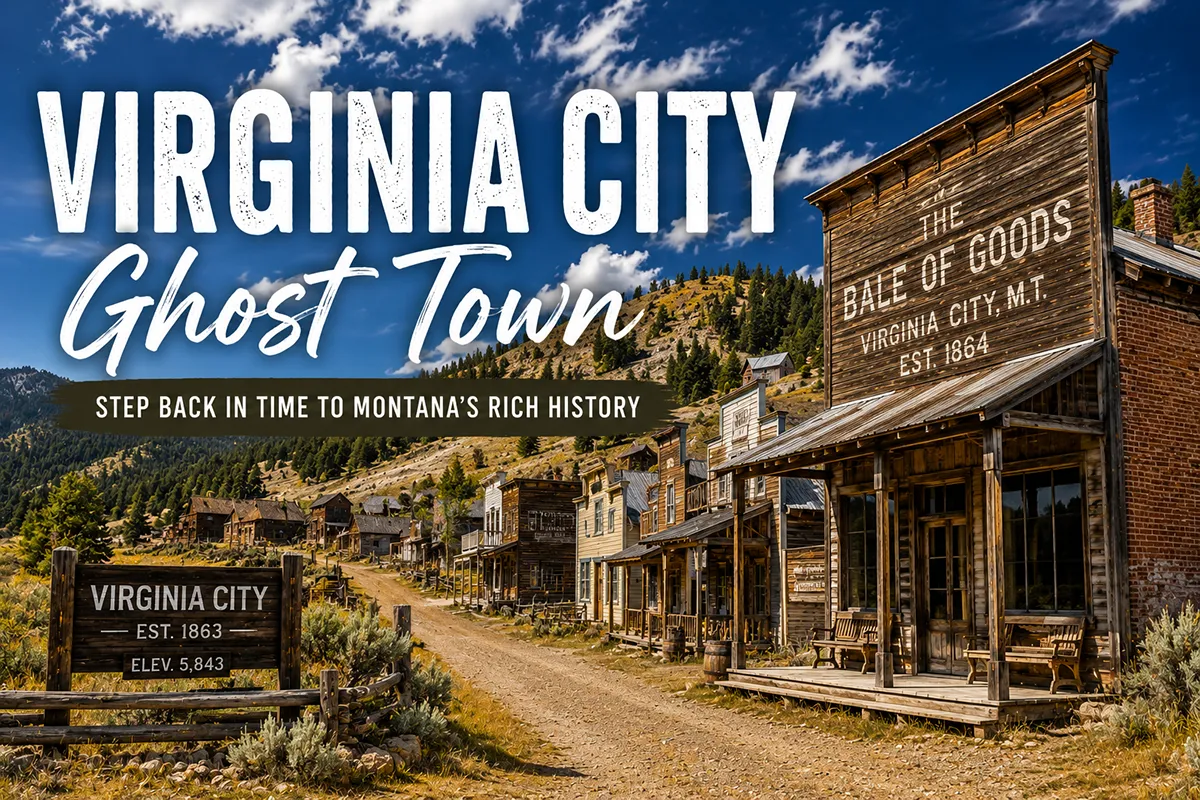
I once watched the sun set on Wallace Street in Virginia City from the porch of the Bale of Hay Saloon, with a craft beer in one hand and the kind of feeling you only get when you realize that 22 men were hanged within walking distance of your barstool in less than two months.
Virginia City is Montana’s most famous “living” ghost town — about 150 year-round residents, over 100 original 1860s buildings, and a full summer season of theater, shopping, dining, train rides, and ghost tours. It’s where the Montana Territory’s biggest gold strike happened in 1863 and where the secret Montana Vigilantes hanged 22 men in 60 days in 1863-64. Most of the town is functionally closed October through April. The sweet spot is mid-June through early September. Below: the full guide to what to do, where to stay, and the history that makes this place unlike any other ghost town in the West.
Why Virginia City Is Different From Every Other Montana Ghost Town
If you’ve read my Montana ghost towns guide, you know I categorize Virginia City separately from Bannack, Garnet, and the rest. Here’s why.
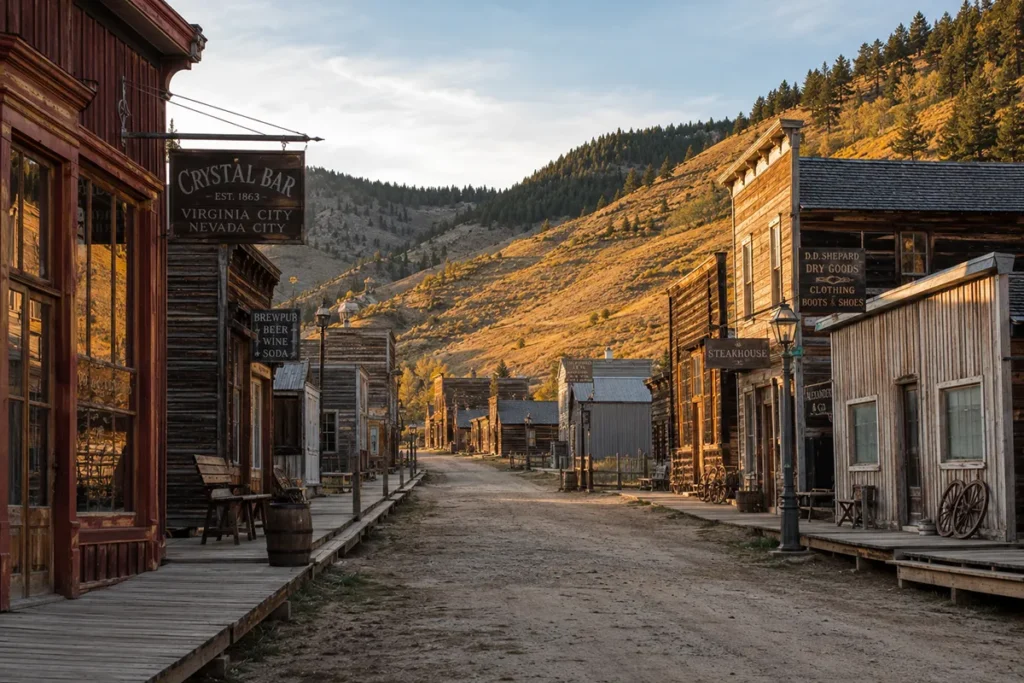
Most ghost towns are abandoned. Virginia City isn’t. About 150 people live here year-round, the population swells to 300+ in summer, and from Memorial Day through Labor Day the town runs as a working historic district with restaurants, hotels, shops, theaters, train rides, stagecoach tours, and ghost tours. The boardwalks are original 1860s wood. The buildings are mostly the actual structures from the gold rush.
The Montana Heritage Commission preserves over 150 certified historic structures here — more original 19th-century buildings in one place than almost anywhere else in the American West.
But it isn’t a theme park. The shops are owned by people who live in the buildings. The Bale of Hay Saloon has been serving drinks since 1867 [verify].
The Star Bakery still bakes the same way. When you walk into Rank’s Mercantile, you’re walking into a general store that’s been continuously operating since 1864.
The first time I visited Virginia City was in July 2019 [verify]. It was crowded — I’ll get to that — and honestly, I left a little unimpressed. The second time was a quiet weekend in early June 2021 [verify] before the summer programming had fully started, and that’s when I fell in love with the place.
The third visit was the one that hooked me: a Tuesday evening in mid-September with most of the day trippers gone, walking the boardwalks at dusk, ending up at Boot Hill cemetery reading the headstones.
This is what Virginia City rewards: returning, slowing down, and learning the story before you walk through it. This guide is built from those visits, and the practical details I’ve marked [verify] should be confirmed before you go.
A Quick History — From Alder Gulch to the Fourteen Mile City
On May 26, 1863, a small party of prospectors led by Bill Fairweather and Henry Edgar stumbled onto gold in Alder Gulch while heading back from a failed expedition to find tobacco. Their first pan reportedly yielded $2.40 in gold. Within weeks, miners flooded in.
What followed is one of the most extraordinary booms in American history. Within three years, an estimated 10,000 people lived in a near-continuous string of mining camps stretching 14 miles along Alder Gulch — Nevada City, Virginia City, Junction, Adobetown, Pine Grove, Highland, Bear Town, and others. This was called the “Fourteen Mile City.”
Alder Gulch produced an estimated $100-150 million in gold [verify] in its peak years — by far the largest placer gold strike in Montana history, and one of the largest in the American West.
Virginia City became the commercial and political heart of the Gulch. In 1865, it was named Montana Territory’s second capital, replacing Bannack as the seat of government. (The capital later moved to Helena in 1875.) At its peak, Virginia City had hotels, opera houses, multiple newspapers, breweries, a brick-making operation, and the social infrastructure of a real city in the middle of what had been wilderness three years earlier.
Then the placer gold ran out. By the 1870s, most of the Fourteen Mile City had begun to empty. By the 1890s, Virginia City was a fraction of its peak size. By the early 1900s, it was effectively a ghost town with a few hundred residents holding on.
What saved it from total collapse was the Bovey family — Charles and Sue Ford Bovey — who began buying and preserving buildings in the 1940s. Their work, eventually taken over by the Montana Heritage Commission, is the reason Virginia City still looks the way it does today.
For deeper context on the broader era, see my piece on the Montana gold rush.
The Story Most Visitors Miss — The Montana Vigilantes
If you visit Virginia City and don’t understand the vigilante story, you’ve missed the most important chapter of its history.
Between Bannack and Virginia City, throughout 1863, prospectors leaving the gold camps with their gold dust started disappearing on the roads. Stagecoaches were robbed with disturbing precision.
Travelers were murdered. The road agents — a gang that called themselves “the Innocents” — operated with such inside knowledge of who was carrying what and when that suspicion fell on the law enforcement itself.
In late 1863, a small group of citizens in Virginia City and Bannack secretly formed the Montana Vigilantes (also called the Vigilance Committee). Their first action came in December 1863. Between then and February 1864, they hanged 22 men without formal trials.
The most famous of the hangings was Sheriff Henry Plummer of Bannack — secretly, allegedly, the head of the Innocents gang — hanged on January 10, 1864, on his own gallows.
But many of the other hangings happened in Virginia City and along the road between the two towns. You can stand on Wallace Street and look at the actual second-story window from which a man named Joseph Slade was reportedly hanged from a beam after disrupting one too many gatherings.
The Vigilantes adopted a numerical cipher — “3-7-77” — which appeared as a warning sign nailed to suspected outlaws’ tents. The exact meaning has been debated for 160 years (one theory: dimensions of a grave, 3 feet by 7 feet by 77 inches deep). You’ll see “3-7-77” still displayed on the patches of the Montana Highway Patrol today. That’s how deeply this history is woven into the state.
The vigilante movement effectively ended highway robbery in southwest Montana within months. Whether the 22 men were all guilty — particularly Plummer — historians still debate. What’s not in question is that this all happened right here, in these buildings, on these streets, in a 60-day stretch of one Montana winter.
For more context, see my pieces on the key historical events in Montana and my Bannack ghost town deep-dive, which covers the other half of this story.
Virginia City vs Nevada City — Cleaning Up the Confusion
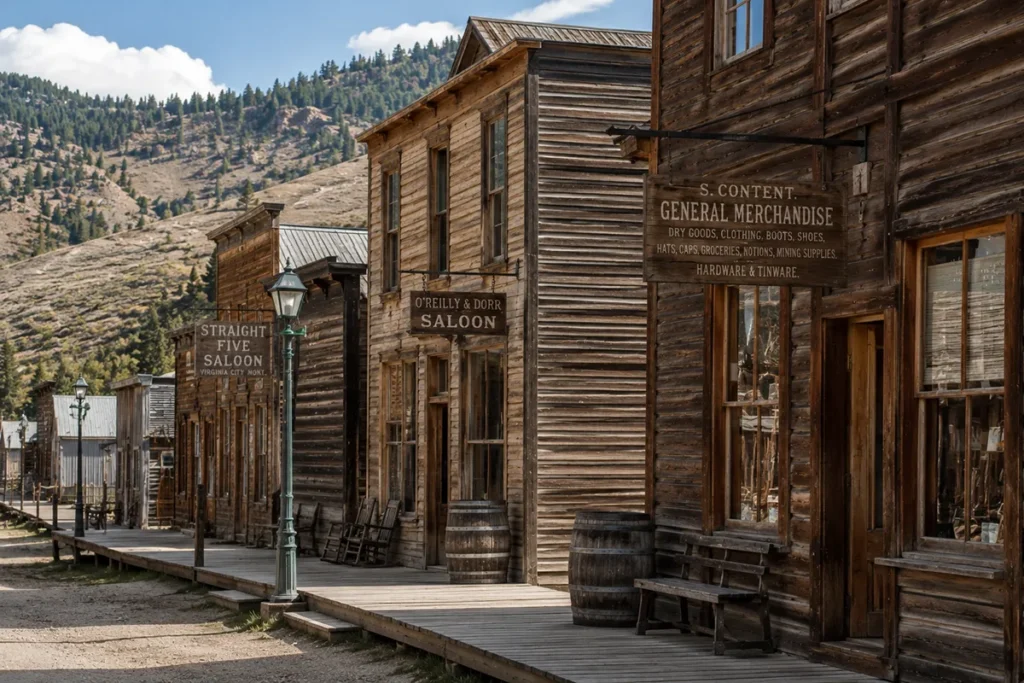
This trips up almost every first-time visitor. Virginia City and Nevada City are two separate places about a mile and a half apart, but they’re operated as a combined historic district by the Montana Heritage Commission. Here’s the difference:
Virginia City
- About 150 year-round residents (300+ in summer)
- Functioning small town with active businesses
- Original 1860s buildings in continuous use
- Main Street (Wallace Street) is a working commercial strip
- Lodging, restaurants, shops, saloons
- Opera House, Brewery Follies, ghost tours
- The political and commercial center
Nevada City
- Essentially a preserved open-air museum — no full-time residents
- 108 buildings, of which only 14 are original to the Nevada City site
- The other 94 were relocated from across Montana by the Bovey family to create a preserved 1860s mining town
- Houses the Music Hall with one of the largest collections of antique mechanical music machines in the world
- Living history museum operations on summer weekends with reenactors
- Less commercial than Virginia City — quieter, more contemplative
How to combine them: Buy a combination ticket and ride the Alder Gulch Short Line Railroad between the two. It’s an open-car narrow-gauge train that runs about 1.5 miles between Virginia City and Nevada City, doing 4-6 round trips per day in summer. The ride takes 25-30 minutes round trip. Most visitors spend a half day in each town and use the train as the connector.
If you can only visit one, choose Virginia City for the active town experience or Nevada City for the museum and music hall. If you have a full day, do both.
The Best Things to Do in Virginia City
Here’s what I’d prioritize, ranked roughly by what I’d hit first on a one-day visit.
Walk Wallace Street end to end
Start at the visitor center on the east end of town, walk west to the Opera House, then loop back. Take your time on the boardwalks. Look up at the second-floor windows — many still have their original glass. Notice that the boardwalk planks are uneven and original. You’re not on a recreation.
See a Brewery Follies show (adults only)
The Brewery Follies is performed in the H.S. Gilbert Brewery — Montana’s first brewery, dating to the 1860s. The show is a comedy cabaret with sketch comedy, political satire, music, and impressions. The cast describes it as “risqué, bawdy” and explicitly not family-friendly. PG-13 to R-rated content. Adults will probably love it. Kids should not be there.
Performances run Memorial Day through Labor Day. Tickets are typically sold via the Brewery Follies website [verify]. Reservations strongly recommended for weekend shows.
See a Virginia City Players show (family-friendly)
The Virginia City Players perform at the Virginia City Opera House — the oldest continuously operating professional summer theater company in the Northwest, founded in 1948. They do 19th-century melodramas, vaudeville, and family-friendly comedy. Seven shows a week, Memorial Day through Labor Day.
The Opera House itself is worth seeing for the building alone — a converted livery stable from the 1860s with one of the few remaining Cremona player pianos in the world, used to accompany silent films during intermissions.
Ride the Alder Gulch Short Line Railroad
The narrow-gauge train between Virginia City and Nevada City is one of the experiences kids remember and adults underestimate. Open cars, scenic views of Alder Gulch, narrated commentary about the gold rush operations along the route. Tickets are inexpensive and the loop takes about 30-45 minutes including time at Nevada City [verify pricing].
Walk through Boot Hill Cemetery
A short walk uphill from town, Boot Hill is one of the most loaded pieces of ground in Virginia City. Five of the road agents hanged by the Vigilantes are buried here, with simple wooden markers. The men include George Ives (the first major Vigilante hanging, in December 1863), Jack Gallagher, Boone Helm, Frank Parish, and Hayes Lyons.
Bring this list with you. Read the markers. Stand there for a few minutes. This is where the vigilante story becomes physical.
Take an evening Ghost Tour
The Bale of Hay Saloon runs evening ghost tours in summer, walking small groups through buildings with documented paranormal reports. The Bonanza Inn has its own ghost tour focused on the building itself (it was a Sisters of Charity hospital in the 1870s before becoming a hotel, and it generates a lot of ghost stories). Both are atmospheric and well-told.
For more on Virginia City’s paranormal reputation, see my guide to Montana’s most haunted places.
Ride a stagecoach with Vigilante Carriages
Vigilante Carriages runs horse-drawn stagecoach tours up Alder Gulch to the original gold strike site, with narration about the road agent robberies that happened on this same road. Also offers horseback rides. This is the most underrated experience in Virginia City — a real stagecoach on the actual road where stagecoaches were robbed in 1863.
Visit the museums
Several small museums worth time:
- Thompson-Hickman Museum — extensive photo collection, rare guns, geological samples
- J. Spencer Watkins Memorial Museum — local history collection
- Charles A. & Sue Ford Bovey Visitor Center — free, tells the story of how the Bovey family saved Virginia City from disappearing
- Nevada City Music Hall — world-class collection of mechanical music machines
Eat at the Star Bakery, drink at the Bale of Hay
The Star Bakery in Nevada City has been baking the same way for decades and is a justifiable pilgrimage. The Bale of Hay Saloon in Virginia City claims to be Montana’s oldest continuously operating bar (since 1867 [verify]) and serves some of the best craft beer in the state.
For the full Montana food scene context, see my guide to the best restaurants in Montana.
Try gold panning at River of Gold
About a quarter mile east of Nevada City on Highway 287, River of Gold offers paid gold panning experiences with sluice boxes and trained guides. Kids love it. You will find actual flecks of gold.
When to Visit — Virginia City Is Functionally a Summer-Only Town
This is the single most important thing to understand. Most of Virginia City closes from October through April. The Opera House goes dark. The Brewery Follies takes the season off. Most shops shutter. The train stops running. Many restaurants close. The town doesn’t become hostile — about 150 people still live here year-round — but the visitor experience evaporates.
Seasonal breakdown
| Season | What’s Open | My Take |
|---|---|---|
| Mid-May (Memorial Day) | Season opens. Most businesses, train, theaters start. | Quietest of the open season — my favorite time |
| June | Full operations, weather warming, wildflowers | Excellent. Crowds modest. |
| July (peak) | Everything open, busy weekends, hot afternoons | Beautiful but crowded. Plan around weekends. |
| August | Peak season continues, Grand Victorian Ball for Peace 1865 | Same as July. Ball weekend is unique. |
| September (Labor Day) | Season winds down quickly | Best balance — most things open, crowds gone |
| October through April | Mostly closed. Some restaurants open for residents. | Don’t visit unless you’re a contrarian who wants empty streets |
My honest recommendation: aim for mid-June or the first half of September. You get the full programming and a fraction of the July/August weekend crowds.
Practical Visitor Info
| Topic | Details |
|---|---|
| Location | Wallace Street, Virginia City, MT 59755 |
| Coordinates | 45.2939°N, 111.9436°W |
| Distance from West Yellowstone | ~80 miles (~90 minutes) via Highway 287 |
| Distance from Bozeman | ~85 miles (~1 hour 45 minutes) |
| Distance from Bannack | ~90 miles (~1 hour 45 minutes) |
| Entry fee | Free to walk the town. Individual attractions (Brewery Follies, Opera House, train, Nevada City museum) charged separately [verify pricing] |
| Operating season | Memorial Day through Labor Day for most attractions |
| Cell service | Spotty — Verizon best |
| ATM | Limited — bring some cash |
| Pets | Allowed on leash on boardwalks; check individual venues |
| Accessibility | Boardwalks are uneven; some buildings have steps. Nevada City museum is mostly wheelchair accessible. |
| Visitor Center phone | (406) 843-5247 [verify] |
Getting There
Virginia City sits at the south end of the Madison Valley in southwest Montana, on Highway 287. The drives:
- From West Yellowstone: ~90 minutes north on Highway 287, through Earthquake country and past the historic 1959 Hebgen Lake earthquake site
- From Bozeman: ~1 hour 45 minutes west on I-90 to Three Forks, south on Highway 287
- From Bannack: ~1 hour 45 minutes east, mostly via Highway 41 and 287
- From Yellowstone National Park (West Entrance): Same as West Yellowstone above
The drive from West Yellowstone is particularly scenic and goes through some genuinely historically interesting country — the 1959 Hebgen Lake earthquake zone is right along Highway 287, with a quake visitor center that’s worth a 30-minute stop. See more in my guide to West Yellowstone.
Where to Stay
Virginia City has a handful of distinctive lodging options, all in historic buildings. None of them feel like a chain hotel.
Fairweather Inn
A 15-room historic hotel on Wallace Street, named for Bill Fairweather who made the original gold strike. Period decor, walking distance to everything in town, well-maintained. The most central option. Reservations book up months ahead for July/August weekends.
Bonanza Inn
A historic building that was originally a Sisters of Charity hospital in the 1870s. Now operates as a small inn with significant ghost story reputation. If you want the most haunted experience, stay here. Some rooms reportedly have more activity than others (ask at check-in).
Nevada City Cabins
Restored 1860s cabins available for overnight rental in Nevada City. Rustic but charming. Best for travelers who want maximum immersion in the historic atmosphere. No TVs, no Wi-Fi, period-appropriate everything.
Outside town — Ennis or Sheridan
If everything in Virginia City is booked or you want more standard amenities, Ennis (15 miles west, famous for fly fishing) and Sheridan (12 miles north) both have hotels, motels, and B&Bs.
What I Wish I Knew Before My First Visit
A few things that would have improved my visits and that I rarely see in other guides.
Avoid weekends in July if you can. The town gets genuinely crowded — boardwalks full, restaurant waits long, parking tight. Tuesday through Thursday in any peak summer week is dramatically better.
Buy tickets for Brewery Follies and the Opera House in advance. Weekend evening shows sell out. Don’t show up assuming you’ll get in.
Read the vigilante story before you go. The buildings, Boot Hill, and Wallace Street all hit very differently when you understand what happened on these streets in winter 1863-64. Most casual visitors don’t realize they’re standing in the middle of one of the most dramatic moments in American frontier history.
Don’t skip Nevada City. Most day-trippers do Virginia City and skip the mile and a half over to Nevada City. They miss the Music Hall — which is genuinely one of the most unique cultural experiences in Montana.
Bring cash. Some smaller venues and tours are cash-preferred. ATMs are limited and not always working.
Walk the back streets, not just Wallace. A block off Wallace, you’ll find original residences, the old fire house, smaller cabins, and a much quieter atmosphere. This is where Virginia City stops feeling touristy.
Visit at dusk. Most day-trippers leave by 5-6 PM. From 6 PM to dark, the town empties out and the boardwalks become almost contemplative. The light hits the buildings beautifully. This is when I’d photograph or just sit on a porch with a drink.
Don’t try to do Virginia City and Bannack in one day. People try this. They both deserve more time than a half-day. Two-day minimum if you want to do both properly.
Photography Tips
Specific things I’ve learned:
- Best overall light: Late afternoon, about 90 minutes before sunset. The west-facing buildings on Wallace Street glow.
- Best vantage point for the town: From the hill above Boot Hill Cemetery, looking back at Wallace Street with the Tobacco Root Mountains in the background.
- Best interior shots: The Opera House — beautiful 19th-century stage and seating, available to photograph during slow hours.
- Best detail shots: Original hanging signs (the H.S. Gilbert Brewery sign, the Bale of Hay sign), boardwalk planks, second-floor windows with original glass.
- What to avoid: Mid-day light from June through early August. The boardwalks are also visually busy with tourists during this window — much cleaner shots before 10 AM or after 6 PM.
Multi-Day Itineraries
Some combinations that work well:
Two days in Virginia City and Nevada City
Day 1: Virginia City walking tour, Brewery Follies in the evening Day 2: Nevada City museum, train ride, gold panning, Opera House in the evening, Boot Hill at sunset
Three-day southwest Montana ghost town circuit
Day 1: Drive in, Virginia City Day 2: Nevada City + Virginia City evening shows Day 3: Drive to Bannack (90 minutes) for a half-day visit, return through Dillon
Five-day Yellowstone + Virginia City combination
Days 1-3: Yellowstone (West Entrance base) Day 4: Drive north on Highway 287 to Virginia City, full afternoon and evening Day 5: Nevada City morning, return south or continue north
For more comprehensive Montana ghost town planning, see my full Montana ghost towns guide.
Frequently Asked Questions
Is Virginia City Montana actually a ghost town?
Sort of. It’s a “living ghost town” — about 150 people still live here year-round, but the town’s 1860s commercial district is preserved as a historic district with over 150 original buildings, and much of the population is seasonal. It’s not abandoned like Garnet, but it’s not a normal modern town either.
How much does it cost to visit Virginia City?
The town itself is free to walk through. Individual attractions are paid separately — Brewery Follies, Virginia City Players, the Alder Gulch train, Nevada City Museum, ghost tours, and stagecoach rides each have their own ticket prices [verify].
Is Virginia City worth visiting?
Yes, especially in the summer season (Memorial Day through Labor Day). Outside that window, most attractions are closed and the town reverts to a small residential community.
What’s the difference between Virginia City and Bannack?
Bannack is a fully preserved, abandoned ghost town operated as a state park — no living residents, no commercial businesses, ~60 original empty buildings. Virginia City is a living town where people still live, work, and operate businesses in 1860s buildings. Bannack feels older and emptier. Virginia City feels like a frontier town that never stopped operating. Both share the gold rush and vigilante history.
How long should I spend in Virginia City?
A focused day works for Virginia City alone. Two days lets you do Virginia City and Nevada City properly with evening shows. Most visitors regret rushing.
Can you stay overnight in Virginia City?
Yes — Fairweather Inn, Bonanza Inn, Nevada City Cabins, and a few other small lodgings. Book months ahead for July/August weekends.
Is Virginia City family-friendly?
Very much so. The train, gold panning, Virginia City Players shows, stagecoach rides, and Nevada City museum are all excellent for families. Note that Brewery Follies is explicitly not family-friendly — it’s an adult comedy show.
Is Virginia City haunted?
Multiple buildings have documented paranormal reports — the Bonanza Inn (former hospital), the Bale of Hay Saloon, and the Fairweather Inn all generate stories. Evening ghost tours operate in summer. See my most haunted places in Montana guide.
What happened to the Montana Vigilantes?
The vigilante movement effectively ended highway robbery in southwest Montana by spring 1864 after hanging 22 men in roughly two months. The “3-7-77” cipher they used is still displayed on Montana Highway Patrol patches today. Historians continue to debate whether all 22 men were guilty — particularly Sheriff Henry Plummer.
How far is Virginia City from Yellowstone?
About 80 miles from the West Entrance of Yellowstone, roughly 90 minutes by car via Highway 287. It’s the best ghost town to combine with a Yellowstone trip.
When does Virginia City open and close for the season?
Most attractions operate from Memorial Day weekend through Labor Day weekend. A few extend into early September. From October through April, most things are closed.
Liked this article?
Add Roaming Montana as a preferred source so you see more of our articles and guides on Google.
Final Thoughts
Virginia City is the Montana ghost town that took me the longest to appreciate. On my first visit, the summer crowds and the tourist apparatus put me off. It felt commercial in a way Bannack and Garnet don’t.
The second visit changed that. The third visit hooked me. And now I think Virginia City might be the most important historical site in Montana — not because it’s the prettiest or the most authentic ghost town in the empty-buildings sense, but because the gold rush boom, the vigilante movement, the territorial politics, the saving of the town by the Bovey family in the 1940s, and the ongoing preservation work today all happened in the same square mile. You can walk it in an afternoon and absorb 160 years of compressed Montana history.
If you’re planning a trip, my recommendation is this: pick a Tuesday or Wednesday in mid-June or early September. Arrive late afternoon. Skip Boot Hill on day one — go straight to Wallace Street, find a spot at the Bale of Hay or on the porch outside, and let the town settle around you for an hour before you start exploring. Then read about the Vigilantes that night. Then go back the next day with the story in your head.
That’s the order of operations that gives you the real Virginia City.
Drop your questions or your own Virginia City stories in the comments. I’m always looking for an excuse to plan another trip down to the Madison Valley.