I once watched a self-playing 1907 German orchestrion fill an empty 1912 building with music it hadn’t made in a century — and realized that the building itself had once stood in Yellowstone before being moved to Nevada City by a man on a mission to save Montana’s gold rush past.
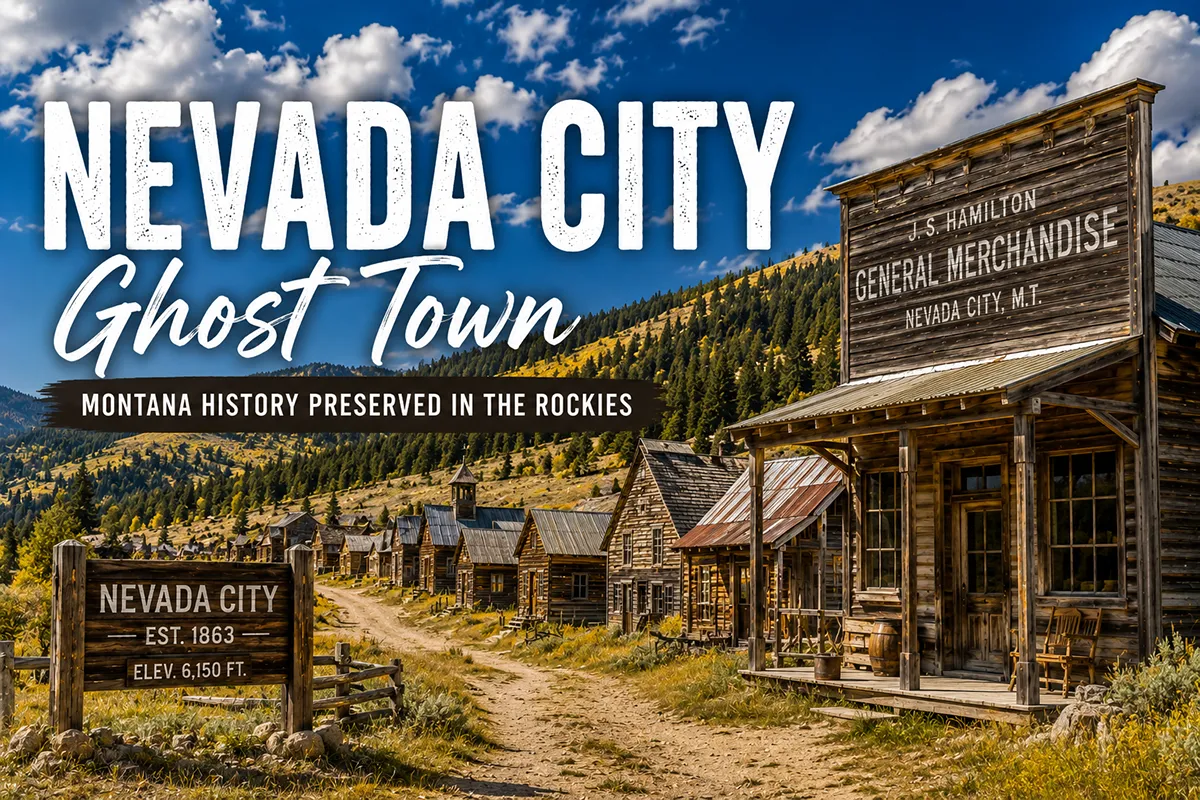
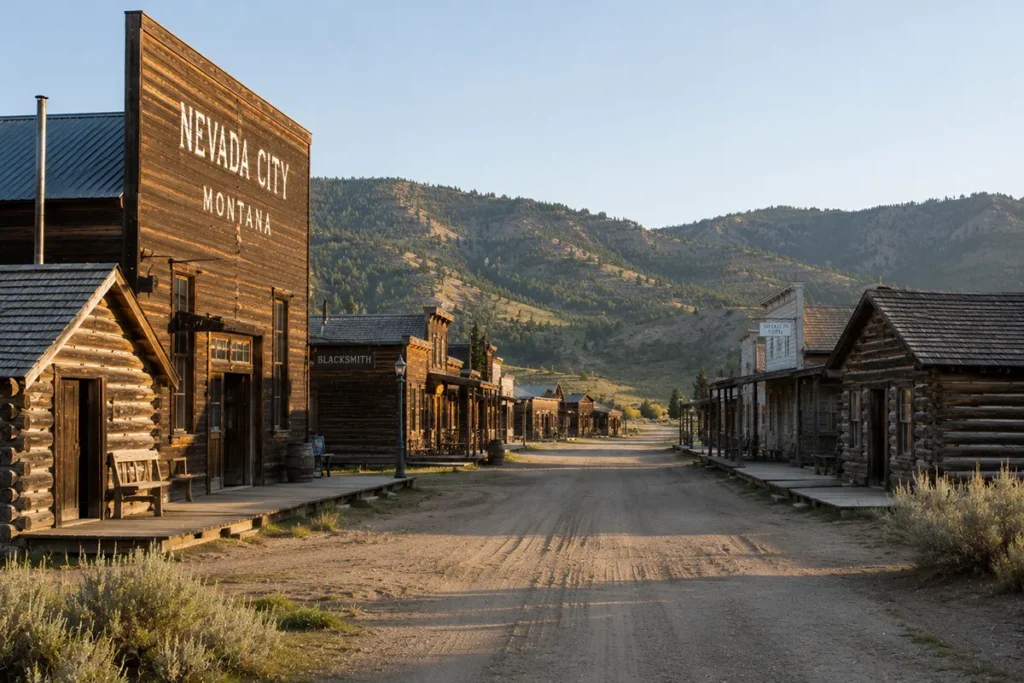
Nevada City is the open-air mining museum next to Virginia City — about a mile and a half apart, operated together by the Montana Heritage Commission. Roughly 14 of its buildings are original to the site; the other ~90 were relocated here from across Montana between 1945 and 1978 by the Bovey family. The town houses the Music Hall — North America’s largest public collection of automated music machines. It’s open Memorial Day through Labor Day, admission runs $6–$12 depending on age and weekday/weekend, and weekends bring period-costume reenactors. Below: everything you need to plan a visit, the building stories most visitors miss, and the wild history of how this place came back from the dead.
Liked this article?
Add Roaming Montana as a preferred source so you see more of our articles and guides on Google.
What Nevada City Actually Is — and Isn’t
If you read my Virginia City ghost town guide, you already know Nevada City exists about a mile and a half down the road. What most travel guides don’t make clear is exactly what Nevada City is.
It is not an abandoned ghost town that’s been left alone. It is also not a totally fake recreation. It’s something in between — what historians call a historical preservation district — and the story of how it got that way is itself worth the price of admission.
Here’s the short version: Nevada City was a real 1863 gold-rush boom town along Alder Gulch, peaking with thousands of residents and serving as a partner town to Virginia City a mile and a half east.
By the 1870s the placer gold had played out, and by the 1890s Nevada City had effectively emptied. Most of the original buildings collapsed, were torn down for materials, or were swept away by the massive gold dredging operations that worked Alder Gulch into the early 20th century. By 1945, only about 14 original buildings remained on site.
Then Charles Bovey and his wife Sue Ford Bovey stepped in. Over the next 33 years — from 1945 through 1978 — they bought up Nevada City lot by lot, then began moving in historic buildings from across Montana that were slated for demolition. A schoolhouse from Twin Bridges.
A blacksmith shop from Sheridan. A boarding house from somewhere outside Helena. The 1912 Recreation Hall from the Canyon Lodge area of Yellowstone National Park, which became the Music Hall. The Boveys created a living, organized open-air museum of 1860s–early 1900s frontier Montana.
That’s what you’re walking through. About 14 of the buildings are original to Nevada City; the other ~90 are authentic Montana frontier structures relocated and arranged into a recreated mining-town layout. Interior contents — antiques, furnishings, signs, fixtures — are largely original to the era, much of it collected during the Bovey decades.
This is why I think of Nevada City as Montana’s most ambitious history project. It’s not a fake. It’s a curated rescue.
A Quick History — Boom, Bust, Dredge, Rescue
Gold strike (May 1863). Bill Fairweather and Henry Edgar’s party discovered gold in Alder Gulch on May 26, 1863. Within weeks, miners flooded the valley.
The string of mining camps that formed along Alder Gulch came to be called the “Fourteen Mile City.” At its peak in 1864, an estimated 10,000+ people lived along Alder Gulch, with Virginia City and Nevada City as the two largest camps.
The George Ives trial (December 1863). Nevada City played one of the most important roles in Montana’s vigilante history. George Ives, a confessed road agent, was tried publicly in Nevada City on December 19-21, 1863 — an open-air, three-day trial that ended in his hanging.
That trial is widely considered the catalyst for the formal organization of the Montana Vigilantes, who over the next 60 days hanged 21 more men, including Bannack’s Sheriff Henry Plummer. (Full story in my Bannack ghost town deep-dive.)
Decline (1870s–1890s). As the easily accessible placer gold played out, miners moved on. Both Nevada City and Virginia City shrank dramatically.
Dredging era (1890s–1920s). Large-scale industrial gold dredging operations worked Alder Gulch for decades after the original placer boom. The dredges literally rolled through the old townsites in some cases, destroying buildings as they extracted residual gold from the gravels.
Near-disappearance (1930s–1940s). By the time Charles Bovey arrived in 1945, Nevada City had been reduced to a handful of remaining original buildings on a creek bed that had been turned upside down by dredges.
Bovey restoration (1945–1978). Charles Bovey, a Great Falls businessman, began buying property in both Virginia City and Nevada City, eventually acquiring most of the historic district. He and Sue spent over three decades buying, relocating, and assembling buildings, and amassing one of the largest collections of frontier-era Americana outside the Smithsonian.
Montana Heritage Commission (1997–present). In 1997, the State of Montana purchased Bovey’s Virginia City and Nevada City properties to ensure long-term preservation. The Montana Heritage Commission now operates Nevada City as a public open-air museum.
For the broader context, see my pieces on the Montana gold rush and the key historical events in Montana.
What to Do in Nevada City
Here’s how I’d structure a visit.
Walk the museum townsite
The core experience is wandering through the recreated frontier town. About 100 buildings are arranged across the museum site, all with interpretive signage explaining what each structure is and where it came from originally. Highlights to prioritize:
- The schoolhouse — original interior with desks, blackboard, primers
- The assay office — gold rush–era equipment for testing ore samples
- The general store / mercantile — fully stocked with period dry goods, signs, and counters
- The blacksmith shop — working forge, tools, demonstration setups
- Saloon and dance hall — period furniture, bar fixtures
- Miners’ cabins — small one-room dwellings reflecting how working miners lived
- The Chinese laundry — important reminder that Chinese workers were essential to Montana mining
- The dressmaker’s shop / “lady boutique” — antique clothing and textiles
Plan at least 2 hours to do this justice. Most visitors regret rushing. The reward is in the small details — handwritten labels, original signage, the way a working forge looks in afternoon light.
Visit the Music Hall (you’ll enter through it)
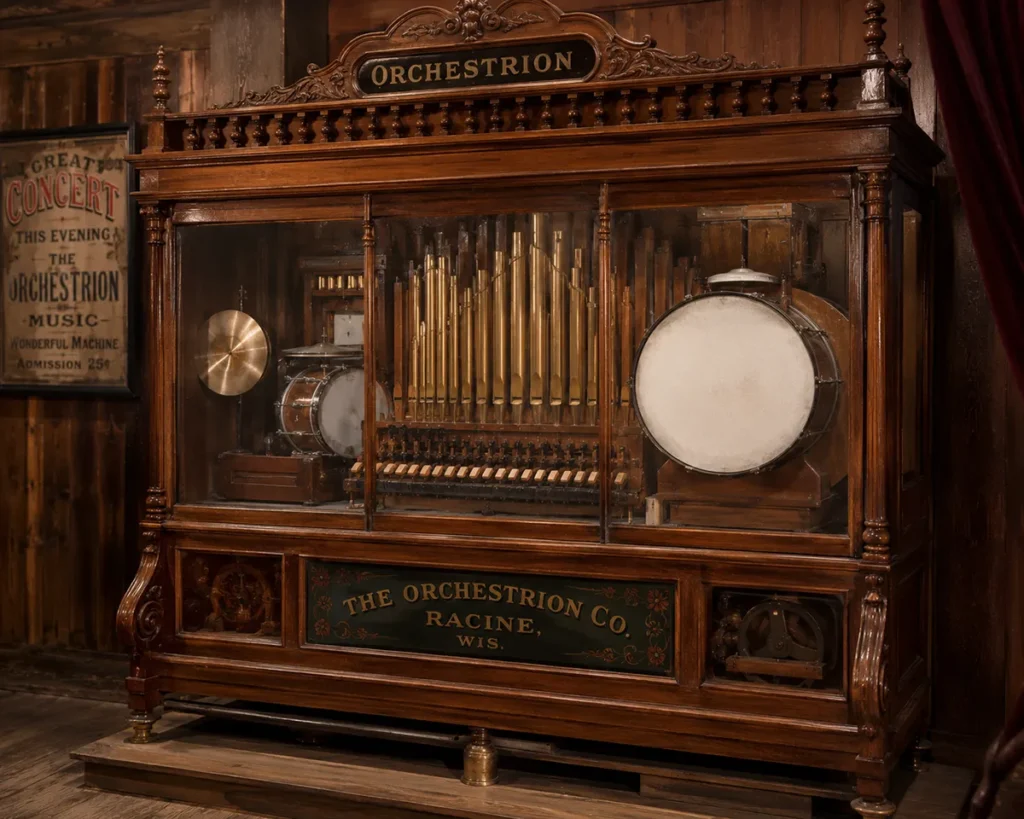
The Nevada City Music Hall holds North America’s largest public collection of automated music machines. The building itself has a backstory worth knowing: it was originally constructed in 1912 as the Recreation Hall at Canyon Lodge in Yellowstone National Park, and was relocated to Nevada City by Charles Bovey when the Park Service replaced it.
Inside, the collection includes:
- Roll pianos and player pianos
- Violanos — early 20th-century machines that play violins automatically using a paper roll
- Band organs — large carnival-style automated orchestras
- Orchestrions — full mechanical orchestras in cabinet form
- Calliopes, music boxes, and hurdy-gurdies
Charles Bovey was passionate about these machines and acquired them from across Montana and beyond throughout his lifetime. Many still play. Some are demonstrated by museum staff during operating hours.
I sat through a private demonstration of a German orchestrion on a slow Tuesday in August and it remains one of the most surreal cultural experiences I’ve had in Montana. If you visit during a slow weekday and ask politely, there’s a real chance you’ll get the same.
Eat at the Star Bakery
The Star Bakery is a working bakery operating out of a Nevada City building. Cinnamon rolls, fresh bread, savory pastries. It draws people from Virginia City and beyond. Hours are seasonal and not always predictable — go early if you can.
Catch the living history reenactors (weekends only)
This is the part most travel guides bury. Reenactors in period costume are present at Nevada City on Saturdays and Sundays between Memorial Day and Labor Day. They demonstrate:
- Blacksmithing
- Spinning and weaving
- Cooking on a wood-fired stove
- Card games (especially the gold-rush favorite, faro)
- Gold panning techniques
- Period dress and household work
The weekend experience is fundamentally different from a weekday visit. If you have flexibility, the weekend brings the place to life; if you prefer quiet contemplation, the weekday is the better choice. There’s no wrong answer.
Ride the Alder Gulch Short Line Railroad
The narrow-gauge train shuttle between Virginia City and Nevada City stops right at the museum entrance. It runs multiple round trips daily in summer and is the easiest way to combine the two destinations. Tickets are sold at both stations [verify pricing].
Try gold panning at River of Gold
Just east of Nevada City along Highway 287, River of Gold offers paid gold panning experiences with sluice boxes, guided technique, and actual gold flakes guaranteed in your pan. Kids love it. Most adults end up loving it more than they expected to.
Tickets, Pricing, and Hours
This is where the SERP has the most outdated info. Here’s what to expect [verify before visiting].
Pricing (approximate)
| Visitor Type | Weekday Rate | Weekend / Holiday Rate |
|---|---|---|
| Adult | $10 | $12 |
| Youth (4–11) | $8 | $10 |
| Senior (65+) | $8 | $10 |
| Children 3 and under | Free | Free |
| Groups of 6+ | $8/person | $10/person |
Tickets are typically sold at the entrance to the Music Hall, which is also where you enter the museum townsite. Several payment methods accepted including major credit cards. Some discounts may apply with the combined Alder Gulch Short Line Railway ticket.
Hours
- Open: Memorial Day weekend through Labor Day (approximately late May – early September)
- Daily hours: Typically 10:00 AM – 6:00 PM [verify]
- Closed: October through April (mostly — special events may occur outside this window)
The museum is functionally a summer-only attraction. Don’t show up in November expecting access — the buildings will be there, but the museum will be closed and most interior contents inaccessible.
Practical Visitor Info
| Topic | Details |
|---|---|
| Location | Highway 287, Nevada City, MT (about 1.5 miles west of Virginia City) |
| Coordinates | 45.2911°N, 111.9692°W |
| Distance from Virginia City | 1.5 miles (5 minutes by car; 25 minutes via the Alder Gulch train) |
| Distance from West Yellowstone | ~80 miles (~90 minutes) via Highway 287 |
| Distance from Bozeman | ~85 miles (~1 hour 45 minutes) |
| Phone | (406) 843-5247 [verify Montana Heritage Commission line] |
| Wheelchair accessibility | Most buildings accessible from main paths; some have steps |
| Pets | Check current policy — generally not inside historic buildings |
| Cell service | Spotty |
| Restrooms | Yes, on-site |
| Parking | Free parking near Music Hall entrance |
| Food | Star Bakery (seasonal hours); restaurants in Virginia City a short drive or train ride away |
Nevada City vs Virginia City — When to Visit Which
First-time visitors to the area often ask which to prioritize. Here’s the head-to-head.
| Factor | Nevada City | Virginia City |
|---|---|---|
| Type | Open-air museum | Living historic town |
| Year-round residents | None (essentially) | ~150 people |
| Active businesses | Star Bakery, museum store | Restaurants, hotels, shops, saloons |
| Buildings (original to site) | ~14 | 100+ |
| Buildings (relocated) | ~90 | Very few |
| Admission | $6–$12 paid ticket | Free to walk the town |
| Best for | Frontier life immersion, music machines | Living history, theater, dining |
| Live performance | Reenactors on weekends | Brewery Follies, Opera House (paid tickets) |
| Time needed | 2–3 hours | Half day to full day |
| Crowd feel | Quieter | Busier, especially July/August weekends |
If you can only visit one: Visit Virginia City if you want active town life, dining, and theater. Visit Nevada City if you want immersive frontier history and the Music Hall.
If you can visit both (recommended): Spend a half day in each, use the train to shuttle between them, and ideally see at least one Virginia City evening show.
When to Visit
| Month | Status | My Take |
|---|---|---|
| Memorial Day weekend (late May) | Opening weekend | Quieter, weather variable |
| June | Full operations, fewer crowds | Excellent shoulder season |
| July | Peak season, hot, busy | Beautiful but crowded weekends |
| August | Peak continues | Same as July |
| Labor Day weekend (early Sept) | Closing weekend | Last full programming weekend |
| Mid-Sept – April | Closed | Don’t bother — site is locked |
My recommendation for a first-time visitor: mid-June or the first week of September. Full operations, all reenactors present on weekends, fewer crowds, comfortable weather.
What I Wish I’d Known Before My First Visit
A few things that would have improved my visits.
You enter through the Music Hall, so don’t rush past it. Many visitors blow through the Music Hall to get to the “real” museum outside. Don’t. The Music Hall is the museum’s signature collection.
Weekends are completely different from weekdays. On a Saturday or Sunday, you’ll have reenactors actively demonstrating period skills, live music, possible faro games, costumed actors interacting with visitors. On a Tuesday, you’ll have a quiet, contemplative open-air museum with most buildings to yourself. Choose your day based on what you want.
Bring some cash. The Star Bakery and a few smaller venues are sometimes cash-preferred. ATMs are limited.
Allow more time than you think. Most online guides say 2 hours. That’s enough for a fast pass. 3-4 hours is the real number if you want to explore each building.
Pair with Virginia City but don’t try to do both in 3 hours. I see people parking in Virginia City, walking the boardwalk for an hour, riding the train to Nevada City, doing the museum in 60 minutes, and racing back. They’re missing 80% of what’s here. Plan a full day minimum for both.
Ask the reenactors questions. They are seasonal interpreters with deep knowledge. Many are history students or local historians. The 10 minutes you spend in conversation with the blacksmith or schoolteacher will reshape your visit.
Check Music Hall demonstration times. Demonstrations of the larger automated music machines may follow a posted schedule. If you arrive in the middle of one, you’ll have one of the most memorable experiences of any Montana museum.
The graveyard is worth a walk. Just outside the main museum core, there’s a small cemetery with original markers worth a quiet visit.
Photography Tips
A few specifics:
- Best overall light: Late afternoon, around 5 PM. The museum closes at 6 PM, so the last hour gives you long shadows and warm light with most day-trippers gone.
- Best vantage point: The hill behind the museum, looking down at the recreated town. Most visitors don’t walk up here.
- Best interiors: The general store and the dressmaker’s shop both have window light that hits beautifully in mid-morning.
- Music Hall: Low light interior — phone cameras struggle here. A small fast lens (35mm or 50mm at f/2 or wider) handles the mechanical music machines beautifully.
- What to avoid: Bright mid-day light in July washes out the wood textures that make frontier buildings photographically interesting.
Where to Stay
You have a few options if you want to extend the visit.
Stay overnight in Nevada City
The Montana Heritage Commission has historically offered overnight stays in restored Nevada City cabins — period-appropriate rustic lodging directly inside the historic district. No TVs, no Wi-Fi, period furnishings. Check current availability and rates with the Heritage Commission [verify].
Virginia City lodging
A mile and a half away. Options include the Fairweather Inn (historic Wallace Street hotel), the Bonanza Inn (a former 1870s Sisters of Charity hospital, reputedly very haunted), and several B&Bs. See my Virginia City ghost town guide for details.
Ennis (15 miles west)
The closest standard town with chain motels and hotels. Famous for fly fishing on the Madison River. A good base if you want to combine Nevada City with fishing.
West Yellowstone (~90 minutes south)
Better for travelers combining Nevada City with a Yellowstone trip. Wide range of accommodations.
Frequently Asked Questions
Is Nevada City Montana a real ghost town?
Sort of. Nevada City was a real 1860s gold rush boom town that emptied out by the early 1900s. About 14 original buildings still stand on the site. The other ~90 buildings you see were relocated here by the Bovey family between 1945 and 1978 to create a comprehensive open-air museum of 1860s frontier Montana life. So it’s an authentic preservation district built around the bones of a real ghost town.
How much does it cost to visit Nevada City?
Approximately $10 weekday / $12 weekend for adults, $8 weekday / $10 weekend for youth (4–11) and seniors, and free for children 3 and under. Group rates available for 6+ visitors [verify current pricing].
Is Nevada City the same as Virginia City?
No — they’re two separate places about 1.5 miles apart, operated together by the Montana Heritage Commission. Virginia City is a living town with year-round residents, restaurants, hotels, and shops. Nevada City is an open-air museum with no year-round residents. They share gold rush and vigilante history.
How long does it take to visit Nevada City?
A focused visit takes 2 hours. A proper exploration takes 3-4 hours, especially if you include the Music Hall demonstrations and any reenactor interactions.
Is Nevada City worth visiting?
Yes — especially if you’re interested in frontier history, antique music machines, or Montana’s gold rush. It pairs naturally with Virginia City and the Alder Gulch railway.
When is Nevada City open?
Memorial Day weekend through Labor Day, typically 10:00 AM to 6:00 PM daily. Outside this window the museum is closed.
Can you stay overnight in Nevada City?
Yes — restored historic cabins are sometimes available for overnight rental through the Montana Heritage Commission [verify current options]. They’re rustic and period-appropriate, with no TV or Wi-Fi.
Are the buildings at Nevada City real?
The buildings are all authentic 1860s–early 1900s Montana frontier structures. However, only about 14 of them are original to the Nevada City site. The other ~90 were relocated here from across Montana by the Boveys to create the museum. The buildings themselves are real, but the layout is a curated recreation.
Is Nevada City family-friendly?
Very much so. Kids tend to love the freedom to walk into old buildings, the train ride from Virginia City, the gold panning at River of Gold, and the weekend reenactors. Strollers can navigate the main paths.
What is the Music Hall at Nevada City?
A 1912 building (originally the Recreation Hall at Canyon Lodge in Yellowstone, relocated here by Charles Bovey) that houses North America’s largest public collection of automated music machines — including roll pianos, violanos, band organs, orchestrions, and calliopes. Many still play.
Are there reenactors at Nevada City?
On Saturdays and Sundays between Memorial Day and Labor Day, period-costume living history interpreters demonstrate blacksmithing, spinning, cooking, card games, and other frontier skills. Weekday visits are quieter without reenactors.
Is Nevada City haunted?
The Bonanza Inn in nearby Virginia City has the strongest ghost story reputation, but Nevada City buildings generate their own quiet reports — particularly around the schoolhouse and the dance hall. See my Montana’s most haunted places guide for more.
Final Thoughts
Nevada City is the Montana ghost town that takes the longest to explain and the longest to appreciate. On the surface it looks like an open-air museum that someone built — and that’s not wrong, exactly.
But what they built was a faithful, exhaustive, expensive labor of love stretching across 33 years, with original Montana buildings rescued from demolition and arranged into a town that approximates what Nevada City actually looked like in 1865.
The Music Hall alone justifies the trip. The reenactors on weekends make it feel alive. The quiet weekday afternoons let you sit on a porch and imagine the place actually working.
If you’re planning a visit, my recommendation: pick a Sunday in mid-June. You’ll get the reenactors, the full programming, and the train running with manageable crowds.
Eat at the Star Bakery for lunch. Stop at the Music Hall before you leave. Walk through the schoolhouse twice. And take a few minutes to look at the small plaques on the buildings that explain where each one came from.
That last part — the relocation history — is what makes Nevada City different. You’re not walking through a single town that survived. You’re walking through dozens of Montana frontier buildings that were saved one at a time and brought home.
Drop your questions or your own Nevada City stories in the comments. And don’t forget to combine it with my Virginia City ghost town guide — they really are a pair.