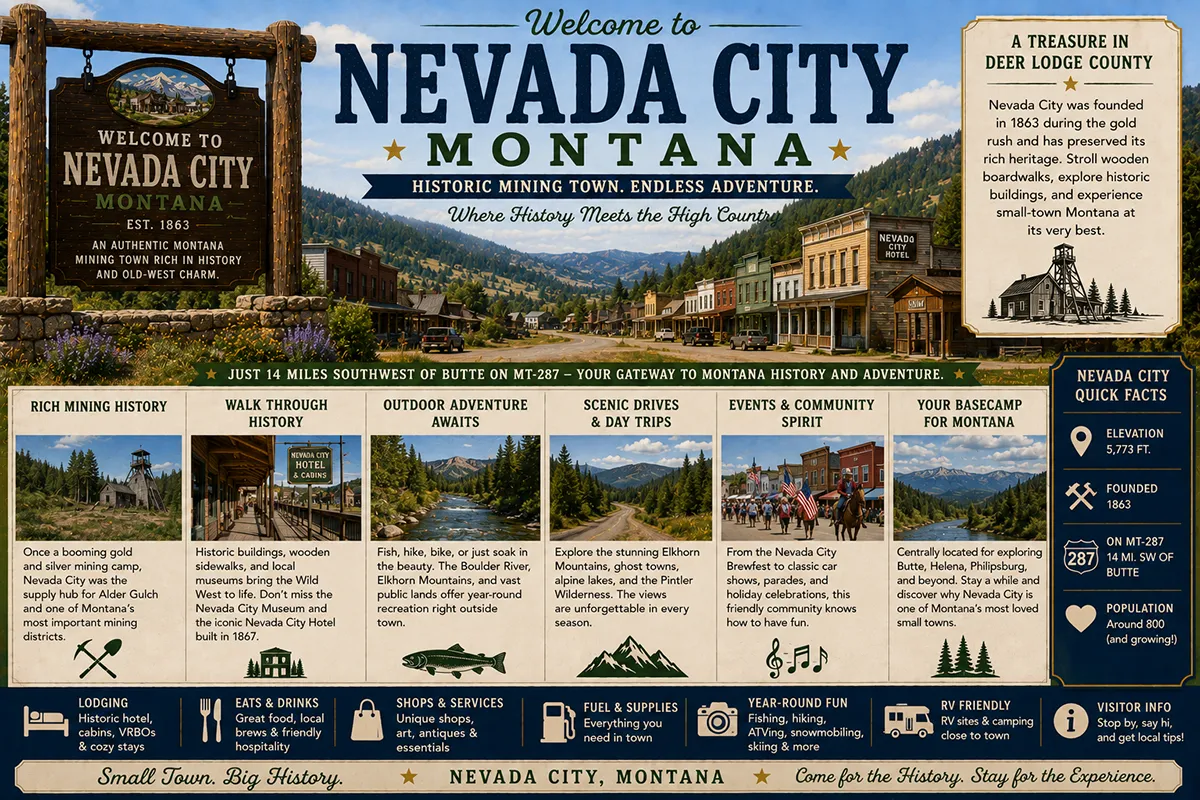
Nevada City almost didn’t survive the 1900s.
The town was founded in 1863 during the Alder Gulch gold rush, one of more than a dozen mining camps that strung along the gulch like beads on a necklace.
By fall of that year, an estimated 10,000 people lived in the chain of settlements that locals called the “Fourteen-mile City.” Nevada City was one of the principal ones — placer miners worked Browns Gulch just south of town, Granite Creek to the northwest, and the gulch itself in every direction.
The problem was that Nevada City sat directly on top of gold-bearing gravel.
When floating dredges arrived in 1899 under the Conrey Placer Mining Company, they began processing the ground underneath the town. Over the next 24 years, the dredges processed approximately 37 million cubic yards of ground along seven miles of Alder Gulch and recovered about $10 million in gold.
In the process, they destroyed most of Nevada City’s original buildings. By the early 1920s, the once-thriving town was essentially gone.
What’s there today is something genuinely unusual.
In 1945, a Montana history enthusiast and philanthropist named Charles Bovey — who, in a bit of trivia worth knowing, had been originally scheduled to be aboard the Titanic in 1912 — began restoring the surviving fragments of Virginia City a mile east.
Then he turned his attention to Nevada City. Almost nothing was left to restore. So Bovey did something different: he began moving historic 1860s-1900s buildings from elsewhere in Montana to the original Nevada City townsite, eventually creating an entire outdoor living history museum from approximately 70+ relocated structures plus reproductions. The last building was moved to Nevada City in 1978.
The result is something locals affectionately call the “building zoo.”
It’s an open-air museum where you can walk through cabins from Boulder, schools from Sun River, hotels from Brockton, and dozens of other historic Montana structures, all arranged to recreate what an actual 1860s Alder Gulch mining camp looked like.
On weekends during operating season, costumed interpreters live in the buildings — baking bread, doing laundry, teaching school children, arguing in saloons over boxing matches. It’s genuinely substantive living history, not the watered-down theme park version that some restored Western towns produce.
TL;DR
- Nevada City is an outdoor living history museum 1.5 miles west of Virginia City on MT-287 in Madison County.
- Founded in 1863 during the Alder Gulch gold rush; almost completely destroyed by floating dredges between 1899-1923.
- Restored beginning in 1945 by Charles Bovey and his wife Sue using historic buildings moved from across Montana — the famous “building zoo.”
- The Bovey holdings in both Nevada City and Virginia City were purchased by the State of Montana on May 16, 1997 — approximately 250 buildings and over 1 million artifacts.
- The Alder Gulch Short Line narrow-gauge railroad runs the 1.5 miles between Nevada City and Virginia City with a 1910 No. 12 Baldwin steam locomotive.
- The Nevada City Music Hall and Museum houses one of America’s largest collections of mechanical music machines.
- Costumed interpreters live in the buildings on weekends during operating season.
- Best for: Montana gold rush history travelers, Virginia City visitors, living museum experience, steam train enthusiasts, music machine collectors.
Nevada City at a Glance
| Population | <50 year-round (museum complex) |
|---|---|
| County | Madison County |
| Status | Unincorporated; outdoor museum operated by Montana Heritage Commission |
| Region | Southwest Montana (Alder Gulch) |
| Elevation | 5,615 ft |
| Distance to Virginia City | ~1.5 miles east on MT-287 |
| Distance to Ennis | ~14 miles east |
| Distance to Sheridan | ~12 miles south |
| Distance to Twin Bridges | ~20 miles southwest |
| Distance to Dillon | ~60 miles southwest |
| Distance to Bozeman | ~75 miles east (~1.5 hours) |
| Distance to Three Forks | ~70 miles northeast |
| Founded | 1863 (during Alder Gulch gold rush) |
| Best for | Living history museum, gold rush heritage, steam train ride, music machines |
What Makes Nevada City Different
Three things distinguish Nevada City from every other restored Western town in America.
The first is the scale of the Bovey restoration. Most preservation projects work with existing structures in place. The Boveys had to recreate an entire town because almost nothing of original Nevada City had survived the dredge era.
Their solution — moving historic buildings from across Montana to the original townsite — produced something that isn’t quite a restoration and isn’t quite a recreation. It’s a curated outdoor collection of authentic 1860s-1900s Montana architecture arranged on real Nevada City ground.
The second is the depth of the artifact collection. When the State of Montana purchased the Bovey holdings on May 16, 1997, the acquisition included approximately 1 million artifacts along with the 250 buildings.
Most are still in storage; many are displayed in the buildings themselves. The result is interior spaces filled with period-appropriate furnishings, tools, mercantile goods, and everyday items at a level of detail that most American living history museums can’t approach.
The third is the music machines.
The Nevada City Music Hall
The Music Hall and Museum at the entrance to Nevada City houses what is widely considered one of the largest collections of mechanical music machines in America.
The collection includes player pianos, nickelodeons, orchestrions, and rare automated instruments collected from across the world. Many of the machines originally lived in the front room of the Bale of Hay Saloon in Virginia City, which Bovey had restored in 1945.
A 1983 fire damaged many of the machines significantly. Some were sent to specialty restoration shops in Europe and other parts of the United States. Many of the restored machines now anchor the Nevada City museum collection. Entrance to the broader Nevada City museum is through the Music Hall.
Charles Bovey and the Titanic
The Charles Bovey backstory deserves its own mention.
Bovey was born in Minneapolis in 1907 to a wealthy milling family. As a young man planning his European education, he was originally scheduled to travel on the RMS Titanic’s maiden voyage in April 1912. His family changed the booking at the last minute. Bovey was five years old at the time.
Decades later, in 1945, Bovey visited Virginia City for the first time and found the historic gold rush town largely abandoned and decaying. He began purchasing and restoring buildings using his own family wealth.
His wife Sue worked alongside him for decades. The Boveys spent nearly 35 years on the Alder Gulch restoration projects — Charles working hands-on through his 70s, Sue managing collections and historical research.
The state purchase in 1997 came after Charles Bovey’s death (1978). The Bovey family had operated the sites for over five decades. The Montana Heritage Commission now manages them with technical assistance from the National Park Service.
The Alder Gulch Short Line Railroad
The narrow-gauge railroad that runs between Nevada City and Virginia City is one of Bovey’s more eccentric additions.
The original Northern Pacific Railroad never reached Virginia City — its tracks ended at Alder, several miles east. Charles Bovey built the Alder Gulch Short Line himself in the 1960s as part of the broader tourism vision for the restored towns. The 1.5-mile run uses original narrow-gauge track and equipment.
The centerpiece is a 1910 No. 12 Baldwin steam locomotive — a beautifully restored mechanical engine that runs on weekends during operating season under volunteer engineers.
On weekdays, a gasoline-powered engine handles the trains. Round-trip tickets are inexpensive and the 25-35 minute ride is one of Montana’s most unusual transportation experiences. See my broader Montana train tours guide for additional rail-based options.
For broader trip context, see my Montana cities and towns hub.
The Top 10 Things to Do In & Around Nevada City
1. Nevada City Living History Museum
The signature attraction. The museum requires a paid entrance ticket and provides a walking-tour experience through 70+ relocated buildings on the original Nevada City townsite.
Map provided at entrance helps identify each building’s origin and historical use. Costumed interpreters work the site on weekends during operating season.
Open seasonally — typically Memorial Day weekend through Labor Day. Verify current hours and admission with Montana Heritage Commission.
2. Alder Gulch Short Line Railroad
The narrow-gauge train ride between Nevada City and Virginia City using the 1910 Baldwin steam locomotive on weekends (gasoline-powered weekdays).
About 1.5 miles each direction, 25-35 minute round trip. Tour guide narrates the journey with local history.
A genuine Montana experience for train enthusiasts. See best Montana train tours.
3. Nevada City Music Hall and Museum
Entrance to the broader museum complex passes through the Music Hall, which houses one of America’s largest collections of mechanical music machines, player pianos, nickelodeons, and orchestrions.
Worth slow attention even if mechanical music isn’t normally your interest. The machines are genuinely remarkable.
4. Virginia City (1.5 miles east)
The sister community — a more substantial restored mining town and the Territorial Capital of Montana from 1865 to 1875. Boot Hill cemetery, the Vigilante Trail, the historic Pioneer Bar, and dozens of original buildings on Wallace Street.
For most travelers, Virginia City and Nevada City function as a combined destination. See Virginia City guide for full details.
5. River of Gold Gold Panning
Operated at Nevada City by the Montana Heritage Commission. Visitors can pan for actual gold (and other minerals) under guided supervision.
A family-friendly activity that connects directly to the 1863 placer mining heritage that founded the area.
6. Star Bakery Restaurant
The original 1863-era Star Bakery building (one of the few buildings original to Nevada City) operates as a restaurant on the highway side of the complex.
The bakery is accessible without museum admission and offers genuine period-appropriate dining. Verify current operating schedule.
7. Mining History Outdoor Exhibits (between Nevada and Virginia City)
Located at 1559 MT-287 between Nevada City and Virginia City, the free outdoor exhibits showcase original mining equipment and the Mount Vernon Dredge — one of the actual floating dredges that worked Alder Gulch.
The site provides essential context for understanding what destroyed Nevada City’s original buildings. Free; brief stop.
8. Alder Gulch Driving Tour
The MT-287 corridor through the historic Alder Gulch mining district can be explored as a self-guided driving tour. Markers identify the locations of the various 1860s settlements — Summit, Junction, Adobetown, Central City, Highland, Pine Grove — that once made up the “Fourteen-mile City.”
Most of those settlements are gone; only Virginia City and the rebuilt Nevada City remain.
9. Day Trip to Ennis (14 miles east)
The Madison Valley town with world-class fly fishing on the Madison River, multiple breweries, and dining significantly broader than what Virginia City and Nevada City can offer.
10. Day Trip to Sheridan and Twin Bridges (south)
The Ruby Valley and Beaverhead corridor south of Nevada City offers additional gold-rush-era heritage at Bannack State Park (Montana’s original territorial capital), as well as exceptional fly fishing on the Big Hole and Beaverhead Rivers.
Where to Stay
Nevada City has limited lodging. Most travelers base in Virginia City (1.5 miles east) or Ennis (14 miles east) for more options.
| Hotel | Vibe | Price | Best For |
|---|---|---|---|
| Nevada City Hotel | Historic Bovey-era lodging | $130–220 | Authentic Nevada City experience |
| Virginia City hotels (1.5 mi E) | Multiple historic options | $140–280 | Most travelers |
| Fairweather Inn (Virginia City) | Historic 1865 hotel | $180–300 | Historic luxury |
| Ennis hotels (14 mi E) | More variety | $150–280 | Madison River anglers |
| Vacation rentals (Alder Gulch area) | Historic homes and cabins | $200–400 | Families, longer stays |
Most lodging operates seasonally. Verify availability before traveling.
Where to Eat
- Star Bakery Restaurant (Nevada City) — original 1863-era building; check current hours
- Nevada City Hotel dining — historic dining when operating
- Virginia City dining — Pioneer Bar, Star Bakery (multiple locations), Bale of Hay Saloon, Wells Fargo Coffee House
- Ennis dining (14 min east) — broader restaurant variety; Burnt Tree Bakery, Reel Decoy Pub
- Bring picnic supplies if visiting on a non-operating day
Getting There & Around
From Virginia City: 1.5 miles west on MT-287, about 3 minutes — or take the Alder Gulch Short Line train.
From Ennis: 14 miles west on MT-287, about 20 minutes.
From Bozeman: 75 miles via I-90 west to Three Forks, then US-287 south and MT-287 west, about 1.5 hours.
From Dillon: 60 miles northeast via Twin Bridges, about 1.25 hours.
From Three Forks: 70 miles southwest via US-287 and MT-287, about 1.5 hours.
Cell service: Limited in Nevada City and along MT-287 through Alder Gulch.
What Nevada City Unlocks
Virginia City (1.5 mi E)
Montana’s territorial capital 1865-1875; National Historic Landmark; full restored mining town.
Alder Gulch / “Fourteen-mile City”
The 14-mile chain of 1860s gold-rush settlements; living Montana gold rush heritage.
Ennis & Madison River (14 mi E)
World-class fly fishing on the Madison River.
Madison Valley
Significant ranching and recreation country.
Sheridan & Ruby Valley (south)
Additional gold rush heritage and the Ruby River.
Bannack State Park (~75 mi SW via Dillon)
Montana’s original 1862 territorial capital, preserved as a ghost town.
Bozeman (1.5 hours E)
Montana’s fastest-growing city with full city services.
When to Visit
Memorial Day weekend through Labor Day: Standard operating season for Nevada City museum, Alder Gulch Short Line, and most attractions. Verify exact dates each year.
Summer (June–August): Peak conditions; warmest weather; full living history programming on weekends.
Fall (September–early October): Quieter; many attractions on reduced schedules; some operations close after Labor Day weekend; Bovey-era buildings beautiful in autumn light.
Winter and Spring (October–May): Most museum buildings and attractions closed; the highway corridor remains accessible but limited services.
For Montana history-focused travelers, see my key historical events in Montana and Montana oldest towns and cities guides for broader context.
Personal Tips
Buy the combined Nevada City + Virginia City pass. The Montana Heritage Commission offers combined tickets that cover museum access at both sites and the Alder Gulch Short Line train. The pass is significantly better value than individual tickets.
Time a visit for a weekend. Costumed interpreters work the buildings on weekends, dramatically improving the living history experience. Weekday visits give you the buildings but not the interpretive programming.
Allow a full day for both Nevada City and Virginia City. Most travelers underestimate the time required. The two communities together are essentially a single destination, and rushing through one to get to the other shortchanges both.
The Music Hall rewards slow attention. Don’t blow through it. The mechanical music machine collection is one of the most genuinely substantive in America. The 1983 fire damage and subsequent restoration stories are themselves significant.
Take the steam train. On weekends when the 1910 Baldwin runs, the train ride between Nevada City and Virginia City is one of Montana’s most unusual tourism experiences. Don’t drive between the two towns; ride the train.
Several films were shot here. Multiple Hollywood productions have used Virginia City and Nevada City as filming locations, including westerns from the 1960s through the present. See my movies filmed in Montana guide for the complete list.
Bring cash for some smaller transactions. Card payments work at major attractions, but some smaller vendors and the gold panning operation may prefer cash.
Combine with Bannack State Park if time allows. Travelers serious about Montana gold rush heritage should plan a multi-day Alder Gulch + Bannack itinerary. Bannack — Montana’s original 1862 territorial capital — is preserved as a ghost town about 75 miles southwest near Dillon.
Nevada City Quick Facts
| Founded | 1863 (during Alder Gulch gold rush) | | Original gold discovery | May 26, 1863 (six prospectors) | | “Fourteen-mile City” peak population | ~10,000 (fall 1863) | | Conrey Placer Mining Co. organized | 1896 | | Dredge mining operations | 1899-1923 (24 years) | | Gold recovered by dredges | ~$10 million | | Bovey restoration began | 1945 | | Last building moved to Nevada City | 1978 | | State of Montana purchase date | May 16, 1997 | | Buildings acquired | ~250 | | Artifacts acquired | 1 million+ | | Alder Gulch Short Line built | 1960s (Charles Bovey) | | Steam locomotive | 1910 No. 12 Baldwin | | Nevada City Music Hall fire | 1983 | | Average summer high | 79°F | | Average winter low | 9°F |
Conclusion
Nevada City is one of the most unusual destinations in the American West.
It’s not exactly a restored ghost town — most of what was here was destroyed by floating dredges over a century ago. It’s not exactly a museum either, though it functions as one.
What it is, instead, is an outdoor curated collection of authentic Montana mining-era architecture arranged on real Alder Gulch ground, populated on weekends by costumed interpreters who genuinely live the period roles they’re playing.
Combined with neighboring Virginia City — Montana’s actual territorial capital from 1865 to 1875 — Nevada City forms one of America’s most substantive gold rush heritage destinations.
The Bovey family spent four decades and considerable personal wealth making it possible. The Montana Heritage Commission has stewarded it since 1997.
If you visit only one mining heritage site in Montana, the Virginia City-Nevada City combination should be the one.
Have a Nevada City question? Drop it in the comments — I read every one.
Frequently Asked Questions
Is Nevada City Montana worth visiting?
Yes — Nevada City is worth visiting for the substantive outdoor living history museum (70+ historic 1860s-1900s buildings relocated from across Montana), the Alder Gulch Short Line steam train ride to neighboring Virginia City, the Nevada City Music Hall’s collection of mechanical music machines, and the combined Virginia City-Nevada City experience as one of America’s most genuine gold rush heritage destinations. Costumed interpreters work the site on weekends during operating season.
Who were Charles and Sue Bovey?
Charles and Sue Bovey were the Minneapolis-area philanthropists who restored Virginia City and reconstructed Nevada City beginning in 1945. Using their own family wealth (the Bovey family had milling and grain industry interests), the couple spent more than three decades purchasing and restoring historic buildings in Virginia City, and moving authentic 1860s-1900s buildings from across Montana to recreate Nevada City — which had been almost entirely destroyed by dredge mining in the early 1900s. Charles Bovey had been originally scheduled to travel on the RMS Titanic as a five-year-old in 1912; his family changed the booking before the voyage. The Bovey holdings were purchased by the State of Montana on May 16, 1997 after Charles’s death (1978).
What is the Alder Gulch Short Line?
The Alder Gulch Short Line is a narrow-gauge railroad built by Charles Bovey in the 1960s connecting Nevada City and Virginia City. The 1.5-mile track runs between the two communities. The signature equipment is a beautifully restored 1910 No. 12 Baldwin steam locomotive that operates on weekends during the operating season; a gasoline-powered engine handles the trains on weekdays. The original Northern Pacific Railroad never actually reached Virginia City — its mainline tracks ended at the town of Alder several miles east. The Alder Gulch Short Line is the only railroad to ever serve the two restored mining communities.
What was the Alder Gulch gold rush?
The Alder Gulch gold rush was triggered by the May 26, 1863 discovery of gold by six prospectors in the gulch that became known as Alder Gulch, in present-day Madison County, Montana. By fall of 1863, an estimated 10,000 people lived in the chain of mining camps that strung along the 14-mile gulch — locally known as the “Fourteen-mile City.” Major settlements included Summit, Junction, Adobetown, Central City, Nevada City, Virginia City, Highland, and Pine Grove. The placer gold was extraordinarily rich, ultimately producing an estimated $100 million in gold over decades of mining. Virginia City briefly served as the territorial capital of Montana from 1865 to 1875.
How big are Nevada City and Virginia City Montana?
Virginia City is the larger of the two communities, with approximately 130-200 year-round residents and substantially more services and businesses. Nevada City is significantly smaller — under 50 year-round residents — and functions primarily as an outdoor living history museum complex operated by the Montana Heritage Commission. The two communities are only 1.5 miles apart on MT-287 and effectively function as a combined destination.
What is the Nevada City Music Hall?
The Nevada City Music Hall and Museum is the building at the entrance to the Nevada City living history museum that houses one of America’s largest collections of mechanical music machines, including player pianos, nickelodeons, orchestrions, and rare automated instruments. Many of the machines were originally collected by Charles Bovey and displayed in the Bale of Hay Saloon in Virginia City. A 1983 fire damaged many of the machines significantly; restored examples now anchor the Nevada City Music Hall collection. Entrance to the broader Nevada City museum is through the Music Hall.
How far is Nevada City from Bozeman?
Nevada City is approximately 75 miles southwest of Bozeman — about a 1.5-hour drive via I-90 west to Three Forks, then US-287 south and MT-287 west through the Madison Valley. Many Bozeman-area travelers visit Nevada City and Virginia City as a long day trip or overnight excursion.