Calamity Jane tried to open a restaurant in Castle Town in the 1890s — and a railroad meant to save the town arrived ten years too late, three months after the last residents had given up and walked away.
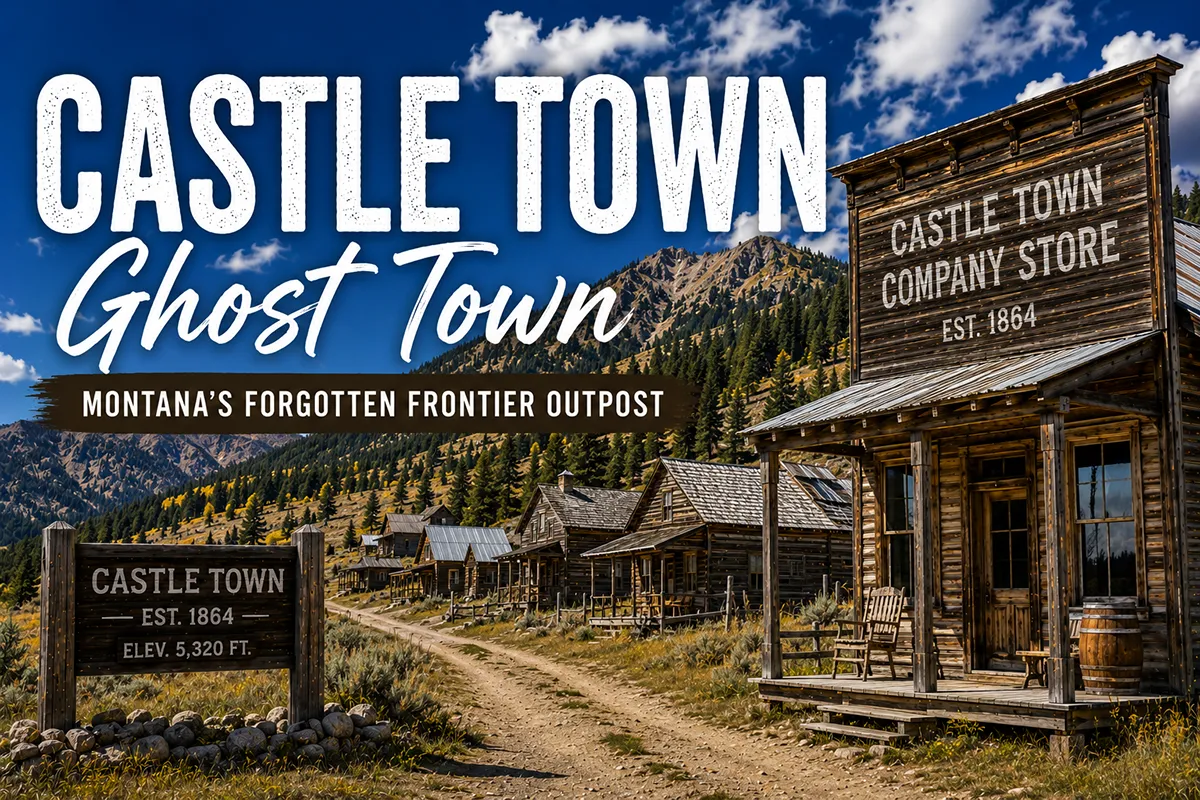
Castle Town (also called Castle City or just “Castle”) is a vanishing silver-mining ghost town in the Castle Mountains, about 15 miles south of White Sulphur Springs, Montana. It boomed from 1884 to 1893, peaked at around 2,000 residents, and is most famous as one of Calamity Jane’s brief homes. It is on private property. A handful of leaning wood-frame and stone buildings still stand, but the town is genuinely disappearing — to weather, time, and vandals. Visitors should view from public roads or seek explicit landowner permission, never trespass, and never take artifacts. Below: the full history, the Calamity Jane story, how to visit responsibly, and what makes this the most tragically-timed ghost town in Montana.
Liked this article?
Add Roaming Montana as a preferred source so you see more of our articles and guides on Google.
Important — Castle Town Is on Private Property
Before anything else, this needs to be said clearly: Castle Town sits on private agricultural land.
Sources online vary on what this means in practice. Some travel blogs describe people simply driving in and walking around the ruins. The owners and the U.S. Forest Service have at various times posted signage.
The legal reality is straightforward: the land is private. Unannounced trespassing is trespassing, regardless of how publicly known the ghost town is.
The responsible options are:
- View from public roads. A county road passes near the town site, and several buildings are visible from the roadway. This is the option this guide recommends.
- Seek explicit permission from the current landowner. Local White Sulphur Springs residents and the Forest Service ranger station may be able to direct you. Don’t assume permission based on what a stranger on the internet did 10 years ago.
- Take nothing, leave nothing. Even if you secure permission, every piece of weathered wood, rusted metal, or glass you remove accelerates the town’s disappearance. Castle Town is “vanishing” — and visitors are part of why.
This is not a “you can go anywhere and do anything” ghost town like Bannack or Garnet. It’s a private property with significant historical character that depends on visitors being respectful for what remains to survive.
With that out of the way — the story is genuinely extraordinary, and worth knowing whether or not you ever set foot on the property itself.
Why Castle Town Is the Most Tragically-Timed Ghost Town in Montana
If you’ve worked through my Montana ghost towns guide and the marquee deep-dives — Bannack, Virginia City, Garnet, Granite — you’ve heard the silver crash of 1893 story multiple times. Castle Town is where that story carries its sharpest edge.
The town’s mine owners spent years trying to bring a Montana Railroad spur to Castle. Their ore was rich enough to support a town of 2,000 people, but the freight costs of hauling it out by wagon ate into the profits.
A railroad would have changed everything. Construction was planned. Investors were lined up. And then the Silver Panic of 1893 triggered by the repeal of the Sherman Silver Purchase Act collapsed silver prices, paralyzed Western mining capital, and stopped the railroad project in its tracks.
The miners began leaving. The town began emptying.
The railroad was finally completed in 1903 by Richard A. Harlowe — ten years after the silver crash, three months after the town had effectively been abandoned. The train arrived in a town that no longer needed it.
That’s Castle Town. The Cumberland Mine continued working at reduced scale until 1950 [verify]. The last two permanent residents stayed until the 1930s. Most of the wood-frame buildings — built in a hurry on miners’ gambles — leaned, weathered, and slowly collapsed across the next nine decades.
I visited Castle Town in October 2023 [verify], driving the county road from White Sulphur Springs and viewing the buildings from public access points. This guide is built from that visit, the U.S. Forest Service interpretive signage in the area, and the published documentation through Legends of America, the Bozeman Daily Chronicle, and Western Mining History.
A Quick History — Silver, Calamity Jane, and a Late Railroad
1882 — Hanson Barnes finds silver
Hanson Barnes, a prospector working the Castle Mountains in central Montana, discovered silver ore in 1882. The Castle Mountain district that emerged was one of the more remote silver discoveries in Montana — far from the established gold rush centers around Bannack and Virginia City.
1884 — The North Carolina Mine
The North Carolina Mine was the first major mine developed in the district, opening in 1884. As word spread, the area saw an explosion of claim filings — nearly 1,000 mining claims were eventually filed in the district. The town of Castle was platted on the gentle slope where the main mines clustered.
1884–1891 — Boomtown
By 1891, Castle was officially incorporated with approximately 1,500 residents. At its peak shortly after, the town reached approximately 2,000 residents — more than any other Meagher County town has had before or since.
The boomtown infrastructure was substantial:
- A schoolhouse
- 80 dwellings (some sources cite multi-story homes with bay windows, decorative shingles, and ranch-style porches)
- A jail
- 14 saloons
- 7 brothels (including the famously named “Minnie’s sporting house”)
- Multiple stores: Baker’s general store and post office, Berg’s meat market, Kidd’s furniture store
- Several fraternal organizations
- A smelter
- Three daily stagecoach lines serving the town
The most prosperous mine in the district was the Cumberland Mine, which began producing lead and silver in 1884. The North Carolina continued. Dozens of smaller operations filled in around them.
The transportation problem
Castle’s economic Achilles’ heel was its location. The town sat in the Castle Mountains with no railroad. Every wagon of ore had to be hauled to the nearest rail connection — a slow, expensive process that ate into the margins of every operation. Mine owners worked desperately to get a Montana Railroad spur extended to Castle, which would have transformed the district’s economics.
1893 — The Silver Panic killed the railroad
The repeal of the Sherman Silver Purchase Act in November 1893 collapsed silver prices nationwide. Western mining capital evaporated. The Montana Railroad spur project lost its financial backing. The town’s mine owners watched their plans die in the months that followed.
When the lead price also dropped, the Cumberland Mine closed temporarily, and the town’s residents began leaving in significant numbers. Many headed for Helena, Butte, or other still-functioning mining districts.
1903 — The railroad arrives ten years late
Richard A. Harlowe completed the railroad line to Castle in 1903 — a decade after it was needed. By the time the rails reached town, most residents had already left. A few mines were re-worked at reduced capacity during the early 1900s, but the boom never returned.
Calamity Jane — Castle Town’s most famous resident
Among the people who lived briefly in Castle during its peak years was Martha Jane Cannary, better known as Calamity Jane — by then one of the most famous (and notorious) women in the American West.
Calamity Jane was already a known figure by the time she arrived in Castle in the mid-1890s. She’d worked as a frontierswoman, army scout, sometime sex worker, alcoholic, performer in Wild West shows, and friend of Wild Bill Hickok in Deadwood, South Dakota. By the time she came to Castle, she was traveling with her husband Clinton Burke and possibly her young daughter Jessie.
The story is that Calamity Jane came to Castle to open a restaurant — an attempt at a stable, ordinary life. Local newspapers documented “Mr. and Mrs. Burke” arriving in town. The restaurant never actually opened. Within months, the Burkes left and headed back toward Deadwood and the wandering life Jane could never seem to escape.
She would die in 1903 — coincidentally the same year the Castle railroad was finally finished — in Terry, South Dakota. She was 51 years old. She is buried next to Wild Bill Hickok in Deadwood’s Mount Moriah Cemetery.
Castle’s connection to Calamity Jane is brief but real. She tried to settle here. She failed. The town tried to survive without a railroad. It also failed. There’s a thematic alignment that gives Castle Town’s history more weight than the sum of its facts.
1903–1950 — The long slow decline
After the boom collapsed, Castle continued at reduced scale. Some mines reopened at smaller scale, including the Cumberland which continued working until 1950. The last two permanent residents reportedly stayed at the town site until the 1930s.
1950s–present — Vanishing
Since 1950, Castle Town has slowly disappeared. Weather, gravity, and time have taken most of the wood-frame buildings. Vandals and souvenir hunters have accelerated the loss — visitors carry away pieces of historical material every year. The Bozeman Daily Chronicle reported in 2025 that the town is “vanishing” and that the Forest Service and local preservationists worry about how much will be left in another decade.
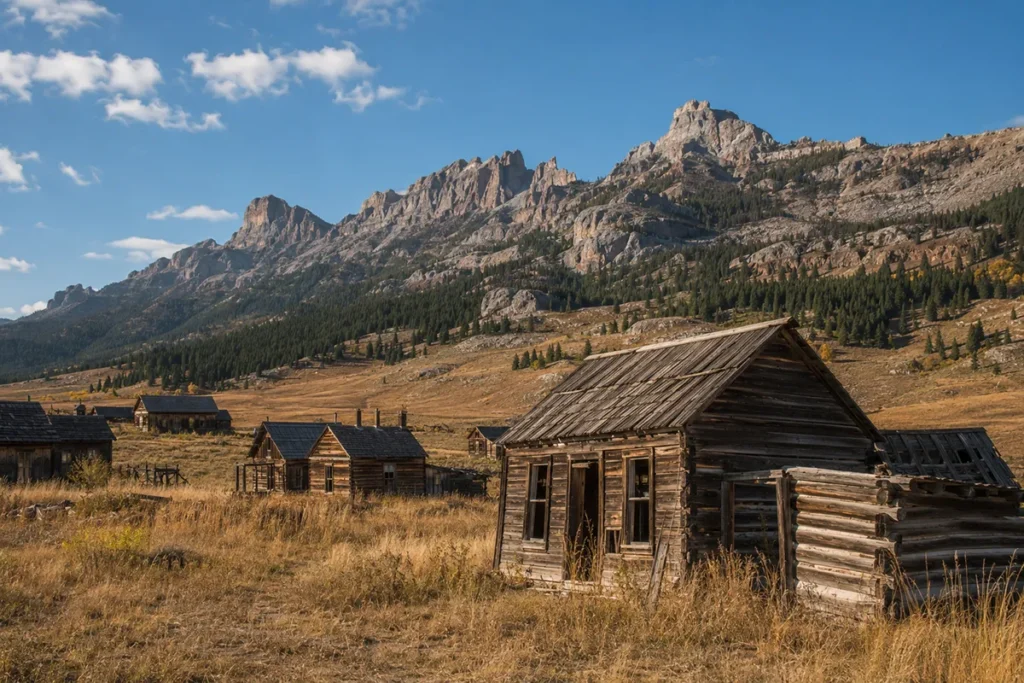
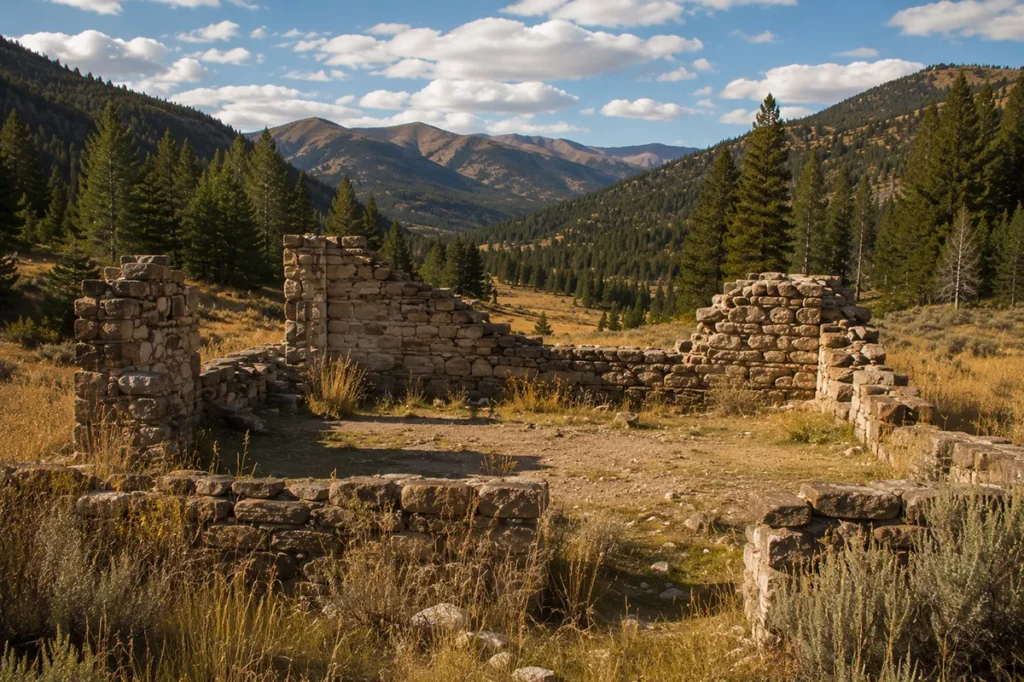
About a dozen buildings remain in various states. Most are leaning, sagging, or partially collapsed. Open stone foundations mark dozens of other structures.
What You Can See (From Public Access)
Even from public roads and respectful viewing distances, you can see a meaningful slice of Castle Town. The remaining structures and identifiable sites include:
Wood-frame and log buildings
Approximately 12 standing structures remain in various states of preservation — most leaning, weathered, and visibly working their way toward final collapse. From the road you can see several of these dotted across the grassy slope below the Castle Mountains.
Baker’s general store and post office
One of the most identifiable building sites is the open stone foundation of Baker’s general store and post office — once the commercial heart of Castle. The foundation walls still stand at varying heights.
Berg’s meat market and Kidd’s furniture store
Across the street from Baker’s were Berg’s meat market and Kidd’s furniture store — standard frontier town businesses. Foundations and partial structures remain.
Minnie’s sporting house
On the far hillside above the main town was Minnie’s — the most famous of Castle’s seven brothels. Sex work was a major component of any silver-mining town economy, and the surviving documentation of named brothels in Castle is unusually complete. The site is identifiable from a distance.
Mining infrastructure
On the slopes above the town, remnants of the smelter, mill foundations, and ore-processing equipment survive in scattered form. Most are visible from public access.
Cumberland Mine area
The district’s largest mine continued operating until 1950, so the mine site itself is more recently disturbed than most of the original town. The mine workings, tailings, and some structures are visible from public roads but should be viewed from a distance — old mine workings are genuinely dangerous.
Getting There — The Drive From White Sulphur Springs
Castle Town is in central Montana, off Highway 294 between White Sulphur Springs and Martinsdale. The drive itself is one of the most beautiful in central Montana.
From White Sulphur Springs (~25 minutes)
- From White Sulphur Springs, take Highway 294 east toward Martinsdale
- Watch for the county road signed for Castle / Lennep turning south off Highway 294
- Follow the county road approximately 8-10 miles south toward the Castle Mountains
- Castle Town becomes visible to your right as you approach the foothills
From Bozeman (~2 hours)
North on Highway 89 to White Sulphur Springs, then follow the directions above.
From Helena (~2 hours)
East on Highway 12, then north on Highway 89 to White Sulphur Springs.
From Billings (~3 hours)
West on I-90 to Big Timber, then north via Highway 191 and Highway 89.
Road conditions
| Factor | Detail |
|---|---|
| Highway 294 surface | Paved |
| County road to Castle | Gravel |
| Vehicle requirement | Standard passenger car in dry conditions |
| Avoid when | Wet, muddy, or recently snowed |
| Season | Late spring through fall (~May–October) |
| Cell service | None most of the way |
| Public road access for viewing Castle Town | Yes — but do not enter the property without permission |
Practical Visitor Info
| Topic | Details |
|---|---|
| Location | Castle Mountains, ~15 miles south of White Sulphur Springs, Meagher County, MT |
| Approximate coordinates | 46.82°N, 110.97°W [verify exact] |
| Owned by | Private landowners |
| Entry fee | None — but entry requires permission |
| Visitor center | None |
| Restrooms | None |
| Drinking water | None |
| Cell service | None |
| Pets | If you’re on private land with permission, leashed; if viewing from public roads, your call |
| Camping | Not at the town site. White Sulphur Springs and surrounding national forest. |
| Accessibility | Public road viewing is accessible by any vehicle; walking the actual town site requires uneven-terrain capability |
When to Visit (or Drive By)
| Season | Experience | My Take |
|---|---|---|
| Spring (April–May) | Variable, road may be muddy | Risky |
| Summer (June–Aug) | Best access, longest days, wildflowers around the town | Good |
| Early fall (Sept–Oct) | Cool weather, golden grasses, low traffic | My favorite. Late September is exceptional. |
| Late fall (Nov) | Cold, possible snow | Roads may be impassable |
| Winter (Dec–March) | Snow likely; roads often impassable | Don’t try it |
Combining Castle Town With Other Stops
The drive to Castle Town is worth taking even if you only view the buildings from public access. Combine with:
White Sulphur Springs
- Spa Hot Springs Motel — historic hot springs hotel right in town. See my Montana hot springs guide for context.
- Castle Museum and Carriage House — small but well-curated local history museum
- Smith River access — White Sulphur Springs is the gateway to the Smith River, one of the best multi-day float trips in the country (permit-required)
Lennep and Martinsdale
Two tiny ranching communities along Highway 294 worth a few minutes each. Lennep has a beautiful 1914 church. Martinsdale has the Charles M. Bair Family Museum — an art and historical collection well above what you’d expect for the town size.
Other ghost towns
- Comet Ghost Town — the other “drive-by only” private property ghost town in central/southwest Montana. Different region but similar visitor framing.
- Granite Ghost Town — for travelers continuing west to Philipsburg
A full-day central Montana loop
Morning at Spa Hot Springs in White Sulphur Springs → late morning drive to Castle Town for viewing and photography → lunch in Martinsdale or at the Bair Museum café → afternoon drive through Lennep → return to White Sulphur Springs for dinner.
What I Wish I’d Known Before My First Visit
Read about Calamity Jane first. The Castle Town story is mostly about the silver-mining boom, but Calamity Jane is the human anchor that makes it feel personal. Knowing she lived here briefly with her husband Clinton Burke transforms the drive.
Respect the private property situation. Don’t be the visitor who ruins the town for everyone by trespassing or pocketing souvenirs. The owners and the locals have seen plenty of that over the decades, and it’s why the town has been disappearing faster than weather alone explains.
The drive is half the experience. The road from White Sulphur Springs through the Castle Mountains is one of the most underrated drives in central Montana. Even if you spend only 20 minutes viewing the buildings, the trip is worth taking.
Bring a real camera with a longer lens. Public-access viewing means you can’t get close enough for good wide shots. A 70-200mm or even a 100-400mm zoom dramatically improves what you can capture of the leaning buildings without trespassing.
Don’t expect a Bannack experience. This is not a state park. There are no interpretive kiosks. There are no rangers. There are leaning wood-frame buildings on a grassy slope below the Castle Mountains, viewed from a county road, and the responsibility for getting context falls entirely on you.
Stop at the Castle Museum in White Sulphur Springs. Small but well-curated, and includes Castle Town-specific photos and documentation. Best place to get the local-historical context.
Plan 20-30 minutes at the viewing point. Castle Town is small and most of what’s visible is from public access. A focused viewing visit takes less than an hour. The drive there and back is the larger time investment.
Photography Tips for Drive-By Viewing
Specific notes for visitors who are viewing from public access only:
Best overall light: Late afternoon to golden hour. The Castle Mountains face generally east, and the late-afternoon side-light hits the surviving buildings from the right angle.
Best lens choice: 70-200mm zoom or longer. Shorter lenses won’t pull the buildings close enough from the public viewing distance. A 100-400mm gives you the most flexibility.
Best vantage point: Wherever the county road has a safe pull-off near the closest view of the town site. The road is lightly trafficked but you should still pull entirely off the road and not block any access.
Best subjects from the road:
- The leaning wood-frame buildings against the Castle Mountains
- The open stone foundations
- The general town site against the autumn grasses
What to avoid:
- Drone photography without explicit landowner permission
- Mid-day light from June through early August
- Stopping in places that block ranch access roads
Frequently Asked Questions
Where is Castle Town Montana?
Castle Town is located in the Castle Mountains of Meagher County, about 15 miles south of White Sulphur Springs, Montana. Access is via a county road off Highway 294 between White Sulphur Springs and Martinsdale.
Is Castle Town on private property?
Yes. Castle Town sits on private agricultural land. The town can be viewed from a public county road that passes near the site, but walking among the buildings requires explicit landowner permission. Trespassing is not appropriate regardless of how publicly known the site is.
Can you visit Castle Town?
You can view Castle Town from public roads. You can walk among the buildings only with permission from the current landowner. The Spa Hot Springs Motel and the Castle Museum in White Sulphur Springs can sometimes provide current contact information for the landowners.
Did Calamity Jane really live in Castle Town?
Yes. Martha Jane Cannary (Calamity Jane) lived briefly in Castle Town in the mid-1890s with her husband Clinton Burke. Local newspapers documented her arrival. She reportedly came to open a restaurant, which never actually opened. The Burkes left town within months and eventually returned to the Deadwood area.
Why did Castle Town die?
Two reasons. The Silver Panic of 1893 collapsed silver prices and stopped a planned Montana Railroad spur that would have transformed the town’s economics. The railroad was finally completed in 1903 — ten years too late. By then most residents had already left. The Cumberland Mine continued at reduced scale until 1950, but Castle never recovered.
How big was Castle Town at its peak?
Approximately 2,000 residents around 1891–1892, with 80 dwellings, a schoolhouse, jail, 14 saloons, 7 brothels, multiple stores, and a smelter. Nearly 1,000 mining claims were filed in the district.
Is Castle Town worth visiting?
For travelers interested in central Montana history, the Calamity Jane connection, or the dramatic story of a town killed by tragically-timed financial events, yes. As a casual ghost-town visit, Castle Town is more about the story and the drive than about walking through preserved structures.
How much does it cost to visit Castle Town?
Free — but viewing is from public roads only without explicit permission, and the town is on private property.
How long does it take to visit Castle Town?
20-30 minutes at the public viewing point. Round trip from White Sulphur Springs is roughly 1.5-2 hours including drive time.
Is Castle Town vanishing?
Yes. The Bozeman Daily Chronicle reported in 2025 that Castle Town is genuinely disappearing — to weather, time, and ongoing vandalism. The buildings are decades into their slow collapse, and visitor-caused damage (souvenir taking, climbing on structures) accelerates the loss. What you can see in 2026 may not be there in 2036.
What other ghost towns are near Castle Town?
Comet is the closest with a similar drive-by-only private-property visitor experience, though it’s farther west. Maiden, Giltedge, and Kendall are the closest Montana ghost towns to the east in the Fergus County cluster.
Is Castle Town haunted?
Like several Montana ghost towns, Castle has its share of local stories — particularly around the surviving wood-frame buildings and the old Cumberland Mine workings. The historical weight of the Calamity Jane connection and the failed-town narrative gives the site an emotional charge regardless of whether you believe in paranormal activity. See my guide to Montana’s most haunted places for the broader list.
Final Thoughts
Castle Town is the Montana ghost town for travelers who already understand what they’re looking at when they see a leaning wood-frame building on a grassy slope in central Montana. It’s not a state park. It’s not a museum.
It’s a real piece of private land where a real town existed for a few short decades, where Calamity Jane briefly tried to settle down, and where a railroad that would have saved everything arrived a decade after everyone had given up and moved on.
The story is what makes Castle Town worth the drive, even if you never set foot on the property itself. A man named Hanson Barnes finds silver in 1882. By 1891, 2,000 people are living in the Castle Mountains.
Calamity Jane shows up in the mid-1890s with her husband and tries to open a restaurant. The Silver Panic of 1893 kills the railroad project that would have saved the town.
By 1903 — when the railroad finally arrives — Castle is already a ghost town. The last residents stay until the 1930s. The buildings continue leaning, weathering, and disappearing into the present day.
If you’re planning a visit, my recommendation: pick a mid-September Tuesday. Drive from White Sulphur Springs in the morning. Stop at the Castle Museum first if it’s open. Drive Highway 294 through the Castle Mountains.
Pull off at the public viewing point and spend 20-30 minutes with a long lens and a quiet head. Drive back to White Sulphur Springs for a soak at Spa Hot Springs and dinner at one of the local restaurants.
That’s the responsible version of a Castle Town visit. The buildings are still there for now. The fewer souvenir takers and trespassers visit, the longer they’ll continue to be.
Drop your questions in the comments. And don’t forget to check out my full Montana ghost towns guide and the companion deep-dive on Comet Ghost Town — the other Montana ghost town best visited as a respectful drive-by.