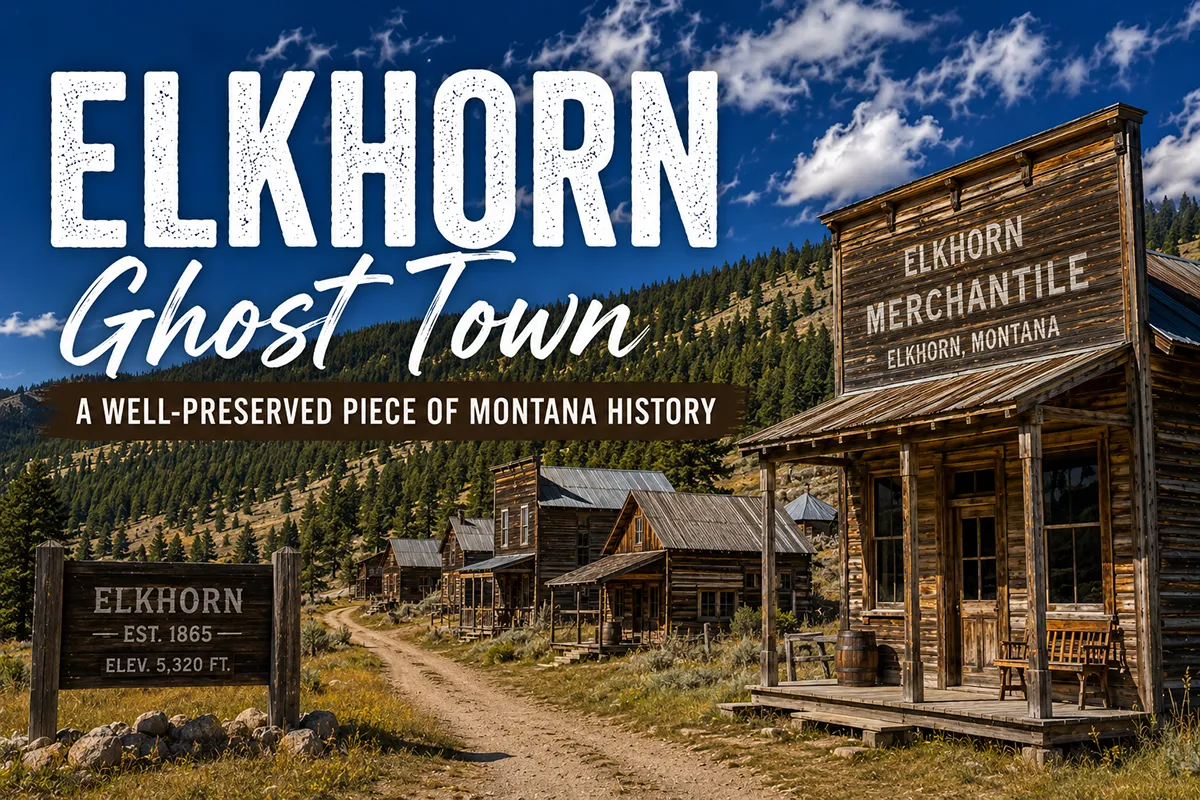
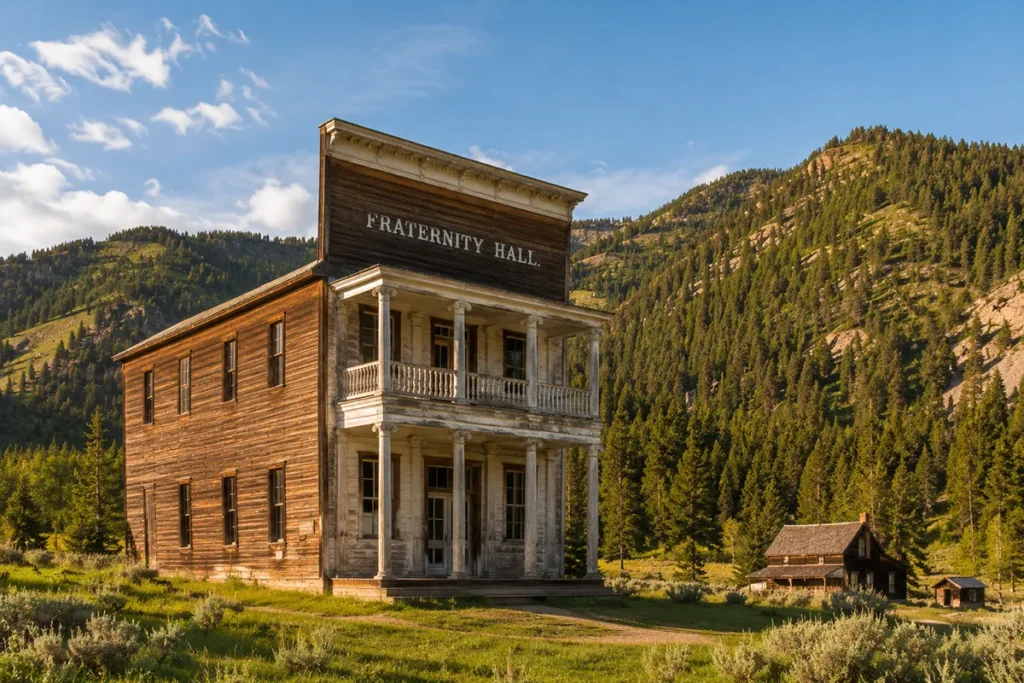
The Fraternity Hall at Elkhorn is officially “perhaps the most photographed ghost town building in the United States” — and the cemetery a three-quarter-mile walk up the road is full of children’s graves from the diphtheria epidemic that helped kill the town.
Elkhorn is the smallest state park in Montana — just two preserved buildings on less than an acre, surrounded by a privately owned semi-ghost town with about 10 year-round residents. Fraternity Hall and Gillian Hall are the survivors of an 1880s silver-mining boomtown that once held 2,500 people. The park is free, year-round, and an easy half-day from Helena via a 12-mile gravel road from Boulder. Below: the full visitor’s guide, the wild diphtheria story most guides skip, and how to pair Elkhorn with Boulder Hot Springs for a perfect Saturday.
Liked this article?
Add Roaming Montana as a preferred source so you see more of our articles and guides on Google.
Why Elkhorn Is the Easiest Montana Ghost Town to Visit From Helena
If you’ve read my Montana ghost towns guide, you’ve seen me recommend Bannack, Garnet, and Virginia City as the marquee Montana ghost town experiences. Elkhorn isn’t on that list. It’s something different.
Elkhorn is Montana’s smallest state park — only two buildings on less than one acre — surrounded by a still-inhabited semi-ghost town of cabins and ruins, set in a beautiful green mountain valley in the Elkhorn Mountains.
About 10 people still live here year-round in private homes scattered across the town site. It’s a half-day from Helena, accessed by a 12-mile gravel road through Helena National Forest. There’s no admission fee, no visitor center, no programmed experience.
What it offers instead is two of the most photogenic buildings in Montana — Fraternity Hall and Gillian Hall — set against a quiet wooded valley, and a cemetery up the road that tells a harder story than any other Montana ghost town: the story of a town that lost most of its children to a diphtheria epidemic between 1884 and 1889.
I’ve visited Elkhorn three times — twice in summer, once on a cold October morning [verify dates]. This guide is built from those visits and from official Montana State Parks documentation. Anything time-sensitive is marked [verify].
A Quick History — The Silver Veins in the Mountains
Elkhorn’s story unfolds in four phases.
1868–1872 — Peter Wys and the discovery
A Swiss immigrant named Peter Wys discovered silver veins in the Elkhorn Mountains in 1868, while prospecting in the rugged area southeast of Helena. He worked his claims for four years but died in 1872 before serious development began. His grave is in the Elkhorn cemetery to this day — you can still read his marker.
1872–1878 — Holter takes over
After Wys’s death, his claims were acquired by Anton M. Holter, a Norwegian-born Helena entrepreneur who had made his fortune in lumber, mercantile, and mining ventures. Holter and his partners developed the Elkhorn Mine starting in 1878.
1878–1893 — The boom
By the mid-1880s, Elkhorn was a thriving silver-mining boomtown. At its peak around 1888, the mine was producing $30,000 worth of ore monthly and was the largest mining operation in the surrounding area. The town’s population peaked at approximately 2,500 residents.
What made Elkhorn unusual among Western mining towns was its demographic profile. Most mining camps of the era were dominated by single male workers.
Elkhorn was a family town — populated heavily by European immigrants, including Norwegians, Germans, Swiss, English, and Italians, who brought their families.
The town had a school, multiple churches, a hospital, hotels, multiple saloons, stores, brothels, and even a railroad spur with three passenger trains arriving weekly.
In 1888, the mine was sold to an English syndicate, tying Elkhorn’s future to international silver markets. In 1893, the Fraternity Hall Association was incorporated and built the Fraternity Hall that still stands today — designed in a striking fusion of Greek Revival and gold-camp architecture, with neo-classical balcony and pillars on a Western false-front building.
1893–1937 — Decline and death
The decline of Elkhorn was driven by two simultaneous disasters.
The first was the diphtheria epidemic that swept through the town between 1884 and 1889. Diphtheria is a bacterial respiratory disease that primarily killed children before the development of antitoxin and vaccines.
The Elkhorn outbreak killed many of the town’s children — exactly how many is unclear, but the cemetery tells the story. Walk three-quarters of a mile up the road from the state park and you’ll see a heartbreaking number of small graves from those years.
Schools closed temporarily during the worst outbreaks. Families with surviving children began leaving for healthier locations.
The second blow was the Silver Panic of 1893. The same federal legislative action that destroyed Granite — the repeal of the Sherman Silver Purchase Act — collapsed silver prices nationwide and made Elkhorn’s mining operations unprofitable.
The mine continued operating at reduced scale into the early 1900s, briefly reopened during World War I, and was permanently shut down in 1937. By the 1970s, Elkhorn had become a true ghost town with only a handful of residents holding on.
For more on the broader era, see my pieces on the Montana gold rush and key historical events in Montana.
What’s Actually at Elkhorn — The Two Buildings of the State Park
Elkhorn State Park consists of exactly two buildings on less than one acre. Each is on the National Register of Historic Places and has been documented in the Historic American Buildings Survey.
Fraternity Hall (built 1893)
The signature building of Elkhorn and one of the most distinctive ghost town structures in the American West. Built in 1893 by the Fraternity Hall Association, it served as a gathering place for various fraternal orders, dance hall, theater venue, and community center for the dwindling town.
The architecture is remarkable. The building combines:
- Greek Revival elements: neo-classical balcony, decorative pillars
- Gold-camp Western style: false front, wooden construction
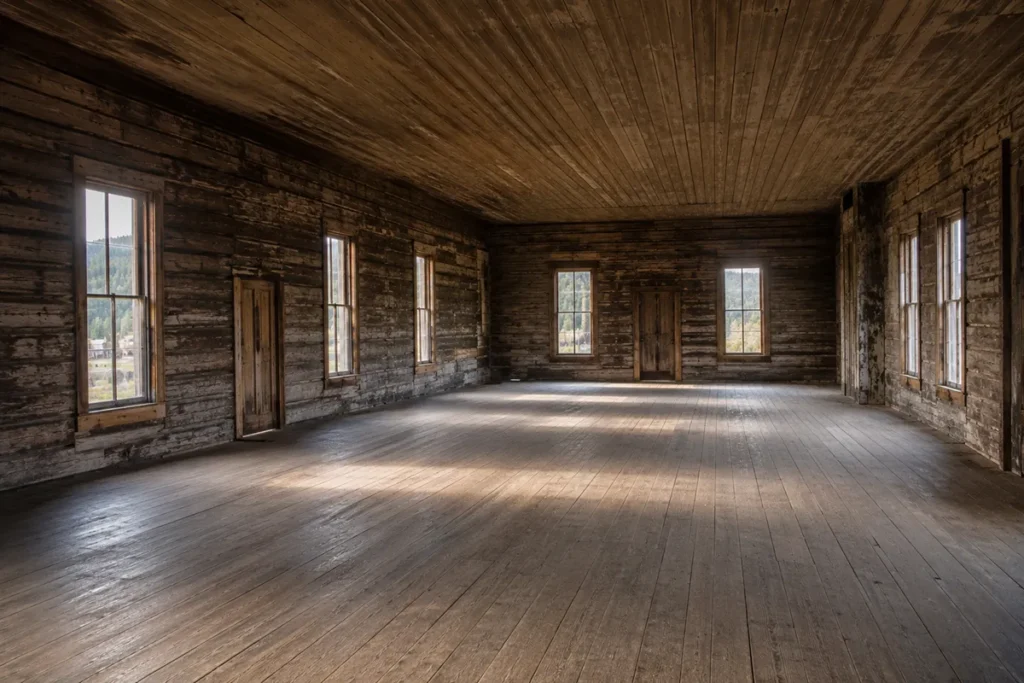
- Frontier practicality: large open second-floor hall designed for community events
The Fraternity Hall’s National Register of Historic Places nomination states it is “perhaps the most photographed ghost town building in the United States.”
That’s a federal-government claim, not a tourism brochure exaggeration. Photographers have been documenting this building for over a century, and it’s been featured on the covers of dozens of books and magazines about American ghost towns.
You can walk inside. The second floor is open to the public — climb the original staircase, walk into the open dance hall, and look out from the neo-classical balcony toward the mountains.
The original interior fixtures are largely in place. The space is empty, quiet, and acoustically alive — clap once and the sound bounces back across decades.
Gillian Hall
The neighbor to Fraternity Hall, built earlier in the boom years (likely 1880s). Less is documented about Gillian Hall’s specific history, but it was probably used as a store or saloon on the ground floor with a dance hall on the second floor — a common arrangement in Western mining camps.
Gillian Hall is also open to visitors. It’s smaller, more spartan, and gives a quieter sense of what a working commercial building in a 1880s silver town looked like. The second-floor balcony has a view across to Fraternity Hall.
These two buildings are the official state park. Everything else you see in Elkhorn is private property.
A Living Town Within a Ghost Town — Respecting Private Property
This is the part most guides don’t make clear, and it matters.
Elkhorn is not a pure ghost town. About 10 people live here year-round in scattered private homes. The “town” you walk through as you approach Fraternity Hall and Gillian Hall contains a mix of:
- The two state park buildings (open to the public)
- Privately owned occupied homes (some restored, some lived-in cabins)
- Privately owned vacant buildings (boarded up, in various states of repair)
- Mining-era ruins and equipment scattered on private land
The state park property is less than one acre. The rest of what you see is private. The unwritten visitor etiquette is straightforward:
- Stay on the main road and around the two state park buildings
- Don’t walk into yards or onto porches
- Don’t peer into windows of buildings that look occupied
- Don’t climb on or enter buildings outside the state park (they’re private property and often structurally unstable)
- Don’t drone the area without checking — residents have privacy concerns
The locals here are generally friendly to respectful visitors but understandably tired of trespassers. Be the good kind of ghost town tourist.
The Cemetery — A Three-Quarter-Mile Walk Up the Road
Don’t leave Elkhorn without visiting the cemetery, located about three-quarters of a mile up the main road from the state park (just outside the park property). This is where the diphtheria epidemic story becomes physical.
The cemetery contains:
- The grave of Peter Wys, the Swiss miner who discovered the silver veins in 1868. His marker is one of the oldest in the cemetery and worth finding.
- Numerous small children’s graves from the 1884–1889 diphtheria years, with poignant carved markers
- Adult graves of miners, families, and town founders
- Some recent graves of people who lived in or near Elkhorn into the 20th century
The cemetery is quiet, scattered across an open slope, and largely unkempt. There’s no formal trail — just walk between the markers carefully. Take time here. The disproportionate number of children’s graves makes the diphtheria story unmistakable in a way no historical marker could.
Getting There
Elkhorn is in the Elkhorn Mountains, located roughly in the triangle between Helena, Bozeman, and Butte but not directly on the way to any of them. The most common access:
From Helena (45 minutes)
- Take I-15 south for about 25 miles
- Take Exit 164 toward Boulder
- In Boulder, head north on Boulder Hot Springs Road (or whichever route the signs direct you)
- Continue approximately 11-12 miles on a mix of paved and gravel forest service roads
- Watch for Elkhorn signs
From Bozeman (~2.5 hours)
Via I-90 west to Three Forks, then north on Highway 287 to I-15, then north on I-15 to the Boulder exit.
From Butte (1.5 hours)
North on I-15 to the Boulder exit, then the same forest service road route.
Road conditions
| Factor | Detail |
|---|---|
| Total gravel | ~12 miles on Boulder Hot Springs Rd / forest service roads |
| Surface | Gravel, well-maintained in summer, washboard in places |
| Vehicle requirement | Standard passenger car friendly in dry conditions; high-clearance preferred |
| Avoid when | Wet, snowy, or recently muddied — sections can be slick |
| Season | Open year-round but winter access requires capable vehicle and conditions |
| Cell service | None most of the way; spotty in town |
| Total time from Helena | ~45 minutes one-way |
Practical Visitor Info
| Topic | Details |
|---|---|
| Location | Elkhorn, MT (Jefferson County) |
| Coordinates | 46.2750°N, 111.9456°W |
| Elevation | ~6,400 feet |
| State park size | Less than 1 acre |
| Managed by | Montana Fish, Wildlife & Parks |
| Entry fee | Free |
| Hours | Open year-round, daylight hours |
| Visitor center | None on site |
| Restrooms | None at the state park |
| Drinking water | None — bring everything |
| Cell service | Spotty to none |
| Pets | Allowed on leash |
| Accessibility | Limited — Fraternity Hall and Gillian Hall have stairs and original uneven flooring; cemetery walk is on dirt road |
| Camping | Not at the ghost town. Forest Service campgrounds and private campgrounds in nearby Boulder area. |
When to Visit
| Season | Experience | My Take |
|---|---|---|
| Spring (April–May) | Road accessible, weather variable | Variable — check conditions |
| Summer (June–Aug) | Best weather, longest days, green valley | Most reliable, slightly busier |
| Early fall (Sept–Oct) | Aspens turning, cool weather, very few visitors | My favorite. September weekday mornings are stunning. |
| Late fall (Nov) | Cold, possible snow, road still accessible | For solitude seekers |
| Winter (Dec–March) | Snowy access, no facilities, beautiful | Possible with capable vehicle and proper preparation |
Combining Elkhorn With Other Stops — Day Trip Ideas
Elkhorn is small enough (90 minutes on site is plenty) that you’ll want to combine it with other stops. The best pairings:
Half-day from Helena: Elkhorn + Boulder Hot Springs
The natural pairing. Drive from Helena to Elkhorn in the morning, spend 90 minutes at the state park and cemetery, then drive back to Boulder for an afternoon soak at Boulder Hot Springs Inn and Spa. End with dinner in Helena. See my Montana hot springs guide for more on Boulder Hot Springs.
Full day from Helena: Elkhorn + Marysville
Combine two of central Montana’s most accessible ghost towns. Marysville is about an hour west of Helena. Hit Elkhorn in the morning, lunch in Boulder or back in Helena, Marysville in the afternoon.
Two-day southwest Montana circuit
Day 1: Drive from Helena to Elkhorn, then to Boulder Hot Springs for the evening Day 2: South to Butte, west to Anaconda, north to Granite/Philipsburg
Helena weekend
Use Helena as your base. See Helena attractions, then add Elkhorn as a half-day excursion.
What I Wish I’d Known Before My First Visit
Plan only 60-90 minutes at the actual state park. Elkhorn is small. With two buildings and the cemetery, the visit is shorter than most ghost towns. Don’t drive 45 minutes from Helena expecting a half-day on site.
Bring everything. No water, no food, no restrooms, no services at the state park. Boulder (12 miles back) is your last stop for supplies.
Climb to the second floor of Fraternity Hall. Most visitors stay on the ground level. The second-floor dance hall and balcony are the real reward.
Walk to the cemetery. It’s 0.75 miles up the road. Many visitors skip it. They miss the most affecting part of the visit.
Respect the private property. Walking through Elkhorn, you’ll pass occupied homes, vacant private buildings, and scattered ruins. Stay on the road. Don’t approach buildings outside the state park property. The locals are generous about quiet, respectful visitors and tired of the alternative.
Go on a weekday. Even by ghost town standards, Elkhorn is quiet on weekdays — sometimes you’ll have the entire site to yourself.
Combine with Boulder Hot Springs. A ghost town in the morning and a hot springs soak in the afternoon is one of the best Saturdays you can have in central Montana.
Don’t drone without checking. With residents living in private homes, dropping a drone over Elkhorn without considering their privacy is the fastest way to ruin everyone’s day.
Photography Tips
A few specifics:
Best light for Fraternity Hall: Late afternoon. The building faces generally south-southwest and the front facade glows in golden hour. Mid-morning is also good for the false-front detail.
Best light for Gillian Hall: Earlier in the day — the angle of the building makes morning light flatter and more interesting.
Best vantage points:
- Standing in the road below Fraternity Hall, looking up at the balcony and pillars
- From the cemetery side, looking back down at both buildings with the valley behind
- From the second-floor balcony of Fraternity Hall itself, looking down the road
Detail shots: The neo-classical pillars on Fraternity Hall, the carved details on Peter Wys’s gravestone, the small children’s markers in the cemetery (be respectful), and the weathered siding on the unrestored private buildings.
Gear: A 24-35mm lens covers most of what you need. A 50mm prime for portraits of the architectural details.
What to avoid: Mid-day light from June through early August flattens the white siding on Fraternity Hall.
Frequently Asked Questions
Where is Elkhorn Ghost Town?
Elkhorn Ghost Town is located in the Elkhorn Mountains of Jefferson County, Montana — approximately 12 miles north of Boulder, MT, and 45 minutes south of Helena. Coordinates: 46.2750°N, 111.9456°W. Elevation roughly 6,400 feet.
Is Elkhorn really the smallest state park in Montana?
Yes — Elkhorn State Park consists of two buildings (Fraternity Hall and Gillian Hall) on less than one acre of land, making it the smallest unit in the Montana State Parks system.
How much does it cost to visit Elkhorn?
Free. There is no entry fee at Elkhorn Ghost Town State Park.
Can you go inside the buildings at Elkhorn?
Yes — both Fraternity Hall and Gillian Hall are open to the public, including the second floors. They are the only buildings in Elkhorn open to visitors; all other structures are private property.
Is Elkhorn worth visiting?
Yes, especially for photographers and history travelers. Fraternity Hall is sometimes called “the most photographed ghost town building in America” per its National Register of Historic Places documentation. Elkhorn is small (60-90 minutes on site), so plan to combine it with Boulder Hot Springs or Helena attractions.
Why did Elkhorn die?
Two reasons. A devastating diphtheria epidemic between 1884 and 1889 killed many of the town’s children and drove families away. The Silver Panic of 1893, triggered by the repeal of the Sherman Silver Purchase Act, collapsed silver prices and made the mine unprofitable. The mine continued at reduced scale until permanent closure in 1937.
Are there people still living in Elkhorn?
Yes — about 10 people live in Elkhorn year-round in private homes scattered across the town site. Most of the buildings you see around the state park are private property.
Can you visit the cemetery at Elkhorn?
Yes. The Elkhorn cemetery is about three-quarters of a mile up the main road from the state park, just outside the park boundary. It contains the grave of Peter Wys (who discovered the silver veins in 1868) and numerous small graves of children who died in the diphtheria epidemic.
Is Elkhorn family-friendly?
Yes — the buildings are safe to explore (the second-floor of Fraternity Hall is structurally sound), the walk is short, and the cemetery walk is on a flat road. Younger kids may find it less engaging than larger ghost towns like Bannack with more buildings.
Is Elkhorn open in winter?
Yes, technically — the park has no closure date. But the gravel road access requires capable winter driving and conditions. Most visitors come May through October.
How long does it take to visit Elkhorn?
60-90 minutes on site is typical, including both buildings and the cemetery walk. Round trip from Helena is roughly 3-4 hours including drive time.
Is Elkhorn haunted?
Elkhorn has fewer documented paranormal reports than Bannack or Virginia City, but the cemetery in particular has an unmistakable emotional weight from the diphtheria losses. See my haunted places in Montana guide for the broader list.
Final Thoughts
Elkhorn is the Montana ghost town that does the most with the least. Two preserved buildings. Less than an acre of state park. A walk-up cemetery. About 10 living residents in private homes scattered across the original town site.
What makes it work is the specificity of what’s there. Fraternity Hall isn’t just a photogenic building — it’s possibly the most photographed ghost town building in America, and standing on its neo-classical balcony at golden hour, you understand why. The cemetery isn’t just a cemetery — it’s a record of what happened to a town that lost too many of its children to a disease that’s now preventable.
If you’re in Helena and have a free Saturday, the answer is straightforward: morning at Elkhorn, afternoon at Boulder Hot Springs, dinner back in town. That’s a near-perfect Montana day.
My recommendation: pick a mid-September Tuesday. Arrive at Elkhorn around 9 AM with coffee in a thermos. Walk through both buildings. Walk the road up to the cemetery. Sit on the porch of the Fraternity Hall balcony for a few minutes. Take your photos. Then drive back down to Boulder for lunch and a soak at the hot springs.
Drop your questions or your own Elkhorn stories in the comments. And don’t forget to check out my full Montana ghost towns guide if you’re planning to do more than one.