The population of Comet, Montana is officially three — and in the 1930s, this same valley housed the second-largest mining operation in the state, employing 300 men in the most modern flotation mill in Montana.
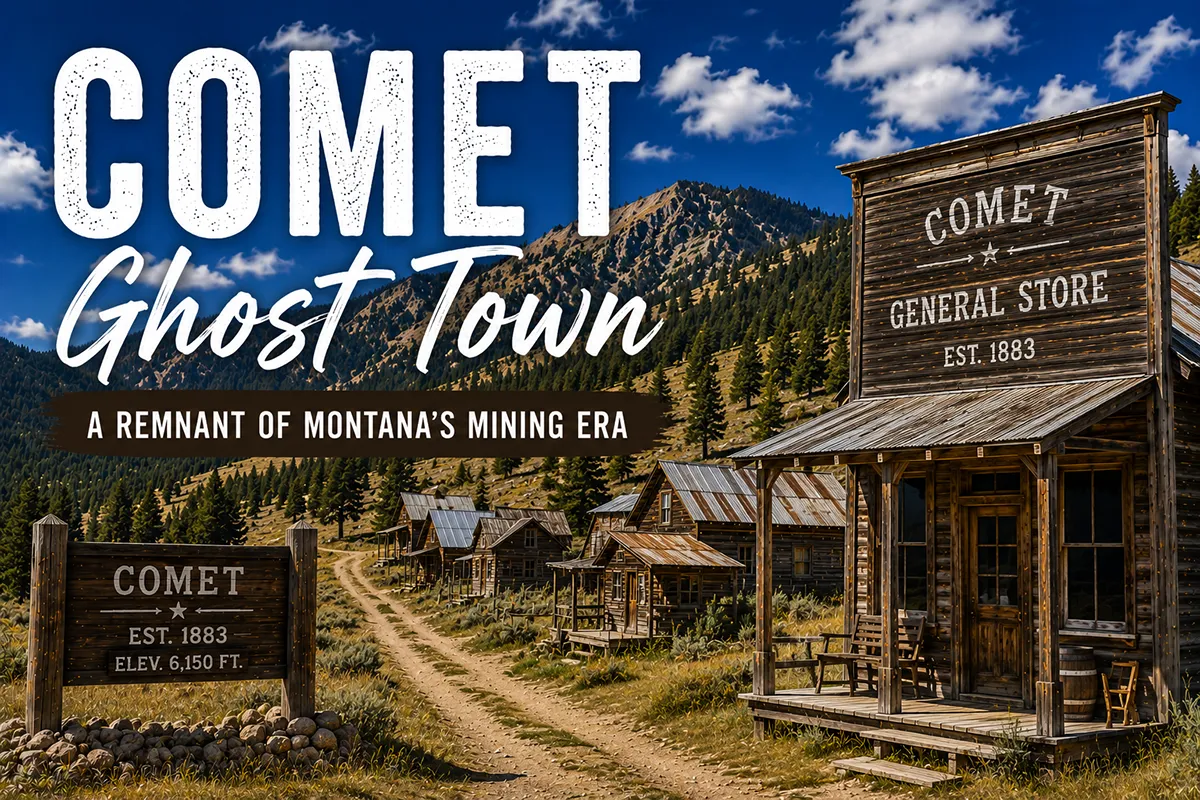
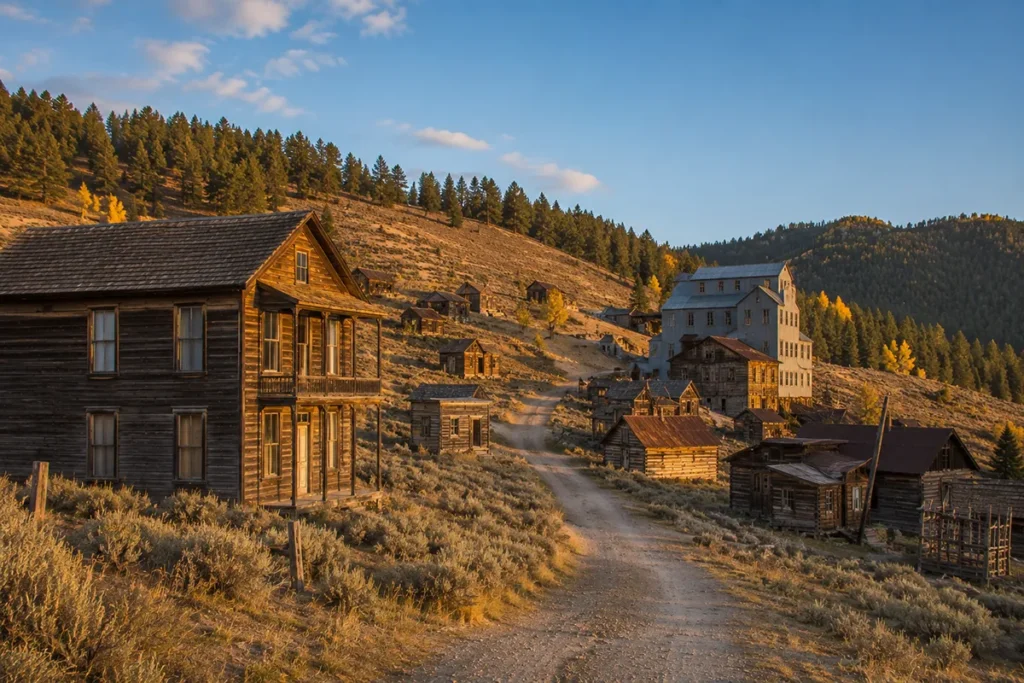
Comet is a striking silver and lead ghost town in the Boulder Valley between Boulder and Basin, Montana, about 40 miles northeast of Butte. It sits on private property, but a Jefferson County dirt road runs directly through the town, making it the most viewer-friendly of Montana’s “private property” ghost towns. The Comet Mine was the richest in the High Ore Mining District, producing $20 million in lead, zinc, silver, copper, and gold across two boom periods (1880s and 1926–1941). What remains today includes a striking two-story boarding house, a large mill, a bunkhouse, an ore hopper, and dozens of cabins scattered across a 12-block radius. Population today: 3 people. Below: how to visit responsibly, the wild revival story, and what makes Comet the most photographable ghost town in central Montana.
Liked this article?
Add Roaming Montana as a preferred source so you see more of our articles and guides on Google.
Access — How Comet Is Different From Castle Town
If you’ve read my Castle Town ghost town deep-dive, you know that the responsible way to visit that town is from public roads only, with explicit permission required for closer access. Comet is slightly different and worth understanding.
Comet sits on private property — one family lives there full-time, making the official population three people. The buildings, the mine site, the boarding house, the mill, and the cabins are all on privately owned land.
However, a Jefferson County dirt road — High Ore Road — runs directly through the town site. This is a public roadway. You can legally drive through the town, view the buildings from the road, pull over briefly at safe spots, and take photographs. What you cannot legally do is leave the road and walk onto the private buildings, climb on the mill structures, or enter any of the cabins.
In practice, most sources describe Comet as “private property but open to the public” — meaning the landowners have historically tolerated respectful visitor traffic through the town site. That tolerance depends on visitors doing the right thing:
- Stay on the road or pull off at obvious turnouts
- View buildings from public access
- Take photos from a respectful distance
- Do not take artifacts (every piece you pocket accelerates the town’s disappearance)
- Do not enter buildings (structurally unsafe AND private property)
- Do not climb on the mill or mining equipment (extremely dangerous and disrespectful)
- Don’t disturb the family that lives there
If you do those things, Comet is one of the most rewarding ghost-town drives in Montana. If you don’t, you’re part of the reason the town is being lost.
Why Comet Is Different From Every Other Montana Ghost Town
If you’ve worked through my Montana ghost towns guide and the marquee deep-dives — Bannack, Garnet, Virginia City — you’ve seen the gold-rush boom-and-bust pattern over and over. Most Montana ghost towns died once, in the 1890s or early 1900s, and never came back.
Comet died twice.
The first death came around 1900, when the original silver and lead ores began playing out. By 1913, the town was already being described as a ghost town. Most residents had moved to Helena, Butte, or other still-active mining districts.
But in 1926, the Basin Montana Tunnel Company resurrected the town. They built what was described at the time as “the most modern flotation mill in Montana” — a 200-ton-per-day concentrator that processed lead, zinc, silver, copper, and gold from both the Comet Mine and the nearby Gray Eagle Mine.
By the 1930s, Comet had become the second-largest mining venture in Montana — after Butte itself. Three hundred men worked the mines. The town came back. New families moved in. Mining boomed through the Great Depression, when most Montana mining was struggling.
Then World War II’s ban on nonessential mining killed the operation in 1941. Most equipment was sold. People moved away. Comet became a ghost town for the second and final time.
You can stand on High Ore Road today, look at the silent metal mill across the way, and try to imagine 300 men working that operation through the Depression years. That’s what makes Comet different. Most Montana ghost towns are 19th-century stories. Comet is also a 20th-century story.
I visited Comet in October 2023 [verify], driving High Ore Road south to north and stopping at multiple safe pull-offs along the way. This guide is built from that visit, the deep historical documentation in HistoryNet, Explore Big Sky, and the Helena Independent Record, plus the Montana DEQ’s documentation of the mine cleanup.
A Quick History — Two Booms and Two Busts
1869 — John W. Russell discovers silver galena ore
A prospector named John W. Russell discovered silver galena (lead-silver) ore on High Ore Creek, a tributary of the Boulder River. He worked his claims and in 1873 obtained a patent on 17.7 acres that included what would become the Comet Mine, his house, a second house, and an “ore house” for storing extracted material.
1874–1876 — Alta-Montana Company takes over
In 1874, Russell sold his claims to the Alta-Montana Company, owned by Montana mining moguls Samuel T. Hauser and D.C. Corbin. The new company invested heavily and built a 40-ton-per-day concentrator on site. The town of Comet was officially surveyed and platted in 1876, with the post office opening the following year.
1880s — The first boom
The Comet Mine produced extraordinarily rich ore. Reports describe the vein as 12 feet thick at a depth of 145 feet — exceptional grade. The ore was transported over a mountain pass to Wickes, the company smelter town nearby.
The smelter at Wickes couldn’t keep up with Comet’s ore production, leading to repeated slowdowns at the mine. Hauser and Corbin’s solution was to build an aerial tramway over the pass to reduce transportation costs — a major engineering project for an 1880s Montana mining operation.
At the 1885 peak, the greater Comet area held approximately 300 residents across approximately 90 buildings. Some sources describe 22 saloons in operation at the peak — more saloons than residential buildings remain today.
1883 — First bust
The Alta-Montana Company went bankrupt in 1883, causing the first complete shutdown at Comet. Hauser and Corbin reorganized the operation with new capital and continued through the 1890s, but the ore quality was declining and the economics were tight.
1897–1900 — Operations fade
By 1897, the original ownership had shut the operations down again. A revival under the Montana Consolidated Copper Company in 1900 worked the mine at reduced scale.
1913 — First time as a “ghost town”
By 1913, journalists were already calling Comet a ghost town. Most residents had moved on. A few miners and their families held on, working what was left of the ore at small scale.
1926–1941 — The second life
Basin Montana Tunnel Company purchased the Comet Mine and the nearby Gray Eagle Mine in 1926. The company tore down the old mill and built a new 200-ton flotation mill that was described at the time as the most modern milling plant in Montana.
By the early 1930s, the revived operation employed about 300 men — and combined with the Gray Eagle Mine, Comet was the second-largest mining venture in Montana, after Butte itself. The mines produced over $20 million in silver, lead, zinc, copper, and gold during this period (combined with the original 1880s production).
1941 — Final closure
World War II’s ban on nonessential mining put a stop to operations in 1941. Most equipment was sold. The mining workforce was redirected to wartime industrial work elsewhere. People moved away. Comet became a ghost town for good.
1990s — Environmental cleanup
The Comet Mine left a serious environmental legacy. High Ore Creek was polluted with toxic mine runoff for 80+ years. The Montana Department of Environmental Quality completed a major reclamation project at Comet in 1997, restoring the creek and removing toxic materials. The project received a national award for environmental restoration.
That cleanup is one of the most successful mine-reclamation stories in the American West and is genuinely part of why Comet today is a viable visitor destination — without it, the creek and surrounding area would still be toxic.
Present — Population 3
Today, one family lives in Comet year-round, making the official population three people. The buildings continue to weather, lean, and slowly collapse. The mill stands silent. The mine workings are closed. The Jefferson County dirt road runs through it all.
What You Can See From High Ore Road
Driving High Ore Road through Comet, you’ll see most of the town’s surviving structures. About a dozen buildings remain in various states of preservation. Here’s what to watch for, roughly in the order you’ll encounter them driving north from I-15:
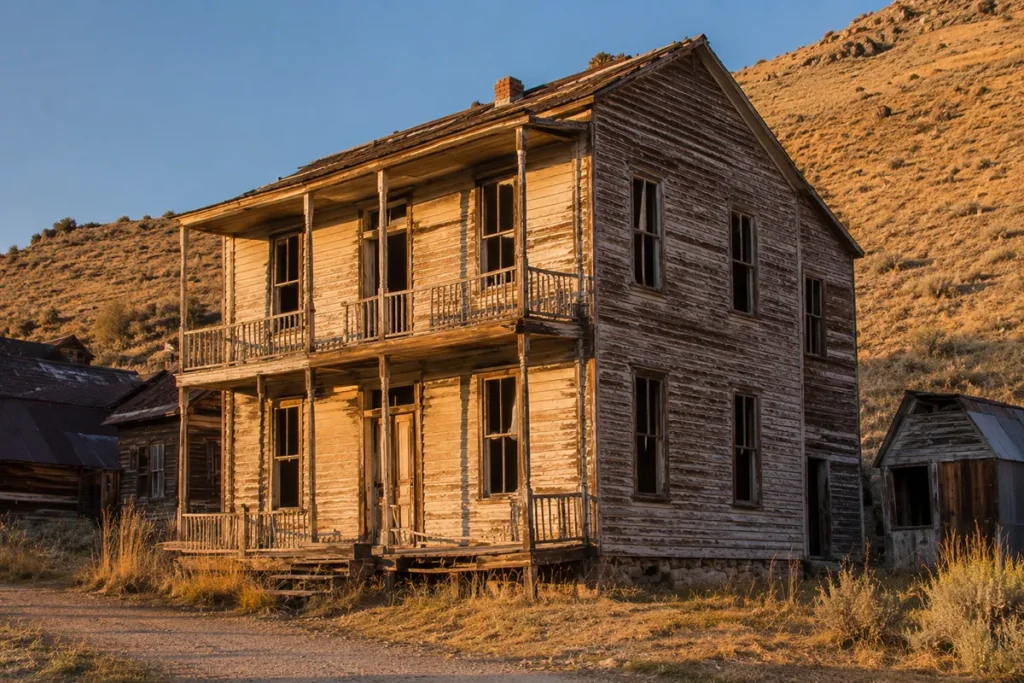
The two-story boarding house
On the left side of the road as you approach the heart of town. A tall weathered wood-frame structure where miners rented rooms during the 1930s revival.
According to surviving documentation, miners could find room and board at the boarding house for 75 cents per day — out of an average daily wage of $4.00.
That economics — paying nearly 20% of your wages just for a bed and meals — tells you a lot about working-class life in 1930s Montana.
The mill
On the right side of the road, the large grey metal mill is the most prominent structure in Comet. This was the 200-ton flotation concentrator built by the Basin Montana Tunnel Company in 1926 — once “the most modern milling plant in Montana.”
The mill is shuttered and partially collapsed but still substantially intact. Do not approach or climb on it — old mill structures are genuinely dangerous and this one is private property.
The bunkhouse
Adjacent to the mill, a smaller building that served as a single-miner bunkhouse during the 1930s operation. Less rent than the boarding house but considerably more cramped quarters.
The ore hopper
Near the mill is a wooden ore hopper — the chute through which raw ore was fed into the milling process. Strikingly photogenic from a distance.
Scattered miners’ cabins
Throughout a 12-block radius around the main town site, dozens of cabins stand in various states. Some are partially restored. Most are weathered, leaning, or collapsing. Some still contain fragments of furniture and household items visible through broken windows.
These cabins were the homes of the miners and their families during both boom periods. Walking the road past them in late afternoon, you can see the original window frames, doorways, and (occasionally) interior details through the gaps.
Mine-area buildings
Up the slope from the main town, a few mine-related structures survive — small office buildings, a shed or two, and the visible remnants of mine workings (closed off to entry).
The town site geography
The 12 blocks of Comet are bisected by High Ore Creek, which runs through the center of the property. Mine buildings are on one side; the town proper is on the other. The 1997 DEQ reclamation has restored the creek to a healthy state — the water is clear, and aquatic life has returned.
Getting There — The Drive Up High Ore Road
Comet is approximately 40 miles northeast of Butte and 20 miles south-southwest of Helena, between the small towns of Boulder and Basin.
From I-15 (most direct)
- Take I-15 to Exit 160
- Follow High Ore Road north for approximately 5 miles to the Comet town site
- The road continues past Comet — you can either turn around or continue toward Boulder
From Helena (~30 minutes)
South on I-15 to Exit 160, then High Ore Road north for 5 miles.
From Butte (~50 minutes)
North on I-15 to Exit 160, then High Ore Road north for 5 miles.
From Bozeman (~2 hours)
West on I-90 to Butte, then north on I-15 to Exit 160, then High Ore Road north.
Road conditions
| Factor | Detail |
|---|---|
| Total distance from I-15 | ~5 miles |
| Surface | Gravel, well-maintained in summer; rough in places |
| Vehicle requirement | Standard passenger car in dry conditions; high-clearance preferred |
| Avoid when | Wet, muddy, or recently snowed |
| Season | Late spring through fall (~May–October); winter access difficult |
| Cell service | Spotty to none |
| Public road through town | Yes — High Ore Road is a Jefferson County public road |
| Parking | Pull off at safe shoulder spots; do not park in front of the family residence |
Practical Visitor Info
| Topic | Details |
|---|---|
| Location | Between Boulder and Basin, Jefferson County, MT |
| Coordinates | 46.3108°N, 112.1700°W |
| Elevation | 6,388 feet |
| Population | 3 (one family, year-round) |
| Owned by | Private |
| Access | Jefferson County dirt road runs through town; viewing from road is allowed; entering buildings is not |
| Entry fee | None |
| Visitor center | None |
| Restrooms | None |
| Drinking water | None |
| Cell service | Spotty to none |
| Pets | If you keep them in your vehicle or on a leash at roadside, fine; don’t let them off-leash onto private property |
| Camping | Not at the town site; Boulder area Forest Service campgrounds |
| Accessibility | Drive-through viewing accessible by any vehicle; walking the road has some moderate uphill on uneven gravel |
When to Visit
| Season | Experience | My Take |
|---|---|---|
| Spring (April–May) | Mud season possible | Variable |
| Summer (June–Aug) | Best access, longest days | Most reliable |
| Early fall (Sept–Oct) | Cool weather, aspens turning, low traffic | My favorite. October afternoons are exceptional. |
| Late fall (Nov) | Cold, possible snow | Risky |
| Winter (Dec–March) | Road typically impassable | Don’t try it |
Combining Comet With Other Stops
Comet is in a particularly rich area for ghost towns and historic Montana stops. Some pairings:
Boulder + Comet + Boulder Hot Springs
The natural day trip. Boulder is the small town 4-5 miles north of Comet via High Ore Road and connected highways. Boulder Hot Springs Inn and Spa has been operating since the 1880s and is one of central Montana’s most atmospheric historic hot springs. Combine: morning at Comet, afternoon at Boulder Hot Springs, dinner in Helena. See my Montana hot springs guide for more.
Comet + Elkhorn ghost town
Elkhorn is about 30 minutes from Comet by road. The two pair naturally — Comet for the 20th-century industrial mining story and Elkhorn for the 19th-century family-mining town story. A full day with both is one of central Montana’s best ghost-town routes.
Wickes (the other ghost town)
Wickes, the smelter town that processed Comet’s ore in the 1880s, is itself a ghost town today. It’s located a few miles from Comet along similar back roads. Wickes is even less preserved than Comet but has historical significance as the smelter connection. The aerial tramway between Comet and Wickes is long gone, but you can trace the route by looking at the topography.
Helena
Comet’s location 20 miles south of Helena makes it an easy half-day from the state capital. Combine with the Cathedral of St. Helena, the Montana State Capitol, and the things to do in Helena for a full day.
Castle Town (the other private-property ghost town)
For travelers interested in the “drive-by ghost town” experience, my Castle Town ghost town guide covers the other major private-property site in central Montana. The two are different in feel (Castle Town is more vanishing, Comet is more industrial) but share the responsible-visiting framing.
What I Wish I’d Known Before My First Visit
Read the Basin Montana Tunnel Company story before you go. Most casual visitors look at Comet and see a 19th-century ghost town. The reality is more interesting — this town’s biggest era was the 1930s, when the revived flotation mill made Comet Montana’s second-largest mining operation. Knowing that, the silent metal mill across High Ore Creek hits differently.
Bring a real camera with a moderate zoom. Public-road viewing means you’ll want a lens that can pull buildings closer without trespassing. A 24-105mm zoom or a 70-200mm covers most of what you’d want.
Plan 45-60 minutes driving through and stopping. Comet is small but visually rich. Driving through without stopping takes 5 minutes. Stopping at three or four safe pull-offs and walking short distances along the road brings the visit to about an hour.
Don’t try to enter buildings. This is the most important thing. The buildings are structurally unsafe AND privately owned. Visitors who climb on the mill or enter the boarding house are the reason landowner tolerance of ghost-town visitors has eroded over the decades across Montana.
Don’t park near the family residence. One family lives in Comet year-round. Identify which structures are clearly inhabited (mowed grass, vehicles, signs of current use) and give them space.
Combine with Boulder Hot Springs. A Comet morning + Boulder Hot Springs afternoon is one of the best ghost-town-plus-soak days in Montana.
Pack everything. No services anywhere within 5 miles. Water, lunch, layers, sun protection, and a real camera all need to come with you.
Tell someone your plan. Cell service is spotty. The drive is on rural backroads. Standard rural Montana caution applies.
Photography Tips for Drive-Through Viewing
Specific guidance for photographers visiting from public access only:
Best overall light: Late afternoon to golden hour. The valley faces generally east, and the late afternoon side-light from the west is exceptional on the weathered wood and the silent metal mill.
Best lens: A 24-105mm zoom is ideal — wide enough for landscape shots of the full town, long enough to pull buildings closer from the road.
Best vantage points:
- The pull-off near the boarding house with the mill visible across the creek
- A short walk up the road north of town gives you an elevated view back down toward the mill and boarding house
- Looking south toward I-15 from the upper edge of town with the cabins in foreground
Best subjects:
- The two-story boarding house in afternoon side-light
- The shuttered grey metal mill against the dry hillside
- Individual cabins scattered across the 12-block radius
- The ore hopper and mine-area structures from the road
- High Ore Creek (post-1997 DEQ cleanup) running clear through the town
Best detail shots: Window frames on the boarding house, original siding on individual cabins, the texture of the mill’s metal cladding, weathered hand-painted lettering on some structures (where it survives).
What to avoid: Drone photography without explicit landowner permission. Mid-day light from June through August. Stopping in places that block the road or look like trespassing.
Frequently Asked Questions
Where is Comet Montana?
Comet is located in Jefferson County, Montana, approximately 40 miles northeast of Butte and 20 miles south-southwest of Helena. It sits at 6,388 feet elevation between the towns of Boulder and Basin. Access is via High Ore Road, a Jefferson County dirt road, from I-15 Exit 160 — about 5 miles north of the exit.
Can you visit Comet ghost town?
Yes — a Jefferson County dirt road runs through the town, which is a public roadway. You can drive through, view buildings from the road, pull off at safe spots, and take photographs. You cannot enter buildings, climb on structures, or leave the road onto private property.
Is Comet on private property?
Yes. The buildings, the mine site, and the town itself are all on private land. One family lives in Comet year-round. The Jefferson County dirt road through town is the only public-access portion.
How much does it cost to visit Comet?
Free. There is no entry fee. The road is a public county road, and access to the road is at no cost.
Is Comet worth visiting?
Yes — especially for photographers, history travelers interested in the 1930s mining era, and visitors looking for a ghost town with industrial structures (like the flotation mill) rather than just 19th-century cabins. Comet is also more accessible (paved road from I-15 to High Ore Road, gravel for the final 5 miles) than many private-property ghost towns.
Why did Comet die?
Comet died twice. The first death came around 1900 when the original silver and lead ores played out. Then the Basin Montana Tunnel Company revived the operation in 1926 with a new flotation mill, and the town became Montana’s second-largest mining operation after Butte through the 1930s. The World War II ban on nonessential mining in 1941 killed the operation permanently.
How big was Comet at its peak?
Peak 1880s population was approximately 300 residents in the greater Comet area, with about 90 buildings and 22 saloons. The 1930s revival was bigger industrially (300 men employed in mining alone, plus families) and made Comet the second-largest mining venture in Montana after Butte.
Is the Comet Mine still active?
No. The Comet Mine was permanently shut down in 1941. The Montana Department of Environmental Quality completed a major reclamation project at Comet in 1997, restoring High Ore Creek and removing toxic mining runoff. The project received a national environmental restoration award.
What’s the boarding house at Comet?
The two-story wood-frame building on the left side of High Ore Road as you drive through. During the 1930s revival, miners could rent room and board there for 75 cents per day out of an average daily wage of $4.00. The structure is privately owned and not open for entry.
How long does it take to visit Comet?
Driving through takes 5 minutes. Stopping at three or four safe pull-offs and walking short distances along the road brings the visit to 45-60 minutes. Round trip from Helena or Butte is roughly 2 hours including drive time.
Is Comet family-friendly?
For drive-through viewing from the public road, yes — it’s safe and educational for kids of any age. For walking even short distances along the road, older kids who can stay near you and respect the “don’t leave the road” rule are fine. Young kids may not engage with the experience.
Is Comet haunted?
Comet has its share of local ghost stories, particularly around the mill and the boarding house. The Helena Independent Record reported in 2007 that visitors and historians have described “voices” echoing from the buildings — likely the natural acoustics of the metal mill across the valley. Whether you believe in paranormal activity or not, the silent town at golden hour has an unmistakable atmosphere. See my guide to Montana’s most haunted places for more.
What other ghost towns are near Comet?
Elkhorn is the closest preserved ghost town (30 minutes by road), Castle Town is another central-Montana drive-by ghost town, and Wickes — the historic smelter town that processed Comet’s ore in the 1880s — is itself a less-preserved ghost town a few miles away.
Final Thoughts
Comet is the Montana ghost town for travelers who want a slightly different story. Most Montana ghost towns peaked in the 1880s and 1890s, collapsed with the Silver Panic of 1893 or the gold played out, and were dead by 1900. Comet did all of that — and then came back in 1926 with a new flotation mill and became Montana’s second-largest mining operation through the Great Depression.
That’s the story that makes Comet worth the drive. A 19th-century silver and lead camp on the eastern slope of the Continental Divide that briefly seemed dead by 1913 — then revived as one of the most modern mining operations in 1930s America — then died again in 1941 because of World War II policy, never to recover.
You can stand on the public road today and look at the silent grey metal mill across High Ore Creek. The boarding house leans behind you. Miners’ cabins scatter up the slopes. One family lives in the houses you can see — the entire official population of Comet, Montana, is three people. And the creek that ran toxic for 80 years is now clean, thanks to a 1997 DEQ cleanup project that won a national award.
If you’re planning a visit, my recommendation: pick a mid-October Tuesday. Drive from Helena or Butte. Take I-15 to Exit 160. Climb High Ore Road in the afternoon light. Drive slowly through Comet, stop at safe pull-offs, walk short distances along the road. Take your photos. Then continue 30 minutes to Boulder Hot Springs for a soak and dinner.
That’s the responsible Comet visit. The buildings are still there. The boarding house still stands. The mill still sits silent. The family that lives there still tolerates respectful visitors. The longer that’s true, the longer Comet survives — and visitors are part of what determines how long.
Drop your questions in the comments. This is the final deep-dive in my Montana ghost towns cluster — if you’ve made it through all ten, you now know more about Montana’s mining-era ghost towns than 99% of people who visit them. Check the full Montana ghost towns guide if you want to plan a multi-town trip.