A delayed telegram is the only reason Granite, Montana exists — without it, the richest silver strike on earth would have been buried under a closure order issued by frustrated Eastern investors a single shift too soon.
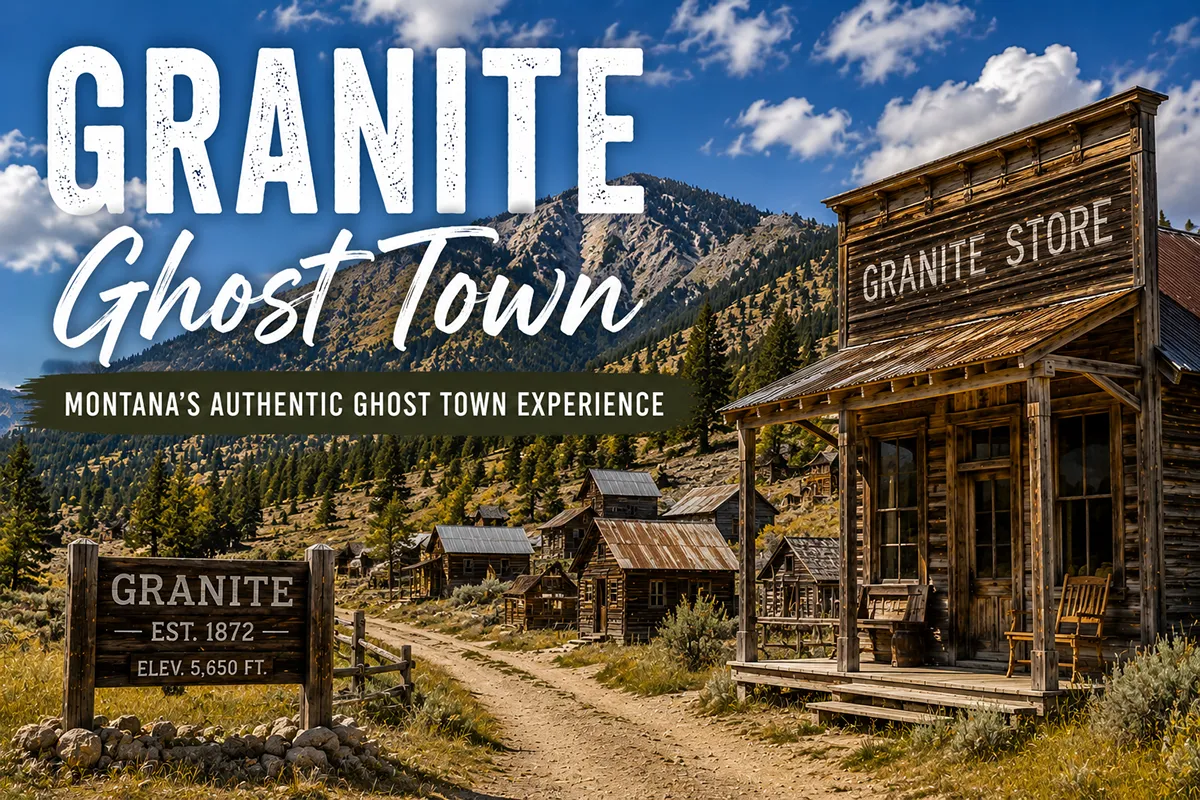
Granite was Montana’s “Silver Queen” — a 3,000-person silver-mining boomtown in the 1880s and early 1890s that collapsed almost overnight after the Sherman Silver Purchase Act was repealed in 1893. Today it’s a small state park with the Superintendent’s House, the ruins of the Miners’ Union Hall, the bank vault, and several other structures preserved at 7,000 feet above Philipsburg. Access is via a steep 4-mile gravel road that climbs 1,280 feet — passable in dry conditions for high-clearance vehicles. No fees, no facilities, no cell service. Best paired with a half-day in Philipsburg. Below: the full visitor’s guide and the wild story of the telegram that saved the town.
Liked this article?
Add Roaming Montana as a preferred source so you see more of our articles and guides on Google.
Why Granite Hits Different Than Other Montana Ghost Towns
If you’ve read my Montana ghost towns guide, you know I send most first-time visitors to Bannack or Garnet for their first ghost town experience.
Granite is the one I send people on their second trip — the one that rewards travelers who already understand what a Montana mining town was and want to see what happens when one of them dies in a single legislative session in Washington, D.C.
Three things make Granite different.
First, it’s mostly ruins. Bannack has 60 standing buildings. Virginia City has 100. Garnet has 30. Granite has roughly six identifiable structures, most of them partial. The full town once had 3,000 residents, 18 saloons, a hospital, four churches, a library, a newspaper, a school, and a Chinatown. Almost all of that is gone now. What remains tells a different kind of story — about how completely a town can collapse when its single reason for existing disappears overnight.
Second, the elevation matters. Granite sits at 7,001 feet on the side of Granite Mountain, four miles up a steep gravel road from Philipsburg. You climb 1,280 feet in elevation to reach it. The town was deliberately built where the silver was, with no thought to easy access. That isolation is part of what killed it; it’s also why so much of what’s left is still here.
Third, the death story is uniquely well-documented. With Bannack and Virginia City, the decline was gradual — placer gold ran out, residents drifted away over decades. Granite died in weeks. The Sherman Silver Purchase Act was repealed on November 1, 1893. By the end of that month, the mine had shut down and the workforce was leaving. Visiting Granite, you can stand in the foundations of houses where families had a single week to decide what to keep and what to abandon. Most chose to abandon almost everything.
This guide is built from my visits in October 2022 and August 2024 [verify], plus the official Montana state park information. As always, anything time-sensitive is marked [verify].
A Quick History — The Silver That Almost Wasn’t Found
Granite’s story unfolds across four key dates.
1865 — The first silver discovery
Hector Horton found silver in the general area in 1865, near what would become Philipsburg. The discovery was promising but didn’t trigger an immediate rush — silver mining required heavier infrastructure than placer gold, and the post-Civil War West had more accessible opportunities elsewhere.
1872 — Holland’s claim
In autumn 1872, a prospector named Eli Holland discovered the specific vein that would become the Granite Mine. By some local accounts, Holland and a partner stumbled across the outcropping while on a deer-hunting expedition, after shooting a buck whose fall exposed silver-bearing rock. The claim was filed and a small shaft dug, but little serious development followed for nearly a decade.
1875 — Claim relocated
The Granite mine claim was formally relocated in 1875 under new ownership. Still no major production. The site remained a marginal prospect.
1882 — McLure’s strike and the delayed telegram
The turning point came in 1882, when Charles D. McLure, superintendent of the Hope Mill in Philipsburg, examined a sample from the Granite claim. The assay came back at 2,000 ounces of silver per ton — an astonishingly rich grade.
McLure partnered with Charles Clark, bought the property, and formed the Granite Mountain Mining Company, capitalized at $10 million by St. Louis investors. The company spent $130,000 over the next two years developing the mine without striking a major lode.
Here’s where the famous story begins. By 1883, the Eastern investors were losing patience. A telegram was reportedly sent ordering the mine shut down.
According to local tradition, the telegram was delayed in transit — and on the final blast of the final shift before closure orders would have taken effect, the miners hit a bonanza. The vein that emerged would eventually produce an estimated $40 million in silver [verify figure] over the next decade.
Whether the telegram story is literally true or local folklore, the underlying fact is documented: the Granite mine was on the verge of being abandoned when its richest ore was discovered. A handful of feet, or a few hours of work, separated a hopeless write-off from one of the most productive silver operations in American history.
1884–1893 — Boomtown
The town of Granite was founded as a company town in 1884. By 1889, the mines were producing more than $250,000 in metals every month. The population grew to 3,000 by 1890, with roughly the same number again living in the surrounding area.
The town had:
- 18 saloons
- Multiple hotels and brothels
- A hospital
- A school
- Four churches
- A library
- A local newspaper
- Its own Chinatown
- A baseball field
- A roller-skating rink
- A miners’ union (formed in 1888)
- And, remarkably, a bobsled run that ran four miles from Granite down the mountain to Philipsburg in winter
The population was diverse — workers came from England, Finland, Denmark, China, and across the United States. The Chinese community in particular was substantial enough to support its own businesses.
1893 — The Sherman Silver Purchase Act and the collapse
This is where the story turns dark. The Sherman Silver Purchase Act of 1890 had required the U.S. government to purchase 4.5 million ounces of silver every month at inflated prices — effectively a federal subsidy that propped up silver markets and made western silver mining profitable.
After the Panic of 1893, President Grover Cleveland called Congress into special session and pushed for the repeal of the Act. The repeal passed on November 1, 1893. Silver prices crashed. The Granite Mountain Mining Company, like every silver operation in the West, faced an instant unworkable economics.
Within weeks, the mine shut down. Workers and their families had days to weeks to decide what to do with their lives and their possessions. Most simply walked away. Houses, furniture, mining equipment, and personal belongings were left in place.
1893–present — Abandonment and preservation
The mine reopened briefly in the early 1900s during temporary silver price recoveries but never came close to its 1890s peak. By the 1920s, Granite was effectively deserted. The town today has no permanent residents. Montana Fish, Wildlife & Parks preserves what remains as Granite Ghost Town State Park, with about 6,878 visitors recorded in 2023 — making it one of the least-visited state parks in Montana, and easily the most striking.
For more on the era, see my pieces on the Montana gold rush and key historical events in Montana.
Walking Through Granite Today
Roughly six structures (or substantial remains thereof) are identifiable at Granite. Here’s what to look for, in the order I’d visit them.
The Mine Superintendent’s House
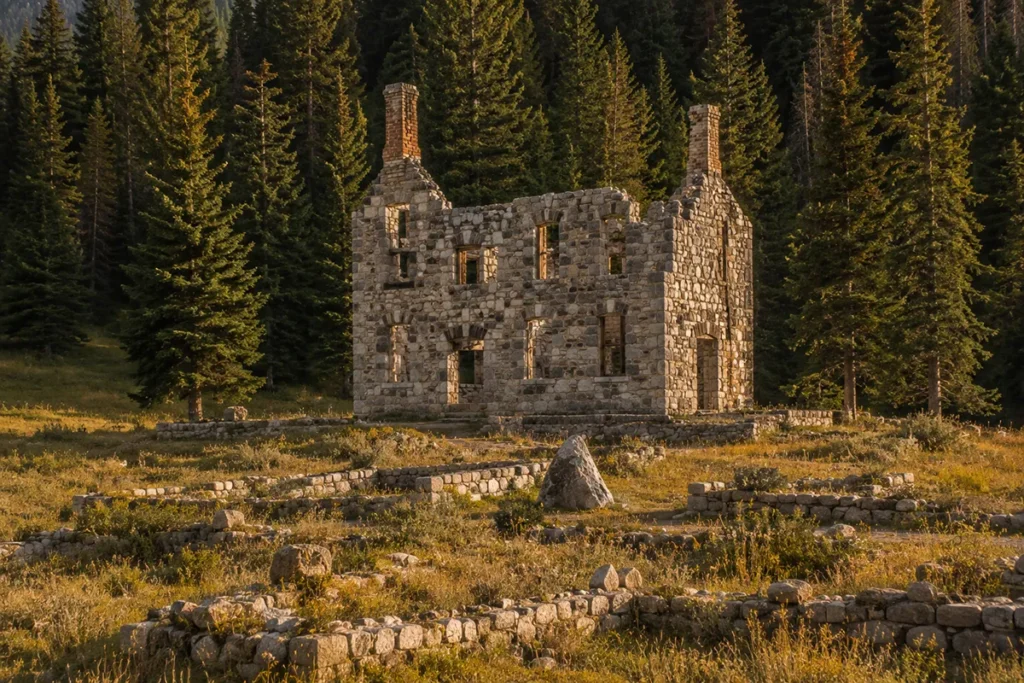
The most intact structure on site is the stone Superintendent’s House, where the manager of the Granite Mountain Mining Company lived during the boom years. Built of locally quarried stone, two stories, with chimneys still standing.
The roof is mostly gone but the walls are largely intact. This is included in the Historic American Buildings Survey — meaning it’s been formally documented by the federal government as a building of historical significance.
Stand here. Look down at the town site below it. The Superintendent had the best house on the mountain, with the best view, and watched his town empty out over a single autumn in 1893.
The Miners’ Union Hall
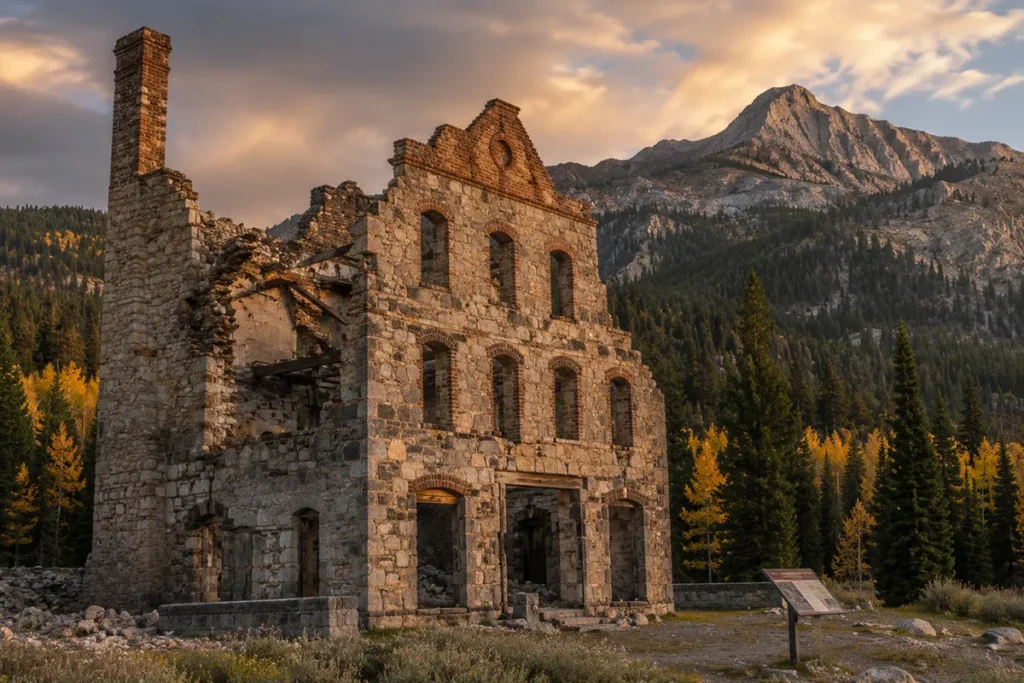
The most photographed ruin at Granite. The Miners’ Union Hall was once a three-story building:
- Ground floor: Saloon and café
- Second floor: Union offices
- Third floor: Dance hall
The miners’ union here was formed in 1888 — ten years after the first union formed in Butte. At the union hall, miners drank, organized, played cards, and danced.
Today the roof has collapsed into the structure, the floors are largely gone, and only portions of the exterior walls remain. The shell still stands, but it’s clearly working its way toward final collapse.
Do not climb on or into the union hall. The structure is unstable and the state park signage explicitly warns visitors away from interior access.
The Bank Vault
A small standalone stone structure that was the bank vault — the rest of the bank building is gone, but the vault itself, designed to be fire-proof and burglar-proof, has outlasted everything around it. It’s a small dark stone box sitting in a field of foundations.
The Hospital Ruins
Granite’s hospital is now mostly foundation, but partial walls and one chimney still stand. With 3,000 residents working a hard-rock silver mine, the town’s hospital saw constant traffic — broken bones from cave-ins, lung issues from rock dust, accidents from the tramway and processing equipment.
The Tramway Remnants
On the road up to Granite from Philipsburg, you can still see parts of the original tramway that carried silver ore down the mountain to processing mills in Philipsburg. Look for the cable supports and concrete footings along the right side of the road as you climb.
Cabin foundations and scattered ruins
Throughout the town site, dozens of foundation rectangles mark where houses once stood. A few cabins still have partial walls. Most are just stone outlines in the grass and brush.
Walking among the foundations is the most affecting part of a Granite visit. Each rectangle was a house. In each one, somebody lived through the news that the mine was closing and made a decision in November 1893 about what to do next.
Getting There — The 4-Mile Climb
This is where every other guide gets a little vague. Here’s the actual breakdown.
Directions from Philipsburg
From downtown Philipsburg:
- Turn south at the four-way stop
- Continue through the railroad underpass
- Take the first left and continue about 1 mile
- Turn right onto the road marked with a white sign reading “Granite”
- Climb approximately 4 miles up the mountain to the town site
Road conditions
| Factor | Detail |
|---|---|
| Distance from Philipsburg | ~4 miles (sources cite 3-6; the practical drive is ~4) |
| Elevation gain | 1,280 feet |
| Final elevation | 7,001 feet at the town site |
| Surface | Gravel, rough in places, narrow |
| Vehicle requirement | High-clearance recommended. Some passenger cars manage in dry conditions but it’s slow going. |
| Avoid when | Wet, muddy, or recently snowed-on. The road becomes impassable. |
| Traffic | Light, but two-way on a one-lane road — be prepared to pull over for oncoming vehicles |
| Season | Late spring through fall (~May–October). Closed conditions in winter. |
| Cell service | None |
The drive itself is part of the experience. The views back toward Philipsburg are dramatic, and you can see the tramway remnants on the climb. Take it slow — there’s no rush, and the road rewards careful driving.
Practical Visitor Info
| Topic | Details |
|---|---|
| Location | 4 miles southeast of Philipsburg, MT |
| Coordinates | 46.3175°N, 113.2444°W |
| Elevation | 7,001 feet |
| Park size | 0.6 acres (the formal state park boundary is small; the larger ghost town extends beyond it) |
| Managed by | Montana Fish, Wildlife & Parks |
| Entry fee | Free — no day-use fee |
| Hours | Open daylight hours year-round (road access limited to May–October) |
| Visitor center | None on site — inquire at Philipsburg if you need information |
| Restrooms | None |
| Drinking water | None — bring everything |
| Cell service | None |
| Pets | Allowed on leash |
| Camping | Not permitted at the ghost town. Closest camping in Philipsburg area. |
| Accessibility | Limited. Uneven terrain, no paved paths, ruins on steep slopes. Not suitable for wheelchairs or mobility-limited visitors. |
When to Visit
| Season | Experience | My Take |
|---|---|---|
| Late spring (May) | Road usually accessible, snowmelt | Variable — call ahead |
| Summer (June–Aug) | Best weather, longest days | Most reliable access |
| Early fall (Sept–Oct) | Aspens turning, fewer visitors, cool weather | My favorite. Late September and early October are stunning. |
| Late fall (Nov–Apr) | Road impassable, snowed in | Don’t try it |
Granite vs Other Montana Ghost Towns
For first-time visitors choosing between Montana ghost towns, here’s how Granite compares.
| Factor | Granite | Bannack | Garnet | Virginia City |
|---|---|---|---|---|
| Type | Ruins | Preserved buildings | Preserved buildings | Living town |
| Buildings remaining | ~6 | ~60 | ~30 | 100+ |
| State park | Yes | Yes | No (BLM) | No (Heritage Commission) |
| Entry fee | Free | ~$8/vehicle | ~$5/person | Free |
| Road | 4 mi steep gravel | Paved | 11 mi gravel | Paved |
| Elevation | 7,001 ft | 5,837 ft | 6,000 ft | 5,807 ft |
| Best for | Photographers, history buffs | First-timers | Solitude | Living history |
| Time needed | 1–2 hours | 4+ hours | 3–4 hours | Full day |
My honest take: If Granite is your first Montana ghost town, you’ll wonder what the fuss is about — it’s small and mostly ruined. If Granite is your fourth or fifth, after you’ve spent time at Bannack and Virginia City, you’ll realize it might be the most powerful of all of them. The dramatic ruins, the elevation, and the silver-crash story compound the further into Montana mining history you get.
What I Wish I’d Known Before My First Visit
Read the Sherman Silver Purchase Act story before you go. The whole place hits differently if you understand that this wasn’t a slow decline — it was a legislative event in Washington that killed the town in weeks.
Don’t climb on the ruins. This isn’t about rules — the Miners’ Union Hall in particular is structurally unstable. People have been seriously injured climbing on collapsing 1890s structures. Stay on the trails and viewpoints.
Bring water and lunch. There’s nothing at Granite — no water, no restrooms, no food, no shade. Pack everything in and out.
Combine with Philipsburg. Don’t drive to Granite without spending at least half a day in Philipsburg. It’s one of Montana’s best small towns, with the Sweet Palace candy store, breweries, sapphire shops at Gem Mountain, and excellent restaurants. See my Philipsburg guide for details.
Plan 1-2 hours at the site. Granite is small. A focused visit takes an hour. Photographers will want closer to 2 hours. Don’t drive up here expecting a half-day visit.
Don’t try it if the road’s wet. I cannot stress this enough. The road to Granite gets dangerous when it’s muddy. If there’s been recent rain, postpone.
The afternoon light is the best light. Most visitors arrive late morning. Try to be at Granite at around 4 PM in summer or 3 PM in fall — the side-lit ruins photograph dramatically and the light feels different.
Photography Tips
Granite is one of the best photography destinations in Montana for ghost-town subjects. Specifics I’ve learned:
Best light: Late afternoon to golden hour. The ruins face generally west and south, so afternoon side-lighting and sunset light are exceptional. Avoid mid-day.
Best vantage point for the town: From above the Superintendent’s House, looking down at the town site with the Pintler Mountains behind. Walk up the hill behind the Superintendent’s House for this view.
Best detail shots: The Miners’ Union Hall walls in afternoon side-light. The bank vault in any light. The tramway footings along the road up.
Gear: A 24-35mm wide lens for the ruins, a 50mm for details, a small tripod for handheld-difficult angles. Bring a polarizer for the Montana sky.
What to avoid: Mid-day light from June through early August washes out the stone textures. The ruins don’t reward bright overhead sunlight.
Combining Granite with Philipsburg
Almost everyone who visits Granite is also visiting Philipsburg, and a half-day or full-day combo makes the trip worth it. Suggested itinerary:
Morning (Philipsburg):
- Coffee and breakfast in downtown Philipsburg
- The Sweet Palace candy store (one of the most famous in Montana)
- Gem Mountain Sapphire Mine store for sapphire shopping
- Philipsburg Brewing Company for a tasting
Lunch (Philipsburg)
Afternoon (Granite):
- Drive up the 4-mile gravel road
- 1-2 hours exploring the ghost town
- Drive back down
Evening (Philipsburg or Anaconda):
- Dinner in Philipsburg
- Or continue to nearby Anaconda for dinner and the historic Washoe Theater
This combination is one of the best ghost-town day trips in Montana. For travelers based in Missoula, the round trip is about 5 hours of driving plus the time on site.
Frequently Asked Questions
Where is Granite Ghost Town?
Granite Ghost Town is located 4 miles southeast of Philipsburg, Montana, in Granite County. Coordinates: 46.3175°N, 113.2444°W. Elevation 7,001 feet. The town is accessed by a steep gravel road from Philipsburg that climbs 1,280 feet.
How much does it cost to visit Granite Ghost Town?
Free — there is no entry fee at Granite Ghost Town State Park, unlike most other Montana ghost towns.
Can you drive to Granite Ghost Town?
Yes, in dry conditions, via a steep 4-mile gravel road from Philipsburg. High-clearance vehicles are recommended. The road becomes impassable when wet or muddy and is closed in winter (typically November through April).
What’s left at Granite Ghost Town?
Six identifiable structures and dozens of foundations. The most notable are the stone Mine Superintendent’s House (largely intact), the ruins of the three-story Miners’ Union Hall, the bank vault, partial hospital walls, scattered cabin remains, and tramway footings along the access road.
Is Granite Ghost Town worth visiting?
Yes, especially for history buffs, photographers, and visitors who have already seen Bannack and Virginia City. It’s one of Montana’s most dramatic ghost town ruins, but it’s small. Plan 1-2 hours on site.
Why did Granite Ghost Town die?
The Sherman Silver Purchase Act was repealed on November 1, 1893, causing silver prices to crash. The Granite Mountain Mining Company shut down within weeks. The town’s 3,000 residents largely left within months. Granite never recovered.
How long was Granite a town?
About a decade as a boomtown — roughly 1884 to 1893 — with brief reopenings in the early 1900s. It was effectively abandoned by the 1920s.
Is Granite Ghost Town haunted?
Granite has fewer documented paranormal reports than Bannack or Virginia City, partly because it’s so remote and partly because few people visit at night. See my most haunted places in Montana guide for the broader list.
Can you camp at Granite?
No — camping is not permitted at the ghost town site. Closest camping is in the Philipsburg area, including Flint Creek and surrounding national forest dispersed sites.
Is Granite family-friendly?
Mixed. Older kids who can handle uneven terrain and respect the “don’t climb on ruins” rule will be fine. Young children and visitors with mobility issues will find the site difficult and potentially unsafe.
What was the bobsled run at Granite?
During its 1890s peak, Granite had a 4-mile-long bobsled run that descended from the town to Philipsburg in winter. Miners and townspeople used it for both recreation and as a faster way down the mountain. Nothing of the run remains today.
What was the Granite Mountain Mining Company?
Founded in 1882 by Charles D. McLure and Charles Clark with $10 million in St. Louis investor capital, the Granite Mountain Mining Company developed and operated the Granite Mine. At its peak in the early 1890s, it produced over $250,000 per month in silver.
Final Thoughts
Granite is the Montana ghost town that teaches you what a silver crash looks like. It’s small. It’s hard to get to. There’s almost nothing on site — no buildings full of furniture, no visitor center, no programmed experiences.
What there is, instead, is a set of stone walls and foundations at 7,000 feet that mark where 3,000 people lived for less than a decade before walking away.
The story of the delayed telegram is what brings most casual visitors here — it’s a great hook. But the story that stays with you is the other one. November 1893. The Sherman Silver Purchase Act gets repealed in Washington.
Within weeks, the workers at the Granite Mountain Mining Company learn that everything they’ve built has lost its economic basis. They have a few weeks to pack up their lives and find new ones somewhere else. Most never came back.
You can stand in the foundations of those houses. You can read the names of mining companies on rusted equipment fragments. You can look down from the Superintendent’s House at a town that doesn’t exist anymore.
That’s what Granite is. It’s not Bannack. It’s not Virginia City. It’s the ghost town that asks you to think harder about how fast everything can change.
If you’re planning a visit, my recommendation: do Philipsburg in the morning, Granite in the afternoon, dinner in town. Pick a Tuesday or Wednesday in mid-September. Bring water, decent shoes, and a real camera if you have one.
Drop your questions in the comments. And don’t forget to check out my full Montana ghost towns guide if you’re planning to do more than one.